Skip to content

food labelling

GM labelling in Canada – you can do something!

Canada stands with other GM producing nations (like the US) in refusing to require labelling of GM foods (currently it’s voluntary) but also trying to force non-GM enthusiasts into allowing GM products into their markets.

It’s a hugely complicated matter, as North America has already travelled so far down the GM road; it can be hard to say what is and is not GM any more. As previously discussed here, more than 90% of Canada’s canola crop is deliberately or accidentally now genetically modified. There is no way to prevent contamination of most non-GM crops once their GM neighbours are out there in our fields.

But, happily, GM crop contaminated pollen may not be the only thing on the Canadian wind this spring. Canadians should sharpen their writing utensils and dash off letters to their MPs right this minute, since Bill C-517 is on the table now, this very week. This bill, introduced by Bloc Québecois MP Gilles-A. Perron, calls for mandatory labelling of GM products; the last attempt to pass this legislation in 2001 was defeated in parliament.

Without labelling of GM products, Canadians cannot know for sure what they are eating, and it is worth remembering that GM foods have not been proven safe for long term human consumption; they are also banned from use in Canadian organic food production (but how would an organic producer know, without labelling?). Worth a try, it seems to me.

For more info and how to get your oar in, see the info on the Greenpeace website.

The difficulty of eating local

One of the difficulties of trying to eat local food is that you can’t trust food labels, at least not in Canada. Last October, CBC’s Marketplace broadcast an enlightening program about the meaning of the ‘Product of Canada’ label, which you can watch again online, in which they revealed that this branding means that 51% of the production costs (not even the content) were spent in Canada. This is allowed thanks to legislation created in 1985, when 20% of Canadian food was imported; now we’re at the 40% stage, it is starting to sound downright silly, let alone outdated.

So in the example given, of Highliner frozen fish products branded ‘Product of Canada’, the fish may have been farmed in Vietnam, Indonesia or China and then shipped frozen to Canada for processing, becoming Canadian somewhere en route. When the program-makers went to Lunenburg, the published address for Highliner, they were told that no fishing boats had come in there for six or seven years.

All of which is problematic to consumers: they can’t make informed choices, because the information they’re using is flawed and misleading. They can’t vote with their wallets against poor labour practices, potentially unsafe food production practices, unsustainable fishing practices, or unsound ecological practices, and they can’t even support local producers because they cannot tell (from packaged goods anyway) which products are truly local.

And now a word from M.F.K. Fisher

..who speaks of her time in Dijon, that started in 1929:

It was there that I learned it is blessed to receive, as well as that every human being, no matter how base, is worthy of my respect and even my envy because he knows something that I many never be old or wise or kind or tender enough to know.

from Long Ago in France.

She speaks tellingly about her fierce and frugal landlady, Madame Ollangnier, who scours the markets and badgers the food sellers into handing over the lamest and haltest of edible foodstuffs which she then transforms into excellent meals for M.F.K. and her other lodgers.

So having read that last night I was delighted by the coincidence of this morning’s speaker, Andrea Segre of the University of Bologna, who told us a fabulous tale about his students’ food economics project that has blossomed into a many-fingered enterprise: Last Minute Market began as a way to turn the horrific waste of supermarket surpluses – those imperfect, unwrapped or dented items the ordinary consumer won’t touch with a ten foot euro – into nutritious meals for the local needy.

More food economy in the afternoon with Riccardo Vecchio who walked us through the ins and outs of PDO (Protected Denomination of Origin) and PGI (Protected Geographical Indication) marks on foods, from a marketing and economic point of view. They’re not just in Italy, not just in Europe or the UK, but potentially all over the place now. And he gave us a briefing on farmers’ markets, which are new to Italy (being gradually brought back in after they died out here around 1900, that is). There are plenty of food markets in Italy, it’s true, but the stall-holders are typically not farmers or food producers selling their own wares.

And now, back to my books. Food technology exam tomorrow. More later.

Some food reading, viewing, listening

An interesting interview with Whole Foods co-president Walter Robb. The CEO of Whole Foods, John MacKay, posts a blog on the company’s website. Of interest to me and my recent reading is the exchange of public letters between MacKay and Michael Pollan, discussing Pollan’s somewhat skeptical take on the Whole Foods phenomenon in The Omnivore’s Dilemma. and the expansion of organic food production and retailing into something that rather too closely resembles the system that organics grew up to counteract.

David Szanto, who completed our course at UniSG in November, joined us for some merrymaking at the Quebec cheese tasting evening last week, and he pointed me to a recent article in The Guardian, The Organic Church Splits, about the Soil Association which I suppose you could say turns some of the same ground from a British perspective; and there was an earlier article and podcast on US organics in Business Week last October. An op-ed piece in the New York Times called The Amber Fields of Bland explains the US farm bill, and the terrifying span of its coverage, and just what it has done to food production in that country.

I’ve been watching a dvd called The Future of Food which MJ brought back from Canada. About farmers, farming, gmo crops and seed/pesticide monopolies, it’s an excellent introduction to the realities of farming today and the issues we should all be attending to in our food. I liked the dvd extras, which included a clip from Michael Pollen responding to the question about ‘will food cost more in future’ – yes, he said, but it’s artificially cheap right now because of heavy crop and farming subsidies in the US and Europe, and people need to perhaps look at their relative priorities: which do you want to spend your money on more each month: safe/nutritious food or $40+ on cable tv? He also made the excellent point that prepared food is always more expensive than food you cook: so people need to learn to cook. But they also need sources for raw ingredients: in some poor neighbourhoods it’s simply impossible even to buy fresh fruit or vegetables.

Doris pointed us to a well respected Austrian documentary on themes of food and hunger, We feed the world – global food which I’d like to have a look at someday.

There’s a Belgian-made short documentary you can view online at EUX-TV called Chicken Madness, about dumping of chicken surpluses in Africa by western countries such as Belgium, Germany, Holland and Brazil. It seems we’ve got very picky in the western world and we just don’t want to eat all of the chicken, so we sell the icky bits to someone hungrier than us. But the lack of effective licensing (=political corruption) and the dearth of functioning cold storage facilities at the receiving end results in an economic double-whammy: food spoilage and the trashing of African poultry farming which can’t compete with the prices — or the convenience of a ready-to-cook product, however tainted. But the industrialised world is committed to free trade at (literally) all costs. As one African farmer bitterly noted, would the US and Europe be ok with the destruction of their local economies in the name of globalisation? Something to think about next time you pick up a packet of chicken breasts…

And I recently listened to a podcast about nutritional food labelling. An education in how little consumers understand of what they read on the label: consumer food education has a long way to go. One telling example from the American representative who said that the majority of American consumers surveyed could not say what a typical daily calorie intake ought to be, despite the calorie information printed on the food labels since 1994 which stated that it was based on a 2000 calorie per day allowance; and that they often disregarded serving size recommendations and simply ate the whole packet. Which says something about labelling, obesity and education.

Tasty week – olive oil, wine technology and the physiology of taste

We’ve had a lovely oily tasty sniffy week, with our first oil tastings and some coaching on olfaction and taste thresholds.

Our oil guy, Alessandro Bosticco, is an inspired teacher, a sommelier as well as an olive oil expert, and I was happy to hear he’ll be steering us through some wine tastings as well. I particularly warmed to him when he dodged a question about his favourite olive oil by saying that he simply loved tasting new things, and if he were offered the choice between his current favourite and one he’d never tried, he’d take the one he’d never tried.
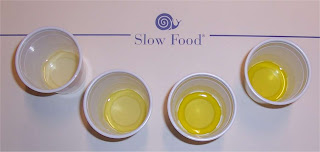

He said oil tastings were rare, even in Italy, and to do them as we were, by tasting oil from cups (rather than by dipping bread) was still fairly unusual. We tried four different kinds on each of the two days. Oil is what carries flavour to our tastebuds, and it does its job well; so, being oil, its flavour is hard to purge from the palate. We had to allow more time between tastings than we would for wine, and take sips of bottled water and slices of apple – granny smith being the apple of choice for oil tastings because it is the most acidic.

We heard about the craze for fresh, unfiltered oils in Bosticco’s own local oil-producing region (Tuscany): cloudy and bright-coloured, these oils are not, he said, good for the long run, because the particles in them are fibres that have not been extracted during filtration, and which will trap water which can in its turn trap bacteria. So murk or sediment will affect the oil’s flavour adversely over time, and he advised that if you intend to keep your oil more than a few weeks, to get a clearer one. Even then it’s not going to last more than about 18 months, with a steady decline in colour and flavour as time goes by. More than once he remarked that the oil you taste today is as good as it’s going to get: it is not a product that improves with aging. Rather it is a living thing that changes over its lifetime. And it’s vulnerable to heat and light, so store it accordingly

We got some pointers on reading labels, and learned about the legal designations of “olive oil”, “virgin olive oil” and “extra virgin olive oil”, as well as a few others, defined by the International Olive Oil Council.

Basically the big deal with extra Virgin Olive Oil is that it must be produced by mechanical means (which is always and inevitably cold pressing, so that phrase added to labels is just hyper marketing). This distinguishes it from the processes used to produce all other kinds of oils (except for specialised niche versions of course), which involve heat and chemicals. Extra virgin oil has to pass a chemical test (it can’t contain more than .8% oleic acid) and it then has to pass a taste test by a panel of experts. This doesn’t guarantee it will taste ‘good’ to everyone, but it gives a basic measure of quality. It may also be the result of blending more than one crop, including crops of different years, but is tested at bottling, so no new blending can taste place once it’s had its testing.

There’s a statement which for 2 years now must appear on bottles of Extra Virgin Olive Oil: it must be described as “superior quality oil obtained straight from olives using only mechanical means of production.” That again is no guarantee of flavour (which is subjective anyway) or origin. Most of the olive oil in Europe is produced in Spain, but Italy has the highest consumption, ergo much of what we describe as Italian olive oil is imported and only bottled in Italy.

So for those who want Italian and only Italian olive oil, there is a fairly recent DOP designation (Denominazione di Origine Protetta, or Protected Denomination of Origin) – a high falutin’ version of extra virgin, which is subject to standards governing where and how the olives may be grown, pressed and bottled as oil. This oil of course sells at a considerable premium. It would be one instance where the bottler will note the date of harvest on the bottle, giving you an indication of the freshness and therefore the power of the oil’s aroma and flavour.

Farther down the scale, what is sold simply as Olio d’Oliva, or Olive Oil, is a blend of refined (by chemical means) olive oil and virgin olive oils. Virgin Olive Oil is produced by mechanical means and has a higher measure of oleic acid than Extra Virgin.

Olive oil is used in its traditional market – Mediterranean, for example – for traditional reasons such as taste. In the newer and ever expanding world-wide markets, it’s been picked up for its health benefits, as it’s a pure unsaturated oil containing fat-soluble vitamins (A and E) and antioxidants. Among the many other advantages it has over other oils, as enumerated by the Oil Council, when you use it for frying, it adds less fat to fried foods because it forms a crust on the surface of the food that impedes the penetration of oil and improves the food’s flavour.

There are different taste preferences for olive oil that are partly cultural: people raised on animal fats tend to prefer milder olive oils to more pungent peppery ones with their bitter after-bite. We had a reinforcement of the advice about becoming a good taster: to taste and smell many different things in order to build an olfactory library, so you have a more comprehensive memory of tastes and flavours to compare.

Due to some weird global synergy, BBC Food Programme and NPR both had programs on olive oil this month.

We also had a first lesson on wine technology… ack – more chemistry. Still, we are paddling around in the sea of knowledge and one day it will all make sense.

We finished the week with a lesson on the physiology of taste from Mirco Marconi. We’d heard already about the classification of taste – sweet, salty, bitter and acid (plus the newcomer, umami, which reflects ‘meaty’ tastes). We learned that the position of taste buds on the tongue is not as static as had originally been supposed, with fixed areas for each taste, but that they are in fact in an overlapping range of regions with the central area of the tongue the least sensitive.

Bitter tastes linger longest because of their placement on the sides of the papillae where the flavour gets ‘stuck’ until it is washed out. We heard that there are varying proportions of the world’s population who are unable to taste bitter (3% in West Africa, 40% in India, 30% of white people in North America; 37% of Italians).

We heard about two theories of taste, which are called either molecular shape theory vs molecular vibrational theory, or docking criteria vs swipe card model. The first supposes that there is a ‘lock and key’ relationship between odorant and receptor: odorous molecules have shapes and sizes that “fit into” the shape and size of corresponding olfactory receptors. In the second, it’s supposed that receptors in the olfactory organs recognise molecules by their vibration, so the nose acts as a kind of spectroscope.

We got into hands-on mode for some tastings and sniffings. We sipped our way through nine samples representing sweet, salty, acid, bitter, umami and astringent – substances dissolved in water – comfortingly straightforward. We then finished by attempting to identify thirty different olfactory samples, ranging from smoke to mint, from cloves to coconut and saffron to bergamot. Fiendishly difficult.

And finally, we were welcomed to Parma officially before Christmas, and here’s the official photo!