Skip to content

events

Poets in Paris

ParisPoemsDes4SaisonsSo finally the Iambic Cafe dusts itself off and drags itself to its weary feet, slightly jetlagged but coming round. Sunday’s arrival in London was enlivened by the rather leisurely delivery of my baggage, but after that it was clear sailing and I was greeted by faltering sunshine on the cobblestones.
ParisGargoyleOff to Paris on Tuesday, arriving by Eurostar in good time, and then an evening of bilingual readings at the Delaville Cafe, courtesy Ivy Writers Paris, comfortably accommodated and efficiently organized by expat poet Jennifer Stills. It featured Belgian poet Constance Chlore and Parisian Dominique Maurizi, as well as Saskatoon’s own Mari-Lou Rowley, shown here with Christmas tree..
ParisMariLouReading2 We passed a relaxing Wednesday afternoon wandering around the 18th arrondissement, mostly towards Montmartre, admiring the food in the windows, prowling its shops and pausing for a leisurely coffee. Hills and steps there are many, but the sun came out from time to time and warmed the way.
ParisBreadParisMimoletteParisWindowSouffle
Entertainingly, we passed a couple of goats gnawing on a grass fence we’d passed several times – and found we’d discovered a little pocket of urban agriculture, apparently lush in the summer but a bit bare now, with chickens pecking trackside near Porte de Clignancourt. ParisClignancourtGoats+Chickens

Our wanderings ended with a delightful dinner at the Bistrot Poulbot. Pour moi, saumon tartare, dorade , and (how could I not) a lovely confection involving lashings of my namesake Valrhona chocolate.

Cheese and cheers

Before April goes out like a lamb, let me share some cow’s milk cheeses with you – much enjoyed at the Cheese & Blues event that Hilary’s Cheese presented in Cowichan Bay last week. Pictured to the left is the king of British cheese, Colston Bassett Stilton, which goes down well with port generally but which paired acceptably with the blackberry dessert wine on offer that evening.

Don Genova was the honorary cheesemaster, forging his way through cloth-wrapped cheddars (Keen’s and Avonlea) and hefty wheels of Shropshire Blue alongside Hilary and Patty. The cheeses – except for the PEI cheddar – had been imported from my spiritual home-from-home, Neals Yard Dairy in Covent Garden, London.

Sunday evening I joined a poet’s dozen (i.e. I lost count) and read a poem from the magnificent new anthology, Force Field – 77 Women Poets of BC, introduced by publisher-poet Mona Fertig, and hosted by contributor Yvonne Blomer. The place was packed, the readers disciplined and the audience appreciative. We drizzled off through the rain to a delightful after-party where we solved a few of the world’s problems before retiring.

Last night was the long-awaited Food Talks event at the Belfry, where this year’s local Food Champs were invited to speak their piece before the winner was named. Some superb nominees both present and unable to be there included: Maryanne Carmack – for the Victoria Downtown Public Market Society (Victoria’s public market opens July 2013); Haliburton farmer Derek Powell – for his involvement in Victoria’s Food Swap Program; Miranda Lane – who works with people with multiple challenges at the Community Kitchens Network; Kim Cummins – for the Camosun FarmBox Program which organizes markets and food boxes at local college campuses; Naomi Lyons – for Stone Soup‘s community building and micro-lending fundraising; Dwane Maclsaac – for the Island Chef Collaborative‘s micro-finance initiative; Elizabeth Upton – on behalf of Meadowbrook Farmily (4 local Victoria families that farm together); Jeanette Sheehy – for LifeCycles‘ many projects, but particularly the Growing Schools project; the Salt Spring Agriculture Alliance – for the community abattoir; and the Sooke Food CHI for their work on the Sunriver Community Gardens and Sooke farm bike tour.

And the winner was… Miranda Lane, Community Kitchens Network, with Kim Cummins, Camosun FarmBox a close second. She is shown below with CRFAIR coordinator Linda Geggie, evening MC chef Heidi Fink, and Kim Cummins. Other pics L-R: chef Heidi with chef Dwane MacIsaac, Naomi Lyons, Derek Powell, Kim Cummins, Elizabeth Upton.

Full steam ahead: a week of talks!

Lots going on this week. If you’re in town I hope you can make it to one or more of these different events!

On Tuesday evening, March 19, look for me in Fernwood, where I’m talking urban agriculture at Fernwood U. Cornerstone Cafe, 1301 Gladstone Avenue, Victoria, at 7pm. (Free!)

Friday night, March 22, I’ll be reading at Planet Earth Poetry alongside Rosemary Griebel. Moka House Cafe, #103-1633 Hillside Avenue, Victoria, at 7:30pm. (Nearly free – just $3)

Saturday afternoon, March 23, I’m on the Food Writing panel at the WordsThaw Spring Writing Symposium, hosted by the Malahat Review, an all day affair that runs 10am until 10pm at the University of Victoria, Human & Social Development Building, Room A240. ($40-50, but you get a whole day of literary fun for your money)

Laughing oysters, food forests and a trip to Bellingham

Last weekend I happened upon this rather lovely book display in the window of the Laughing Oyster book store in Courtenay. I’m keeping good company!

This afternoon I go head-to-head with the Superbowl, whatever that might be, giving a book talk at 4pm at the beautiful Village Books in Fairhaven, Bellingham. I took the marvelously efficient and comfortable Amtrak train from Vancouver, which gave me a little time to wrap my head around a new laptop, purchased reluctantly after my previous faithful companion died a lingering death of old age (obsolete after 5 whole years: why is this legal??).

The trip also gave me time to reflect on last night’s thoughtful and inspiring talk by Seattle’s food forest designer, Jenny Pell. She spoke about community-driven food security initiatives in Washington and Oregon, including the Beacon Hill Food Forest in Seattle, a 7-acre parcel that is being developed as the largest public food forest in all of North America. It’s had lots of media coverage.

Pell, like many permaculturalists I’ve met, was a broad thinker who has passed the stage of thinking about change: the time for change is already here, and she wants to see movement into a more sustainable and positive way of life. Why, she asked, do we behave like zoo visitors, simply marveling over model achievements (like the Bullock Brothers’ permaculture homestead, or the solitary Sea Street in Seattle) and never creating multiples of them? We know what’s coming and that change is needed, but somehow we keep our heads down and live on as if we had nothing to do with making a sustainable world possible.

She admitted she was unusual, having never had a credit card nor made a mortgage payment, so was free of the economic traps that have wrapped so many in knots. Do what you need to do, was her message, and you too can live in a world where a salad costs less than a heavily subsidized hamburger, or you don’t have to call in the media in order to be allowed to keep your front yard food garden; where municipal planners can encourage home owners and builders to incorporate features like greywater harvesting and composting toilets; and where it’s not illegal to sell produce grown in your own garden.

Permaculture & poetry

The last couple of weeks have swung past in a mainly permacultural haze.

The first screening at a new permaculture film night series was Anima Mundi, a bit of a collective disappointment for the 20-odd souls who crowded into the Community Microlending Society office, but a cheery networking session, lively discussion and helpful information share ensued.

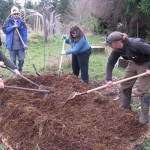
I went for my second round of Permaculture Design classes last weekend, in which we built a hot compost bed in a classically low-maintenance permacultural manner (meaning: let nature do its thing). We prepared the ground by sheet-mulching with layers of cardboard; built a hollowed shell from horse manure; filled it with weeds and seriously rotten kitchen waste; and then covered it with more horse manure. Rats apparently don’t care to dig through manure to get to rotten food. You can then plant squash on top, which keeps the weeds down and thrives on the nitrogenous waste beneath. And harvest fresh soil in a year’s time, when the hill will have sunk to about ground level. Or leave it in place and plant something else there.


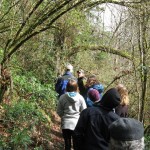
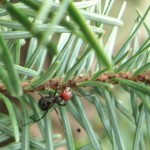
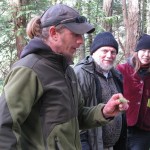
Later we went for a forest walk with Brandon Bauer in order to test our powers of observation and  taste a few ants. Very tasty indeed. A sharp organoleptic explosion that Brandon likened to tamarind or vinegar; I’d say a very acerbic sorrel.


There’s a nice-sounding workshop I won’t make it to this weekend, An Introduction to Home-Scale Permaculture with Elaine Codling; and the Duncan Seedy Saturday takes place that day as well.

And finally, back to poetry. I read with Ruth Pierson and Ted Blodgett at Vancouver Public Library last night and a good time was had by all, I’d say. I read food poems to one of the most responsive and delightful audiences ever, and sold lots of books, including the last few copies of Sunday Dinners. If you have one, you can now officially treasure it as a rare book.

Ruth Roach Pierson
E.D. Blodgett