Skip to content

urban agriculture

Back in Victoria… just in time for winter

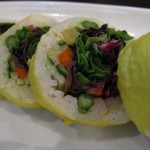
Before I left Vancouver we took a spin around a newish supermarket in West Vancouver: Osaka (the nineteenth store to be opened by T&T Supermarkets) is huge with a mind-boggling selection of just about anything Asian – from soya sauce to rice and noodles, and vast quantities of everything in between. There were large fish tanks offering shoppers live seafood: king and Dungeness crab, lobster and abalone as well as several varieties of oysters, clams and fish, and a bakery with all manner of Asian pastries and decorated cakes. While we browsed, reading labels as best we could, I couldn’t help but wonder what effect all these ultra-processed foods, high in sugar, salt, fats and all kinds of preservatives, will have on the much-studied Japanese life expectancy. We calmed ourselves at Bene with a couple of platters of sushi, including this vegan roll in a cheerful soybean wrapping.

Back in Victoria, winter waited politely until I was settled, unpacked and the larder stocked with vegetables before drawing in with a little snow and cold weather, ideal for making soup and catching up on my reading. One of my astoundingly heavy bags held a copy of the River Cottage Veg Every Day! cookbook which holds some worthy temptations.

With my poetry ear I’ve been listening to the Saturday Play on BBC Radio 4, Tom and Viv, which explores the problematic relationship of TS and Valerie Eliot. Available until Saturday January 21, and starring Benedict Cumberbatch who seems to be everywhere just now. Listen for the reference to Robert W. Service…

Time, food and agriculture never sleep, at least not where interesting stories are concerned. Here are some that have been stacking up while I was away.

There’s a link here to a rather beautiful brochure  shows that shows you who’s growing what and where in twenty-six urban farms in Vancouver.

And a nice story about the loneliness of the the farming life which I suppose applies to urban farmers as well; it offers a reminder that we are often in too much of a hurry, and too accustomed to shopping anonymously for food, to thank those who provide it.

Some good news for Victoria food shoppers, with a new whole/local foods store opening, conveniently situated near the wondrous Capital Iron.

There was  wrist-slapping lesson in public consultation for Stephen Harper whose decision to bring to fruition his longtime plan to dismantle the Canadian Wheat Board was declared illegal by a federal court.

And finally, the soil is the thing: the EU Soil Report warns about the cost of doing nothing in a time when we are quickly losing the soil we’ll need to grow food by building on and contaminating it. Soil: Worth standing your ground for from The European Environmental Bureau explains why we should be paying attention, in urbanizing and industrialized countries everywhere:

Soil is the basis of all our food and fibre production and plays an essential role in water purification, waste decomposition and climate mitigation. It therefore must be regarded as a natural resource of strategic importance which should be protected adequately and used efficiently throughout Europe. The reality however is that Europe is losing this natural asset, thereby jeopardising Europe’s food security and its ability to deal with the consequences of climate change.
Vancouver’s urban farms

Time, food and agriculture never sleep, at least not where interesting stories are concerned.

There’s a link here to a rather beautiful brochure  shows that shows you who’s growing what and where in twenty-six urban farms in Vancouver.

And a nice story about the loneliness of the the farming life which I suppose applies to urban farmers as well; it offers a reminder that we are often in too much of a hurry, and too accustomed to shopping anonymously for food, to thank those who provide it.

And some good news for Victoria food shoppers, with a new whole/local foods store opening, conveniently situated near the wondrous Capital Iron.

A wrist-slapping lesson in public consultation for Stephen Harper whose decision to bring to fruition his longtime plan to dismantle the Canadian Wheat Board was declared illegal by a federal court.

And an opportunity for British Columbians to participate in a public consultation on a province-wide ban on cosmetic pesticides is open until December 15. Anyone who cares about the continuing health of honeybees and other wild pollinators, other species in the food chain/eco system, as well as pet-owners and parents should take a moment to speak in favour of this ban.

The soil is the thing: the EU Soil Report warns about what the soil Soil: Worth standing your ground for from The European Environmental Bureau

Scallops, poetry and lots of SPIN

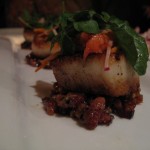
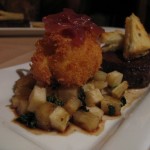
It’s been quite a week. Tuesday I enjoyed a meal at Camille‘s which was very nice food, very nicely served. Starters included some gorgeous scallops, sporting leafy hats and nestled on a bed of bacon. A nice bit of organic beef came with a curiously delicious egg that had been poached and then deep-fried and made to feel crisply oriental. And the apple dessert trio – kaffir lime frozen ricotta the highlight – outclassed my caramel pot de crème with apple foam, but we shared. And the wines were wonderful, particularly the apricot-raisiny delights of the Pentâge Late Harvest dessert wine, dessert wines being one of my favourite things.

The Malahat Review is another of my favourite things, and its Fall launch reading at The Well was jam-packed with literature lovers. I must say I’ve seldom enjoyed a reading more. Attentive and large audience, talented and entertaining fellow readers, nice ambiance. And some rather good salt and vinegar kale chips, which in their clear plastic baggie rather gave me the appearance of a purveyor of puff than an advocate of antioxidants.

Anyway. I was up first, followed by Julie Paul reading a tantalizing beginning to a short story; then Richard Osler in good poetic form, Tom Wayman in passionate voice dedicating his first poem to the Occupy people, and Zoey Peterson sending us home to contemplate his delightful prize-winning story.

Thursday night at Fernwood Community Centre I’d guess there were nigh on a hundred of us gathered to hear Curtis Stone, the cycling SPIN farmer of Kelowna. He gave a terrific talk about his business and a great preview of the three-day workshop he’ll be leading in April.

When he started Green City Acres, he had no farming background at all – just nine years of tree planting and a great love of cycling, and so he took himself on a tour of urban farms in Canada and the US to see how urban agriculture was being done. He learned his trade from the manual sold by Wally Satzewich and Gail Vandersteen’s SPIN farming enterprise, and through a couple of years’ trial and error. And has emerged as a generous and enthusiastic teacher-farmer.

In his first year of operation he made about $22,000 and worked 16 hour days. “Like you would for any startup small business,” he says. This past year so far he’s pulled in $60,000 from the three quarters of an acre he farms – spread across half a dozen backyards. With a partner helping ease the load this year he’s been working 50 hour weeks – and adds “most of our time is cycling.” On their bikes they pull custom-designed trailers piled with tools, compost, produce, even bales of hay and a small rototiller. His startup capital costs were around $7,000 and he believes it’s possible to make $100,000 an acre.

He tills lawns in three stages to kill the grass and give himself time to test the soil for clay-sand ratios and pH level, so that he knows what amendments to use to boost its fertility. He gets food waste from restaurants and composts prolifically for his production which is organic but not certified. His first plot was a needle-strewn wasteland with poor, contaminated soil which he had to fill and remediate. He says the drug users who used to shoot up on the property still come by there, but now they come to look at the garden, which is flourishing.

He thinks that the scattered fields of SPIN farming offer a lot of advantages, as plantings are spread between different microclimates, soil conditions, light conditions, biodiversity (weeds and pests) and land configurations, so if one row or crop is lost, chances are that the other plots – all planted in standard 2″ by 25″ beds – will be ok. And growing intensively on such a small scale offers other advantages: SPIN farmers can grow a wide variety of produce in small amounts, much  closer to their market than rural farmers; they have a much smaller capital outlay – hand tools and small machinery; and because they deal directly with their market (CSA, restaurants or farmers markets) their profits stay in their own pockets.

Stone is a big proponent of CSA programs, which he dubs “modern crop insurance” as it spreads the risk of growing between farmer and consumer. And the customers are well served too, by eating food that is extremely fresh, very locally grown, by someone who lives and works in their own community.

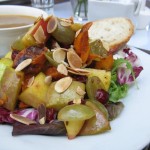
On Friday, I escorted a veteran to the cenotaph in Duncan and was rewarded with lunch at Bistro 160, which was chanterelle soup and a very fine roasted yam and apple salad. The fuel was needed to tackle the very large quantity of leaves that had blown up my driveway on that stormy day: gifts from the gods of mulch, to be enjoyed by my garden beds (and a whole new generation of slugs, I’m sure) over the winter.

Fruit Tree Project strikes again

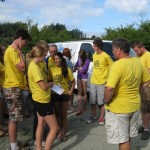
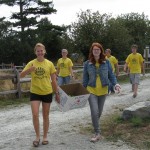
I spent a fruitful morning yesterday with a dozen teens from the CISV Peace Bus out at Island View Beach on my first pick of the year for the Fruit Tree Project. As part of their cross-Canada tour, the teens involve themselves in community projects, aiming to make the trip carbon neutral. Picking local fruit fits the bill because it means less imported fruit is needed to feed the communities and enterprises where the unwanted urban fruit is distributed.

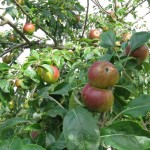
We were picking from trees that had been planted in a beachside campsite that the CRD took over a few years ago. Because the irrigation that had watered the trees had to be taken out (not up to code, apparently) there hasn’t been any watering since then, so the fruits tend to be small while the trees adapt to their new micro climate.

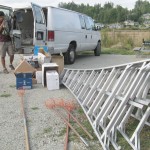
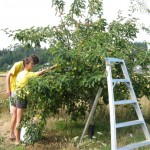
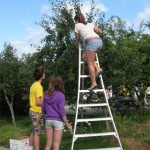
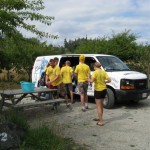
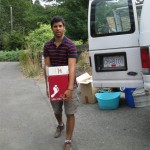
The Fruit Tree Project van holds all the ladders and picking equipment, together with weigh scales and as many sturdy boxes as can be found. Jesse, one of the program coordinators, lays it all out ready for the arrival of the bus, and gets everyone started, while a local TV cameraman covered the event.


A peaceful period of picking passes


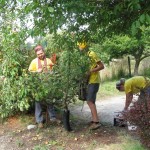
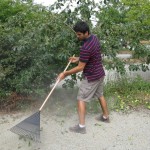
and then it’s time to weigh and load the fruit in the van, clean up the fallen fruit, and head off to store it.


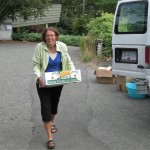
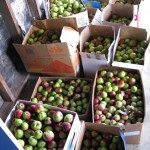
The cooler at Fruit Tree Project’s HQ – LifeCycles – where it’s normally kept is full to bursting while the team works on distributing the seasonal bounty to community groups and local food processors. So, with the help of Fruit Tree Project co-coordinators Renate and Jesse, we park nearly 500 lbs of apples in a trusted garage while the smaller quantity of pears and plums goes back to LifeCycles.

Heirloom schmeirloom

The LA Times has a good article on heirloom fruits and vegetables. The word “heirloom” is one that’s widely abused, but one that’s also treasured by many farmers and gardeners in these days of hybrids and genetic engineering.

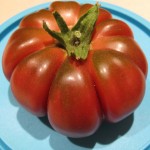
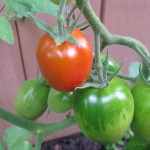
There is much to commend, for example, the complex flavour and charming fissures of an heirloom tomato over its supermarket version, round and hard and bland as a tennis ball. Here’s one of mine, as discussed on my gardening blog recently.

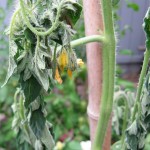
But woe, or perhaps that should be more woe, has befallen my tomato kingdom. I’ve had to pull up one of my beloved Auriga plants as it suffered sudden and catastrophic wilt. Was fine one day and flopping over the next. Because it perked up at night before flopping out again the next morning, and because the stem cross-section revealed the tell-tale dark ring that shows fungal damage to its vascular tissues, I assume it was vascular wilt – which apparently means either Fusarium or Verticillium… although the plant didn’t show any yellowing of the leaves which is said to be a symptom of both these fungal diseases.

So I don’t know for sure, but I had to pull it up to be on the safe side. My tomato garden will have to move to a new location next year in any case, since several of the plants were infected with early blight (Alternaria solani). Aside from not growing in the (now contaminated) soil for several years, the main suggested procedure for controlling vascular wilt is to buy seed that has been bred for disease resistance. In the words of one source of advice, “The incidence of these diseases has increased with the growing popularity of heirloom, non-resistant, varieties.”

Well that’s the problem, isn’t it? The old conflict between taste and functionality. We may complain mightily that new food plant varieties are bred for longevity in shipping containers and on supermarket shelves rather than for taste or texture, but they are bred for other useful purposes as well. Disease resistance and other useful qualities like drought tolerance are key objectives in many plant breeding programs. Good breeding should aim to keep those most important qualities, the ones that made us love a food – flavour, nutritional content – while secondarily working on other aspects. But in a world that seems to have forsaken its tastebuds if a cheaper product can be had, this doesn’t always happen.

And maybe it’s not possible. If it’s not, then it means urban (and other) farmers who want to grow heirloom varieties need to be skilled and knowledgeable about avoiding the risks that can do in their crops. Gaining that skill and knowledge is the tricky bit in a busy world.

Meanwhile, I will have to look into wilt-resistant varieties that grow around here (apparently the resistance has to be localized as there are so many variations of the wilt fungi). Perhaps tempt fate and see how well they fare in the same garden bed. And how they taste!

There are ambiguities around the term “disease-resistance” too; this was a term used about one of the tomatoes I’m growing this year, the Bearo plum. In fact it was said to be highly resistant to blight, but I’ve managed to prove that its resistance hasn’t extended to early blight, unfortunately, as it’s one of the plants affected in my garden this year (so far only the leaves). But its enthusiastic growth and ample fruits make me want to try it again, and next time somewhere it can have room to reach for the skies.

Food – sight and sound

B is for Bananas (if you didn’t know why it was important to buy these organic and Fairtrade, here’s your briefing)


BANANAS!* trailer.
 

B is also for Bees


Queen of the Sun trailer from Youtube.


And R is for radio, specifically NPR (I’m close enough to the border to be able to listen in) where you can hear

Yotam Ottolenghi talking vegetables – promo for his excellent cookbook Plenty (recipes born in YO’s wonderful Guardian column, The New Vegetarian); Barry Estabrook speaking in depth to NPR’s Fresh Air about his new book Tomatoland, which blows the lid off many aspects of the Florida tomato industry – labour standards, soil depletion, pesticide use – and explains why big ag’s focus on high yield tomatoes does not put good tasting food on your plate (which is exactly why Slow Food exists); and then a brief look at sustainable fish (tilapia) production: urban fish agriculture (but not the kind that involves feeding them corn and, like other farmed protein sources, causes more of the same old problems to those who eat them)