Skip to content

tomatoes

Readings & mushrooms & quince

On Wednesday I went along to Bolen Books to hear Lynn Coady reading with Douglas Gibson. Gibson was in good form, spinning tales I hadn’t heard on my last listen, from WO Mitchell’s farewell joke, to respectful admiration of Alice Munro, to the dangers of crossing Montreal streets with Pierre Elliot Trudeau. Coady read a mesmerizing passsage from The Antagonist, which I must get my hands on one of these days when I can force myself to sit down and read something.
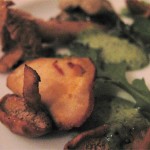
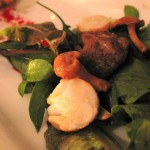
Last night I joined about 50 others to enjoy wild mushrooms, many of them unearthed earlier that day by participants in a foray led by our mycophilic host Sinclair Phillip. The chefs of Sooke Harbour House were given the challenge of coming up with a menu to suit the finds (on top of regular restaurant duties and, I think they said, a reception as well). They more than managed to offer us four fine courses, starting with a Matsutake broth in which were floating the selfsame pine mushrooms, surrounded by assorted wild morsels, a bit of nettle emulsion and a few nasturtium petals and shuagiku leaves.

Second course was a trio of tasties: porcini quinotto topped with boletes; pear-poached white chanterelle; and a bear’s head and spot prawn herbal salad with pickled hedgehogs.


Third course, the “wild plate”, included morels (from Eric Whitehead) stuffed with polenta; a venison croquette of Sidney Island fallow deer (these are culled annually, a fellow diner told me) with shallots and hunter’s stew (made from assorted foraged mushrooms) ; a pretty triangle of beet-mushroom terrine; and boletus grilled in leek oil with Red Fife “soil”. And the finale was Kabocha squash pie accompanied by an amazing candy cap mushroom ice cream, candied chanterelles and a darling meringue mushroom. The jelly that topped the pie was made from a delicious mushroom reduction (from the icecream making).


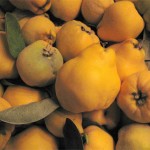
Back in my own kitchen, it’s preserving time and I’m wearingmy fingers to the bone making quince everything.

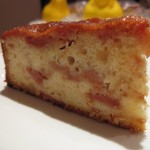
My lunch today was a modest harvest feast: a tomato-mustard tart, some fresh sauerkraut which made itself while I was away in Banff, and a crunchy baby cucumber from the garden; then a slice of yesterday’s Sticky Quince & Ginger Cake – part of my ongoing quest for new ways to use quince.
Heirloom schmeirloom

The LA Times has a good article on heirloom fruits and vegetables. The word “heirloom” is one that’s widely abused, but one that’s also treasured by many farmers and gardeners in these days of hybrids and genetic engineering.

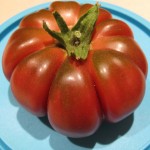
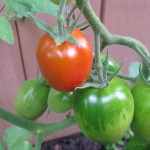
There is much to commend, for example, the complex flavour and charming fissures of an heirloom tomato over its supermarket version, round and hard and bland as a tennis ball. Here’s one of mine, as discussed on my gardening blog recently.

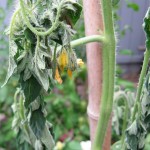
But woe, or perhaps that should be more woe, has befallen my tomato kingdom. I’ve had to pull up one of my beloved Auriga plants as it suffered sudden and catastrophic wilt. Was fine one day and flopping over the next. Because it perked up at night before flopping out again the next morning, and because the stem cross-section revealed the tell-tale dark ring that shows fungal damage to its vascular tissues, I assume it was vascular wilt – which apparently means either Fusarium or Verticillium… although the plant didn’t show any yellowing of the leaves which is said to be a symptom of both these fungal diseases.

So I don’t know for sure, but I had to pull it up to be on the safe side. My tomato garden will have to move to a new location next year in any case, since several of the plants were infected with early blight (Alternaria solani). Aside from not growing in the (now contaminated) soil for several years, the main suggested procedure for controlling vascular wilt is to buy seed that has been bred for disease resistance. In the words of one source of advice, “The incidence of these diseases has increased with the growing popularity of heirloom, non-resistant, varieties.”

Well that’s the problem, isn’t it? The old conflict between taste and functionality. We may complain mightily that new food plant varieties are bred for longevity in shipping containers and on supermarket shelves rather than for taste or texture, but they are bred for other useful purposes as well. Disease resistance and other useful qualities like drought tolerance are key objectives in many plant breeding programs. Good breeding should aim to keep those most important qualities, the ones that made us love a food – flavour, nutritional content – while secondarily working on other aspects. But in a world that seems to have forsaken its tastebuds if a cheaper product can be had, this doesn’t always happen.

And maybe it’s not possible. If it’s not, then it means urban (and other) farmers who want to grow heirloom varieties need to be skilled and knowledgeable about avoiding the risks that can do in their crops. Gaining that skill and knowledge is the tricky bit in a busy world.

Meanwhile, I will have to look into wilt-resistant varieties that grow around here (apparently the resistance has to be localized as there are so many variations of the wilt fungi). Perhaps tempt fate and see how well they fare in the same garden bed. And how they taste!

There are ambiguities around the term “disease-resistance” too; this was a term used about one of the tomatoes I’m growing this year, the Bearo plum. In fact it was said to be highly resistant to blight, but I’ve managed to prove that its resistance hasn’t extended to early blight, unfortunately, as it’s one of the plants affected in my garden this year (so far only the leaves). But its enthusiastic growth and ample fruits make me want to try it again, and next time somewhere it can have room to reach for the skies.