Skip to content

food tours

Canada Day, and the pain in Spain

Just got back from nine days in northern Spain: a record breaker for the university, I think, as being the sickest stage ever. We racked up the following ailments which affected, if I counted right, 18 out of 24 of us (some people had more than one thing) requiring 4 hospital visits:

3 respiratory tract infections/bronchitis
1 attack of vertigo
1 sinus infection
1 jellyfish sting
1 grazed knee
1 dicky hip
1 stiff neck
7 nausea/vomiting
1 incapacitating hangover
1 sore throat (that stopped there)
5 or 6 colds
1 scary allergic reaction

We arrived in Vic on Canada Day and celebrated with some contemporary tapas (outcome: two sick stomachs). Novelties included a salad with a frozen yogurt dressing:

Delicious cheese flowers: a taste similar to high quality gruyere, and oh so pretty:

Some sausage and the omnipresent Pan con Tomate (tomato bread):

Bacon-wrapped dates:

Not sure why anyone would do this to perfectly nice asparagus, but it looks impressive:

Piemonte Thursday

We spent our last day touring Torino‘s ethnic markets with Vittorio Castellani, journalist, broadcaster and self-declared gastronomad, known locally as Chef Kumalé. An anthropologist by training, he has put his background to good use in communicating the issues, circumstances and foods of Torino’s ethnic communities. He’s a writer as well, and worked with our friends at Lavazzo to write Coffee Roots. He was kind enough to agree to an impromptu book signing at our meeting point, outside the Hamam, which originally served as the bath house to Torino’s immigrant workers. We toured the facility later: abandoned for 20 years, it’s been refurbished and offers meeting spaces, a cool and tempting basement restaurant and a turkish bath open on alternating days to men and women.

These are the tenements where the workers lived, above the market. Abandoned now, they held workers from the south of Italy and from many immigrant communities; they still host occasional squatters, many these days coming from China.

The food market is large and varied and sprawls across many streets and buildings: this is the farmer’s market section, an unusual feature in Italy where the food markets nowadays tend to be straight retail operations selling imported produce. One of Slow Food’s projects is to try to develop a network of farmer’s markets around the country.

The market changes to reflect the communities it serves. In the enclosed section of the food market, Italian traditional producers now also sell cheeses and salumi tailored to Romanian tastes. There are areas of the market for all the different regions of Italy as well: we passed a little slice of Puglia, way up here in the north.

From an Asian-run stand, you can buy a bit of pork tongue or veal nerves. Why not?

We checked out a local Moroccan bakery, serving that community’s needs for pastries and sweets. These are part of its culture; a social currency as well as a food tied to religious observance. When breaking Ramadan fast, sweets and pastries are some of the allowed items. Packed with dates, nuts and honey they are a quick, effective source of energy to bodies depleted by fasting.

In the courtyard at Torino’s mosque. It’s the simple grey door left of centre in the photo, situated in the courtyard of a tenement well hung with laundry and plastic sheeting. There were 24 of us there, which was comfortable; every Friday afternoon 20,000 moslems head in here for worship, aiming for one of the 200 spaces inside. The ensuing tension and conflict are widely reported, but nobody seems to know what to do about it.

After we parted from Vittorio, we leapt back into the bus and sped off to Eataly for lunch. Built in a former vermouth factory, it’s a large and impressive edifice, one of the new wave of groceries (not unlike Whole Foods?) promising products for all budgets and offering a whole consumer experience. We started our day there with very good bread and lovely pizza (mine had fresh tomatoes, ham, anchovies and burrata – a fresh mozzarella with cream).

We travelled round the facility with Sebastiano Sardo, Slow Food’s man in Eataly. He shows us a whole lot of beer. Unusual for Italy.

A whole lot of wine. Not so unusual.

A Spanish wood fired oven explained in part why the bread and pizza were so good…

Education is a big part of the picture: the seasonal wheel shows families, as they enter the store, what’s in season here.

The store has a library where you can browse food guides, surf the internet and even buy books and Slow Food paraphernalia.

The foods of Piemonte, a special display which gives a bit of history and background to the foods of the area.

Paying tribute to the building’s origins, there’s a vermouth museum on the top floor, with these cool copper sniffing devices which give you a sense of the relevant aromas.

Piemonte Wednesday

We had a morning at the Pollenzo campus with some of the Slow Food folk on Wednesday. Representatives of the Slow Food International, Slow Food Editore and the Foundation for Biodiversity gave us a talk on their mandates and activities. It was a helpful boost to our understanding, half a year since our last talk from them, and was particularly useful for classmates hoping to do internship postings with the organisation. We left for Bra, where the offices and our lunch were waiting.

Where it all began: the restaurant in Bra where the Slow Food movement became a reality.

Italian sushi, quipped Piero Rondolino, who joined us for lunch. We had lardo, salsiccia di Bra – a delicately spiced raw veal sausage, and carne cruda battuta al coltello (raw, hand-cut veal). All delicious.

Then some pasta, followed by the best panna cotta in the world? Maybe, surely in the running, lots more research needed. It was sweet, soft, delicate. Creamy but not too rich. And very pretty.

Back on the bus, after a shuffle round the hot, closed-for-lunch town, and away we sped towards our final Italian winery in San Martino Alfieri. Not sure what was ahead, we strolled up the path…

Heading in the right direction for Marchesi Alfieri winery…

A very old grapevine (for table grapes)

And hey presto there we were in a castle with beautiful grounds, meeting our winemaker Mario Olivero, who gave us another talk about my beloved Barbera, which is the main one of the several varieties of red wines they produce. A neglected grape, it was dismissed as fit only for table wine until about fifteen years ago, when a few and then many Piemonte winemakers began to take it seriously for its fruit and body and capacity for ageing. Now there are some 50 million bottles produced in the region, and it’s the area’s second most important variety. We sampled a couple of different years each of Marchesi Alfieri’s Alfiera and La Tota wines, and yes they were very good indeed.

After the cellar tour, Marco introduced Elena Rovera, from Cascina del Cornale, the organic cooperative that is an agriturismo, restaurant and seller of organic products, situated in Magliano Alfieri, between Alba and Asti. And what a spread she put on for us…


Piemonte Tuesday

Breakfast on the road. Only at the best eateries in Italy? Surprised us all by having what might be the best croissants we’d ever tasted.

Unfortunately good taste did not extend to their selection of Hitler beer and dictator wines…

We arrived in Torino ready for our day of coffee at the Lavazza Training Centre, and sure enough we were coaxed into our seats after lashings of freshly made Lavazza espresso. After a morning learning about the ins and outs of Italian coffee production and marketing, and a bit of the bean’s history and geography, we went for a tasting session of a dozen different coffees, both robusta and arabica varieties.

There was a dramatic difference between all of them, tasted side by side like that. Under the natty tutelage of the company’s Golden Palate, we learned the sniff ‘n slurp method of coffee tasting, and heard about the differences between wet and dry processing: washed and unwashed beans, and the various ways of preparing them for roasting. We got a whole new tasting vocabulary, learning new defects like quakery, grassy, woody and fermented.

Lavazza has the biggest roasting operation in Italy and the lion’s share of the domestic market, and so it’s important to keep pressing forward to stay ahead of the competitors (…can I resist saying: in the poisonous growth economy we find ourselves in?) and we heard about a few of the new product lines, which ranged from worthy to silly. Many of them were spawned (and as you will shortly see I use the word advisedly) through the company’s partnership with Spanish foam-meister, chef Ferran Adria.

Here we see the Coffeesphere, a bit of complicated nonsense to create a hit of sweet, gooey coffee substance that has the shape and texture of a soft-boiled egg yolk.

And syringes, perforated plexiglass slabs and a snappy lab coat are required to make the same thing, only smaller, so they can call it coffee caviare.


There was also a sweet, sticky foam coffee that came out of a nitrogen canister, like the ones restaurants use for whipped cream, making something called Espesso that, being foam, is the coffee that doesn’t spill. They’ve even designed a special coffee spoon with a hole in the middle as if to prove to skeptics that it really isn’t a liquid anymore. Well, maybe in a market that finds Italian television watchable it could work, I don’t know.

And this miracle of twentieth century necessity: your very own tube of UHT milk foam for those moments of crisis when you must have spuma (foamed milk) now now now. If that’s the sort of thing that amuses you, you might want to invest in a special plastic cup with a divider in the middle to drink it from. I guess what I found most disturbing about the innovation section was the amount of packaging and plastic and all round waste it was generating for the sake of stimulating a saturated market. We’re a long way from a simple coffee bean here.

The company has other promotional devices, like their vamped up girlie calendar (shades of Italian television with its partially dressed presenters) that made me feel less and less Italian by the minute. But produces some excellent print publications. And there’s its worthy sustainability project, Tierra, which lets the company pump a bit of money and development aid back into coffee-growing economies. Long may that project last.

We finished our day with a tour of the highly automated factory, dodging unmanned forklifts and miles of conveyor belts, and pondered the acres of warehouse with its robotic shelf-stockers gliding silently up and down the towers of packaged coffee, reading bar codes and pulling pallets out and putting pallets in. Surreal and strange and not a little overwhelming.

And then we were turned out for a free hour or so in the hot streets of Torino – everything having just shut for the evening – until it was time for supper at Pizzeria Le Rondini, with its decidedly, and thankfully, manual production methods.

Many of us had the house specialty, which had a thick, chewy crust filled with fresh ricotta, and topped with buffalo mozzarella, fresh tomatoes and salami.

We dined with Piero Rondolino, owner of Tenuta Colombara, a farm which produces the estimable Acquerello Rice, whose business we sadly didn’t get to visit. He grows the prestige risotto rice variety, Carnaroli, and ages it to give it better flavour and texture. It’s an organic business, and he uses a number of creative methods to manage it; he told us about the dragonflies they introduce to the fields to eat the mosquitoes that breed there.

After supper, a few of us slipped away to bide our time in the neverending summer evening queue at Grom‘s mother ship.

Piemonte Monday

We had four busy days exploring Piemonte (Piedmont), in north-western Italy. We made an early start from Parma and lunched in Pollenzo, at the campus cafeteria of the first and other campus of our university, and were able to exchange notes with a couple of students on the degree course, which lasts three years and has a much higher enrollment (60) than our master’s program. The first group of students in this program is due to graduate this year, after many travels and many experiences. It’s an expensive proposition, but even so the tuition only covers half the expenses: with tours stretching as far afield as India, Australia and Scotland, it can be pricey and complicated to administer.

After lunch we met the first of two winemakers from the region. Michele Chiarlo specialises in two famous Piemonte grapes: nebbiolo and barbera. I had fallen in love with Barbera wine this year so was thrilled to taste a couple of excellent examples, and some excellent Barolo, while hearing about the winery’s operations from oenologist Stefano Chiarlo. The interesting details he explained included setting the corks (only natural ones – like others we’d met, he maintained that artificial materials don’t work in wines that need to age in the bottle more than three years) with the bottles upright; after two weeks, the bottles are all turned by hand into the horizontal position. He feels this keeps the cork in better condition for aging.

After the tour and the tasting, we had a particular treat when he took us up into the hills to see a barbera vineyard. He told us about the green harvest, which is the pruning, over the summer, of excess grapes, so that the plants can pour their energies into producing more concentrated flavours in the remaining bunches. He also explained that the vineyard had originally been owned by Tuscans, who brought the cypress trees in the background, which are now about 250 years old.

His family are art lovers, and there were some very cool things to see alongside the grapes.

New takes on an old tradition which posted heads on every road, as protection against malady. Note the ubiquitous rose bushes which here too play their important role in predicting fungal attacks.

They also host a summer festival in the vineyard, with music and wine.

That evening we were treated to dinner in a special osteria, the Ristorante ‘Belbo Da Bardon’ where we had some excellent meat-filled pasta, some very tender veal with broad beans, and a lovely slab of creme caramel.


Gelatorama

We spent Thursday at Gelato U, learning some things from the gelato equipment manufacturer Carpigiani, near Bologna. What did we learn? Hard to say. In a course really designed for companies who’d bought the incredibly expensive (25,000-35,000 euros for the basic gelato maker) equipment, we were given recipe after recipe for making four or five kilos of gelato at a time.
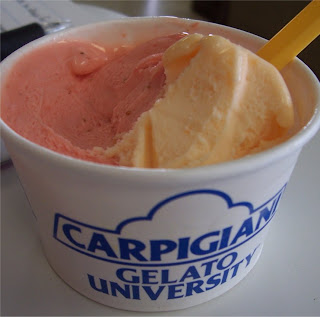
The instructor began with some distinctions between “ice cream” and “gelato”. Ice cream, he said, was made in high volumes, and so could not use fresh ingredients, but tended to use industrial flavourings. Gelato on the other hand, could be and was made artisanally (his definition of artisanal: not necessarily made at home, or even by hand, but in small quantities), with fresh ingredients. Another main difference was the over-run, which was 100% in ice cream and more like 45-50% in gelato; this turned out to mean the volume of air pumped into the final product by the industrial — err, artisanal? mixer/freezer. And a final difference was the fat and sugar ratio: gelato is lower in fat but higher in sugar than ice cream. He observed that higher fat doesn’t automatically result in a softer product, since fat freezes solid, so the serving temperature will have more to do with its texture than anything.
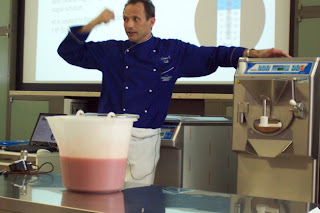
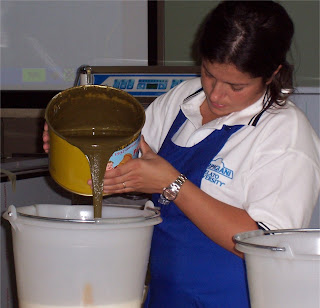
After dutifully noting all that down, we had to wonder anew what was really meant by ‘fresh ingredients’ when we watched the making of gelato. Yes, fresh fruit was used. But so was a powder which included stabilisers and emulsifiers, and protein, in the form of milk powder. And we were told that although fresh milk is a good ingredient, you could as easily use UHT or sterilised milk. To add fat, you could use fresh cream, but you could also use butter (as long as it was industrially-produced butter, made by centrifuge, and not the lower-tech kind made by skimming, as this could introduce bacteria into the mix). And all kinds of calculations come in when adding sugar: dextrose, sucrose, fructose all have different degrees of sweetness which must be balanced with the sugars introduced by fruit or other flavourings. The instructor spoke fondly of the companies who have laboured long to save the gelato maker the toil and trouble of crushing his own pistachios, and produced a neat tin of flavouring ready to pour. Here we see a nice can of hazelnut going into the mix.
The original gelato recipe, which originated (in Italy!) consisted of: milk, sugar and egg yolks. Apparently eggs are not used much now, because they make the gelato taste, well, eggy. Which is apparently a bad thing when you want to make it taste of many other things. So, gelato makers have isolated the functions that eggs served (fat to add texture and bind ingredients, protein to add structure, emulsification to smooth things out) and introduced powdered substances that may include alginates, pectins, starches, xanthan gum, gelatin, lecithin, guar gum and carageenan (identified by E numbers). The one gelato flavour that is still allowed to taste, or at least look, eggy is Crema, which is really only ‘custard’ flavour, and I had to wonder if fresh eggs are ever involved…
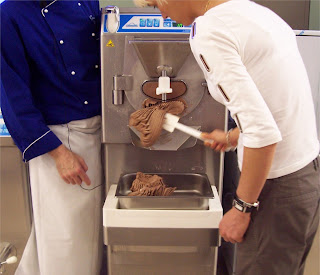
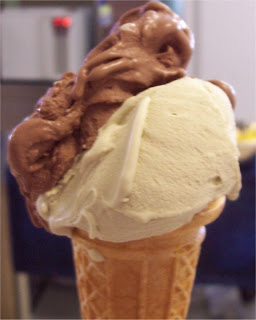
We sampled both sorbet (below, in lemon) and gelato (above, chocolate). In the demonstration we saw, the mix for the gelato needs to be ‘aged’: the milk, cream, stabilisers, emulsifiers, protein and sugars are combined, heated to 85 degrees celcius and then cooled, ideally overnight, before adding flavourings. This improves the texture, allows the mixture a longer shelf life (three days) and improves the flavours. Quite, well, all those powders after all; we did not learn whether if you used old fashioned ingredients like milk, eggs and sugar, the flavours would meld without aging.

A few other distinctions we learned: sorbet (sorbeto, sorbetto) is gelato made with water instead of milk; granita is gelato without the air (from mixing), stabiliser and emulsifier (it’s slush, basically); and semi-freddo (aka gelato caldo or gelato alto) is made with vegetable fat. Not sure about the last definition; I think the term semi-freddo, or indeed semifreddo, is used differently by different people: I’ve seen it used for various frozen desserts.
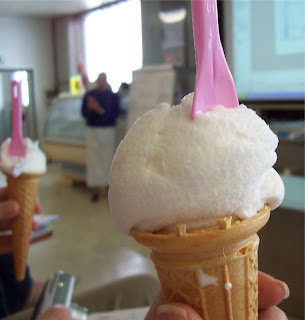
The verdict? Disappointing. The flavours ranged from bland to unbalanced, the texture fatty. The words “artisan-made gelato” will not impress any of us in future, since all they mean (as in fact we’d heard as well from another of our lecturers) is that the seller has mixed his batch of formula, from what we know now are bags of stabilisers and powdered milk, and poured it into his expensive machine in small quantities, and put it into the display case at what we hope are frequent intervals. The skill, I suppose, lies in the chemical skills of the mixer, the kind of milk and cream used, and the intensity, purity and freshness of the flavourings. Further research at Grom, K2 and other favourite outlets will be needed. We are all off to Piemonte next week and I hope will have occasion to revisit the excellent cafe/gelateria in Bra that we stopped in on a cold day back in March, which features some dazzling Presidia flavours.