Skip to content

GMOs

GM labelling in Canada – you can do something!

Canada stands with other GM producing nations (like the US) in refusing to require labelling of GM foods (currently it’s voluntary) but also trying to force non-GM enthusiasts into allowing GM products into their markets.

It’s a hugely complicated matter, as North America has already travelled so far down the GM road; it can be hard to say what is and is not GM any more. As previously discussed here, more than 90% of Canada’s canola crop is deliberately or accidentally now genetically modified. There is no way to prevent contamination of most non-GM crops once their GM neighbours are out there in our fields.

But, happily, GM crop contaminated pollen may not be the only thing on the Canadian wind this spring. Canadians should sharpen their writing utensils and dash off letters to their MPs right this minute, since Bill C-517 is on the table now, this very week. This bill, introduced by Bloc Québecois MP Gilles-A. Perron, calls for mandatory labelling of GM products; the last attempt to pass this legislation in 2001 was defeated in parliament.

Without labelling of GM products, Canadians cannot know for sure what they are eating, and it is worth remembering that GM foods have not been proven safe for long term human consumption; they are also banned from use in Canadian organic food production (but how would an organic producer know, without labelling?). Worth a try, it seems to me.

For more info and how to get your oar in, see the info on the Greenpeace website.

Growth hormones in dairy, and National Poetry Month in Canada

Shocked by a grim if slightly dated tale about rBST – recombinant bovine somatotropin, marketed under the name “Nutrilac” – a synthetic hormone, developed by Monsanto through genetic engineering, that increases a cow’s ability to produce milk – which is allowed in US dairy cattle but banned in Canada and the EU. Despite intense lobbying by Monsanto, and a made-in-Canada whistle-blower scandal, eventually further study showed cause for concern over introducing it to the human food chain: but it is even more harmful to the health of dairy cattle, who suffer greater risk of lameness, infections and sterility when given it.

Bear that in mind when buying anything containing dairy products from the US. I’m not sure if there are any regulations at all that limit the use of US dairy products in this country – the regs only say we can’t give the hormones to our cattle. A number of dairy producers in the US now label their products as hormone-free, which is causing Monsanto to protest that such claims might make consumers think the hormone-free products are in some way ‘better’ than those which are produced with the benefits of Monsanto’s chemicals. Gosh…

More about milk another day. Meanwhile, National Poetry Month looms in Canada, and starting April 1st, the League of Canadian Poets will showcase poems by its members on a blog, whose theme is “Poetry Without Borders.”

GM canola and alfalfa, and a little poetry news

I’ve been discovering some shocking things about genetically modified foods in Canada this week, and so will all of you with televisions that can be tuned to Global for a documentary on Saturday night, March 23 at 7pm (dunno if it’s the same outside BC). Hijacked Future is about GM foods, but also about the stranglehold that large, profit-driven corporations are securing on the world’s food supply, while we consumers blithely carry on as it it were the most natural thing in the world for farmers to be forced to buy new seeds every year instead of saving and planting their own stocks, developed for local ecosystems and disease resistance.

Stephen Hume‘s article in the Vancouver Sun this week previews it nicely:

“…it’s fascinating to observe how we appear to be collectively sleepwalking toward … a potential catastrophe with that most strategic of all things, a sustainable, secure, equitably distributed global food supply… [Hijacked Future] takes dead aim at the question of whether it’s in our best national interests as informed, intelligent citizens of a global civilization to snooze while a few giant trans-national corporations succeed in their attempt to monopolize food production.”

I learned a bit about organic farming, too, and the loss of Canada’s organic canola crops, both as a commercial crop and as an invaluable rotation crop. It appears that because of the (non-organic) genetically-modified canola in our fields, over 90% of all canola – including organic – has been contaminated now. This has caused a significant loss of livelihood to organic farmers, so two Saskatchewan canola farmers tried to bring a class action suit against Monsanto, on behalf of all certified organic farmers, but our very own supreme court told them in December they couldn’t. The farmers are currently considering their options. Percy Schmeiser is our best documented case of unwanted GM crops intruding on private land against the wishes and intent of a farmer, and our higher courts did a less than heroic job there too. Although he’s just won – wait for it – $660 from Monsanto in a small claims settlement for costs involved in cleaning the GM canola off his fields.

Thank heavens for the farmers, consumers, environmentalists and courts of California, who were able to call the USDA on its ill-judged approval of genetically modified alfalfa. Alfalfa is hardly a glamour crop, being mostly known as animal feed, but it is also a crucial rotation crop for organic farmers. In both these roles, it sits at the bottom of our food chain, and we should – must – pay attention to what happens to it, or risk losing organic farming forever.

And on the poetry side of things, if you want a little extra CanLit reading you can sign up for The New Quarterly‘s new e-newsletter.

Pausing in Puglia

Greetings from Puglia, where pigs fly.
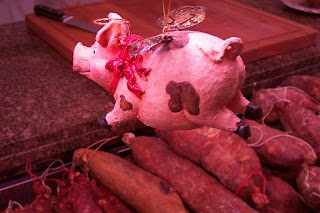
Here in the heel of Italy, the weather has turned wet and cold and I have passed on a trip to Lecce to catch up with a few things. Naturally now that I have made that decision the rain has lifted and the sun has come out… Ah well.

We arrived in Brindisi yesterday at a desperately early hour and carried on to IAMB, the Bari centre of the Mediterranean Agronomic Institute: we will be visiting the institute’s Chania centre when we visit Crete next month.
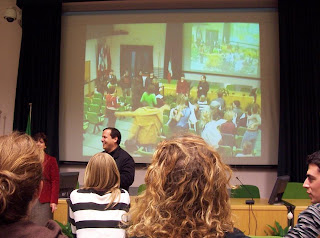
Our Escher moment at IAMB.

They offer research training to agronomists from Mediterranean countries to study such issues as irrigation and water management, aspects of organic agronomy, and methods of managing endemic insects such as the olive fly.
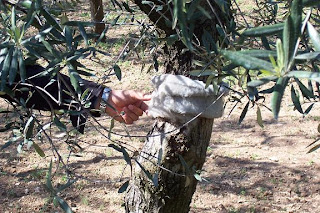
Clever way to catch crawly insects on an olive tree: a collar of fiberglass.

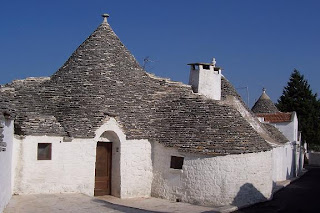
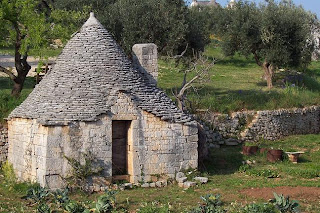
We had an incredibly good lunch of local dishes, many of them seafood, and then paused for half an hour or so to view the characteristic conical houses, the Trulli, which are found in abundance in the area but particularly in a town called Alberobello.
On we sped to our appointment with butchers in Martina Franca where we watched the making of capocollo, another cured meat made of a whole cut of pork.
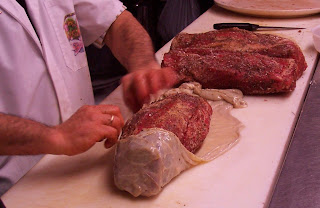
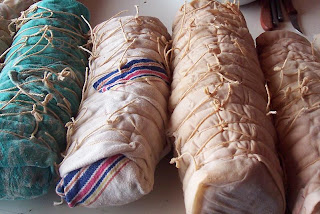
This one is trimmed to size, seasoned and dried for a few days, then marinated in boiled wine must and white wine, then wrapped in pork intestine, tied in a tea towel, dried a bit longer, unwrapped, hung to dry, then briefly smoked, and then hung again until start to finish it has gone through its paces for a total of about 120-150 days. By then it is a firm, sweet, slightly salty and lightly smoky treat, made in small quantities between October and Easter, when the climate is suitable for the cool dry winds it needs over part of the process.

After that we had a surprise gift of music and dance from a local folk troupe, then watched a bit of hand-crafting of orecchiette and maccheroni and sat down to another wonderful meal. We had a couple of soups – zuppa verde and zuppa di carciofi – and some pastas including the ones we had seen made. There was, for the strong, a further buffet featuring such specialties as Puglian salumi, raw artichoke and cheese salad, and a kind of risotto made with orzo (barley) and mushrooms. Some pastry and fruit followed, and a merciful sleep.

This morning we had a talk by Gino di Mitri, author of a book on Tarantism, the historic and region-specific ailment of Puglia, attributed to the bite of a spider, and which may have its pagan roots in Dionysian rituals, while its Christian expression took the form of prayers to St. Paul, saint of spiders. Affecting mainly, but not exclusively, women, tarantism was treated by music and a highly energetic dance, in which the sufferer used her body to describe the circumstances of the bite, and which ultimately evoked a trance that would allow the sufferer reconciliation with the spirit of the spider. The musicians – a tambourine player (almost exclusively female), accompanied by violin, guitar and accordion – would diagnose the colour of the spider, which corresponded to the nature of the ailment: for example, a blue spider would express melancholy and disharmony with the community. Homosexuality, we were told, was often entwined with the condition. Women who did not want to marry might claim to have been bitten, and the contaminating nature of the spider bite might in any case render them unmarriageable.

Last week is already a blur, but we had some wonderful people talking to us, including Stuart Franklin who walked us through a fraction of his formidable portfolio and spoke movingly about his latest project and forthcoming book on the changing landscapes of Europe, a depressing tale of overproduction, land-grabbing, overdevelopment and standardisation. We also enjoyed Richard Baudains who led us through some of the issues of wine reviewing: the extreme ends of its readership and the difficulties of communicating subjective analysis of an edible subject. We saw some wonderful films as well, from the Slow Food on Film curator, including a fantastic documentary called Life Running Out of Control which encapsulated the complex issues of genetic engineering, including the contamination of organic seed stocks by GM crops in North America, the risks to the farmers of India of the dubious economics of GM seed developers, and the moral and practical issues of experimental animal development. Shades of Oryx & Crake

We Feed The World

I watched We Feed The World the other night and it was more around the troubling subjects this year has been opening up for me. The film’s ironic opening and closing image shows corn cobs and husks being burnt for industrial fuel. Its title comes from the slogan for Pioneer Seeds, which appears to be the Monsanto of Europe. In the film, one of the company’s senior directors took a tour through Romania, observing that the small scale production there was a reminder of how European farming used to look about fifty years ago, and he hoped things would not change too fast there but the big companies are already moving in, and it probably won’t be long before their world changes for the worse. Some of the things that stayed with me from the film:

  • The initial subsidisation of hybrid crops (the example given was eggplant – which looks better but tastes nowhere near as good as traditional eggplants) by the Romanian government so that farmers buy cheap seed, reap the profits, and then the subsidies are removed the next year, leaving the farmers without saved seed from traditional crops, unable to plant the reproductively sterile hybrid seed, and eating into their earnings to buy the more expensive hybrid seed. And thus starts the cycle of uneconomic overproduction that must surely lead to selling out to industrial giants. And doing what after that: working in some peripheral industry for a poor hourly wage?
  • The wholesaling of Brazilian rainforest which is being systematically razed to plant genetically modified soya for European farm animals. The soil is good, but unsuitable for soya so all the nutrients must be brought in to make that happen. And it means that all the efforts to keep GM out of the European food market are in vain because the animals are eating it.
  • Vast areas of southern Spain are covered in warehouses growing the amount of vegetables needed to feed Europe. More monoculture, more hybrids, and lots of impoverished farm workers from Northern Africa, driven out of their homes and livelihoods by— cheap greenhouse vegetables from Europe. A story very much like the one told in Chicken Madness, where African chicken farmers were being driven out of business by cheap frozen chicken from Europe and Brazil.
  • Small scale fisherman are being removed from the equation by the EC which aims to make all fishing industrial-scale. Which means no more fresh fish for the markets, only the product of trawling deeper and deeper and selling anything and everything they can dredge from the ocean because there’s less and less of what we want. Fish that’s been sitting in the hold for a couple of weeks having died on the nets that are in the sea for 10 or 12 hours does not, the film said, compare with fish brought out of the nets by hand after a couple of hours and sold in the market later that same day.
  • The CEO of Nestle is captured giving a chilling talk about water. What he regards as an “extreme position” is that water is required for human life, and should be a human right. But he, his company (which just happens to be the market leader in bottled water) think it should be considered a “foodstuff” and priced and sold accordingly. He also says that we’ve never had it so good; we’re better fed with more money than any time in history. Yes, we agree, looking at his sleek and well-tended self, you probably are. But not so much those Africans living in greenhouse-shantytowns in Spain, or the farmers starving in Brazil and drinking unclean water while locally grown food is exported for animal feed. Or all the farmers and agricultural workers driven out of business, together with all the businesses that used to serve them.
  • Quote from the poultry breeder, whose mass produced chickens were shown from egg to packaging: “All the market’s interested in is the price. Taste is not really a consideration.” Nor are a lot of other things, from the looks of the world we’ve created.