Skip to content

food

Gordon’s seasonality campaign & Delia’s chicken comments

Gordon Ramsay caused a bit of a flutter by proposing that out-of-season fruit and veg be outlawed in Britain. A little light counter-attack from readers of his restaurant menus, but aside from the dessert menus he seems to be sticking pretty well to his principles. I was glad to see him coming down on ex-saint Delia Smith who has been flogging a re-edition of an old book of hers from the seventies which promotes use of ready-made food, which by now we should know is less healthy and more expensive than learning to cook from scratch.

She also made some rather ill-advised comments about supermarket chicken which made feathers fly. Supporters say it’s her working class roots, and that she was just showing sympathy for people who simply can’t afford organic food. But although she concedes she doesn’t like “the way battery chickens are reared,” it strikes me that in describing battery chickens as “nutritious food” she doesn’t seem to grasp the public health risks – increased and dangerous overexposure to antibiotics that come to us through chicken meat, the salmonella and e. coli risks – and the issues around over-consumption of meats by Western consumers.

Most of the cookbooks we’ve all grown up with are meat-based, and so it’s unsurprising to find someone who’s made a living writing them (though her Vegetarian Collection cookbook is excellent) promoting that same unimaginative thinking about feeding the poor.

So my rhetorical question of the day: is it better to invite low-budget shoppers to buy cheap (because inhumanely reared with unhealthy production standards) meat or to point them towards other ways of cooking which use more economical sources of protein?

Return to Mosaiko

I was worried when the website for Ristorante Mosaiko dropped off the virtual map, but the place itself is still three dimensional, and chef Davide di Dio assured me that the website was only being redesigned, and would return one day under a new url. But not yet. There was some lovely raku on the walls and the Oltretorrente locals trickled in steadily until the place was humming a happy Parma air.

From my corner table I was reassured by another terrific meal that chef Davide has not worked himself into the ground, nor lost his imagination. The amuse-bouche – a tiny meat pie on a beetroot and balsamico base – was exquisite.

The Insalata d’astice, asparagi e arancia siciliana (lobster, asparagus and Sicilian blood oranges) was out of this world; if I’m not mistaken there were flecks of home-pickled ginger which made a gorgeous sensory contrast to the rest. And it was simply beautiful to look at.

How could I resist the Ravioli al baccala’ mantecato (salt cod ravioli), with shrimp, rucola and black olives? They were quite rich but I’d come to eat and eat I did. I also liked the bowl; at Mosaiko every dish has had its housing carefully planned.

And then Branzino in crosta di pane (sea bass) with zucchini – which was absolutely delicious – and black olive and pesto.

After my past experiments trying to make bonet myself, I thought I’d better try the real thing, which is reliably excellent here. And so it was again.

And this one’s for Howard (these guys live in a cabinet at Croce di Malta)

Croce di Malta

Yesterday’s lunch was a delight, in the clean bright and delicious world of Croce di Malta in central Parma.

I’d had a wretched supper the night before, ill-advisedly following an internet recommendation of Trattoria Corrieri, a place I’d passed a thousand times last year when I lived in Parma, but never went in, thinking it smacked of tourist haven. Too many tables, for one thing I guess. When I entered and saw it was apparently owned by the same people who owned Gallo d’Oro (which one of my classmates had been disappointed by), Enoteca i Merli – another nearby eatery – and a disco club, I should have fled, but it was Monday and not that many places are open; certainly none of my favourites.

So I ordered, intrigued, the Tris di Tortelli – a selection of three pastas, two of which are local favourites I’d been wanting in my ritual way to taste again (tortelli d’erbata and tortelli di zucca) and a third that sounded like fun (one made of spalla cotta, which is a delicious salumi). When I finally got my order (after it had been delivered to and half consumed by the man at the next table and whisked away and re-cooked and re-routed without a word of apology from the grim faced waitress) it was lacklustre; all of the tortelli were bland and uninteresting. The melanzane parmigiana which followed it was truly horrible: tough, poorly cooked eggplant and utterly lacking in visual or gustatory charm. The waitress never reappeared – ashamed I hope of her own and her kitchen’s performance – so I left, my only enduring gift a morning after headache from the house wine.

And this is what I got at Croce di Malta. Parmigiana di carciofi – made with fresh artichokes, and every bit as good as the one I had there a year ago.

Followed by zucchini alla scapece with smoked provolone, more a salad since it was served at room temperature. I was told the zucchini had been prepared with oil, a little vinegar and fresh mint; they like to make this with vegetables such as zucchini and eggplant. It was utterly amazing, the zucchini tender and lightly but thoroughly flavoured.

And to finish things off, a beautiful crema caramelata – freckled with vanilla and perfectly smooth and just the right size.

And of course, a caffe macchiato to finish, the milk properly frothed to the right silky consistency.

Lucky old me

I got to realise a long-deferred wish on Saturday, and visited Cyrus Todiwala’s Cafe Spice Namaste to check out some Parsee cuisine. I read elsewhere that the Parsees are shrinking in number, because their religion, Zoroastrianism, prohibits intermarriage and conversion; you have to be born right.

Anyway, the food was very good. The starters were unusual; after poppadoms with wonderful chutneys, we had crab cakes,

beetroot & coconut samosas and some potato pancakes filled with minced beef with smooth tomato chutney. Then some absolutely astounding tandoori duck

that had been marinated in yogurt and lime before grilling, a version of saag paneer and a dish of buttered sweetcorn and water chestnuts.

Naan with chili, garlic and ginger on the side was fluffy and crispy and pretty as a picture.

The passion fruit sorbet was terrific but the toffee and apricot icecream was to slide under the table and faint for.

And the lassi was excellent also.

Saturday afternoon

Moving on from the already full morning, on Saturday afternoon I went to a talk by Rachel Laudan, on how food makes us moral agents – more or less virtuous. She presented two trays of foods representing opposing value systems: in one, we gain altitude on the moral scale through refinement, through mixing and perfecting through cooking and treating our foods. Proponents of the refined side of the equation believe that cooking separates humans from the animals and barbarians who eat raw, unrefined food. Examples include refined flours and sugars (sugar, she observed, is an immortal food: you can remain pure by eating foods that never perish — might be said of a lot that we find on supermarket shelves these days) and wine.

On the other side, where we find wholemeal breads, water or milk, we gain moral value through the belief that foods are naturally good, and that cooking or refining them disguises their benefits. In this value system, cooking stimulates unnatural appetites and leads to sins like gluttony. So, I guess the bottom line would be that once again, you judge others according to what you’re used to.

Then on to Steven Kramer, a philosopher-foodie, who invited us in How Clean Is Your Plate? to think about morality and change, the entrenchment of habit when it comes to our food choices. The talk’s title referred to the admonishment by parents to clean your plate because children (always elsewhere) are starving. Quoting from Plato, Michael Pollan and Eric Schlosser, his recommended starting point was actually a book about animal welfare by Peter Singer, a utilitarian philosopher, called The Way We Eat: Why our food choices matter. He spoke about our willed ignorance when it comes to food production, particularly the raising of animals for meat: we don’t want to ask the questions about what’s on our plate. But when we introduce ethical issues to our eating, are we creating a fear of food? He concluded with a discussion of the moral issues demonstrated in Babette’s Feast, with its opposition of dull but virtuous cuisine versus extravagant gourmet foods, and the less than simple value systems attached to each.

There was then a discussion of food and environmental challenges, in which student Brian Melican asked how one brings people round to actually make choices and change their eating patterns without imposing on them a kind of consumer dictatorship. He questioned the difference between marketing and propaganda and balancing food preferences – like, say, mangoes – against their wider issues, such as the environmental cost of transporting them to your table and the need for their producers to make a living. It was, he said, a ‘different pocket’ reality: when ultimately we pay for the real and hidden costs of cheap food under different names, there’s a disconnect.

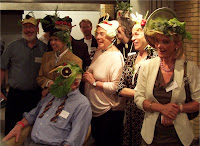
Saturday night’s Ethical Dinner, prepared by chef Tim Kelsey in consultation with Caroline Conran and Anissa Helou, was based entirely on ingredients sourced within 25 miles of Oxford. The evening’s entertainment was edible hat-making, led by Alicia Rios, to which end we gathered what was left on the tables after supper, and added it to the groaning board of ingredients.
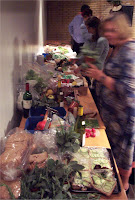


Some stunning headgear emerged.
And meanwhile, it was the Last Night of the Proms, which was celebrated remotely and appropriately even in Oxford.