Skip to content

Texas time

We left Victoria on Sunday morning, dressed in our winter clothes, appropriate to the 5 degrees or so that it was at 5am. And when we stepped off the plane in Austin at around 6 that night, it was 24 degrees (78f), and muggy. Which of course means we must go and buy new clothes at the earliest opportunity.

Which is not yet. We got distracted today by wandering through our neighbourhood – Soco (South Congress), a funky, fashionable area of alternative art galleries, great restaurants and even Allen’s, the cowboy boot emporium where we tried on many colourful pairs but decided we didn’t have the $300 – $400 necessary to complete our ensembles.

We have been knocked out by the food. We are dangerously near Magnolia Cafe, which is a 24 hour diner serving more than above average food. Had a chicken piccante there last night which was cooked in wine, lemon and capers with some smoky heat to season it to perfection; served with a mountain of grilled vegetables – yellow zucchini, red peppers, mushrooms, and a foothill of garlic mash. Judy had an amazing bowl of black beans with a cornmeal cake generously larded with jalapenos (we liked the way it showed on the bill: ‘japs in cake’). All washed down, of course, with a couple of Lone Stars.

Before dinner we’d made our way to a fabulous grocery store, the Farm to Market, which stocks amazing local products including Texas honey, Austin salsa verde, spelt crackers, fresh yogurt, great and varied cheeses, and gorgeous crusty bread. Friendly owners who volunteered their services as advisors on anything we wanted to know about Austin.

Lunch today was terrific as well: the South Congress Cafe, very chic and stylish with friendly staff and wonderful food – a duck and oyster gumbo followed by a seared ahi tuna salad with avocado vinaigrette for me; a shrimp and artichoke soup and a garden salad with jicama and a lime chipotle dressing for Judy, and some purdy pink hibiscus flower iced tea to drink.

Tonight we stopped in at a wonderful place, Cuba Libre, which we’d wanted to see because they advertise Martini & Manicure nights on Thursdays ($10!). They had great decor – leather benches and raw glass lampshades – and the most excellent entry: you open the front door and just as you’re wondering how to tackle the floor to high ceiling sheer curtains, they part magically at your first step, giving you a splendid grand entrance. They promised the best mojitos in Austin – they were very good indeed – and it being two for one appetizer night, we had plantain chips with pineapple mojo sauce and chipotle ranch dip, and some plantain-breaded oysters with a heap of lovely black beans. So much for supper.

We haven’t seen any cowboys, or even horses, but we have seen a lot of grackles! And last night we met a couple of Texas-sized cucarachas americanas. Too big to step on, too small to wrassle, so we compromised by relocating the one we captured: it scampered off to start its new life on the streets of Austin, and we wish it adios and good riddance.

What did they mean by that

Just the other rushed afternoon, when I was short of both time and protein for dinner, I consulted the Fannie Farmer Cookbook, and ended up making good ol’ salmon loaf, which I adulterated with some fresh dill and chopped capers. (It tasted a lot nicer than it looked.) Fannie recommended serving it with mustard sauce, and although I thought I was craving some lovely home-made tartar sauce, this was just as satisfactory, very yum and apparently can be used for a veggie dip as well. I used about a cup of strained yogurt, a tablespoon of Dijon, a teaspoon of prepared mustard, a tablespoon of minced onion, a tablespoon of lemon juice, salt and pepper.

Dinner out of the way, I went back to reading – slowly so it doesn’t have to end – Don’t Ask Me What I Mean: Poets in their own words, from Picador. It’s a collection of the pieces written by the poets whose books have been selected as quarterly choices for the Poetry Book Society, a kind of book of the month club for poets, which has been selecting a best book published in Britain each quarter since the 1950s. Here are a couple of my favourite quotes so far:

“It’s embarrassing to discuss your own poems in print. You come across as either an awestruck fan of your own genius or a tedious explainer of jokes.” —Michael Donaghy

“What keeps me writing poems – besides the sheer self-entertainment value of playing with language – is the impossible hope that one day I will produce that perfect poem, the one that is balanced precisely on the knife edge between comedy and tragedy, or at least between silliness and sincerity. As it is, every poem I have ever written loses its balance and falls to one side or the other.” —Billy Collins

The other morning we saw three harbour seals wending their way toward Portage Inlet, and a lone fisherman on the bridge, which make us suspect that the herring may be running, which means spring is here! Doing his bird dog best, Anton has spent a challenging week here on the Gorge helping local water fowl to find their way back into the water where they belong. Luckily, as demonstrated, he can do this on one foot while holding a yellow rubber bone in his mouth. So talented. I am hoping to have him back, possibly on a dogshare basis, after I return from Austin. Over and out till Texas!

Workshops that don’t cost a thing, and one that is worth every penny

“I like to write for performance, but I end up doing things which are somewhat beyond my capacities as a performer… What I can do, at a poetry reading, is give you an impression of what a piece would sound like if it were performed by somebody else more competent than myself.”– James Fenton (Don’t Ask Me What I Mean: Poets in their own words. Picador, 2003)

Last night at Mocambo, we had the excellent John Gould – always droll and delightful – reading with a terrific discovery, Canadian-born, Vermont-based poet David Cavanagh. Definitely one worth seeking out.

I’ve been a follower of the Guardian for some time, not least because of its extensive poetry coverage. Last year they began offering an online poetry workshop which is a great thing to try if you’re feeling stuck for ideas.

Another place that offers workshop ideas is Mslexia magazine. A good and useful website and a worthwhile extravagence to subscribe to the print copy.

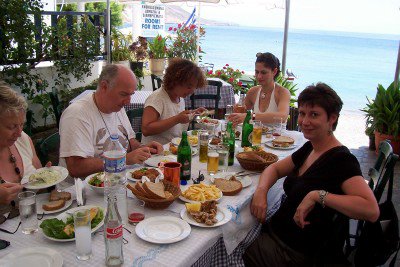
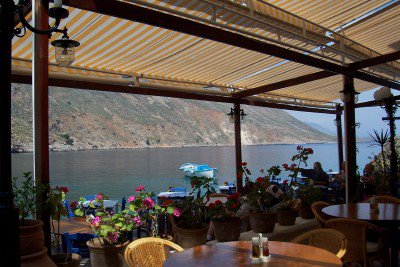
And on the other side of the coin… well a pile of coins really… ok, to get to the venue might take quite a *big* pile of coins, with some paper thrown in… check out Tamar Yoseloff’s workshop in Crete coming up in June – no idea how full it is, but if you can do it, do it. I did last year, and I’d happily do it again. Have you ever seen such a delicious workshop space, or a more focused group of writers? Man, the calories we burned working on those writing exercises… This particular taverna, Notos, served the best kolokythokeftedes, tzadzki, octopus and much more besides. Our favourite lunching spot.

My first time in Greece, and yep I really get it now, why everyone who goes there gets misty and wistful talking about it. The food, the food: everything just tastes better under a Cretan sun.
Here’s a little bite from one of the pieces I wrote in Tammy’s workshop:

Kalispera, Good Evening

An evening breeze, kalispera,
blows us towards dinner, till now
the only Greek I’ve ever spoken:
fluent in haloumi, moussaka, souvlaki,
names grown tender
in the memory of my mouth…

Outsider arts

My dear pal Nancy has been taking a course called The Picture a Poem Makes, at The Poetry School in London, and she sent me a link her classmates have been sharing: UbuWeb, which describes itself as “a completely independent resource dedicated to all strains of the avant-garde, ethnopoetics, and outsider arts”. Just the place to find those elusive Gertrude Stein MP3s.

Making a living in one of the worst paid job markets in Canada

A little rant, for the record.

This morning I was approached, through a tip from a well meaning colleague, by a technical recruiter from Calgary who was looking for a technical writer in Victoria. But it was a junior position, and she offered me $20 an hour! That, I told her, is what my cleaner charges. This is the second recruiter in a six month period who’s offered me $20 an hour for tech writing; the last one was in Vancouver, for heaven’s sake. I think there is more pure dignity in working as a cleaner for that kind of money than as a technical writer, so I turned it down — in the interests of not driving the salary standards for professional writers any further towards the basement than they already are.

Who is accepting such wages, and can you please stop?

I think this also demonstrates the perils of agency employment vs contracting for a living; through the sweat of our brows we are offered the opportunity to subsidize the decent wages the recruiters are making. They do not seem to understand that there is a difference between a permanent salaried job with benefits that can be quoted as a theoretical hourly wage, and a contract position that requires us to patch a living together from a month here and a month there, and pay our own health care, training, holidays and overhead. Grrr.

Meter mania

The lovely Saskatchewan-born neo-formalist Elizabeth Bachinsky shared her passion for sonnets with Kate Braid’s form class in Nanaimo last night. She is very fond of palindromes and Sapphic stanzas as well, and her first book, Curio, included a translation into anagrams of part of The Wasteland. She has done some wild things with Google search results too.

There was a preliminary discussion of meter, and while reading the chapter on Iambic meter from the excellent text, An Exaltation of Forms, we ran into diverging opinions on how to scan the line, which I now learn is “oft-debated” in scansion: “When to the sessions of sweet silent thought” (–Shakespeare, Sonnet 30).

Kate said that Keith Maillard had once told her that it was important not to confuse rhythm with meter and that this had made sense of the metrical world for her. If I’m paraphrasing her correctly, she said that rhythm has more to do with the emphasis we might put on a line when we read it, and meter is the more abstract “unreal” template we put over that line to measure it, within the context of the rest of the poem.

I’m still puzzling on that, but I found something that supports Maillard’s view, if music and poetry are this strongly connected, on a page about music theory. It says:

Many modern conceptions of rhythm and meter place them in opposition. Rhythm is often defined to consist of the actually sounding durations of music, while meter is the alternation of strong and weak beats, or the interaction of pulse strata, that are inferred from the rhythm. Rhythm is thus conceived as emerging and active— a “concrete” patterning that is measured by, and heard to work with or against the “abstract,” deterministic, rigid metrical grid.

Does that make sense to anyone? A couple of us thought the line (see second paragraph above) could be scanned as more or less straight dactylic tetrameter (quibbles over whether “silent” could be read without an initial stress, in context), but others wanted to put it into iambic pentameter with a double ionic (unstressed/unstressed/stressed/stressed) foot in the middle and a trochaic substitution in the first foot.

Ok, any [other] prosody geeks out there? For the rest of us, I like this page for a nice basic summary of meter. And I was having a little fun today with this one that has some online quizzes and tutorials on prosody.

And for those of you who prefer food, here’s what I had for supper last night (Rich Leek Tart, it’s called). Obviously I have a long way to go as both a cook and a food photographer, but it was pretty tasty. The leeks were sweated for about half an hour, with minced shallots and a couple of sliced mushrooms, before being mixed with strained yogurt, swiss cheese and eggs, and the result was sweet and dense; it almost tasted like I’d added sugar.

Subscribe