Skip to content

Playing catch-up

Time has got away from me, but here are a few highlights of my doings since November.

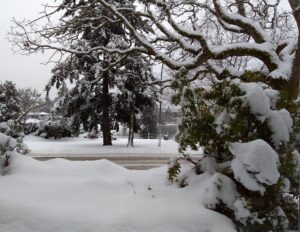
Christmas came and went – abbreviated by pandemic restrictions, but enlivened by snow, which after a couple of days of heavy shovelling became old fairly soon, particularly when accompanied by a polar vortex. Which was then followed by an atmospheric river, though happily not to the degree we experienced in November.
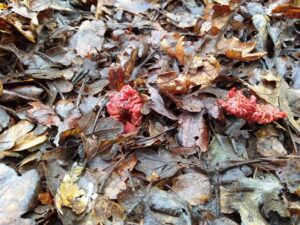
And then some signs of spring (rhubarb) to come, though it’s frozen and thawed and frozen and thawed since then. It will be a while until the soil is warm and dry enough to start planting anything. Meanwhile, I’m sorting and swapping seeds with neighbours and getting ready to plan this year’s garden.
In literary news, one of my poems, Tasting Dirt (all about compost!) appears boldly on the front inner cover of the current issue of Small Farmer’s Journal (winter 2021). Fascinating and one of a kind journal, lavishly illustrated, with lots on farming with horses and oxen, and all kinds of interesting detail on everything from setting up a binder to a report on the apples of New York in 1908.

Another poem, Hügelkultur, which happens also to be on a soil-amendment theme, appeared in the autumn issue of the long running UK literary journal Acumen, and was featured as a guest poem.

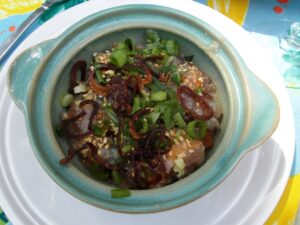
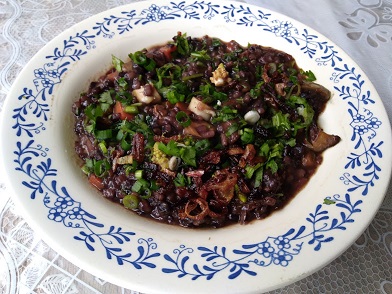
And finally, an update on the rice porridge post below, from last summer: I made some with black (“Forbidden”) rice and it was as delicious as I remembered. In addition to the spring onions, crispy shallots, cilantro, sesame oil etc, I added some winter broccoli and Romanesco florets, and fennel fronds and slices and a dash of gomasio. A perfect winter food.
Channel this!

I’m delighted to have a poem included in the current issue of the Irish environmental literature journal Channel.

The editors accept poems from around the world and have managed the question of how to celebrate each issue with a launch by inviting participants to record readings and some photographic context. Then they put it all together and livestream it!

I read two poems from my upcoming book Larder, and sent some photos which the editors invited us to provide, to give context to the contributors’ lives and environments.

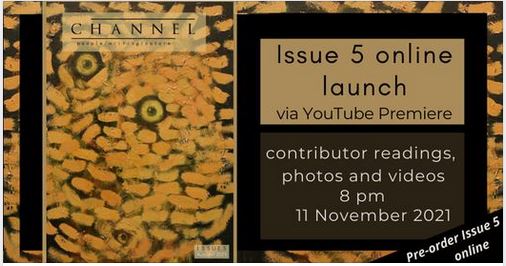
This issue is celebrated on Thursday November 11 at 8pm GMT – which for me is noon in Victoria. See you there?

(From the Facebook event page🙂

Details

We’re delighted to announce that the launch of Channel Issue 5 will take place via YouTube Premieres on Thursday 11 November at 8.00pm.

The online launch will feature readings by Irish and international contributors drawn from a pool of over 1800 submissions, along with photography capturing the settings that have inspired their work. We love the poems and stories gathered in this issue—ambitious, disruptive pieces that seem at home in the flux we’re living in today—and we can’t wait to share them with you all.

Also featured will be an introduction to the work of our Issue 5 cover artist, Kevin Mooney, a Cork-based painter whose practice explores the migration of Irish people and the gaps wrought in Ireland’s visual culture by this history of displacement. Kevin’s current exhibition, ‘The Erlish Tide,’ opened in the Excel Gallery, Tipperary, on 30 October, and features large-scale paintings informed by his research into the history, mythology and folklore of Samhain and Halloween. ‘Peasant,’ the painting featured on our Issue 5 cover, is taken from a body of work exploring links between the folk cultures of Irish émigrés and the cultures of the Caribbean.

Issue 5 is now available for pre-order via our website at https://channelmag.org/current-issue/.

Those who can afford to further support our work may consider subscribing to Channel to receive each new issue upon its release, or becoming a patron to also receive access to our digital archive of back issues as well as acknowledgement in print and online.

The launch video will be viewable from our website at the time of its release, or open the video in YouTube to chat with other readers and contributors during the event. We look forward to seeing you there!

The Future… and the Rice Porridge

I attended (virtually) the Oxford Symposium on Food & Cookery again this year, with much less time available to spend perusing the papers and attending the followup question and answer sessions, but it was delightful to spend some time with fellow food obsessives from around the world.

One of the keynote speakers this year was Rob Hoskins, founder of the Transition movement, speaking on “What is to What If”. I was much taken with his Rilke quote

The future must enter you long before it happens

which he used in the context of the power of imagination to make change in this world that so needs it. His talk coincided with the launch of the millionaire’s rocket and the inhumanity of that gesture in a time of such need.

“Capitalism sells us short term pleasure,” he remarked – together with all the social and personal perils that ensue when expectations don’t meet reality.

In a more grounded session, I got my hands dirty.. well, food-encrusted anyway, at a Kitchen Lab online workshop. Organized by Danish chef Birgitte Kampmann in Copenhagen and featuring a diplomatic chef in Ottawa, Cameron Stauch, we delved into several unusual ways with rice, inspired by Stauch’s cookbook, Vegetarian Viet Nam. Here’s my version of his delicious recipe for Mixed Mushroom Rice Porridge (Cháo Nấm) – well garnished with home made crispy shallots, toasted sesame seeds, cilantro and spring onions – which found its way that morning onto my brunch table… despite a momentary power outage in the midst of the session, which knocked out my modem long enough to miss a few crucial steps!

Joining the Poets Caravan

Some years ago, when I lived in central London, an Afghan restaurant on Baker Street called Caravan Serai was one of my favourite places. In one of those life coincidences, I’ve found myself on another caravan here in Canada.

For much of this year, the Planet Earth Poetry series in Victoria BC has been filming local poets reading their poetry in their chosen location. Poets Caravan is a project that maps the various locations using Google Earth; the texts of many of the poems are shown alongside the readings. The poems are also available on Youtube (without the texts).

Here’s mine from Youtube (click here for the Google Earth version – patience: it takes time to load). I chose to read at Haliburton Community Organic Farm where I’ve been volunteering since 2008. I selected poems suited to the environment I was reading from, which prompted the videographer to ask me if I was an entomologist! (Nope, I’ve just been spending time looking closely at what bugs me and my garden, heh heh.)

Most of the poems are from my new manuscript, Larder, which will be published by Caitlin Press in 2022. One (Vegetable Kingdom) is from my 2006 collection Cartography.

Life on Planet Poetry

Way back in 1988 I visited England for the first time as an adult. I had just published my second poetry collection, with a third on the way, and was keen to learn more about what was going on poetically in the UK. Before I left I got in touch with Mike Shields, then editor of the long running litmag Orbis, where I had had a few poems published. I asked if he knew any London poets I could meet, and he sent me the names Judi Benson and Peter Kenny, both of whom I met that visit and who both became longtime friends.

Towards the end of last year, Peter started up a podcast, Planet Poetry, with fellow poet Robin Houghton. Still fairly new, it charmed me from the outset with its straightforward approach; it feels like joining these two in the pub for a pleasant chat about poets they like, and what they’ve been reading and what they think about it.

So I was charmed to be invited into the virtual pub recently for a chat with Peter about long ago poems and themes of Arrivals/Departures. Hope you enjoy the trip!

Poetry & the Wild

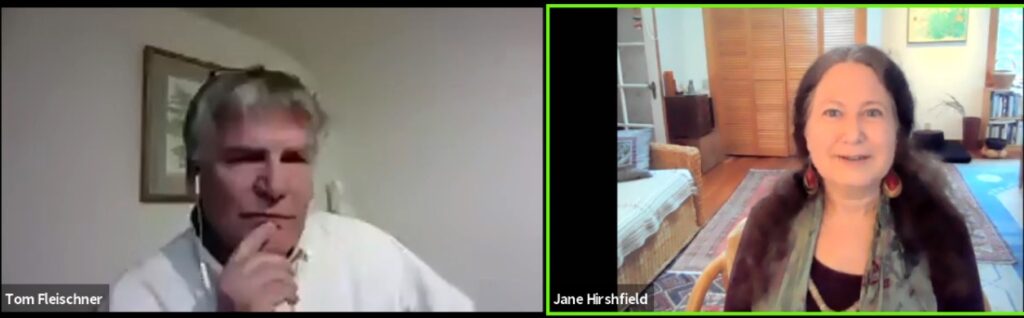
I attended a livestreamed reading and talk called Poetry & the Wild: A Reading and Conversation with Jane Hirshfield last Thursday. Hosted by Tom Fleischner, of the Natural History Institute, the conversation touched on poetry, Zen, natural history… whale trails, Poets for Science, climate change, and much more.

Hirshfield is a poet who’s embraced, or perhaps entered, the natural world more than many. Her Zen practice informed many of her observations. “When the self disappears, the self is happiest” she said, discussing the need to be open to observation in order to engage fully with the world. And citing Robinson Jeffers – “falling in love outward”.

She was asked, how does poetry help us? It’s thinking and understanding with the whole body, she replied. Poetry is a journey of discovery for her, as a reader and a writer. With all that is before us just now, she said, poetry can provide assistance towards a sense of resilience. It can help us engage with what feels beyond understanding — or simply respond to a curiosity. You want to be left changed when you read a poem, and “to find wholeness among the broken”.

When she asked in return why natural history? the answer was also zen-like: the practice of focused attentiveness to the more than human world; “the practice of falling in love with the natural world”, and an observation that natural history should be seen as a verb rather than a noun. And nurtures the deeper feelings about engagement with the world that poetry does.

Fleischner quoted Hirshfield’s own words: “Everything changes, everything is connected, pay attention.”

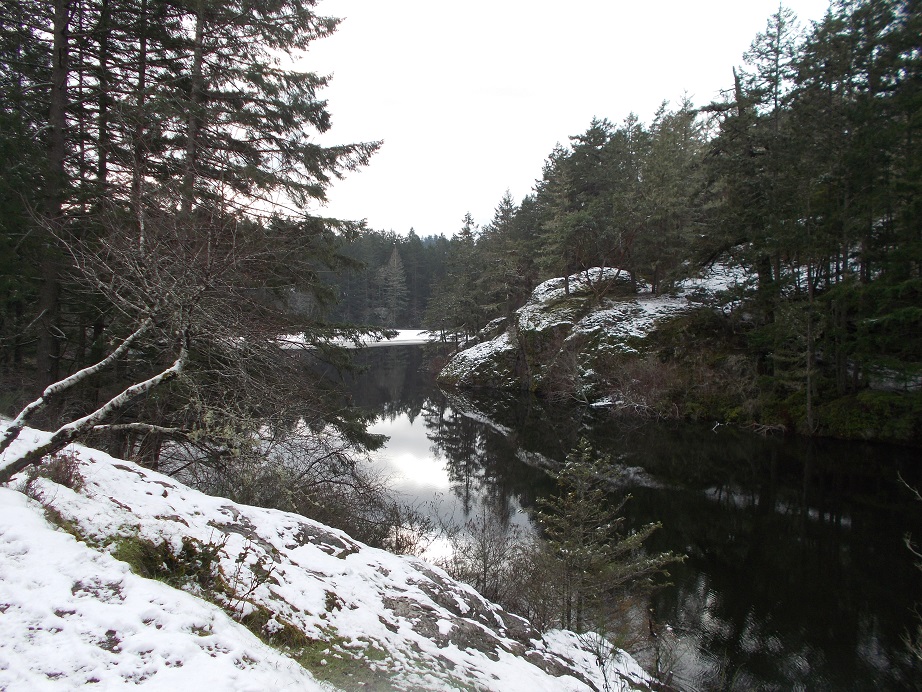
Thetis Lake Park, Victoria BC