Skip to content

Fry on Form and Anchovy Amnesty

A book that has, I’m told, not received the best of reviews lies open by my chair these days, and I’m enjoying it so far. The Ode Less Travelled is Stephen Fry’s guide to Unlocking the Poet Within. It’s a manual of metre, rhyme and form by someone who writes privately himself:

“I do not write poetry for publication, I write it for the same reason that, according to Wilde, one should write a diary, to have something sensational to read on the train.”

(If only we Canadians had trains to read on we might be better poets and diarists…?) He quotes Auden on the difficulties of writing free verse:

“The poet who writes ‘free’ verse is like Robinson Crusoe on his desert island: he must do all his cooking, laundry and darning for himself. In a few exceptional cases, this manly independence produces something original and impressive, but more often the result is squalor – dirty sheets on the unmade bed and empty bottles on the unswept floor.”

Lynne Rossetto Kasper has certainly produced something original and impressive in The Splendid Table, her 1992 guide to the cuisine of Emilia-Romagna, the Heartland of Northern Italian Food. Interesting and unusual recipes, including this pasta sauce (which I have only slightly tweaked) which she says comes from the cooks of Modena’s and Ferrara’s Jewish communities. It features a substance unfairly despised and misunderstood in North America: the amazing anchovy. Be not afraid, and you will be fed.

Lemon Anchovy Sauce (Bagnabrusca):
2 2-oz cans anchovy filets
1 cup cold water
6 tbsp extra virgin olive oil
1 large clove garlic, minced
1/2 cup water
2 large fresh tomatoes, peeled, cored and chopped
6 tbsp minced flat-leaf parsley
3 tbsp fresh lemon juice
Freshly ground black pepper to taste.

  • Rinse the anchovies and soak them in the cup of cold water for 10 minutes. Drain and coarsely chop.
  • In a 12-inch heavy skillet, heat the oil over medium heat. Add the garlic and saute until faintly golden but not brown.
  • Add the parsley and anchovies and heat briefly, 30 seconds or so. Immediately stir in the 1/2 cup water and cook over low heat about 2 minutes, until the anchovies melt (isn’t that the coolest thing??).
  • Blend in the tomatoes and lemon juice, raise the heat to medium, and cook 1 minute.
  • Generously season with black pepper and scrape the pan over hot drained pasta – tagliarini is recommended. Toss to coat. Sprinkle with a further tablespoon of chopped parsley and serve (without parmesan or other cheese).

Democratic poetry contest

Any of you out there seething with feelings of helplessness and impotent rage against competition judging… here’s your chance to set the world to rights. ChapterOnePromotions has an open poetry competition that you the voting public can judge. Just click on the ‘Open Poetry Competition’ link on the home page and make someone’s day, in the best possible way. Deadline for votes is July 15.

Festival and farmers’ market on World Cup weekend

A little more on the festival weekend. Every Saturday morning there is an excellent Farmers’ Market in Courtenay/Comox, conveniently placed right next door to the festival. So the minute we’d staked our tarp we marched ourselves over there to see what was on offer. There was a looong line snaking towards one of the several bakery stalls and I later heard it was all about the cinnamon buns. But I went elsewhere, and bought some incredibly good cheese bread, a fantastic pumpkin muffin and some durable vegetables for snacking on, including peas in the shell and cauliflower florets. This morning I came upon a clipping that’s been floating around my office for a while that says certain vegetables, particularly broccoli and cauliflower, are naturally abundant in the compound sulforaphane (SFN) which is believed to reduce the risk of developing hereditary cancers.

Back at the site, I was greatly amused by Todd Butler who hosted a Sunday morning workshop. Acknowledging they were up against the gospel hour on the big stage he said, thank God for atheists or we’d have no audience… Paul Reddick’s concert was well attended by a well baked Sunday afternoon crowd. One of them in a mellow stupour in front of me piped up at the end of Villanelle. Hey, he said, did you write that one? Yes I did, said Paul. Man, that was beautiful, said the listener… Sunday afternoon in the barn was hot in oh so many ways when the giant talents of the Campbell Brothers shook the pigeons loose from the rafters. As this musical mayhem was immediately followed by epic and ecstatic helpings of Los Rastrillos, the birds didn’t get much rest till much later… Crankiest moment of the festival came courtesy Jamaica-based Anglo-German punker Ari Up who dropped out of her scheduled workshop to feature herself in another and then tried to run overtime, and when that didn’t work she — um… the polite word is remonstrated I think, although her arguments appeared to have far fewer syllables than that — with the beleaguered organizers. I suspect she’s not getting a repeat invitation. Even if her mom did marry Johnny Rotten. (Well ya didn’t see Peter Yarrow‘s daughter or Joe Fafard‘s son behave that way. )

Charlotte and I slipped away midday to cheer with the Italians and weep with the French in the air conditioned comfort of the bar at the local golf club. It was harder than it should have been to find ourselves a World Cup venue (shockingly, we were two of only six footie supporters in the pub) and near impossible to find an authoritative start time for the match: there was not a newspaper in sight and I must have asked at least a dozen people at the festival (including the Information booth, the First Aid booth and a pair of homesick Ozzies working the Mediterranean BBQ kiosk) before a man at the Security booth said he’d heard from a dedicated soccer fan that the start time was 11:00 (PST). Cut no ice with the bartender who had looked it up and decided it started at noon, so we missed the first 21 minutes before he got around to switching it on. And of course with two goals in the first 19 minutes, that was tragically poor timing. Since it all ended I’m tapering off by checking at intervals for breaking news of What Materazzi Said To Zidane To Make Him Do It.

Festivalia on the Island

Just back from a weekend sitting on the cold hard ground, alternately sheltering beneath waterproofs or burning under a too-hot sun, having my eardrums blasted by massive speakers, my sensibilities overwhelmed by fried foods, cold drinks and new music. Yes, it’s festival time again. I was drawn to hear our local wonder Eugene Smith, poetical blues guy Paul Reddick and the always interesting Steve Earle, but a couple of new (to me) standouts this year included a ten-man Mexican reggae epiphany, Los Rastrillos, and Jon Voigt’s musical brother Chip Taylor (songwriter of Wild Thing and Angel of the Morning) with fiddlin’ singer Carrie Rodriguez. Favourite festival food was cheese and potato taquitos from Tita’s – served with Oliva’s salsa (smooth and dangerous: tomatillos, avocado, sour cream, jalapenos).


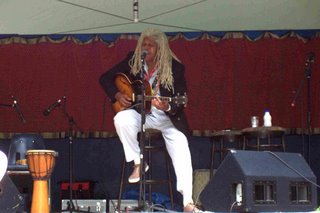
Eugene Smith


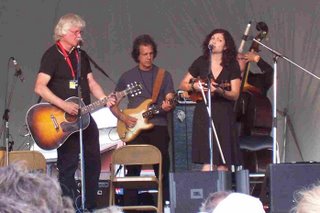
Chip ‘n Carrie


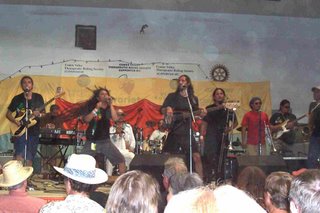
Los Rastrillos

Prior to departure I had to say a sad farewell to my fluffy lodger Boris who has gone back to hang out with his fellow furbies at Animals for Life, dreaming no doubt of the pleasures he found in Anton’s dog dish (and Anton well pleased to be rid of him). With his charming white socks and endless frisk I’m sure he’ll be among the first to find a new home.

Not talking about poetry and not eating oysters

I enjoy talking prosody or fine technical points in the context of a workshop, but otherwise I’m not a one to want to discuss poetics with all and sundry. On this matter I was glad to find a kindred spirit in WS Merwin, who made a few seemingly timeless points when his 1956 collection Green With Beasts was made Poetry Book Society Choice:

“I don’t usually like literary conversations, though I deeply enjoy talking with writers other than poets about the practical side of getting things written. I like talking with some people about particular poems: though I think that in such conversations all I usually do is to try to describe a quality that excites my enthusiasm in a poem. I do not like writing about poetry… Above all I do not like trying to generalize about poetry…

…I think that one of the dangers of modern poetry has been a tendency to become inbred. Its small audience enhances the danger. It even seems possible for some poets to write as though critics, even particular schools of critics, were a fit and sufficient audience for poetry.”

He then makes

“one of the few general statements I feel safe in making about poetry. It is a mystery. It is a metaphor of the other mysteries which comprise human experience. But, like some other mysteries, it gives us a feeling of illumination – one mystery giving us a name by which to know another.”

I’ve been feeling some illumination from reading a collection of writings by MFK Fisher called The Art of Eating. Her prose is exquisite. In The Well-dressed Oyster she begins, firing on all cylinders and out of both barrels:

“There are three kinds of oyster-eaters: those loose-minded sports who will eat anything, hot, cold, thin, thick, dead or alive, as long as it is oyster; those who will eat them raw and only raw; and those who with equal severity will eat them cooked and no way other.

The first group may perhaps have the most fun, although there is a white fire about the others’ bigotry that can never warm the broad-minded.”

One suspects her allegiances lie with the second group.

“..almost every oyster-eater who does not belong whole-heartedly to the third and last division, would die before denying that a perfect oyster, healthy, of fine flavor, plucked from its chill bed and brought to the plate unwatered and unseasoned, is more delicious than any of its modifications. On the other hand, a flaccid, moping, debauched mollusc, tired from too much love and loose-nerved from general world conditions, can be a shameful thing served raw upon the shell.”

At least we have her words to savour, in lieu of a leisurely oyster harvest on the beach, since red tide has robbed us of some of our summer fun.

Poetry family trees and brassica subspecies

Something else of interest from the Poetry Paper I mentioned earlier, a feature called The Poetry Family Trees. Featured poets – just-appointed US poet laureate Donald Hall, Sinead Morrissey, Michael Symmons Roberts, Lorna Goodison, Adrian Mitchell – were asked the following questions, which are interesting ones for all of us to keep in the backs of our minds.

  • Which ‘family tree’ do you think you belong to as a poet – which poets do you recognise as your precursors?
  • Why do you like these poets and what do you value them for?
  • The first poem/poet that made an impact on you. When and why?
  • The next book by someone you’re most looking forward to?
  • How much time do you spend reading poetry in an average week?
  • And what proportion are contemporary/from earlier centuries?
  • What else do you read?

Continuing with the many-named vegetable theme, here’s another one for you: Chinese cabbage. I’m in favour of going by the Chinese simplified name, “Large White Vegetable”. But if you want to do a closer identification, we’re talking Brassica campestris, aka Brassica rapa – subspecies pekinensis, Che-foo type. You may also encounter it as: wong baak, won bok, wong nga bok, da baicai, pe-tsai, pai-tsai, pechay, or nappa, napa, Siew Choy/siu choy, tsina, kubis gna, hakusai, celery cabbage and Peking cabbage; some of these names might attach themselves to another category of pekinensis – Chihili type – which is greener and leafier. We are gravely warned against confusing it with another Brassica subspecies – chinensis – better known as bok choy or pak choy and is also called Chinese white cabbage, Chinese mustard, white mustard cabbage.

A good source of vitamin A, this vegetable – let’s call it Chinese cabbage – has been grown in Asia since the 5th century, and in North America for about a hundred years. It forms the basis of the Korean wonder-food Kimchi (yum!). It is a wonderful salad vegetable owing to its tender, juicy, mildly spicy flavour. The best ever quick salad meal, which I first had in someone’s home in Prague of all places, is:

About 2 cups Chinese cabbage, in 1 inch chunks
3 rashers bacon
1 clove garlic
1/4 lemon
1/4 cup good olive oil
Cook the bacon; cut in 1 inch pieces. While you’re cooking the bacon, mince or press the garlic and toss it with the cabbage. Toss in the bacon, squeeze the lemon and drizzle the olive oil. Grind a bit of pepper over it all if you must. Mix fleetingly and eat hungrily. Speak to no one you haven’t shared this with – at least until the garlic subsides.

There is something ecstatic in this meal for me: the collision of hot salty bacon with crunchy cold cabbage, the tartness of the lemon and bite of garlic. And the trusty olive oil doing what oil does: dispersing all those discrete flavours across the tastebuds