Skip to content

2011

Vancouver’s urban farms

Time, food and agriculture never sleep, at least not where interesting stories are concerned.

There’s a link here to a rather beautiful brochure  shows that shows you who’s growing what and where in twenty-six urban farms in Vancouver.

And a nice story about the loneliness of the the farming life which I suppose applies to urban farmers as well; it offers a reminder that we are often in too much of a hurry, and too accustomed to shopping anonymously for food, to thank those who provide it.

And some good news for Victoria food shoppers, with a new whole/local foods store opening, conveniently situated near the wondrous Capital Iron.

A wrist-slapping lesson in public consultation for Stephen Harper whose decision to bring to fruition his longtime plan to dismantle the Canadian Wheat Board was declared illegal by a federal court.

And an opportunity for British Columbians to participate in a public consultation on a province-wide ban on cosmetic pesticides is open until December 15. Anyone who cares about the continuing health of honeybees and other wild pollinators, other species in the food chain/eco system, as well as pet-owners and parents should take a moment to speak in favour of this ban.

The soil is the thing: the EU Soil Report warns about what the soil Soil: Worth standing your ground for from The European Environmental Bureau

London eating

It’s been quiet here at the Iambic Cafe lately, but only because I’ve been so busy frequenting a few of London’s eateries and drinkeries.

Last week for example I made a joyful visit to Ottolenghi whose pastries look as beautiful as ever; the salads (shaved fennel, roasted aubergine and roasted sweet potato) were exquisite. I’d also heard that the Devonshire Arms was worth a visit, so I popped in for a bit of smoked eel and a most delicious mixed salad and will have to make a return visit soon.


On Thursday I spent a happy evening swanning around Covent Garden with several thousand other merry-making shoppers, lapping up free drinks and hors d’oeuvres at shops participating in a seasonal shopping promotion. At the end we found ourself a cozy bench at Cantina Laredo, which promised gourmet Mexican food. The guacamole, prepared at our table, was fun, and the avocado enchiladas were wonderful – full of artichokes, rice and avocado.


Friday I went to the movies with Nancy and Mike and we wandered Lamb’s Conduit Street in search of nourishment. It was my second visit to La Cigala and although it was good I did sense a few standards slipping (along with a couple of plates in the kitchen). In the chickpea and chestnut stew, for example, I may have found the only rancid chestnut (Mike said the rest were fine), and Nancy – and the pair at the adjoining table – who had the goose stuffed with pork and prunes and served with roasted parsnips, found it tough. Good, but tough. Not, she remarked, what you want with a goose.


I was happy enough with my trio of starters: boquerones – marinated anchovies – with a nice vegetable salad on thinly sliced jerusalem artichokes; a towering tortilla; and padrone peppers. As is the custom there, we did a little celebrity spotting while desserting: meringue with prunes, a stunning orange flan, and a mountain of membrillo (poached quince) with an alcoholic dollop of cream.


And I had a lovely Neopolitan pagnotella – “sandwich” – at Canta Napoli – just flatbread, tomatoes, mozzarella and basil.

Poetry, quince & marmalade

As was foretold, I attended Poetry in the Crypt on Saturday, which expedition yielded these three treasures: a bilingual book of poetry by Stephen Watts & Cristina Viti, fresh off the press; a giant quince, fresh off the greengrocer’s stand; and a jar of lime and lemon marmalade, fresh from Liz Salmon’s jam kettle. The readings were good, the company full of fond familiars, and the tea and cakes most welcome. I had made a sticky ginger cake which I brought along to help with the offerings.

On Sunday we went to see the Group of Seven exhibition in Dulwich. And my goodness what a lot of people came likewise, and what a LOT of paintings were on show. “Can there be any left in Canada?” wondered Meli. Ironies not lost on me that I should travel half a world to come and see paintings by my countrymen that once inspired in me only gloomy associations with gloomy reproductions on the classroom walls of my youth. I liked many of them better in their current settings, but I find it can be harder to love what one has rubbed up against all one’s life than what might be new and exciting and from away. And I haven’t the distance to view it with new eyes. But I’m glad to have gone, and seen more of these paintings than I had, and learned a bit about them, and walked the still-leafy streets of Dulwich where once walked the schoolboy Ondaatje.

It was nigh on teatime by the time we finished, and so we stood around on the platform at South Dulwich admiring the view until the train arrived  and then once back in Central London ambled across the footbridge from the Embankment to the Southbank Centre which is hosting a Christmas market, which was thronged. It had a lot of stalls selling everything from churros and sausages and ostrich burgers to Peruvian knitting, wooden knick-knacks and jewellery that, luckily for my finances, I found of little interest. Though luckily for the traders, not a view that everyone shared as many were very busy – notably the ones selling a fairly foul-smelling Glühwein.

We stopped for a bite at an Italian chain outlet, where I twice sent back my pasta with melanzane which was, twice, badly undercooked (this is why eggplant/aubergine has had such a bad rap, imho: I’ve found only Indian restaurants seem to reliably understand how to prepare to the correct texture this most delicious vegetable)(–tho botanically a fruit, of course). The manager was most understanding and said he agreed with me and would have a word with the chef and offered us a drink and dessert in compensation. But right at the next table I watched someone chew his way through a bowl of the stuff without a whimper. If he’d had a shred of awareness about what he’d been eating and didn’t realize how foully abused it had been he should have gone home grumbling about how he doesn’t really like aubergine and vowing not to order it again.

After a soothing inspection of the offerings at Foyle‘s we wended our way back across the footbridge and into the underground and home to our beds.


More quince, more poetry


There’s a very nice greengrocer on Turnham Green Terrace, whither my yellow friends have followed me. These quince are enormous and flawless, the size of grapefruits, a world away from the lumpy lemon to orange-sized treasures I was working with in Victoria.

I’ve been in London a bit less than a week and have so far had one lunch at Carluccio‘s, taken in one reading (Tamar Yoseloff and Katy Evans-Bush, at CB-1 in Cambridge) and made one visit to the British Library. Tonight I’ll be in Islington attending a great big reading at Poetry in the Crypt (Stephen Watts, Cristina Viti, Ales Machack, Jane Kirwan and Jane Duran).

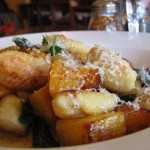
When in Cambridge, I supped with the poets at The Punter, where we passed on the Movember blackboard special: lamb fries. Instead, I had gnocchi with roasted pumpkin and “frazzled sage,” which came in a creamy pumpkin sauce and was rather good. My second such dish in a few weeks, as I’d had a similar one (without the creamy sauce – instead pan-fried in clarified butter I’d guess) at La Piola before I left Victoria.

Quinceaholic

Quince, coing, membrillo, mela cotogna, safarjal

Those who have been tiring of my obsessive ravings about quince recipes will be pleased to know I have not touched a paring knife for about a week now. I had been blessed this year with a large quantity of quince– which I did my best to whittle my way through before abandoning a last box to others and disappearing off to England.

Before I left I tested just about every recipe I had time to try, both sweet and savoury. Here’s a recap of some of the ideas I checked out, including those already mentioned in an earlier post.

Quince jelly is, of course, just about the best thing to do with quince. Beautiful, aromatic and delicious. But I didn’t make any this year, at least none that set properly. Instead I used some of the unset jelly (or quince syrup, we’re calling it) as the base for oven-poached quince, which was gorgeous. Three hours in a slow oven turned the fruit and its syrup (flavoured with orange and vanilla, or lemon) ruby red. It also helped the fruit remain firm enough to can for future use, in a quince sticky cake, for example.

I know that many people faced with a quantity of this fruit immediately think of quince paste (membrillo). I have made my share of this tangy sweet which takes a cheese plate to new heights. But not this year. I have learned that there is only so much quince paste one really needs in one’s life, and it can be tricky to hand off to others as it can’t just be stuck in a gift box, but needs to be refrigerated and dusted with sugar before serving. When it’s been stored for a while, it has a tendency to drool a glorious puddle into its dish, as messy as it is delicious. And sadly, it does not keep forever, though it can last several months in the fridge.

This year, I’ve been browsing some savoury dishes. Lamb tagine with quince is a popular one, as quince has a subtle flavour that pairs well with lamb and is popular in Middle Eastern cooking. Quince soup comes in many varieties: with sweet apple cider and dates; with kabocha squash and Thai spices; with celeriac; and with plum wine and chocolate crème. Pumpkin chestnut risotto with quince sounded wonderful – but also like rather a lot of ingredients competing for attention.

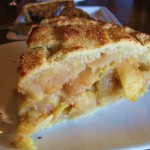
Quince dessert recipes are quite numerous (particularly in French) but quince clafoutis seemed to be one of the most popular. A quince and apple pie that I was lucky enough to sample at La Piola was wonderful. Cakes include an upside-down, one with almond, a pudding cake and a sticky quince & ginger cake.

Scallops, poetry and lots of SPIN

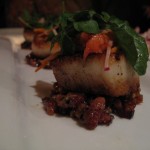
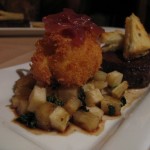
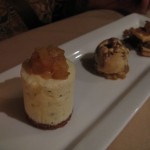
It’s been quite a week. Tuesday I enjoyed a meal at Camille‘s which was very nice food, very nicely served. Starters included some gorgeous scallops, sporting leafy hats and nestled on a bed of bacon. A nice bit of organic beef came with a curiously delicious egg that had been poached and then deep-fried and made to feel crisply oriental. And the apple dessert trio – kaffir lime frozen ricotta the highlight – outclassed my caramel pot de crème with apple foam, but we shared. And the wines were wonderful, particularly the apricot-raisiny delights of the Pentâge Late Harvest dessert wine, dessert wines being one of my favourite things.
The Malahat Review is another of my favourite things, and its Fall launch reading at The Well was jam-packed with literature lovers. I must say I’ve seldom enjoyed a reading more. Attentive and large audience, talented and entertaining fellow readers, nice ambiance. And some rather good salt and vinegar kale chips, which in their clear plastic baggie rather gave me the appearance of a purveyor of puff than an advocate of antioxidants.

Anyway. I was up first, followed by Julie Paul reading a tantalizing beginning to a short story; then Richard Osler in good poetic form, Tom Wayman in passionate voice dedicating his first poem to the Occupy people, and Zoey Peterson sending us home to contemplate his delightful prize-winning story.

Thursday night at Fernwood Community Centre I’d guess there were nigh on a hundred of us gathered to hear Curtis Stone, the cycling SPIN farmer of Kelowna. He gave a terrific talk about his business and a great preview of the three-day workshop he’ll be leading in April.

When he started Green City Acres, he had no farming background at all – just nine years of tree planting and a great love of cycling, and so he took himself on a tour of urban farms in Canada and the US to see how urban agriculture was being done. He learned his trade from the manual sold by Wally Satzewich and Gail Vandersteen’s SPIN farming enterprise, and through a couple of years’ trial and error. And has emerged as a generous and enthusiastic teacher-farmer.

In his first year of operation he made about $22,000 and worked 16 hour days. “Like you would for any startup small business,” he says. This past year so far he’s pulled in $60,000 from the three quarters of an acre he farms – spread across half a dozen backyards. With a partner helping ease the load this year he’s been working 50 hour weeks – and adds “most of our time is cycling.” On their bikes they pull custom-designed trailers piled with tools, compost, produce, even bales of hay and a small rototiller. His startup capital costs were around $7,000 and he believes it’s possible to make $100,000 an acre.

He tills lawns in three stages to kill the grass and give himself time to test the soil for clay-sand ratios and pH level, so that he knows what amendments to use to boost its fertility. He gets food waste from restaurants and composts prolifically for his production which is organic but not certified. His first plot was a needle-strewn wasteland with poor, contaminated soil which he had to fill and remediate. He says the drug users who used to shoot up on the property still come by there, but now they come to look at the garden, which is flourishing.

He thinks that the scattered fields of SPIN farming offer a lot of advantages, as plantings are spread between different microclimates, soil conditions, light conditions, biodiversity (weeds and pests) and land configurations, so if one row or crop is lost, chances are that the other plots – all planted in standard 2″ by 25″ beds – will be ok. And growing intensively on such a small scale offers other advantages: SPIN farmers can grow a wide variety of produce in small amounts, much  closer to their market than rural farmers; they have a much smaller capital outlay – hand tools and small machinery; and because they deal directly with their market (CSA, restaurants or farmers markets) their profits stay in their own pockets.

Stone is a big proponent of CSA programs, which he dubs “modern crop insurance” as it spreads the risk of growing between farmer and consumer. And the customers are well served too, by eating food that is extremely fresh, very locally grown, by someone who lives and works in their own community.

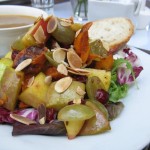
On Friday, I escorted a veteran to the cenotaph in Duncan and was rewarded with lunch at Bistro 160, which was chanterelle soup and a very fine roasted yam and apple salad. The fuel was needed to tackle the very large quantity of leaves that had blown up my driveway on that stormy day: gifts from the gods of mulch, to be enjoyed by my garden beds (and a whole new generation of slugs, I’m sure) over the winter.