Skip to content

poetry readings

Liking London

A week or so ago I attended a reading by Ekstasis authors, in celebration of the Pacific Rim Review of Books. Richard Olafson introduces…

Among others, our excellent Saskatchewanian Glen Sorestad read, and so did the wondrous Yvonne Blomer.

I’m enjoying the bee-keeping course a lot. Here’s how you wrap up your hives and throw them in the back of your truck to take them for a drive. If you listen closely you can hear them hum…

And now, here I am on the other side of the pond once more. I arrived yesterday and after a reviving nap and shower bustled off to the Olivier to catch Much Ado About Nothing, which was nothing short of awesome. Zoe Wanamaker, Simon Russell Beale and everyone — all wonderful. Sets, staging, music, dancing — all wonderful, wonderful, wonderful. I laughed, I cried, and I particularly enjoyed the reaction of the many school kids in the audience, who hooted and hollered and clapped upside down and backwards at the end.

I settled in that evening to a gorgeous box of booty from Ottolenghi roasted aubergines with braised shallots, coriander, chili and green tahini; roasted beets with sunflower seeds, chard, chervil and maple sherry dressing; some soft, tasty new potatoes in mustard sauce; and a couple of slices of char-grilled fillet of beef with dijon mustard, coriander and honey sauce. With a glass of Barbera to wash it down. Looks like I will just miss the publication of Ottolenghi’s new cookbook, but we can still catch some great recipes in the Guardian.

Carrie has sent forth the challenge to participate in NaPoWriMo over April (National Poetry Month) which sounds like an excellent idea. We poets can show those novelists what’s what, eh?

Sweet Mama, what a week

Not a monumental one, but a week in which food and poetry converged at last.

Some good food coverage on CBC, including a week on hospital food, a whole series on food issues in the new India, and an interview with Michael Pollan.

I spent one morning of slashing rain interspersed with bright sunshine driving up the Saanich Peninsula to my favourite grocery stop, Michell Brothers Farm, where I loaded up on leeks, tubers, squash and other winter vegetables. Then on to Dan’s Farm Shop to pick up a Farmer Dan’s Chicken and some organic chicken sausages, and then home to puzzle over my bounty. I had some leek & yogurt soup with dried mint, (using a broth made of my last Farmer Dan’s Chicken) which was fabulous and just as I remembered it.

I am looking forward to eating the Sweet Mama squash which Michell’s grows. My clever cousin, who had encountered it first in New Zealand where they ate it with roast lamb, told me to slice it into wedges and roast it, with or without other vegetables or a Sunday joint, which I have been doing – it’s wonderful, including the skin, very sweet and moist. Michell’s sells both Sweet Mama and Buttercup which looks almost indistinguishable, which got me to wondering about it.

Apparently it is a kabocha (Japanese pumpkin) variety. It can be cooked in Mirin, soy sauce and broth and if you ignore the advice about skinning it, eaten whole that way, a very waste not want not recipe, or you can make it into soup – though you’ll probably have to sacrifice the skin (thinner and more tender than most squash I’ve found, and also tasty) for aesthetic reasons. You could also use it in a pumpkin risotto.

The bad news for growers is that it’s a hybrid and according to at least one source, can’t be grown through seed saving.

I went to Planet Earth Poetry last night, for the first time since my return. It was the first reading of the new year and the place was heaving with youth and energy. There was a lengthy open mike, of good standard – including Linda Rogers, Barbara Pelman, Yvonne Blomer and Pam Porter – all of whom recently had Christmas poems in great big pages of the local paper. Then as ever the young scamps who’d just come to read or hear their buddies in the open mike disappeared and paying seats opened up for the main acts. Sina Queyras flew in from Montreal and young performance poet Martin Hazelboweer paddled over from Vancouver. Queyras had a satisfying revenge poem, The Tummy-Flat Girls, about some of her more resistant ex-students; it showcased well an interesting poetic quirk, a kind of list form (or ok, let’s call it anaphora) which seems to feature in pretty much all her poems.

Going, Going…. Here!! Leah’s Lovely Launch

Wednesday night was a long-awaited moment for the amazing Leah Fritz and her many friends and fans, when she launched her first collection for 8 years. Going, Going saw its debut in the company of loyal followers at the Barbican‘s very smart library

(we are a public library so come and use it! said librarian John Lake during his introduction). Fighting my way past the paparazzi,

…I enjoyed a glass of wine and a few crisps with a passel of poets (including at least one with a forthcoming collection!) before taking my place in a comfortably full reading space.

The publisher was there selling copies of this beautiful hardcover,

and after a reading by Allan Brownjohn and one by Leah herself,

there were books to be signed and wine to be drunk. As for me, I had an early morning date with destiny, or at least a mini-cab, so I slunk off right away so I could catch my 39 winks.

Food Food Poetry Poetry

I braved the pelting rain to get to the Restaurant Show at Earl’s Court last Tuesday, where I saw lots of stands – including some small food producers I’d been learning about while working on our food producers’ database (which launched on Wednesday, yay!). It was lovely to meet the people and taste the food I’d been writing about. I then sat myself down at The Stage and watched some cooking demonstrations. The first was from Barny Haughton,
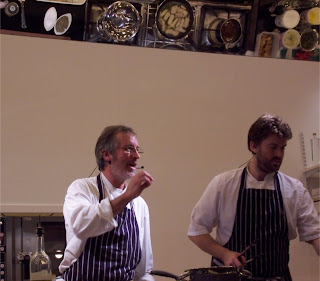
who talked about sustainability in the commercial kitchen: inviting people to use less popular, cheaper cuts of meat – if we’re going to be carnivores it’s more responsible to use the entire animal, which is a theme I’ve been hearing for some time – and sustainable fish varieties. He was followed by like-minded Cyrus Todiwala,
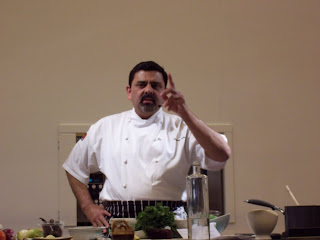
who was speaking on behalf of the Greener Food project. He’d been sent a big box of locally-raised, seasonal vegetables and told to make something of them. His beetroot with coconut salad was terrific, as was everything else he made. We were as heartbroken as he that he didn’t have time to make us his pigeon curry…

Then Ian Pengelley, another London chef, took the stage – by this time things were running very late and it got a bit chaotic. His aim was to show us how nicely champagne went with Asian foods, so we got to try a bit with some Thai beef salad, some sushi rolls and some seared scallops. And sure, we agreed! All very nice.
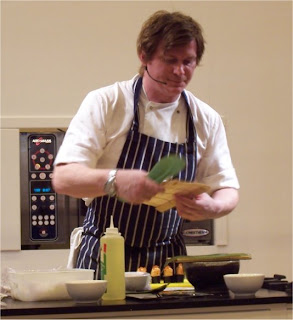
His sommelier was very entertaining – giving us a finale show where he decapitated the last bottle by strategic use of the base of a champagne glass. Definitely not one to try at home.

Then I had a couple of evenings to catch my breath before Friday’s Les Murray reading at Senate House – certainly one building that can accurately be described as neo-brutalist. This grey edifice loomed ahead of me in the dying light, and I sensed trouble ahead as I sought the room which my note to self said was “3rd floor Senate North”.

I entered from a sort of westerly door, I thought, so turned left, looking for north. I found a lift just around the corner, with a notice posted about talks and lectures — including the one I was after, so without anything more to go on, I entered and ascended to the 2nd floor, which was as far as this one went.

On the second floor there was another lift that went up to the 4th floor, but there was a 3rd floor button as well, so I pressed that and pushed my way out through a crowd of students to find myself on a near-deserted floor, where the only open door was to some special library – ancient civilisations or something, with an ominous No Exit sign on the entry.

Not a soul around, so I lugged myself and the bag I was escorting up to the fourth floor, where I found the crowd of students from the lift forming a lengthy queue for library card renewal. Beyond the security gates (only passable by library card holders of course) I spotted and hailed a friendly looking woman in a name badge who told me I wanted room N336. She told me to get back in the lift and go to the ground floor, along the hallway to a different set of lifts.

So back I got in the lift and descended to the ground floor where I found myself facing another set of card-operated barricades and a silver-haired defender of.. of.. whatever it was he was defending seated behind what I’m sure must have been a bullet-proof glass window. He told me I shouldn’t have come to the ground floor in this lift and that I should go back to the third floor as he presumed I was a member of the society for ancient civilisations or whoever it is who lives up there. No, I said, I was looking for the poetry reading in room N336. He said he knew nothing about a poetry reading or any such room, and couldn’t tell me whether I was actually in the north tower or not. After admonishing me again for coming down in that particular lift, and reinforcing his point that this was not an exit, he let me exit through the gate and I was back in the main hallway ready to search out the next set of lifts.

Which I found and ascended to find a big classroom with two doors (one marked 336 and the other 336A) but no other indication there was a reading there. I entered and found a bookseller setting up and three others sitting in wait, which seemed a bit sparse since it was only ten minutes to the reading, but down I sat. The room did in fact fill up nicely by the start time, and Les Murray started his reading. For the next hour, we were entertained by his poems and by the periodic rattling of the door knob closest to the reader (on the door labelled 336, in fact) followed by the covert entry of latecomers through the other door. There followed a wine reception and then it was time to slink off into the night.

I made a nerdy list of the poems he read, and here they are; rather unkindly he read from the Australian edition of his collected poems, so those who rushed the book table afterwards were not always able to find their favourites, but he sold quite a bit and did a little friendly book signing. I was happy he started us off with a food poem, and I liked (and remembered from past readings, I think), his cow poem, which he introduced by saying it was one of his favourite animals, and that he thought he was one of the few real Hindus of Australia. It was a poem from the point of view of the cow, which he observed is a ‘collective creature’ and thus difficult to find a pronoun for.

Beanstock Sermon; Glass Louvres; Words of the Glass Blowers; On Removing Spiderweb; Arial; Cows on Killing Day; Cell DNA; Contested Landscape at Forsayth; The Shield Scales of Heraldray; the Moon Man; Judged Worth Evacuating; Clothing as Dwelling as as Shouldered Boat; Visitor; Jellyfish; Reclaim the Sites; To One Outside the Culture; Melbourne Pavement Coffee; On the North Coastline; Me & Je Reviens; Japanese Sword Blades in the British Museum; The Mare Out on the Road; Birthplace; Sunday on a Country River; and then he finished with a few new poems.

Poetry poetry poetry

Sunday was another one of those floor-to-ceiling poetry readings, with 10 on the menu. Luckily two were unable to attend (a third likewise but she’d enlisted her sister to read in her place) so it was a little shorter than it would have been otherwise.

I’m sure I’ve moaned about this style of reading before; it is, I feel, far too common in today’s poetry programming to attempt to squeeze as many poets as possible into a single event. The reading turns into a marathon, and the one or two you came to hear are lost in the numbing volume of the whole. You don’t get enough of the ones you want to hear, and perhaps you hear too much of those you don’t. And everyone else just doesn’t register.

Magazine launches – where 5 or 10 people come and read a poem they’ve had published in that issue, with perhaps one other – are one thing, and I’m ok with them as long as someone keeps the readers moving along (when faced with a long list of readers, the eye of the audience turns naturally to the clock).

But on Sunday, we were at this particular two hour event to hear a few minutes each of 10 first collections by 10 different readers. Another problem I have with these events is that the readers are introduced in volume, and if you aren’t familiar with them, as I mostly wasn’t, by the time you’ve heard the list of credentials and the readers take the stage you lose track of who of the five poets this half you’re hearing and what their background is. None of them thinks to say their name, or give the bridge into their work as a well composed introduction is meant to do. I’d rather each poet were treated with singular dignity – introduced one at a time, giving the audience a moment to change gears – instead of being bulk processed. There, that’s my rant done for today.

We did have an impressive list of readers, and – my grievances aside – I can totally understand why these 10 readers were chosen to celebrate the Poetry School’s 10 years; the numbers have a nice symmetry and you don’t have to narrow what must be an enormous list of achievers down quite so much to a more manageable number.

Here’s the list: Chris Beckett, Melanie Challenger (represented by her very able sister), Claire Crowther, Helen Farish (not present), Martha Kapos, Sharon Morris, Roger Moulson, Daljit Nagra, Anne Ryland, Greta Stoddart (not present). A new poem of Stoddart’s, called Drawing Breath, did take my breath away, but with my increasingly taxed powers of concentration I confess that was the only poem I heard that stays with me. And it’s not the fault of the readers or the poetry. I guess I needed to pace myself better. Live and learn.

Next up was a more manageable one-man show, by CK Williams, who led us through umpteen drafts of one of his poems. Fortunately he didn’t bring all 255 versions of this single poem (actually I don’t think 255 was the final count, more of a midpoint) which changed title several times, shape certainly, and whose themes shifted in and out of focus while he tried out different images, many of which he was so fond of he got new poems out of them. There followed a good substantial Q&A; session hosted by Fiona Sampson. One of the last questioners asked for advice about how to – as he’d put it (quoting others) – create the poet who was to create the poem. His answer was simple: read poetry. But not everyday stuff, he added: read great poets.

Well. That was good. Then Monday I wandered over to the Troubadour which has changed so much since my day. Today’s Troub is a young noisy place. Well groomed couples were canoodling over their two-for-one happy hour cocktails (cocktails??) to the sounds of Bob Marley. The dark wood twosome booths are mostly gone. The place is twice as big now they’ve knocked it through and put in a deli next door. There are semi-integrated toilets where the genders meet around a big round sink and take turns watching the skin on their hands flap in the high power wind of the hand dryer. Nothing so new here, really. It’s been like this for a few years, but I sat and really looked at it for a while on Monday.

The most shocking change is the basement, where the poetry happens, and which I reflected I’ve now seen in three incarnations. The first, which I remember from circa 1988, was a dark, smoky room with a blanket hung over the door at the bottom of some steep steps; on poetry nights it seemed to be always dim and full of random crazies. The second was a cleaned-up version with a small stage, but a door down from the kitchen that sometimes opened inopportunely, and a guaranteed interruption by emergency siren on the road above at least once in every reading. Now we have a big L-shaped space with odd little private rooms out of sight of the stage that are – in poetry readings at least – never used. And a bar, so you don’t have to rush upstairs at the break for replenishment. And quite a few benches or chairs with backs nowadays, not just back-breaking stools.

The poetry programming has put on a little heft here too: no more one- or two-poet nights; four readers shared the stage on Monday. The star turn and concluding reader was CK Williams, whose Collected Poems is a serious doorstop not realistically in the purchasing (or more accurately carrying) range of a migrant like myself. Roz Goddard, Birmingham’s Poet Laureate, read first; then a southern voice, Janice Moore Fuller; then Brightonian Jackie Wills.

Culture, culture, culture and a little bee bim bap

It’s been a pretty poetic week all in all. Monday evening I went to the South Bank to see Sean O’Brien and Ian Duhig read. I’d been admiring O’Brien’s latest, The Drowned Book, for the past couple of weeks, so was happy to hear him in person, and it turned out to be an auspicious week for him, winning his third Forward Prize a couple of days later. Ian Duhig won me over a couple of years ago with his wonderful ode to string vests, from The Lammas Hireling, and he gave an entertaining and eccentric reading from his new collection, The Speed of Dark.

Tuesday we went out to Troika, which I hadn’t visited for years, and ate too much (thanks for the cheesecake, Howard).

Wednesday I had a day off while I shifted myself to the next charitable bed, in lovely leafy Turnham Green.

And Friday was a start-to-finish day of culture, with some bee bim bap in the middle. I got to the British Museum, despite a painfully slow District Line, in time to collect my ticket and timed entry to the Terracotta Army exhibition. It was a great show; someone had told me the soldier count was only 17 figures (of a possible 7000) but the selling point – getting nose to nose with those present – was convincing, and it was a good thing to see as it’s been widely promoted and will be much talked about.

It was called The First Emperor, and was intended more as a briefing on the life (rather short – died at 49) and times of China’s first emperor, Qin Shihuangdi, and what had led him to have the army – plus civil servants, acrobats and musicians (perhaps they haven’t found the chefs yet) – and his still-buried tomb created on such a scale. Protection, company and entertainment in the afterlife, apparently. Not a nice man, I suppose, but one of awesome ambition. Probably not much liked by the conscripts (over over 700,000) who lived and died making his afterlife a happy one. I wonder where they ended up: let’s hope they are in a kind of eternal beach resort with the likes of those who built the pyramids.

The space chosen for this show was the grand old British Library Reading Room, which had had to be reinforced and rearranged for the occasion. I’d watched a television documentary about the show which gave some useful context for it, so I felt I got as much as I needed and made my way through in about an hour to meet Nancy for some coffee followed by aforementioned bee bim bap, which was good but, really, could not surpass the Bul Go Gi House‘s version, back in Edmonton.

At one of the Poetry School‘s 10th anniversary celebration events on Friday afternoon, there was a good showing for Eavan Boland (introduced by Michael Schmidt) who spoke delightfully and occasionally controversially about the place of the simile in modern poetry. Her first metaphor was a surprising one: she talked about how much she had enjoyed building computers, and how in about 1992 Unix lost its dominance to the appeal of GUI. Unix, she said, had been described to her as a language that spoke to the core of the machine, while GUI spoke to both machine and user. How right, she remarked, to lose a language that was facing inwards.

And went on to argue that the simile was the tool of epic poets, and was no longer relevant; poems and images should be an integrated whole where logic is suppressed and the reader engages to discover meaning instead of being handed it. Though there were some lovely similes in one of the poems she discussed (Sylvia Plath’s “Words“). Her own beautiful example was “The Black Lace Fan My Mother Gave Me“. She provided but didn’t speak to an old favourite of mine: “A Disused Shed in County Wexford” by Derek Mahon. (Which, as I had been talking with Nancy about ekphrasis earlier in the day, I decided could be identified as such, due to the presence of flashbulbs. So there.)

After a break, many of us and some more as well, reconvened to hear Boland in tandem with Robert Potts and Germaine Greer, with Schmidt again hosting events. The topic was Poetry Makes Nothing Happen and the response was, well, pretty much but that doesn’t make it a bad thing. Boland had some sharply phrased things to say about the death of pastoral poetry – gone forever, she observed, in a world where there can be no moral engagement with a nature we have destroyed. And when talk turned to the role of the poet in grappling with the harsh realities of our world, she invoked Seamus Heaney‘s Nobel speech, and the anecdote that speaks of being “caught between dread and witness”. Greer made some good points about the value of poetry that might make nothing happen in a world where too damn much is going on too fast to allow us to make sense of it (shades of Serge Latouche!).