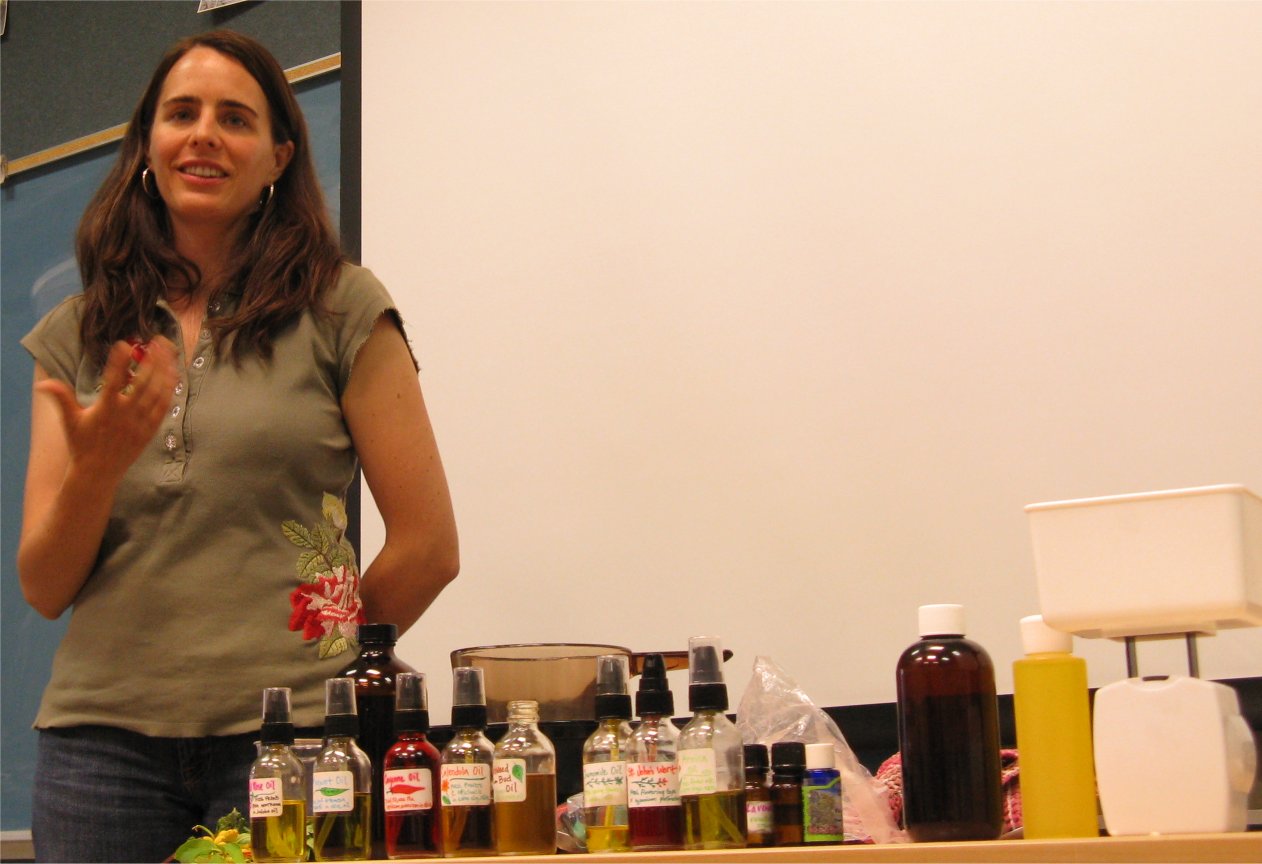
Yesterday CR-FAIR hosted a brilliant speaker, native plant specialist and herbalist Elise Krohn, who runs the Diabetes Prevention Through Traditional Plants program at Northwest Indian College in Bellingham, Washington, as well as the Native Plant Nutrition program at the Northwest Indian Drug and Alcohol Treatment Center.
She was speaking at the Victoria Native Friendship Centre, and began by introducing her programs and talking about the various people who’d guided her along the path to a pretty impressive level of knowledge about native foods, herbs and medicines, and how these have been used by various tribes in the Pacific Northwest, and elsewhere. (One of her teachers, Skokomish spiritual leader Bruce Miller, was featured in the film Teachings of the Tree People.)
Her talk included discussion of the foods used in traditional diets and ceremonial meals. For example: horsetail, thimbleberry and salmonberry shoots can be peeled and eaten. Spruce tips are high in Vitamin C and can be eaten straight off the tree or made into tea. Bull kelp can be pickled, or dried and eaten as chips, for its thyroid-controlling properties and its ability to remove toxins from the digestive system.
Skunk cabbage leaves are “Indian wax paper” used to wrap food for storage or cooking: salmon baked in green skunk cabbage leaf stays moist and has a sweet flavour. Leaves should not be eaten without knowledgeable preparation, because they contain calcium oxalate crystals which are an extreme irritant to say the least (this is what kidney stones are made of).
Huckleberries contain flavonoids (to protect and strengthen arterials) and antioxidants; berries and leaves both contain compounds that will lower blood sugar – eat the berries and dry the leaves for tea. Evergreen huckleberries are sweetest after the frost.
Salmonberries have been so important in native diets that families used to cultivate their own patches. Its name might originate in its appearance, since it resembles salmon eggs (and can be used as trout bait for that reason). Salmonberry abundance in its preferred habitat – near fast-running streams – is said to be an indicator of a good salmon year.
Then we got to camas, which is one of the best known native foods in this area; in fact, Victoria is built upon one of the best camas prairies in the area, cultivated for centuries through a system of burns and careful harvest. (We also heard that the Empress Hotel, built on a portion of James Bay that was dredged, drained, and filled, sits on one of the richest clam beds on the Island) Camas bulbs are harvested with a traditional digging stick which allows the root to be lifted and the bulblets that surround it to be replanted, leaving the ground relatively undisturbed. This aerates the soil and gives the remaining bulbs room to grow, so will result in larger crop yields.
The burning that was traditional for maintaining the camas prairies took place in the fall (seed having been collected in the spring); it improves the habitat by reducing competition to the camas bulb by other vegetation. Camas prairies are important habitat for other native vegetation, including chocolate lily and serviceberry (saskatoon). The bulbs are harvested nowadays in the spring, while the flowers are blooming, although they grow sweeter and fatter in the fall; but the flowers are needed for identification, so as to avoid a toxic imitator, the death camas, which has a very similar leaf. I’d tasted some camas bulb at a pit cook several years ago, but found it inedibly bitter; I learned that this was due to undercooking. It needs about 24 hours to cook fully (and should be black, inside and out) before the inulin it contains activates and becomes sweet and delicious. Nowadays it’s often precooked in pressure cookers before being added to pit cooks with other foods.
Elise then turned to discussing the various projects that culminated in a resource and recipe book I’m grateful to have been able to purchase from her, as the book (together with a companion volume I’d also like to get one day, Wild Rose and Western Red Cedar: The Gifts of the Northwest Plants) is normally only available within tribal communities, to protect the cultural property rights of the tribal contributors. Feeding the People, Feeding the Spirit: Revitalizing Northwest Coastal Indian Food Culture was developed using research from the Traditional Foods of Puget Sound project, which included archaeological digs to identify traditional foods from the remains of old cooking pits and middens. There was also a round table discussion with native peoples in the area, about barriers to eating and accessing traditional foods. And then they held a Tribal Cooks Camp, where experienced tribal cooks worked together to develop a series of healthy recipes suited to modern kitchens and contemporary access to traditional foods.
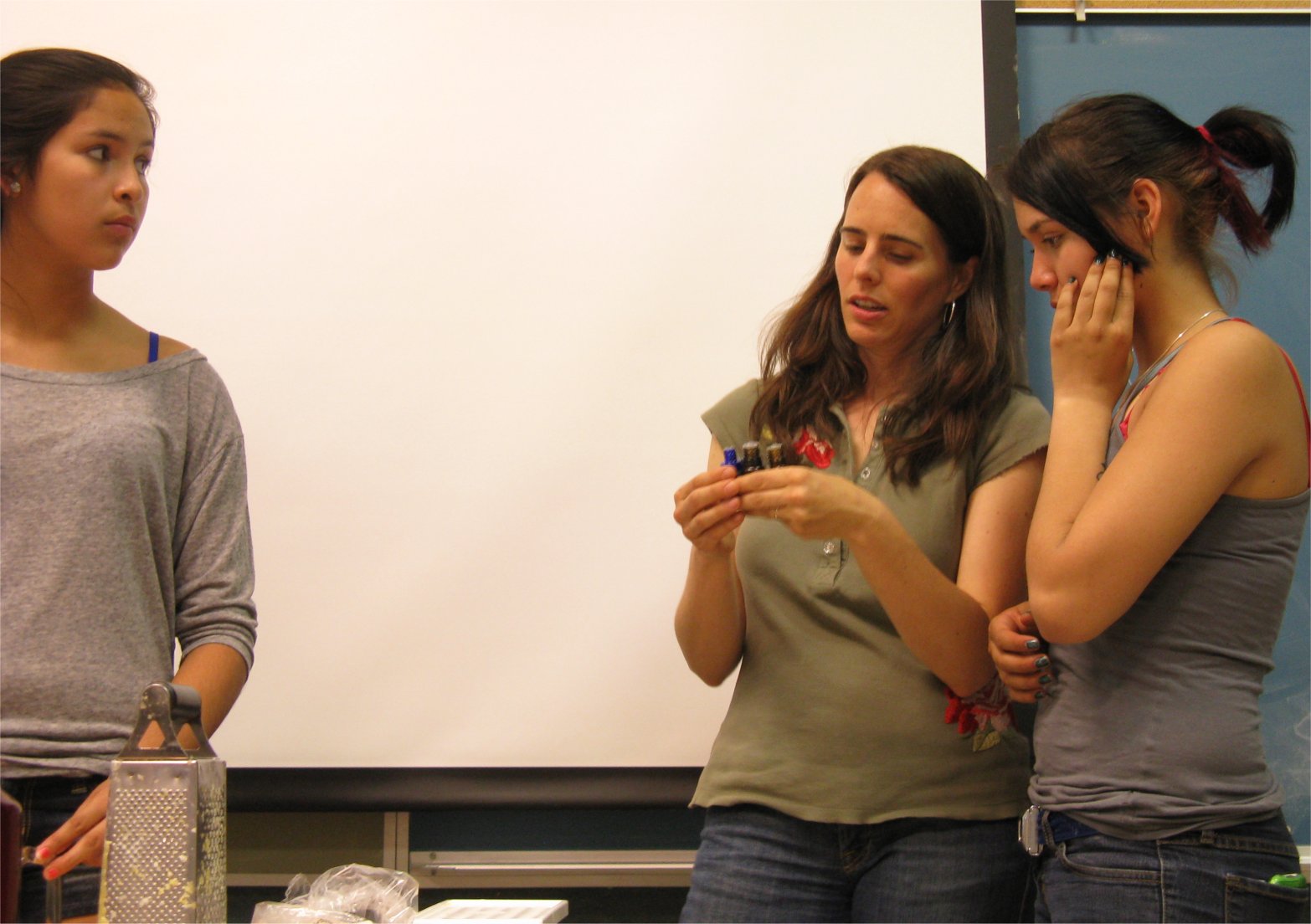
After a break, we prepared to learn how to make lip balm (a clever instructor is this one, who draws young people in by teaching them how to make their own cosmetics!) Here Elise talks about the cottonwood bud, which she’d infused in olive oil and would be using in the lip balm demo. It’s a pungent aromatic, and the oil, or salve made from it, is also known as Balm of Gilead; like most essential oils it’s anti-inflammatory and antimicrobial, and it’s also an analgesic, so a good thing to put into lip balm. Or salve.
She brought with her quite a selection of infused oils, including cedar, wild rose, cayenne (used in Tiger Balm among others), calendula, devil’s club, St John’s Wort, arnica and chamomile. She’d made these with the help of her students; some of the herbs had been heated gently with extra virgin olive oil in a water bath; the more fragile ones (like rose and calendula) had been solar-infused: placed in sunlight. The oils can then be used as massage oils (e.g. devil’s club is used for arthritis relief) or turned into lotion, salve or lip balm.
Mix grated beeswax

with infused oils, essential oils (for our mixture she used black spruce, western cedar and lavender),
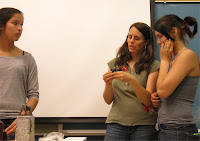
and extra virgin olive oil (organic from the US or choose brands from Spain, Italy or Greece where there is less pesticide use). You can also, as she did in this instance, use jojoba, a plant-based oil from the American southwest, which is said to be the closest substance to bear grease (which is said to be the closest to human fats and therefore perfect for lotions and salves to rub into your own skin). Stir gently over heat until it melts.
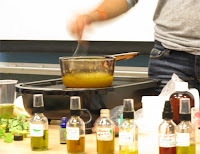
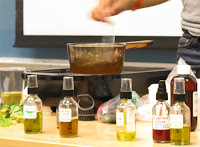
Test on a spoon – cool to room temperature – to make sure it’s the right consistency.
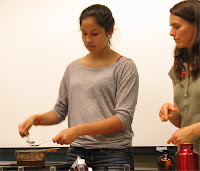
Then decant into a pouring jug

and pour into tubes. If you’re making lots, this handy holder means you don’t have to spill it all over the counter: you can just scrape the excess off with a credit card.

Slap a label on the tube, and you’re done. Great gift for potlatch or canoe trips, she observed.
 Things have been on hold here at the cafe for a couple of months. There has been activity I could have reported on, but I’ve been tied up with other matters, and took an unscheduled break while paddling the river of life and pondering the future of this forum. It’s been nearly nine years since I started, and many things have changed.
 Digging the City came into being – and continues to gratify me with positive reviews both published and anecdotal (anyone out there want to review it on Amazon by the way?). The rest of my writing has been sparse posts here and more numerous but sparser posts in my Facebook pages (and please feel free to Like those pages – one for Digging and one for me the writer).