Skip to content

Italy

Hotsville

I was thinking for a while there that the Parmigiani simply didn’t have sweat glands. Day after day we tender stranieri have been glowing fiercely morning and afternoon on the bus, while Italians of all ages dart here and there on bicycles, hatless, dry-skinned; on one shocking and typically overheated lunchtime we even witnessed one of the Italian students in a cardigan in the dining room. But yesterday’s trip home on the curtainless air conditionless bus, the afternoon sun slamming in through the big windows, we were all dripping and miserable. One might even think, on seeing passengers disembark, that we had all been afflicted by some mass incontinence. It is unbearable.

There, I feel much better, sitting at my steaming laptop, a wet towel draped over my shoulders.

We had a mixed week, a food culture/history exam, some branding, some sociology, but my personal highlight was a talk on the technologies of development, from Ugo Vallauri, who is ex-Slow Food and now works for Computer Aid in Nairobi, where he has been exploring means of development aid publicity using high and low technologies. He told us about the difficulties of using computers let alone internet in an environment where power supplies are patchy at best, and where internet access is prohibitively expensive even where it is available. The telephone and cabling infrastructure doesn’t exist, and so what access there is tends to use, like the much more influential medium of mobile phones, satellite technology.

Off to find some slightly cooler air in Bergamo now. As you’ll see, I’m crawling through back-filling my Spanish postings. Only a couple more days to go. Maybe I’ll finish next week.

The week that ended with Balsamico

Reports, exams and internet problems have been interfering with this blog. More to come on Spain, but maybe not for a couple of days. Meanwhile, back in Parma…

We are counting down now. Ten more days of classes and we’re done, ready to scatter for the summer and then for two months of internships.

Odd to think that after months and months of constant contact we won’t be seeing one another until graduation in November. Good and bad it’s been, and I when I heard Leonard Cohen talking about monastic life in a recent BBC interview, it struck a chord:

“People think of this activity as somehow remote, isolated and serene, whereas it’s much more abrasive than ordinary civilian life. In ordinary civilian life you close your doors at the end of the day and more or less you’re alone with your television set, but in a monastery.. there’s a zen saying: like pebbles in a bag, the monks polish one another.

We are, I think, well polished gastro-pebbles by now.

It’s been a steamy week in Parma with the temperature set to rise and rise into next week; I can’t say I’ll miss the weather here (damp and cold in the winter; hot and humid in the summer, just the way the prosciutti like it). Nor will I miss my visits to supermercato Standa, where you can enjoy spiritual debasement with the rest of the long-suffering Oltretorrentini: standing in long, tedious queues which may randomly end with a terse “E chiuso” from the attending demon, at which point we all shuffle into another long, dispirited queue, and are then hectored into giving up complicated combinations of coins because from all appearances the check-out cashiers are charged for their change floats.

So here we melt. By night we toss in our hot rooms, only to rise welted and itchy from insect bites: spiders, mosquitoes, who knows. To judge by the volume of chittering along the river, the frogs are doing their best to control the numbers; the rondini (swallows) who took on the springtime airborne have all left for what I assume are cooler climates. There’s an abandoned bird nest in the air vent in our kitchen that only coughs a bit of dust on the floor these days, no more face to face confrontation with the parents who for a couple of weeks hovered fiercely at the window, moths in beak, to demand what we were doing so near their home.

This week, several of those who didn’t fall to Spanish ailments began to drop, and our numbers were reduced by nearly half for most of our classes. The end of Consumption Psychology: no more than a recap really of what we talked about before we left for Spain – who we are and our social circumstances influence what we eat and how we think about food – nothing too new there. Then Sociology of Food Consumption, where we talked about branding and advertising techniques as applied to food. Mostly it felt like a depressing recount of mergers and aquisitions among the likes of PepsiCo and Coca-Cola, with less to do with artisanal brands or alternative markets. Then we had two delightful final tastings with Sandro Bosticco, who led us through discussions about the role of oxygen in winemaking, with a finale that featured four Pinot Noirs (three from Burgundy and one from New Zealand) and then group tastings of sparkling (Prosecco), red (Amarone) and sweet (Moscato – passito) wines.

Friday we got on our stage bus for the last time, leaving behind a host of fallen comrades (some suffering from late-breaking flu and others perhaps from a mild case of Friday nightis), to study balsamic vinegar production from industrial prosciutto makers Ferrarini, who as a family have the slightly surprising hobby of artisanal vinegar making. As balsamico derives its name from ‘balsam’ – as in healing substance – it was a shame we couldn’t all be there to breathe the purifying perfumes, and taste the rapture, spoon by blessed spoon.
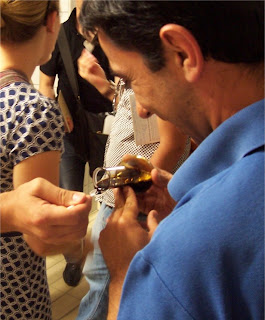
We learned about the rather lax standards for the substance known as Aceto Balsamico di Modena (“Modena Balsamic Vinegar”) – which require that it be of a minimum acidity of 6%, made from grape must (minimum 20%) and vinegar, caramel (maximum 2%, for colour and flavour), with a minimum 60 days aging. Ferrarini make a higher quality product which is aged a minimum of 8 to 10 years, but on the grocery shelf, consumers won’t understand the difference (other than price) when it’s ranked against the lower end products. This version is the balsamico you use for cooking and salad dressings. The more precious condiment is another story entirely.

What we may think we’re getting when we see the words balsamico and Modena and vinegar on a label is in fact correctly known as Tradizionale Balsamico, and there are two strains of it, one from Reggio-Emilia and one from Modena, made in more or less the same way but with a different balance of density and acidity, and bottled in different areas. They also have different quality standards: there are three quality levels for Tradizionale Balsamico di Reggio Emilia (red, silver and gold) and two for Tradizionale Balsamico di Modena. This is the highest end product, a thick, sticky goo that takes at least 12 years to make and should be doled out by the drop, as a condiment on strawberries or parmigiano-reggiano cheese, or even drunk from thimble-sized glasses after a meal or, according to Anna del Conte, diluted with ice and sweetened with a little sugar.
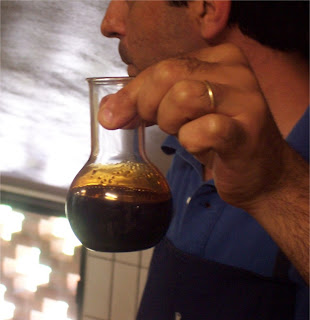
Before you get to that point, though, the stuff has to be made. According to tradition and regulation, it’s made only from grape must: local grapes are crushed and cooked until the volume has reduced by 50-60%, leaving a high density, sweet syrup. It’s fermented in barrels with only natural yeasts (present in air or the grapes themselves) for company. At the end of the year it will have reached about 6 or 7% alcohol, with lots and lots of residual sugars. A small quantity of older balsamico is added, containing live bacteria, and another two years or so go by while these bacteria carry out the acidification process which transforms the alcohol into acid.
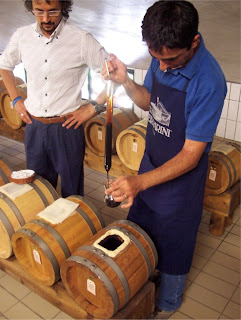
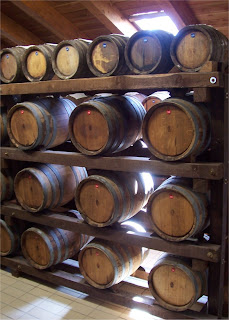
Then the real fun begins, when it’s decanted into a series of barrels of diminishing size, made of different woods: chestnut, oak, ash, mulberry, cherry and locust wood, which all add different flavours. There will be at least three but not more than ten casks, which are not sealed, the opening on the top covered with muslin to allow the liquid to thicken through evaporation. They are stored in vaults where the local climate can play its part: the cold winters concentrating the flavours, the hot summers evaporating the water content.
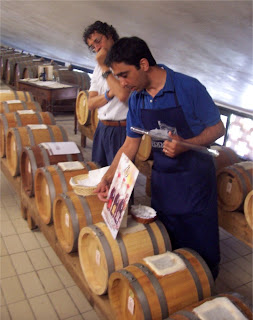
The barrels lose about a litre a year, so they are topped up in a formal process: the smallest barrel gets a litre from the next largest; that one gets two litres from its neighbour, and so on up the chain until the largest barrel receives about 30 to 40% newly acidified balsamico. This chain continues for between 12 and 25 years, at which point between 5-10% of the smallest barrel’s content is decanted and sent to the consortium for testing.

The consortium determines which of the three levels the balsamico will be sold as. These are related to age, but not completely determined by it, as the tasting is the final arbiter. The “lobster red” labelled balsamico is at least 12 years old; the silver is 12-25 years; and the gold is at least 25 years old.
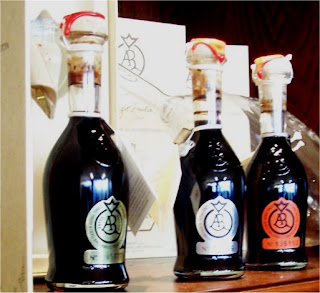
Because vinegar is a preservative, once you’ve invested your money (at least 30 euros for the red label, and upwards of 75 euros for the gold – in Italy; more if you buy it in other countries), you won’t ever have to worry about it going off (perhaps you’d like to pass a bottle down to your grandchildren?). It does behave much like honey though, and has a tendency to crystallise; but, like honey, it can be restored to liquid state by gently heating the bottle in water.
We got back to sticky Parma in time to rest up before supper. A group of us went to see chef Davide at Ristorante Mosaiko and ate ourselves into a happy stupour, with my favourites being an outstanding guinea fowl salad, dreamy gnocchetti topped with amazing mozzarella, and an even better than last time slice of bonet for dessert. I’m still digesting today…

Massa to Mosaiko

Last weekend, in an attempt to escape the unending heat of Parma, we took a trip to the seaside, in search of cooling breezes and nice chilly marble museums. We found a breeze or two, and a few other things of interest.

We arrived in Massa and hopped a bus to the seaside which was large and developed. While looking for the information office we passed a rabbit park which was, well, hopping with rabbits. And little horses. And a lot of signs, like these ones.


A half hour or so in the information office was enough to convince us we didn’t need to stay in Massa, and while searching for other diversions, we spotted a castle in Aulla, which if all else failed was at least on the way back to Parma. And indeed it was a castle, the Brunella Fortress. Its address is number 3 Via Fortezza (why not number 1??) and within it we found a small natural history museum, with a few items of interest including a collection of rather sad looking stuffed animals. Nice views, though.


We walked up the hill and then down the hill. We passed a nifty looking fence.

And then in town, I made the acquaintance of a poet, Ceccardo Roccatagliata Ceccardi (1871-1919), who touched down for a few formative years in Massa (but not as far as I can make out in Aulla) during his life of poverty and peregrination. It was some consolation to having missed the Parma poetry festival

We escaped back to Parma having found only this in the way of sustenance: is it Italy’s answer to Cheez Whiz?

After that, mercifully, it cooled down for a few days in Parma. We had our wine tutor Sandro Bosticco back for some informative tastings, and then spent the rest of the week alternately in a journalism workshop with Corby Kummer and learning about consumer psychology from Nadia Olivero.

Last night, a return visit to Ristorante Mosaiko: very nice indeed. We talked to chef Davide who told us his training route included France, England, Japan and Australia, and before that enjoyed the tasting menus: seafood for me, including in-house smoked salmon (with a touch of wasabi), followed by a mosaic of octopus on a tart nicoisey salad of green beans, potatoes, carrots, capers and more:

followed by some awesomely artfully seared tuna with fennel, oranges, olives and tomatoes and a tantalising pinch of je ne sais quois:

and what do you do when you can’t decide which dessert to have? Have them all of course. That Piemonte classic, bounet, like a chocolate/nut creme caramel as Corrie so rightly observed:

Tart lemon tart:

And the winner was… simple is best? delicious strawberries laced with citrus and topped with yogurt gelato:

And with that it will be over and out, for a while, as we head to Catalunya tomorrow.

Food reading

Just back from a sprint round northern Italy.

Meanwhile, a couple of journals we’ve been pointed towards. Food For Thought, self-described (in the spirit of nose to tail gastronomic studies?) as the Organ of the University of Gastronomic Sciences, is a beautiful thing, like all the Slow Food publications. Helpful in many ways to be part of an organisation started by writers.

And Anthropology of Food is a webjournal produced by a network of European food academics.

Piemonte Wednesday

We had a morning at the Pollenzo campus with some of the Slow Food folk on Wednesday. Representatives of the Slow Food International, Slow Food Editore and the Foundation for Biodiversity gave us a talk on their mandates and activities. It was a helpful boost to our understanding, half a year since our last talk from them, and was particularly useful for classmates hoping to do internship postings with the organisation. We left for Bra, where the offices and our lunch were waiting.

Where it all began: the restaurant in Bra where the Slow Food movement became a reality.

Italian sushi, quipped Piero Rondolino, who joined us for lunch. We had lardo, salsiccia di Bra – a delicately spiced raw veal sausage, and carne cruda battuta al coltello (raw, hand-cut veal). All delicious.

Then some pasta, followed by the best panna cotta in the world? Maybe, surely in the running, lots more research needed. It was sweet, soft, delicate. Creamy but not too rich. And very pretty.

Back on the bus, after a shuffle round the hot, closed-for-lunch town, and away we sped towards our final Italian winery in San Martino Alfieri. Not sure what was ahead, we strolled up the path…

Heading in the right direction for Marchesi Alfieri winery…

A very old grapevine (for table grapes)

And hey presto there we were in a castle with beautiful grounds, meeting our winemaker Mario Olivero, who gave us another talk about my beloved Barbera, which is the main one of the several varieties of red wines they produce. A neglected grape, it was dismissed as fit only for table wine until about fifteen years ago, when a few and then many Piemonte winemakers began to take it seriously for its fruit and body and capacity for ageing. Now there are some 50 million bottles produced in the region, and it’s the area’s second most important variety. We sampled a couple of different years each of Marchesi Alfieri’s Alfiera and La Tota wines, and yes they were very good indeed.

After the cellar tour, Marco introduced Elena Rovera, from Cascina del Cornale, the organic cooperative that is an agriturismo, restaurant and seller of organic products, situated in Magliano Alfieri, between Alba and Asti. And what a spread she put on for us…


Piemonte Tuesday

Breakfast on the road. Only at the best eateries in Italy? Surprised us all by having what might be the best croissants we’d ever tasted.

Unfortunately good taste did not extend to their selection of Hitler beer and dictator wines…

We arrived in Torino ready for our day of coffee at the Lavazza Training Centre, and sure enough we were coaxed into our seats after lashings of freshly made Lavazza espresso. After a morning learning about the ins and outs of Italian coffee production and marketing, and a bit of the bean’s history and geography, we went for a tasting session of a dozen different coffees, both robusta and arabica varieties.

There was a dramatic difference between all of them, tasted side by side like that. Under the natty tutelage of the company’s Golden Palate, we learned the sniff ‘n slurp method of coffee tasting, and heard about the differences between wet and dry processing: washed and unwashed beans, and the various ways of preparing them for roasting. We got a whole new tasting vocabulary, learning new defects like quakery, grassy, woody and fermented.

Lavazza has the biggest roasting operation in Italy and the lion’s share of the domestic market, and so it’s important to keep pressing forward to stay ahead of the competitors (…can I resist saying: in the poisonous growth economy we find ourselves in?) and we heard about a few of the new product lines, which ranged from worthy to silly. Many of them were spawned (and as you will shortly see I use the word advisedly) through the company’s partnership with Spanish foam-meister, chef Ferran Adria.

Here we see the Coffeesphere, a bit of complicated nonsense to create a hit of sweet, gooey coffee substance that has the shape and texture of a soft-boiled egg yolk.

And syringes, perforated plexiglass slabs and a snappy lab coat are required to make the same thing, only smaller, so they can call it coffee caviare.


There was also a sweet, sticky foam coffee that came out of a nitrogen canister, like the ones restaurants use for whipped cream, making something called Espesso that, being foam, is the coffee that doesn’t spill. They’ve even designed a special coffee spoon with a hole in the middle as if to prove to skeptics that it really isn’t a liquid anymore. Well, maybe in a market that finds Italian television watchable it could work, I don’t know.

And this miracle of twentieth century necessity: your very own tube of UHT milk foam for those moments of crisis when you must have spuma (foamed milk) now now now. If that’s the sort of thing that amuses you, you might want to invest in a special plastic cup with a divider in the middle to drink it from. I guess what I found most disturbing about the innovation section was the amount of packaging and plastic and all round waste it was generating for the sake of stimulating a saturated market. We’re a long way from a simple coffee bean here.

The company has other promotional devices, like their vamped up girlie calendar (shades of Italian television with its partially dressed presenters) that made me feel less and less Italian by the minute. But produces some excellent print publications. And there’s its worthy sustainability project, Tierra, which lets the company pump a bit of money and development aid back into coffee-growing economies. Long may that project last.

We finished our day with a tour of the highly automated factory, dodging unmanned forklifts and miles of conveyor belts, and pondered the acres of warehouse with its robotic shelf-stockers gliding silently up and down the towers of packaged coffee, reading bar codes and pulling pallets out and putting pallets in. Surreal and strange and not a little overwhelming.

And then we were turned out for a free hour or so in the hot streets of Torino – everything having just shut for the evening – until it was time for supper at Pizzeria Le Rondini, with its decidedly, and thankfully, manual production methods.

Many of us had the house specialty, which had a thick, chewy crust filled with fresh ricotta, and topped with buffalo mozzarella, fresh tomatoes and salami.

We dined with Piero Rondolino, owner of Tenuta Colombara, a farm which produces the estimable Acquerello Rice, whose business we sadly didn’t get to visit. He grows the prestige risotto rice variety, Carnaroli, and ages it to give it better flavour and texture. It’s an organic business, and he uses a number of creative methods to manage it; he told us about the dragonflies they introduce to the fields to eat the mosquitoes that breed there.

After supper, a few of us slipped away to bide our time in the neverending summer evening queue at Grom‘s mother ship.