Skip to content

Cheesy workshop

I have had a lifelong interest in what the Transition Townies nowadays call reskilling, and so I was happy to have a chance for some more information on making my own cheese. I suppose part of this is a wish for self-sufficiency, but more than that it is my belief in the value of turning my back on commercial food production wherever possible. As we’ve seen over and over again, the priorities of the food industry – creating food with the highest profit margin and the longest shelf life – are not in synch with basic human food priorities: nutrition and good taste.

Coincidentally, there was a review in the Vancouver Sun recently of two books (Just Food: Where Locavores Get It Wrong and How We Can Truly Eat Responsibly by James E. McWilliams, and Empires of Food: Feast, Famine, and the Rise and Fall of Civilizations by Evan Fraser & Andrew Rimas) looking at issues of food security from very different points of view, but reaching the same conclusions about the unsustainability of commercial agriculture. The reviewer nails McWilliams’ logical flaw neatly by pointing out that he “doesn’t properly consider that rapidly expanding food production is exactly the reason that we have so many mouths to feed in the first place” and that

If we, as a race, are committed to uncontrolled population growth, then yes, Williams is right to say that genetically engineered crops are the only way to support the nine billion people we will have to feed in a couple of decades. But the bubble will burst, because commercial agriculture devastates the soil’s natural capital, and famine will result, as it has throughout human history.

So. On to the cheese. It has been workshop central around here. In addition to last weekend’s forest gardening workshop, I was also able to catch the excellent David Asher Rotsztain on one of his teaching forays from Mayne Island. He gave an afternoon introduction to cheesemaking at the Victoria Native Friendship Centre, and showed us just what a piece of cake it is to make your own cheese.

In the three hours available, he demonstrated a quick and easy cheese (paneer) which involes only milk and vinegar. For all cheeses, he recommends raw milk if you can get it, and if you can’t, to use unhomogenized organic milk (Avalon Dairy makes this in BC) as homogenization affects both flavour and the milk’s ability to set (it breaks up the fat molecules). The resulting cheese, once drained and either crumbled or formed, can be mixed with flavourings – he used garlic scapes and smoked chilli peppers –

or sliced and fried (it does not melt like rennet-based cheeses). Because it’s not made with rennet, it’s suitable for lacto-vegetarians.

Rennet of course is an enzyme found in the stomachs of infant mammals and in traditional cheesemaking it comes from calves, lambs or kids depending on whether you’re making cow, sheep or goat cheese. A moral issue for consumers of dairy products, the fact is that male calves and kids are the unwanted byproducts of milk production, and if you’re harvesting the rennet at least you’re at least gaining some value from killing them, rather than the straightforward “shoot shovel and shut up” process that many dairy farmers are obliged to follow when there is no market for the male offspring (dairy animals are not usually suitable as meat animals) but infinite demand for milk.

We took a look at curd cheeses, made with rennet, and in particular cheese curds and camembert-style cheeses. Rotsztain warned against using rennet tablets from Junket, which he believed is genetically engineered (as is 90% of commercially prepared cheese in North America, in fact) and sources a natural rennet (BioRen) from a cheesemakers supply company in Ontario.

He’d started the process off an hour before we got there, so the milk had had starter culture and rennet added and was allowed to sit warming by the stove’s pilot light while coagulation carried on. We had a good demonstration of testing for a good set. One method is the clean break, in which (after you wash your hands!) you poke one finger through the surface. You should get a “popping” sensation as it breaks the surface.
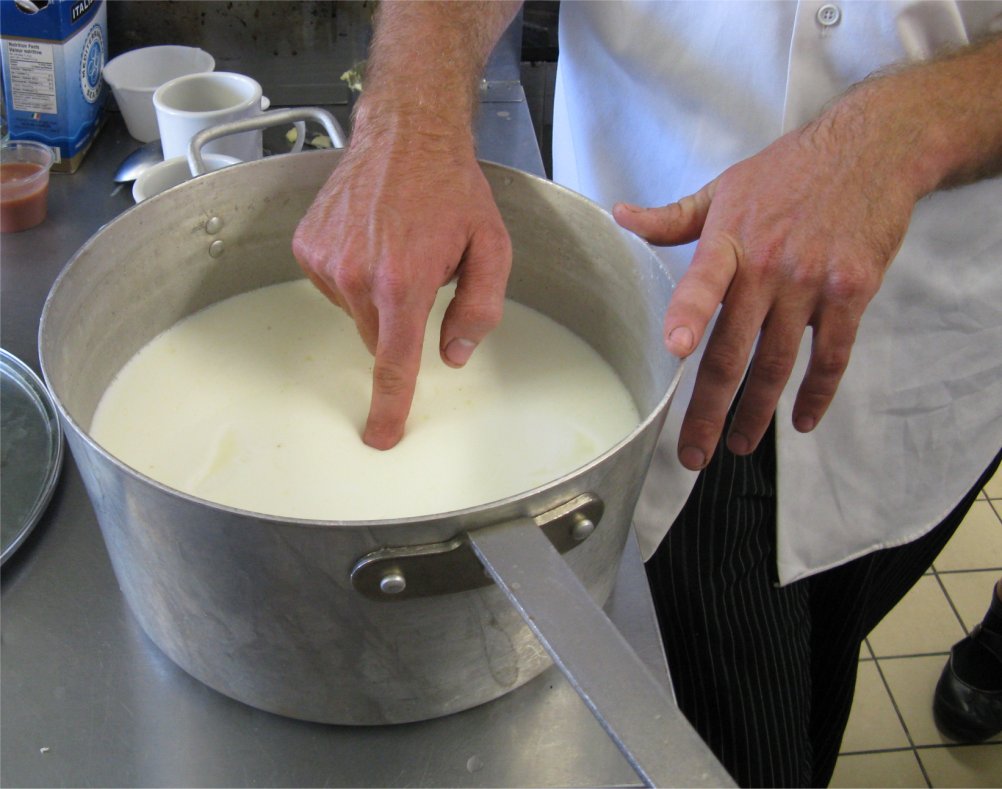
Slowly sweep your finger back up towards the surface.
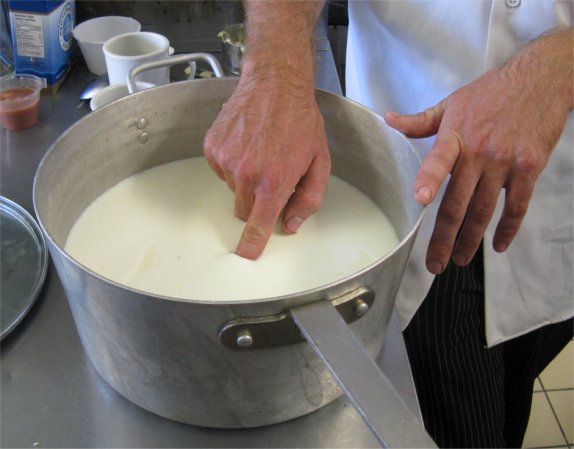
There should be resistance as the curd holds its shape

until your finger breaks through, cleanly.

Another method is to gently press the surface of the curd to see if it will pull away cleanly from the sides of the pot.
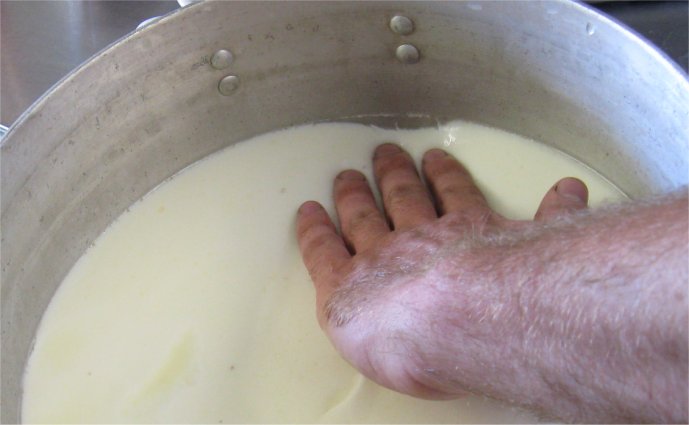
Once satisfied you have a good set, you need to cut the curd, vertically and horizontally, and if you’re really keen and think you can get the pieces evenly sized, diagonally as well.
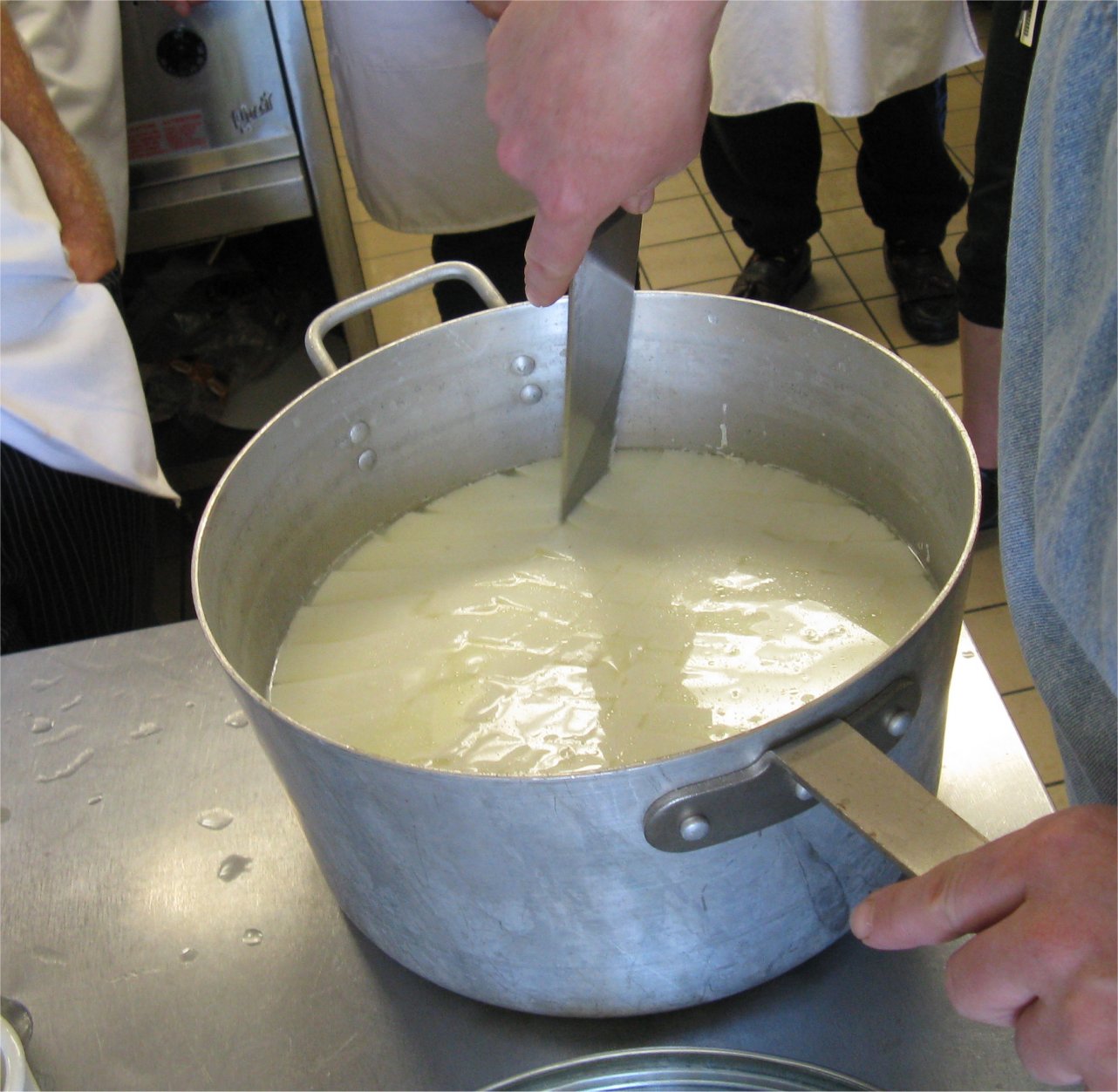
Then the curds just sit around separating from the whey.
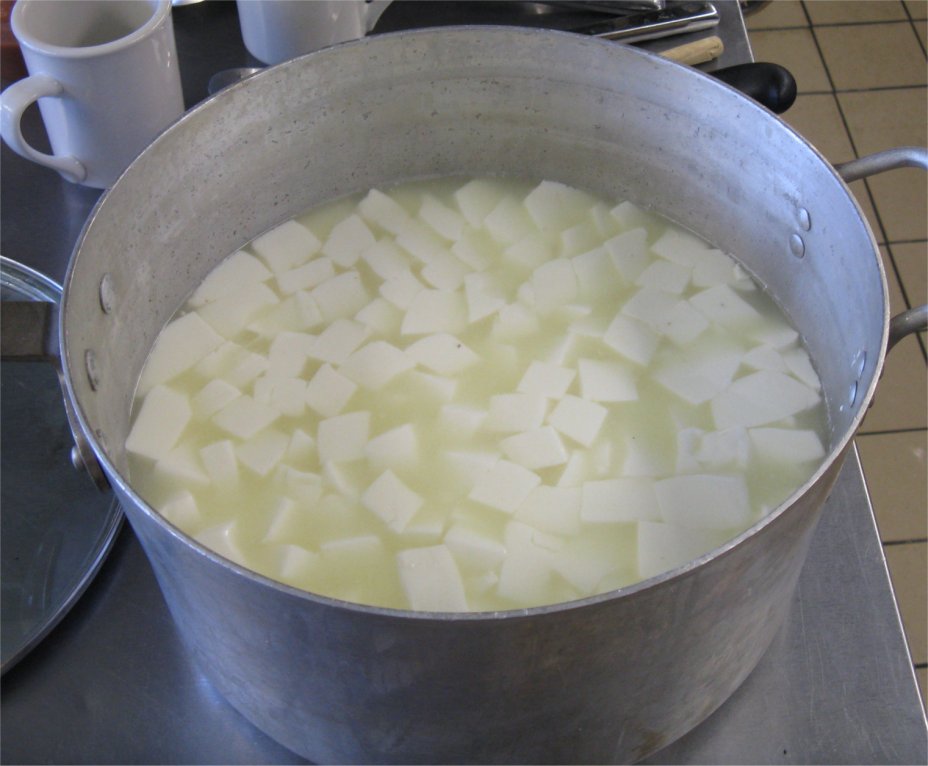
They need to be tested to see how firm they are.
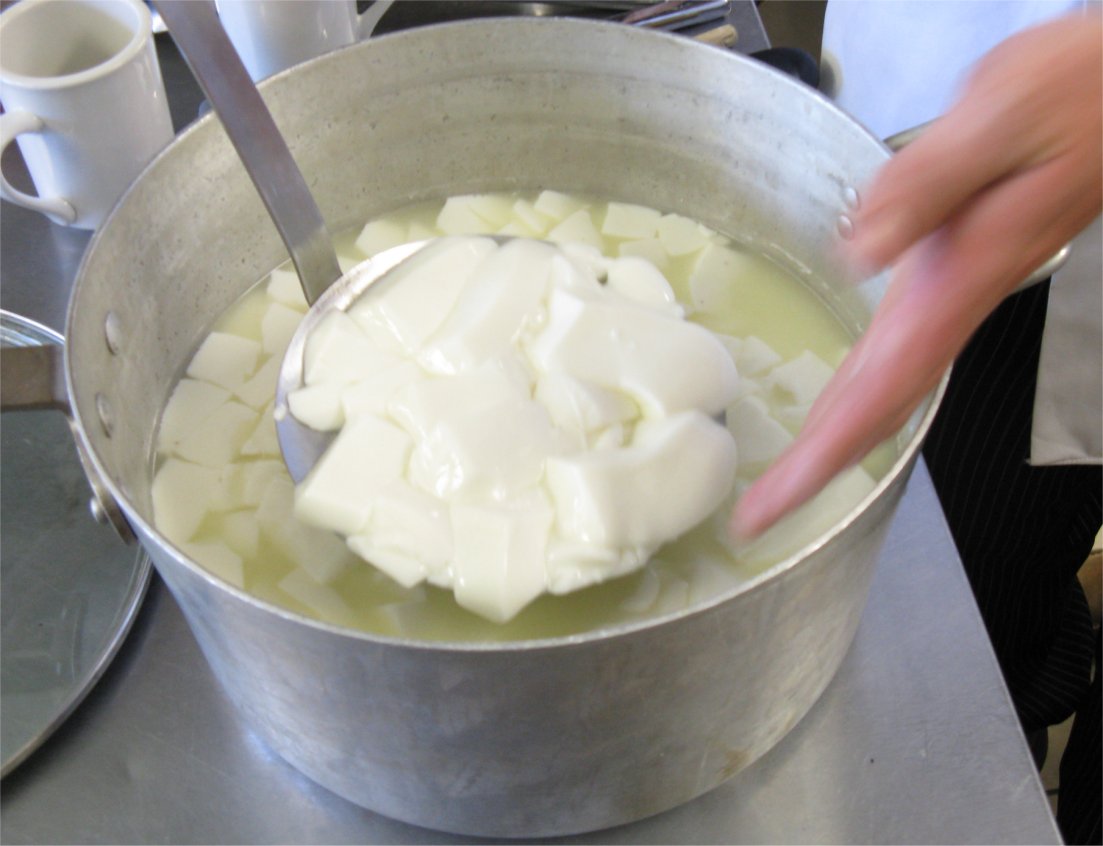
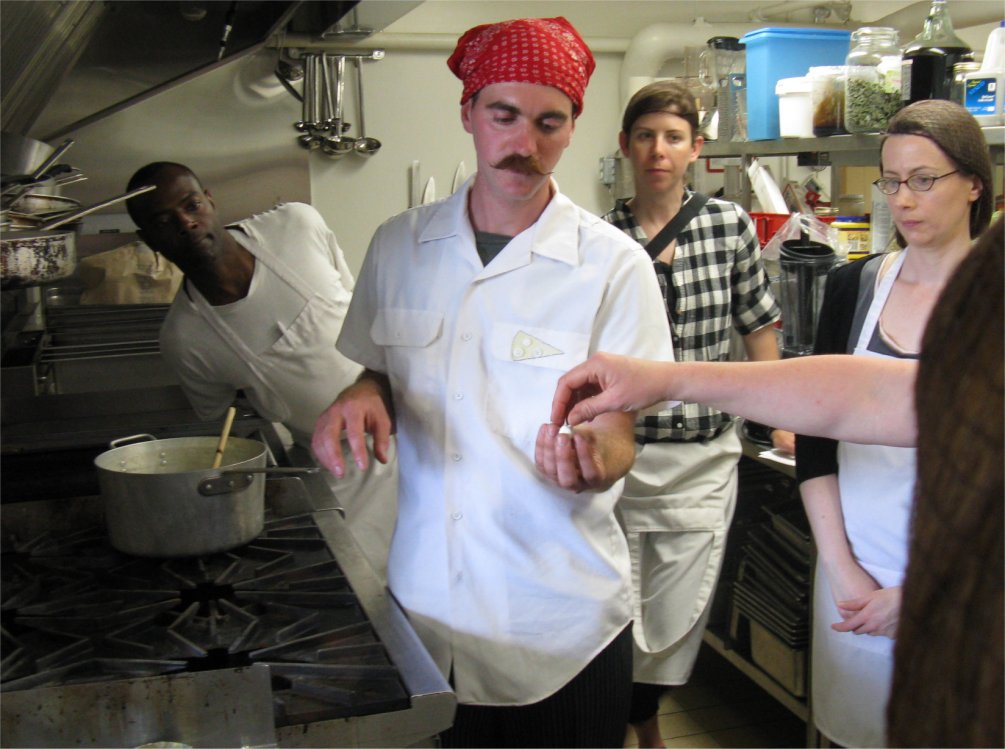
before pouring off some of the whey
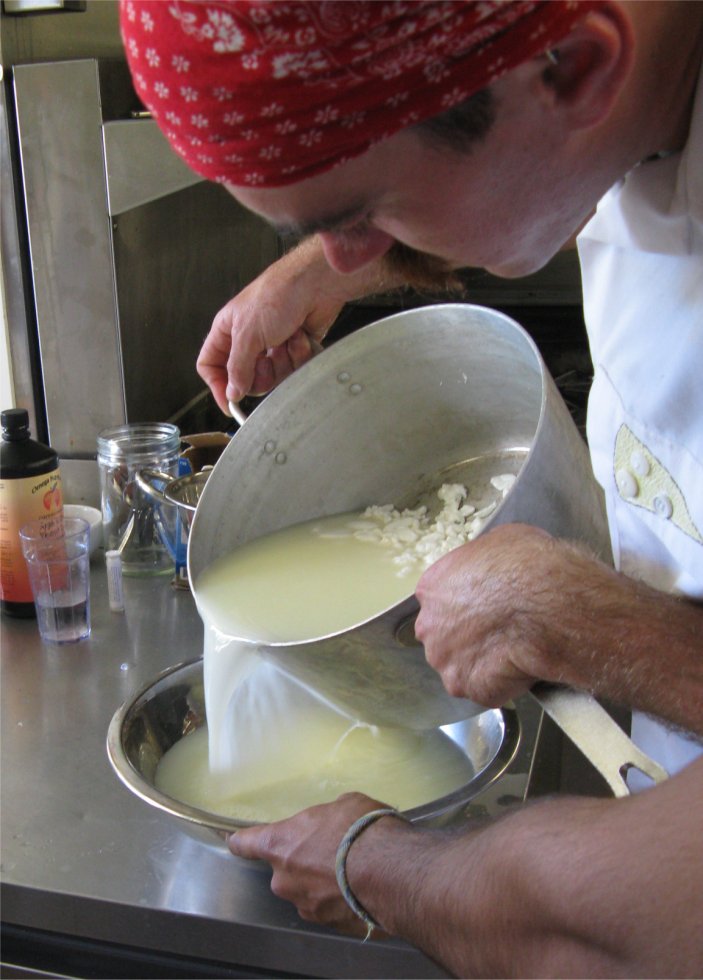
and filling the moulds. Here are two ways of filling a cheese mould. The official way

and the hands-on way.
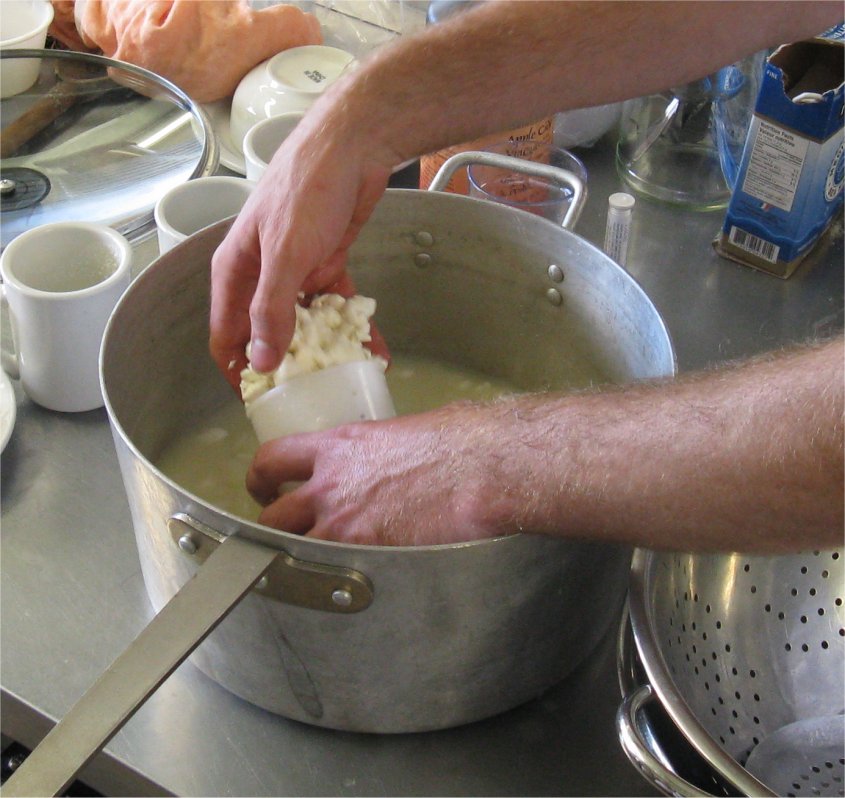
The curds drain in the mould and shrink dramatically during the process. Soft cheese are left to drain naturally, while firmer cheeses are also pressed. Commercial moulds are all plastic, although it may be possible to find stainless steel. Traditional strainers made of woven reeds, unglazed pottery or wood are verboten in plastic-loving commercial production of course. One more reason to make your own.

This one was taken out very early (time being of the essence) but it had already shrunken considerably.

Making cheese curds,
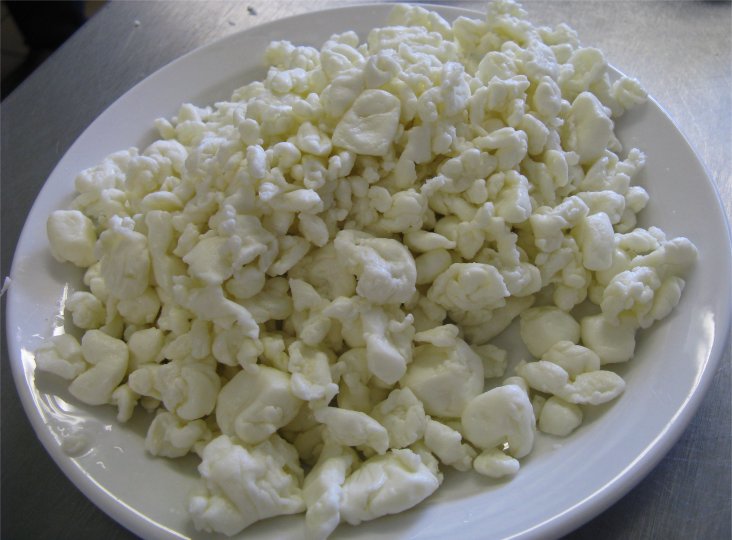
beloved of poutine-eaters, involves an extra step, namely cooking the curds, gently,

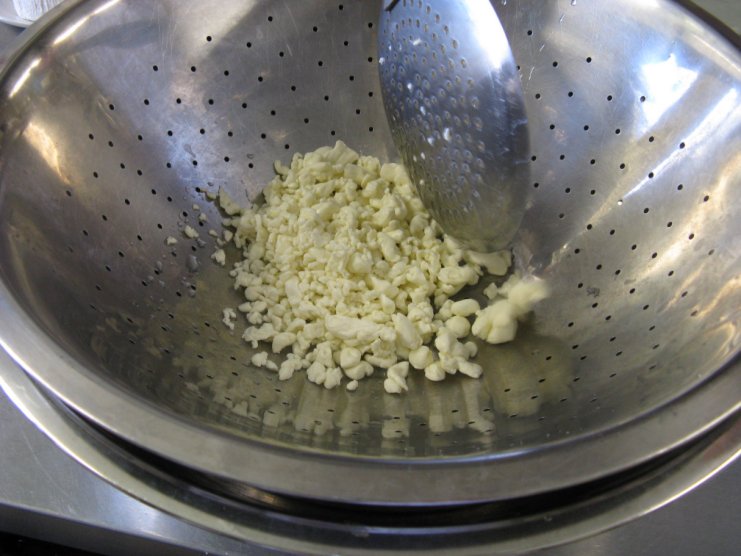
until they are firm. They are then washed

and drained and salted, ready for use.
Here’s what is used to innoculate blue cheeses:

It is a piece of sourdough rye bread that has been wiped with blue cheese. You dissolve it in water and brush it on your cheese to have a blue rind cheese; or poke holes in the cheese and then innoculate if you want blue throughout. Rotsztain had a lot to say about using your fridge as a cheese cave, including the suggestion that you can innoculate cheeses in your fridge if you want to turn them blue.

The last form of cheese again required no rennet. A cheese with no name in North America, it’s the simplest and most common: known elsewhere as labneh, quark, fromage frais, queso fresco, formaggio fresco or just plain old farmers cheese, it’s basically just yogurt that is strained and hung for 24 hours. Rotsztain uses a silk scarf
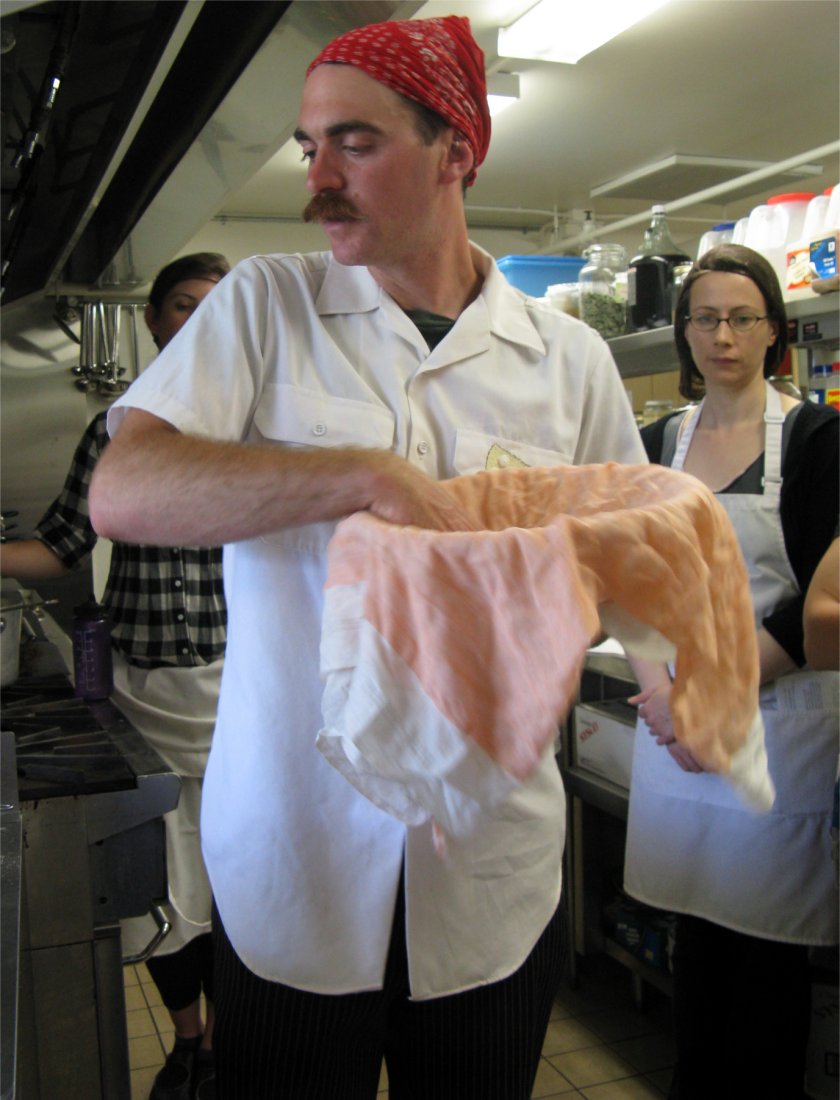
and recommends using anything except what is sold as cheesecloth in our supermarkets. You need something that has a fine weave and can be laundered.

We also discussed Kefir, which is a wild bacterial culture used to ferment milk and other products. It’s the basis for lassi and makes a fine starter for cheese products (curd cheeses require both starters and rennet); easier to maintain than yogurt starters which must be replenished periodically. You need to start with kefir grains (which have nothing to do with grain)

which you put into milk and 24 hours later you have a kefir drink (lassi) that can be salted or flavoured. You can also put them into juice or sweetened tea (I’m thinking this is what was behind the fermented hibiscus tea I enjoyed at the Ethical Kitchen back in April). The result is probiotic and feeds the bacteria in your gut. The grains are fed and nurtured much like a bread starter, and can be shared with friends.

And after all that… we had cheese.

Sunday Dinners on a Saturday

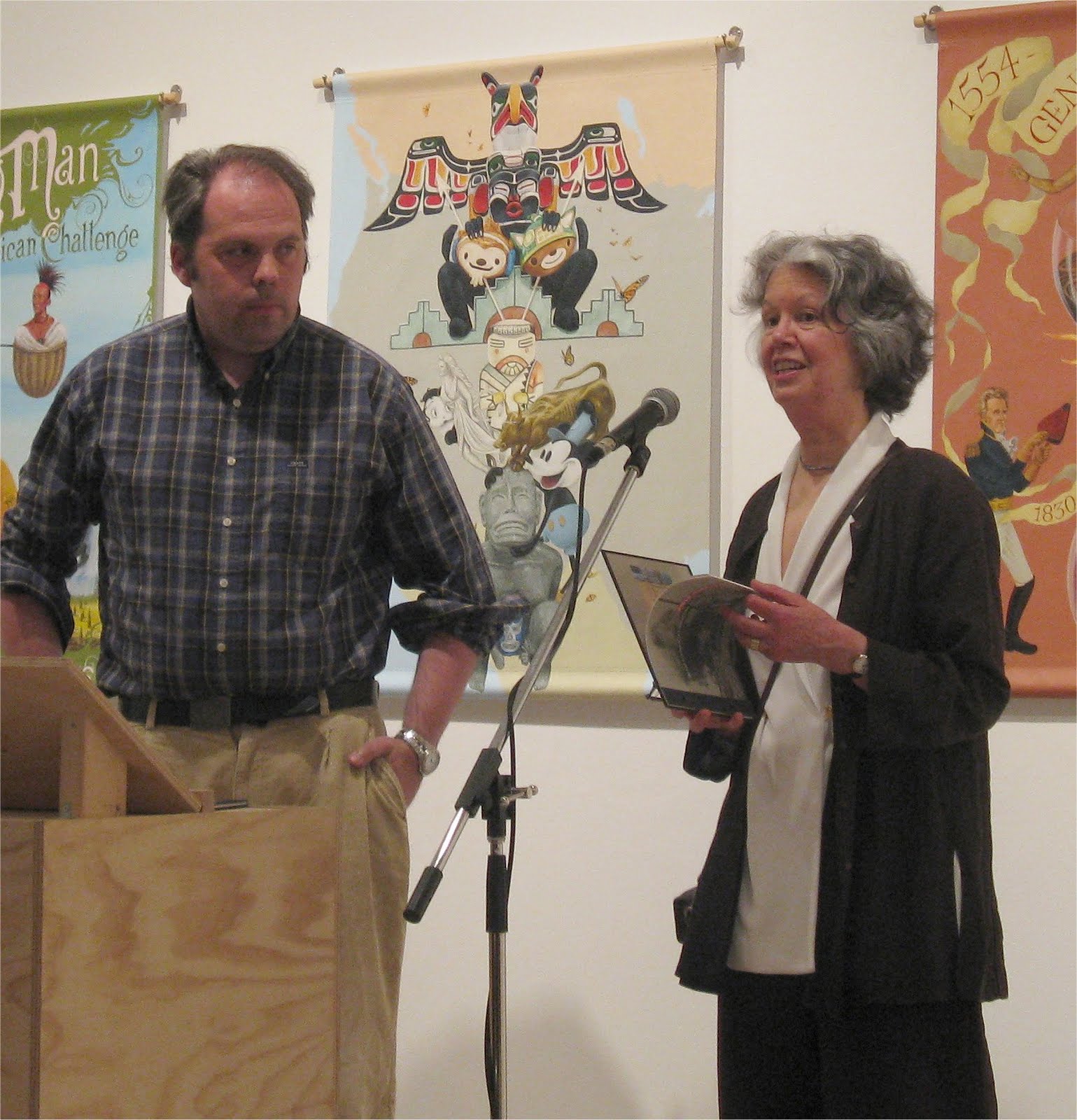
Had a great launch of my chapbook Sunday Dinners last Saturday, thanks to JackPine Press and Open Space Gallery and a lovely audience. Here’s Elise, of JackPine, showing off her natty tights during the intros:

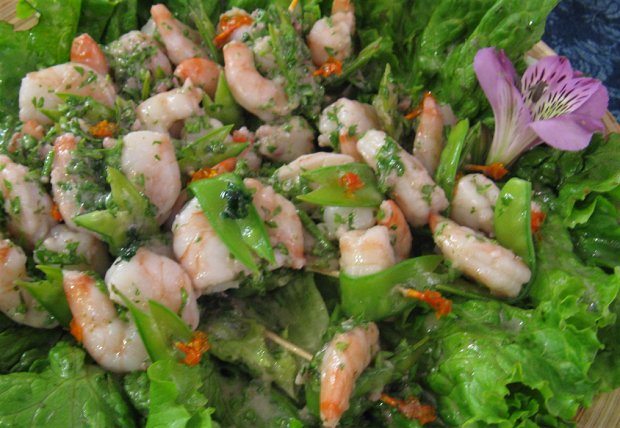
Have no pics of myself, my collaborator Colleen Philippi, my book — but here are some prawns that looked delicious

and here are my co-launchees, Shane Neilson and Frances Hunter.

Sooke community garden

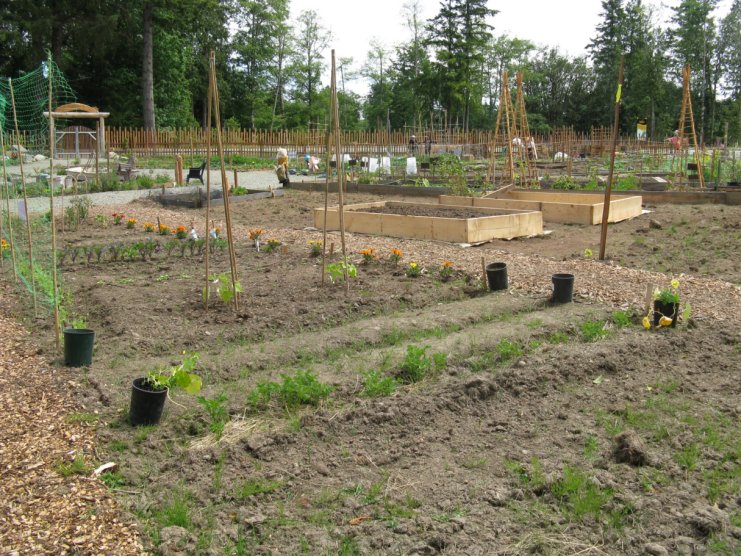
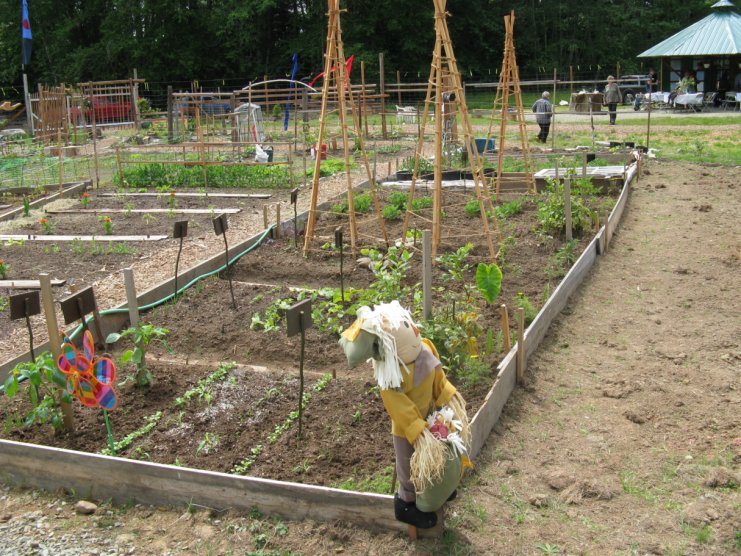
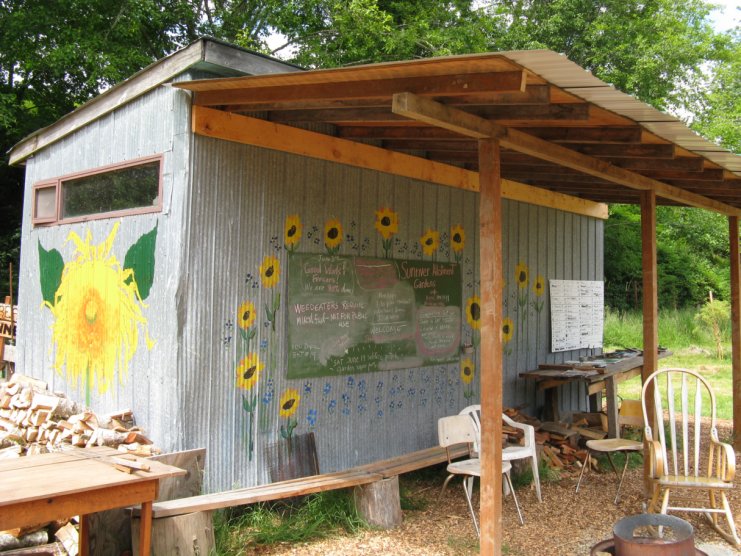
This month’s CR-FAIR meeting was held out at Sooke, where we got a look at Sunriver Community Garden,

officially unveiled a week ago, and already thriving. It was created with the energy and guidance of Sooke Food CHI, who are in the process of handing its management on to a garden committee. They’ve done a dazzling job of raising funds and finding donations of everything from labour to garden sheds.

We sat beneath the gazebo

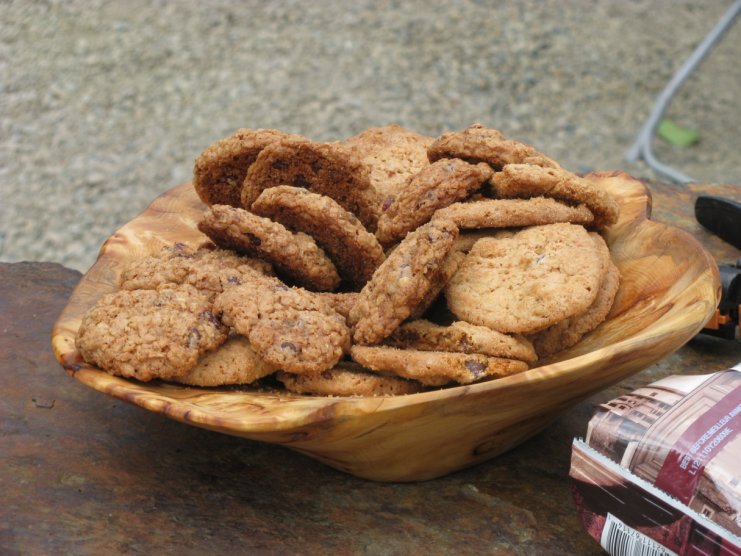
enjoying some excellent cookies – in a burly bowl by the Food CHI’s Phoebe Dunbar

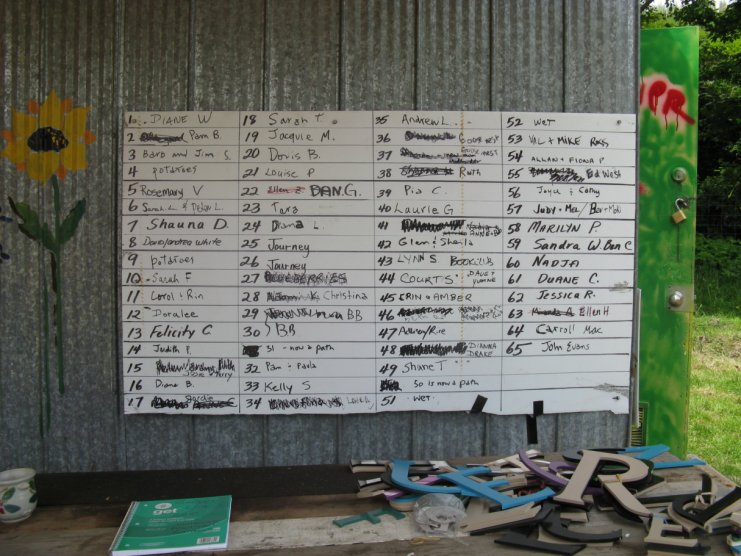
before moving on to discuss the garden, which was on land set aside by the the Sunriver housing development. Half the 65 plots are intended for residents of the development with the rest for people from Sooke. It’s an organic garden, so participants must sign agreements to hold to organic growing principles, and they are bound by a ‘use it or lose it’ guideline. The community has embraced the idea and given generously of time and in-kind donations so it’s off to a good start.

We were treated to a lunch that included local bread and ALM Farm greens – in another of Phoebe’s bowls – and then departed.

Why it’s a good idea to grow and cook as much of your own food as humanly possible

Latest notices from the Canadian Food Inspection website May 25, 2010 – June 18, 2010

  • HEALTH HAZARD ALERT – Consumers Cautioned To Avoid Recalled Meat Products
  • Consumer Advisory – United States’ “SpaghettiOs” With Meatballs Recall
  • HEALTH HAZARD ALERT – Certain Green Cardamon May Contain Salmonella Bacteria
  • Industry Bulletin – U.S. Removes Temporary Restrictions on B.C. Cattle and Bison
  • Industry Bulletin – CFIA Stops Issuing Import Permits for Certain Plant Pests Being used as Feed, Bait or Pets
  • EXPANDED HEALTH HAZARD ALERT – Ready-To-Eat Cooked Meats Produced by Establishment 294 May Contain Listeria monocytogenes
  • HEALTH HAZARD ALERT – Certain LESTERS Brand Montréal Smoked Meat Pouches May Contain Listeria monocytogenes
  • Prosecution Bulletin – LIF Foods Inc. Fined $50,000 and Placed on
  • Probation for Two Years for Offences Under the Food and Drugs Act
  • HEALTH HAZARD ALERT – READY-TO-EAT COOKED MEATS produced by establishment 294 may contain Listeria monocytogenes
  • HEALTH HAZARD ALERT – Certain RICHLAND VALLEY and TAKE AWAY CAFÉ brand SANDWICHES may contain Listeria monocytogenes
  • Foodborne Illness Outbreak Response Protocol (FIORP)
  • Prosecution Bulletin – Oliver Cheung Hon Mok Ordered to House Arrest For Violating the Health of Animals, and Meat Inspection Acts
  • Industry Bulletin – Brucellosis not confirmed in British Columbia
  • News Release – CFIA Extends Compensation Application Period Related to Phytophthora ramorum
  • Approved regulatory amendments that were recently enacted and published in the Canada Gazette, Part II
  • Regulations Amending the Phytophthora Ramorum Compensation Regulations – Sudden Oak Death Extension
  • News Release – CFIA Deploys Traps to Detect Emerald Ash Borer
  • ALLERGY ALERT – Undeclared Milk in Certain 1.5 kg Boxes of Uncle Ben’s Bistro Express 6 Pack
  • Industry Bulletin – New U.S. requirements for tomatoes shipped from Canada
  • Update: Toronto Police Service issue public safety alert for food product tampering
  • Toronto Police Service issue public safety alert for food product tampering
  • News Release – Government of Canada Releases New Common Food Allergen Booklet
  • HEALTH HAZARD ALERT – Voluntary Recall: President’s Choice® Baked By You™ Roasted Garlic Bread May Contain Metal Holding Pin
  • News Release – Canada advances system for cattle traceability
  • CORRECTED HEALTH HAZARD ALERT – Certain Fresh Express Brand Romaine-Based Salads May Contain Salmonella Bacteria
  • Suspected Brucellosis Investigation in British Columbia
  • HEALTH HAZARD ALERT – Certain Fresh Express Brand Romaine-Based Salads May Contain Salmonella Bacteria

Lovely lavender and scourge of the wireworm

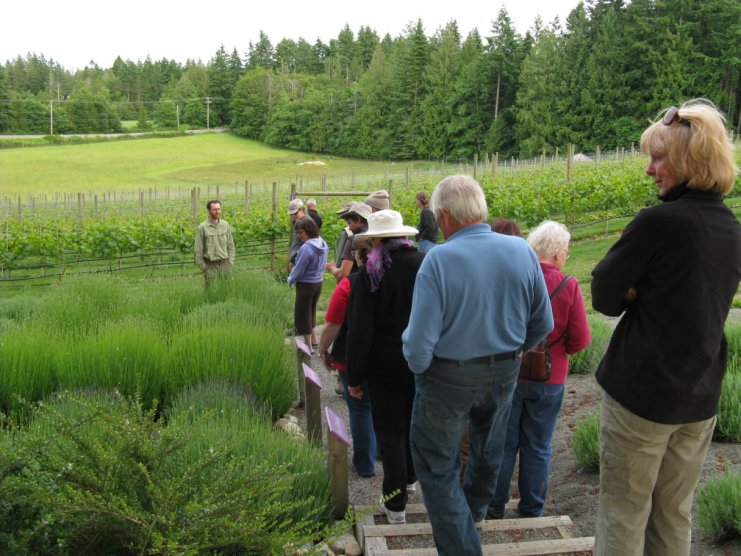
The Canadian Organic Growers, with chapters across the country, has a lively membership on Vancouver Island, which includes summer farm tours in the area. Yesterday’s tour took us to Cobble Hill to see a lavender farm, and on to Cowichan Station to visit a CSA operation that offers grain and vegetables to subscribers.

We started at Damali Lavender Farm and B&B;,

where they grow lavender

and grapes (Castel) – which they had been selling to winemakers but are now turning to premium wine vinegar.

There’s a labyrinth there, used occasionally for workshops and special events

We had a good look at the lavender still,

which is used to extract essential oils. Not an inexpensive piece of equipment, they invested in it after making do with a smaller version their first couple of years, and it’s reduced the workload hugely; from 16 eight hour days to one. It’s portable (they have a trailer to allow them to move it) making it possible to lease it out to others who want to press essential oils from various sources such as fir.

After an aromatic turn round the gift shop – everything from essential oils and soaps to teas (chocolate mint and lavender being a popular one) and vinegars – we departed for our tour of Makaria Farm in Cowichan Station. It’s a 10-acre fruit and vegetable farm, famed for its peas and strawberries, and also for its innovative grain CSA which it started last year, born of Brock and Heather’s desire to learn about small-scale grain production. They’d come across a copy of Gene Logsdon’s 1977 classic Small Scale Grain Raising:An Organic Guide to Growing, Processing, and Using Nutritious Whole Grains for Home Gardeners and Local Farmers and were inspired to experiment with its concepts, while bringing in local experts like Tom Henry to offer on-the-spot guidance; by bringing in 55 other families they were able to share the knowledge, and workload, more widely. This year the grain CSA is more streamlined, with participants coming in to help with the harvest instead of maintaining their own plots.

This year’s plantings have been hugely damaged by pests above and below the soil. Wireworm has devasted the couple’s plantings,

as have ravens which have been descending in droves to pull seedlings out of the soil –

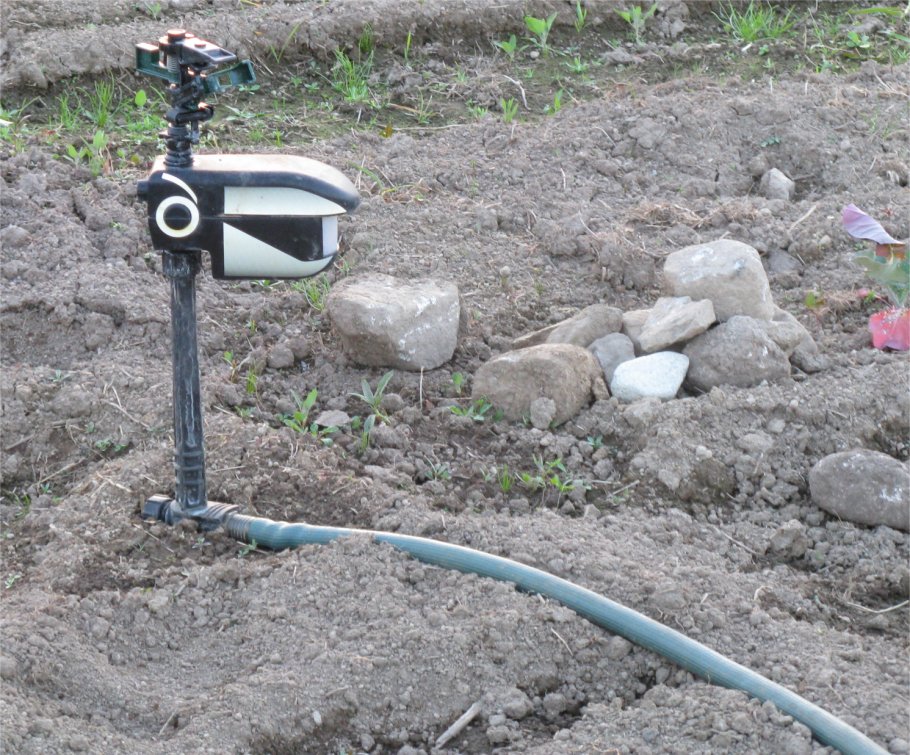
they suspect in search of wireworms. This has led to a heavy investment in modern scarecrows – motion-sensitive water pumps –

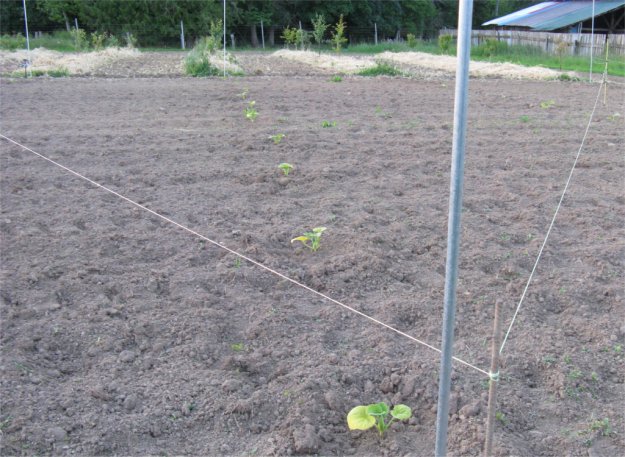
and experiments in stringing off portions of the fields in an effort to keep the birds off.

Here’s a field that they planted and worked and then forgot to turn the scarecrow back on for just one night: by the following morning this was the scene:

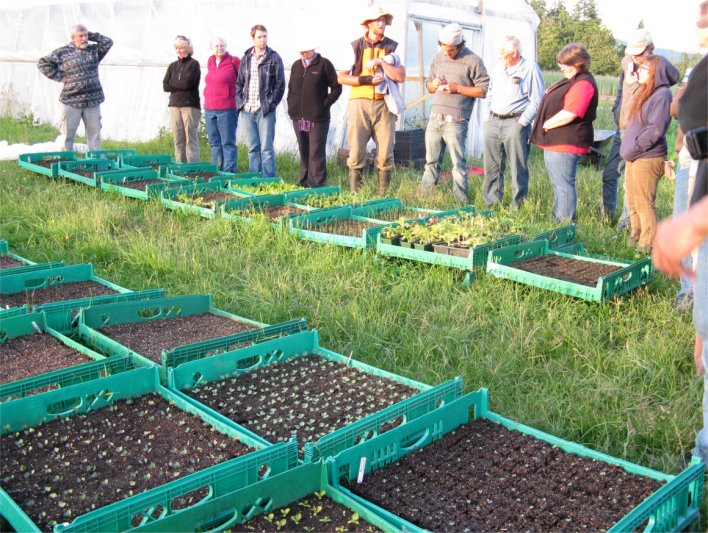
They have done some epic work in soil-blocking, using old bread crates to hold them,

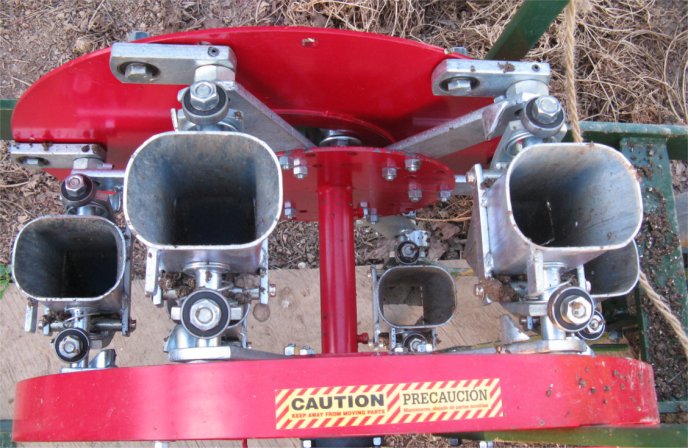
and a fancy machine (designed to plant into plastic mulch, in fact) to plant them.

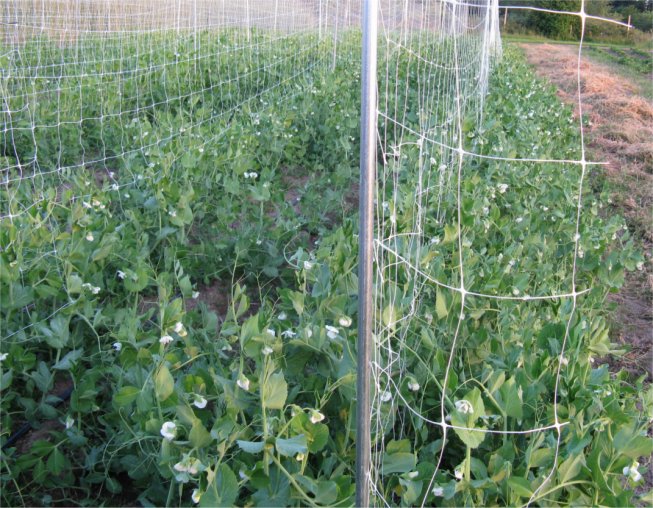
Their peas (climbers on one side of the net and bush on the other)

and strawberries are thriving.

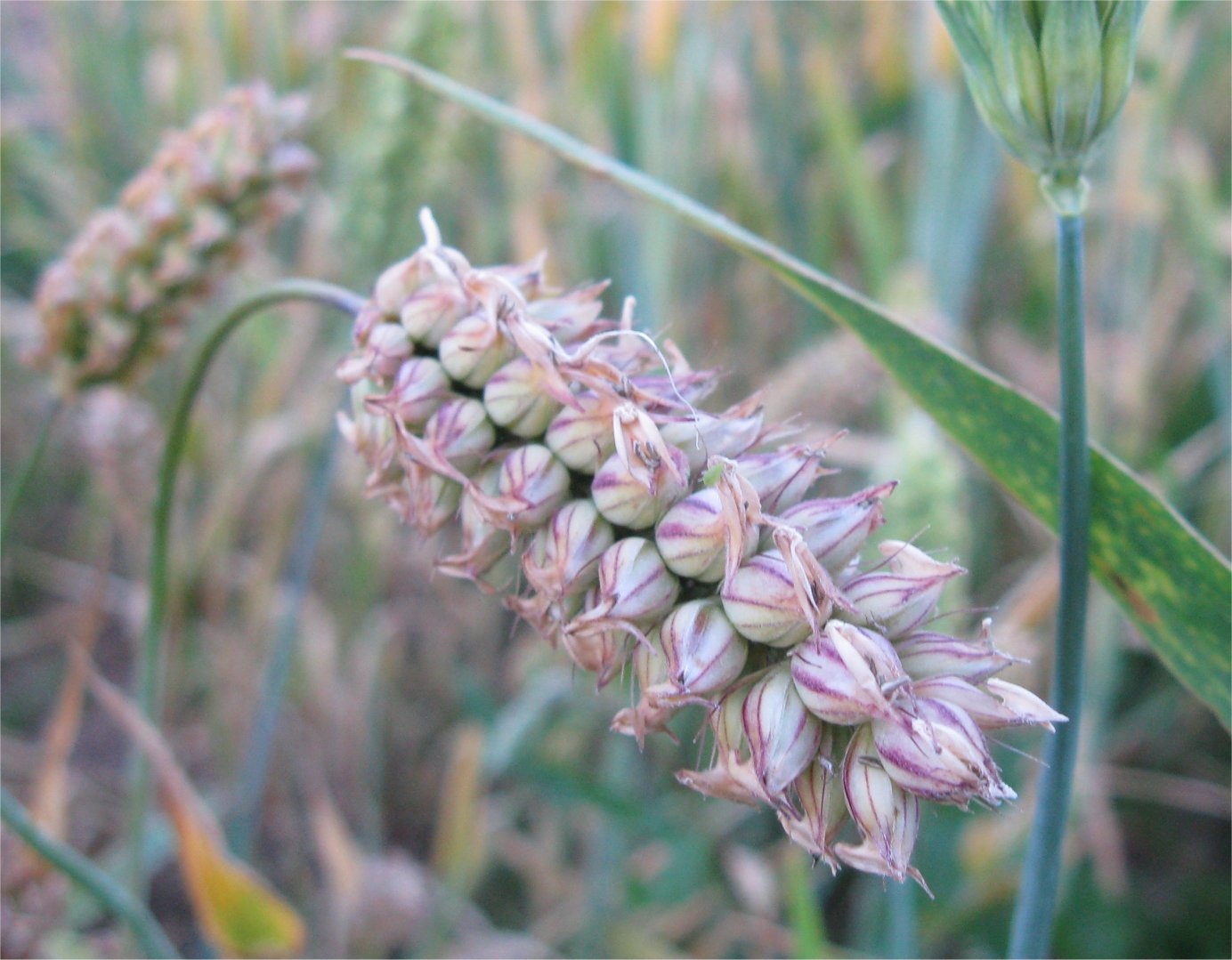
The barley looks healthy

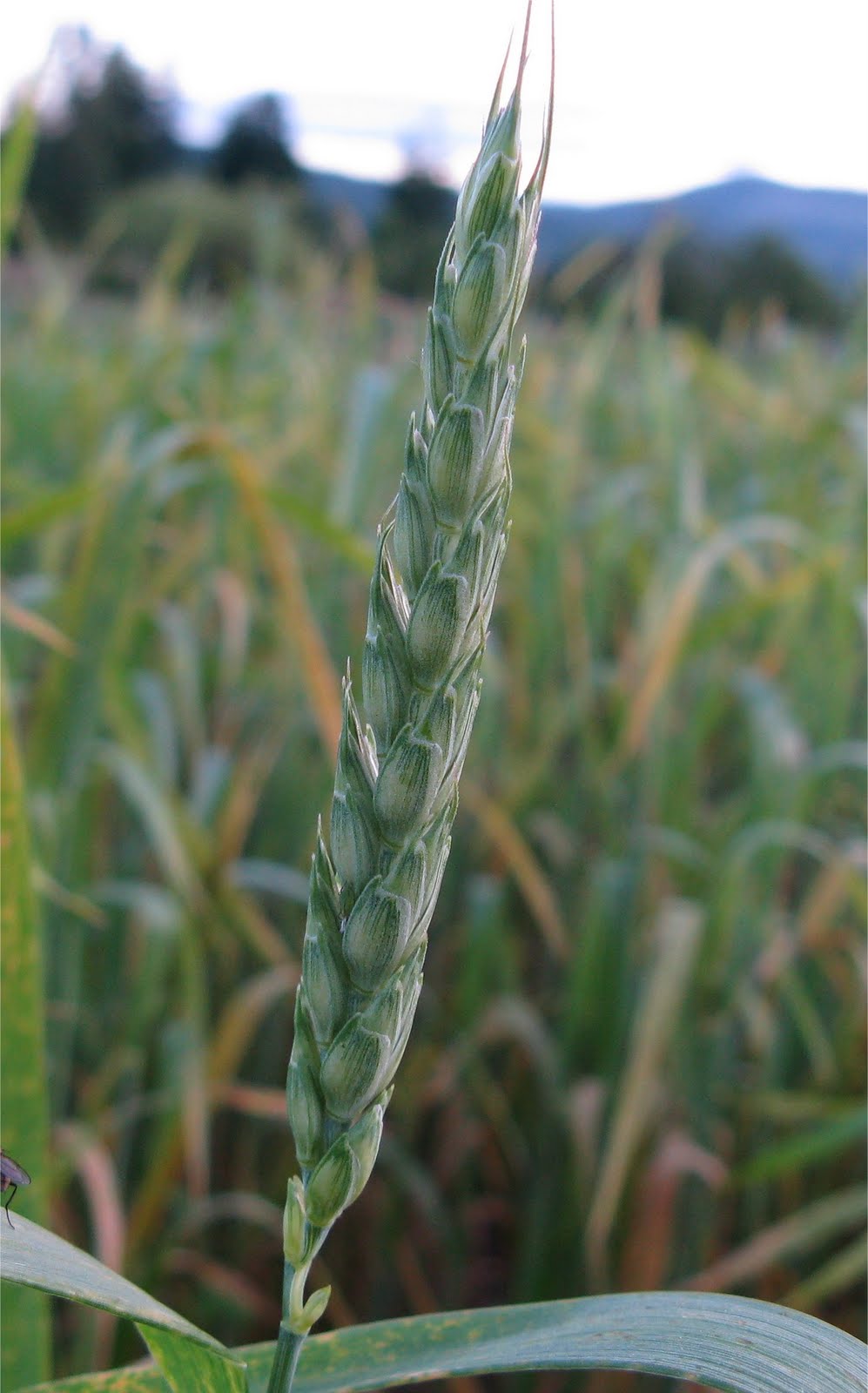
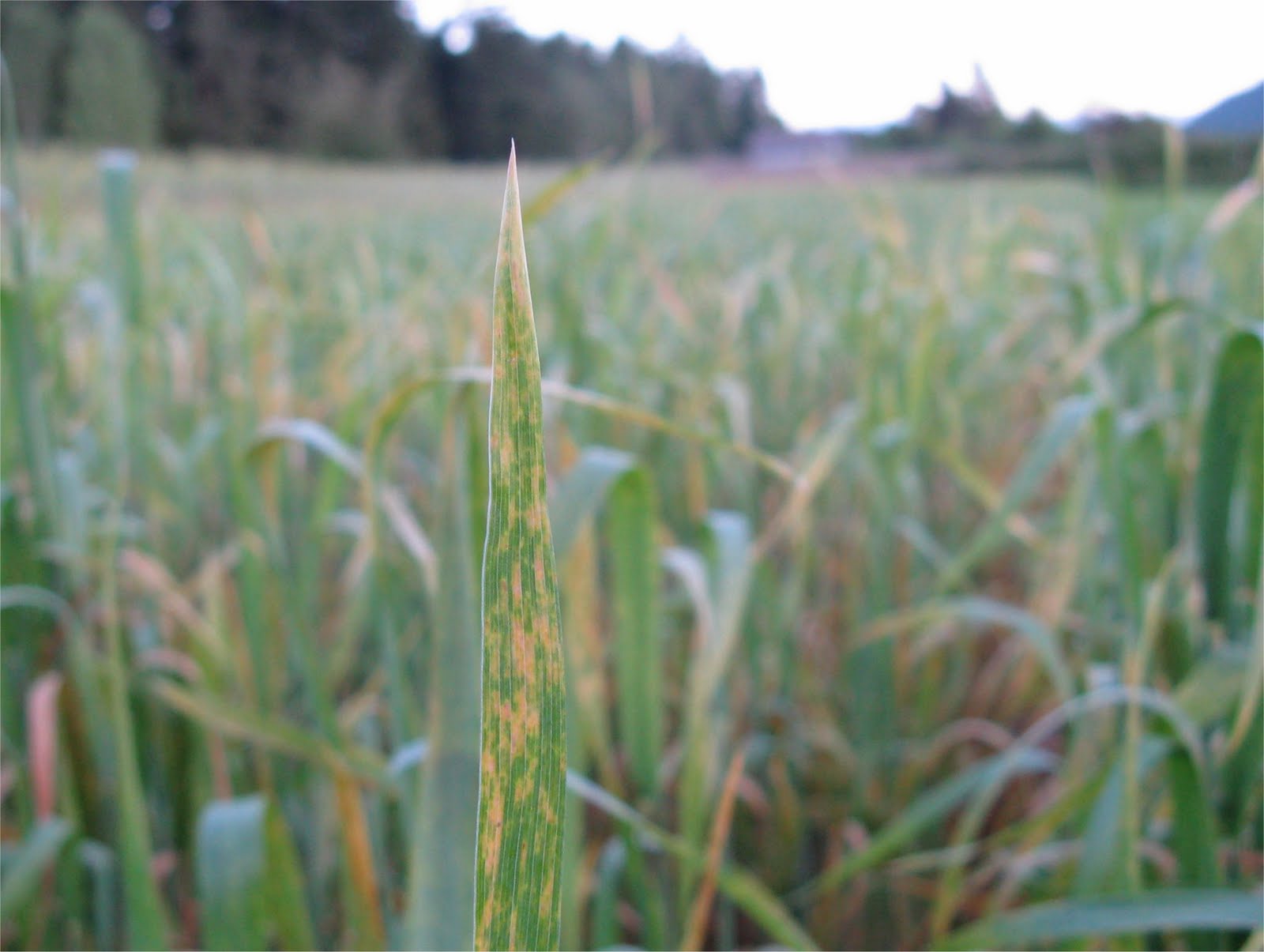
but the Red Fife wheat

has been stricken by rust.

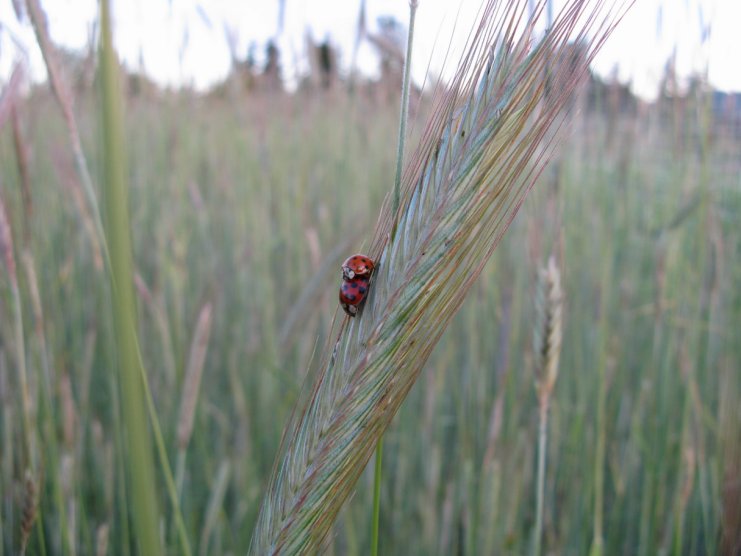
But the beneficial insects seem happy and fruitful, at least.

Farms & gardens

Sooke’s Sunriver Allotment Garden opens properly with a garden dedication this weekend. I won’t be there for that but hope to have a look round soon.

There’s been a lot of buzz about Chinese organics, since this article about dodgy dealings on the inspection end hit the NYT headlines. More fuel for the locavores, and even more fuel for the urban farmers.

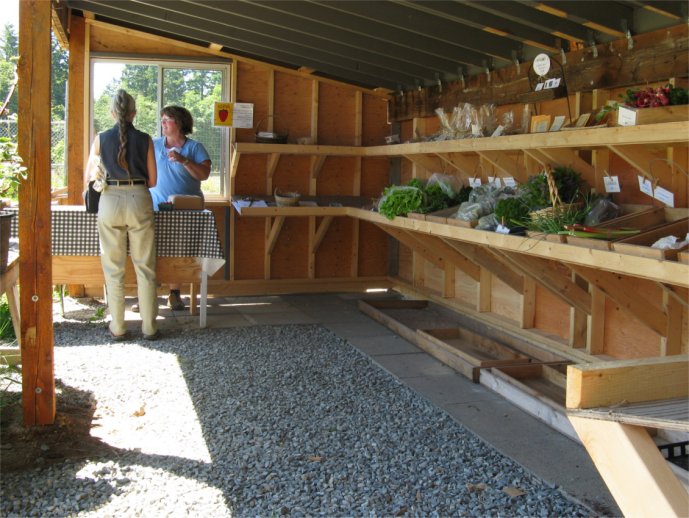
Good to know therefore that there’s clean and impartially inspected certified organic food on offer nowadays at Haliburton Farm‘s farm stand,

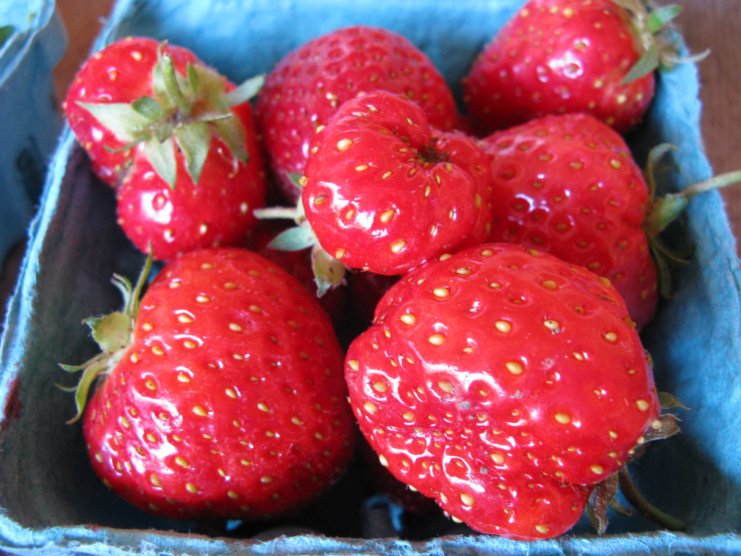
gearing up for full scale summer produce in the next few weeks, but open now with fresh greens, salad fixins and – gosh is it summer already? – strawberries

and (ahem) a little home baking.

Our work parties at the farm have moved to the plot formerly worked by the farm’s gardening and cooking school arm, Terralicious, which has sadly ceased to be since its owner is moving to California. There’s lots to weed

and lots to plant (beans, in yesterday’s case).

We had our own local urban farmers’ garden tour last weekend on a (so far) unusually warm and sunny day, and I found it reassuring to see that even though we’ve had such a chilly spring, there’s lots of life in them there gardens, and some tantalizing signs of summer ready to pick.