Skip to content

Earth Medicine

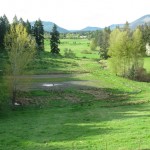
View from Alderlea FarmhouseI’d heard bits and pieces about biodynamics over the years and finally had an opportunity to hear Dennis Klocek speak about elements of it last weekend. It’s not an easy thing to wrap your head around, or define succinctly – though one of my favourite thumbnail definitions of what it is was “organics with knobs on.” Which is amusing though not illuminating, and after a full day plus evening lecture by one of the teachers from the Rudolf Steiner

College I feel a bit closer to understanding some of Steiner‘s ideas about biodynamic agriculture. But don’t feel much more able to capture it in a few words. Nor could Steiner, for good reason, and this perhaps this excerpt from his Agriculture Course Lecture 1 gives you a sense of the span of his thinking:

Why is it that people think they can talk of a thing from theoretic points of view, when they do not understand it? The reason is, that even within their several domains they are no longer able to go back to the real foundations. They look at a beetroot as a beetroot. No doubt it has this or that appearance; it can be cut more or less easily, it has such and such a colour, such and such constituents. All these things can no doubt be said. Yet therewithal you are still far from understanding the beetroot. Above all, you do not yet understand the living-together of the beetroot with the soil, with the field, the season of the year in which it ripens, and so forth….

To take [the beetroot growing in the earth] just for what it is within its narrow limits, is nonsense if in reality its growth depends on countless conditions, not even only of the Earth as a whole, but of the cosmic environment. The men of to-day say and do many things in life and practice as though they were dealing only with narrow, limited objects, not with effects and influences from the whole Universe.

This addresses what I think is the main problem with, well, everything that matters in the world today, which is the human insistence on seeing the biosphere as a jigsaw puzzle of independent objects that can be damaged, altered or removed without any effect on the rest. Our legislators cannot seem to grasp the fundamental interconnectedness of life on this planet, and until that is accepted, I think we are all doomed. Fortunately, we all have the opportunity to educate ourselves, and share that knowledge, and hope to restore some sanity to the world around us.

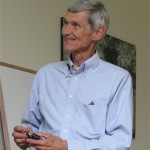
Dennis Klocek at Alderlea Farm 

Dennis Klocek

Klocek has been involved in biodynamics for decades, and besides being author of a revered text on weather patterns is billed as the Program Director of Consciousness Studies at the college. He began by giving us the beginnings of an answer to that “what is the difference between organics and biodynamics” question. It is everything to do with the philosophical underpinnings:

Steiner recognized the principle of evolution of consciousness. The destiny of the earth is congruent with the evolution of human consciousness: and in fact the two are interwoven. The vast majority of people today are divorced from the reality of the spirituality of the earth (it’s been described as “mother” in the past, in more naturalistic cultures) and instead see the earth as a resource to be used.

He went on to discuss the evolution of consciousness in more detail. We are here, he argued, to learn about limitations. While the past, we depended upon others (“tribal consciousness”), today we have evolved to cope with our human limitations using technology. And technology arises from human imagination, which allows us to convert things of nature into things that nature can’t make (medicines, machines, devices): unlike a rock or a bird, we are able to make manifest what exists in our imagination.

But morality has to keep pace with technical capacity: if that doesn’t happen, we can only assess morality after the fact and end up with regulations. We’ve certainly overdone it with Western thinking, and risk being regulated out of existence by our own technology (just think of the legal wrangles over being “allowed” to produce food: chicken bylaws, meat regulations, land use policies). Simulated culture will be all that’s available to us, he warned, unless we find a way to re-establish our connection with nature (“Gluten-free pizza with dairy free cheese,” he mused: “Why even bother?”)

He went on to talk about the uses of imagination, patterns, the mineral cross, the drop picture method, antenna theory, the philosophy and science behind biodynamic preparations and planting charts that use the the star moon (lunar cycles in conjunction with planetary aspects that cause tidal and atmospheric changes) and which are perhaps most simply followed by buying a copy of Stella Natura and doing what it says.

So. A thought-provoking day was had by all and I’ll need to spend some more time mulling over my notes and looking at a bit more Steiner before I rush out to stir up the preparations. One of my earlier encounters with biodynamics was our memorable sojourn to Crete in 2007, where agronomist Kostas Bouyouris had explained some of his background in it. He said he’d been skeptical about the theory and had tested it out enough to convince himself that it worked, and applied it without attempting to explain it in full to local farmers, letting them see for themselves. But there was enough poetry in the talk to intrigue me, and I can enjoy that for starters. As I did the excellent food grown (biodynamically!) on the farm and provided during the day by Katie Ehrlich and her team from the Alderlea Farm Cafe. It’s definitely worth a taste if you’re passing…
Wendell Berry: “It All Turns on Affection”

By now all thoughtful people have begun to feel our eligibility to be instructed by ecological disaster and mortal need. But we endangered ourselves first of all by dismissing affection as an honourable and necessary motive.

Our decision in the middle of the last century to reduce the farm population, eliminating the allegedly inefficient small farmers was enabled by the discounting of affection. As a result, we now have barely enough farmers to keep the land in production with the help of increasingly expensive industrial technology and at an increasingly ecological and social cost.

Wendell Berry is known to many of us in many ways, whether as farmer, poet, novelist, essayist or land activist. I recommend taking the time to listen to his no-holds-barred Jefferson Lecture, in which he urges us to restore affection – for our land, neighbours and community – in order to attend to matters crucial for human survival.

The lecture is a powerful and compassionate analysis of our times. Such words as these struck me:

Now the two great aims of the industrialism, the replacement of people with technology and concentration of wealth into the hands of a small plutocracy, seem close to fulfillment. At the same time, the failures of industrialism have become too great and too dangerous to deny.

Corporate industrialism itself has exposed the falsehood that it ever was inevitable or that it ever has given precedence to the common good. It has failed to sustain the health and stability of human society. Among its characteristic signs are destroyed communities, neighbourhoods, families, small businesses and small farms. It has failed just as conspicuously and more dangerously to sustain the health and wealth of nature.

And these:

The losses and damages characteristic of our present economy certainly cannot be stopped, let alone restored, by liberal or conservative tweakings of corporate industrialism, against which the ancient imperatives of good care, home-making and frugality can have no standing.

The possibility of authentic correction comes I think from two already evident causes.The first is scarcity, and other serious problems arising from industrial abuses of the land community.

A positive cause still little noticed by high officials and the media is the by now well-established effort to build or rebuild local economies, starting with economies of food. This effort to connect cities with their surrounding rural landscapes rests exactly upon the recognition of human limits and the necessity of human scale. Its purpose to the extent possible is to bring producers and consumers, causes and effects, back within the bounds of neighbourhood, which is to say the effective reach of imagination, sympathy, affection and all else, including enough food, that neighbourhood implies.

Earth Day: gruesome gorse and wild food

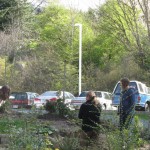
It was a busy Earth Day weekend. Saturday I spent grubbing around in the undergrowth of Gorge Park where a community cleanup was underway, in an attempt to control the spread of gorse as well as other invasives familiar to me from my own garden: English ivy, Spurge Laurel (a toxic black-berried invasive, what I’ve heard called daphnea but is really Daphne laureola), Ivy rootsand holly. The Himalayan blackberries were everywhere too but I think we would have needed two or three pairs of the leather gloves they issued the gorse-gatherers to tackle those. Even the ivy had grown to such staggering strength we had to take an axe to some of it to slow its spread. I considered that we were doing invasive species interruption rather than elimination as the problem of escaped garden plants is pretty much out of control. Still, there’s an ongoing series of cleanup parties planned for the Gorge Tillicum parks to try to get a grip on some of it.

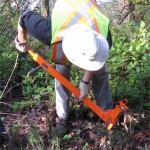
Gorge Park cleanup - gorseOne of the Saanich Parks staff who accompanied us glumly observed at one clearing that he’d been there when they had a gorse removal task ten years ago. But, he said, there’s been no funding since then and it wasn’t a priority. Our mission of the day was to try to keep the spread to a minimum by removing flowering plants before they could set seed, and removing what we could without disturbing the soil too much. We were instructed to pull the smallest gorse seedlings and then tamp the earth back down to slow the replacement through buried seed. LarPulling gorse rootger plants have strong taproots and as they mature the roots branch outward and new plants sprout from those. So we were told to cut below the first root nodule, or to flag the plant for someone to pull later. The largest plants will be strategically poisoned: there is a pesticide ban in Saanich but it is sometimes the only route available to parks workers trying to contain well-established invasives.

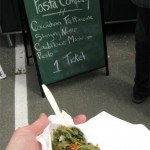
Nanaimo Wild Food Fest-Cowichan Pasta Nettle fettucineYesterday’s treat was a trip to the third annual Wild Food Festival in Nanaimo. A gorgeous day for it and a good throng already queued up by 11:30, half an hour after it opened. I was able to control my consumer urges by sagely bringing only a little cash, but I managed some fine sampling for the half dozen food tickets I did purchase.

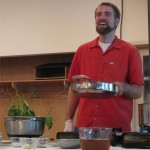
Later I watched a cooking demo with Francois deJong, from Francois deJong - Nanaimo FoodshareNanaimo Foodshare, who was whipping up a generous batch of Nettle Polenta with Blackberry Hazelnut Brown Butter, with a side salad of kale and miner’s lettuce. He had brought along a bag of gleaned local hazelnuts which grow wild and cultivated in the area, and another of stinging nettles, which were the most popular food ingredient at the fair. There was nettle soup, nettle in wild food smoothies, nettle gyoza, nettle pasta and nettle ice cream.

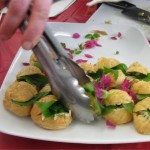
It’s Gougere with wild leaves and salmonberry blossomsa good food with many health benefits, but I think we need to move on and learn to eat a few other things too. So I was happy to see raw blackberry cheesecake; a lovely gougere filled with wild greens and local cheese and apples; and a wild greens salad (chickweed, miner’s lettuce, sorrel and dead nettle) among the offerings. I came away with a bag of delicious Immuni-tea (made from rose hips, wild ginger, peppermint, catnip, elderflower and yarrow) and a few more ideas about turning my weeds into feeds.

Clay, cordyceps, clams and cucumbers

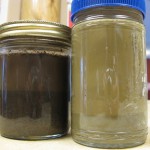
Last weekend’s permaculture course covered soil (with Christina Nikolic of Gaia College, SOUL and The Organic Gardener’s Pantry), fungi and animal husbandry. We started things off with a bit of digging in the garden to collect our soil samples, which we scooped into flat-bottomed jars, topped up with water and commenced agitating to thoroughly break the soil finely enough to settles and show its layers. We were advised to scrape aside the organic matter and just go for the soil. It was going to take some time for everything to settle – but we began to see the surprising truth of Christina’s observation that even where we thought we had hard clay soil, chances were it was simply compacted and the actual clay content would not be that great. The colour of the soil reflects the amount of organic matter, with darker samples being higher in humus, and lighter ones tending towards higher clay content… no bad thing since clay holds water and nutrients better than silt or sand.

Water made up most of the jars, and the layers then settle in this order:

  • (small amount of organic matter floating on top)
  • water
  • clay
  • silt
  • sand

Christina takes a more benign view of soil than most instructors. Knowing your soil type does not mean you have a problem to manage, she says, and nor is there any point to spending money on soil tests. Instead, focus your energies on building up the organic matter in your soil (even a great soil probably only comprises about 10% organic matter) which makes it more able to absorb and retain water and nutrients.

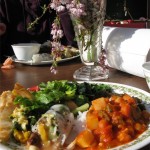
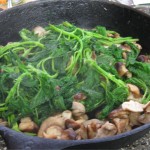
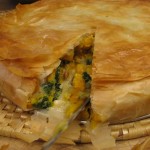
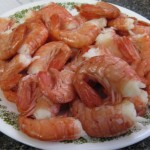
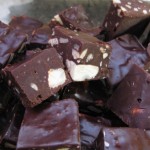
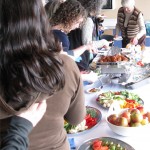
There followed one of our increasingly excellent potluck suppers, which we were delighted to be able to eat on the sunny patio, and which included such local delicacies as steamed nettles with shiitake mushrooms, kale & squash filo pie, mango spring rolls and spot prawns… but the vegan fudge shamelessly stole the show.


After our giant feed, we talked about different ways of growing mushrooms – from inoculated logs (actually bagged bricks of substrate made from grain or wood chips – these are widely

Mushroom stem butt

available here nowadays at farmers’ markets), from spore prints or even stem butts. We were told that mushroom logs can be broken up and used to inoculate mushroom beds made in various ways in the garden, or rehydrated to fruit multiple times, as the mycelium web runs throughout the substrate. By far the most entertaining moment came when Brandon told us about the cordyceps mushroom that infects carpenter ants – compelling them to take to the highest branches of trees, and killing them at the moment their mandibles bite into a leaf, at which point the fungus grows from their bodies. It is a method of pest control (carpenter ants and termites) described by the mushroom guru Paul Stamets whose TED talk also discusses how to use mushrooms to clean industrial waste and for so many other purposes – medicinal, fuel and more – that he proposes preserving old growth forests as a matter of national defense. David Attenborough has documented cordyceps too:

I finished my weekend on Monday evening when I moseyed over to Vancouver Island University to attend a discussion about local food which featured John Ehrlich (of Alderlea Farm) who has a 300-subscriber biodynamic CSA (veg box scheme), and Guy Johnston, who is starting his second year of a Community Supported Fishery offering salmon, prawns and octopus. We broke for a mid-session snack offering local foods including Natural Pastures cheese – but one of the points earlier made was proved to us: in order to offer us local food, the organizers had to buy it and bring it into the meeting. This college with its cafeteria downstairs and a well-established culinary arts program is tied like many institutions to trade agreements and supplier contracts that do not address the provenance of ingredients. In order to assure a local food supply, local food producers need local consumers, and as has been often said most of our food is made up of cheap imports purchased from off-Island wholesalers.

Farmer John Ehrlich
Fisherman Guy Johnston

Spring at Haliburton Farm

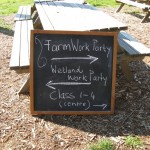
Managed to get to my first Haliburton Farm work party on Saturday. A lovely day for planting spinach, which we then covered with row cover to keep the critters out and give it some warmth while it grows. Might be the solution for my own garden where the leafminers dine well on all my leafy greens. Meanwhile, back in the kitchen Naomi had whipped up one of her nourishing soups for lunch, which we ate with some bread from her local organic bakery, and then ended the work party early. We had to clear out to make room for the new course running there, Growing Food in the City, but that left the better part of a (finally) sunny afternoon to play in our own gardens.


I was delighted to come across this clip of local TV coverage showing off Haliburton’s farmers. Thanks to Permaculture BC for posting it.

Of those featured, some extra info: Farmer Derek is in the process of taking over Carolyn Herriot‘s organic seed company, Seeds of Victoria, and Farmer Ray will be showing his considerable skills in compost building to attendees of the next COG-VI meeting that takes place at the farm next week (Canadian Organic Growers is another endangered species due to funding cuts – membership an inexpensive and hugely worthwhile way to help support organic farming – join today!).

Spring on the wing

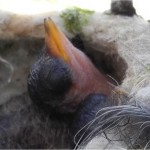
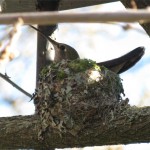
Spring is erupting in all directions. The Anna’s Hummingbird (Calypte anna) nest that graces my fence has very recently produced three newborns and I’m looking forward to watching their progress (and seeing how they all squeeze into a space that’s probably two inches across at most). It’s still damp and chilly here so the mother is spending a good deal of time warming their hairless, featherless bodies. I knew they were big on nectar – hence their value as pollinators – but hadn’t realized they also chow on insects. I’ve hung a feeder nearby that should (for now) be safe from the ants who overran it last time I hung it out. I’ll have to make an ant moat if they become a problem again.

Speaking of moats, I’m intrigued by the idea of a chicken moat. Not a chicken keeper myself, but I’m working on a group project around chickens for the Permaculture Design course I’m taking.

Other airborne creatures have been in the news lately. Meli sent me notice of the headline item that bees are being adversely affected by pesticides. I am not quite certain why it has suddenly become headline news that if pesticides kill insects, and bees are insects, then bees are going to be harmed by pesticide use, but I suppose it does not hurt to belabour this important point. To which should be added the related point that pesticides will also harm beneficial insects besides bees, as well as the higher life forms (hummingbirds, for example?) that feed on those – whether by poisoning them or by removing a food source.

Let us all (who are within geographical reach) celebrate our wisdom in these matters by heading off this Saturday to enjoy a pesticide-free work party at Haliburton Community Organic Farm.