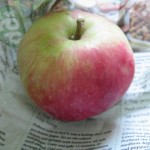
 I came upstairs from a round of apple-wrapping to find some questions on apple preserving from Ruth, who is the lucky recipient of a quantity of hangingoverthefence apples.
Like me, she had heard that wrapping apples individually in newspaper is the way to go. She’d read that coloured inks are toxic so to avoid those, but I’ve been told that Canadian newspapers use soy-based colour inks so they are ok (but glossy inserts are not). (I don’t know if this is really the case or not, so if in doubt, avoid them.) I’d heard it from the Compost Education Centre which suggests that you can add newspaper to your compost (for a “brown” layer), which means the apple wrapping can do double duty if you end up with some spoilage later in the season: you can just chuck the whole thing into the pile. The point of wrapping is to keep the apples from spoiling one another if they’re bruised or damaged. Lacking a root cellar, I am fortunate to have a little bar fridge that I use just for apples and it works reasonably well.
My first year of bounty, Adrienne gave me a wonderfully liberating tip: you can pee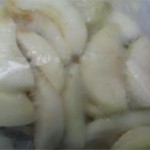 l, core and slice apples and put them in ziplocks in the freezer – works brilliantly for cooking apples. Don’t worry if they brown a little en route to the freezer as they go brown when you cook them anyway. But I suppose if you can’t bear the thought of any brown, you can always dip them in syrup while you work, as the PickYourOwn folks recommend. But I don’t find they brown too badly if you work quickly on fresh and fully ripe apples. The ones in the picture were frozen a year ago with no syrup or preservative: I’d still use them in baking.
If the apples are of a fairly firm texture you can slice and dehydrate them (my tree is a yellow transparent, which produces very soft apples great for applesauce but impossible for drying). Here are some instructions on drying apples in a dehydrator, an oven or a hot car!
I have an apple peeling machine which makes a lot of the labour-intensive aspects slightly less so. As long as you’re dealing with firm, regularly-shaped and very fresh apples. It doesn’t work well on my transparents which tend to be soft and misshapen. It’s also less frugal than I when it comes to peeling and coring: such is the trade-off with labour saving devices of all kinds.
Or you can make applesauce and can that – it’s a high acid food so you don’t need a pressure canner, just a pot large enough to cover the jars with water and process (boil) for 20-25 minutes depending on the jar size and altitude (again from the PickYourOwn website, good instructions on applesauce, with photos) I’ve made it with plums or quince and those are nice combinations; perhaps saskatoon-applesauce or raspberry-applesauce would be good if you have an alternative source of berries.
I own a centrifugal juicing machine so that’s what I use. Because my apples are very tart I always add carrots for sweetener (sugar as a last resort); or blend them with sweeter varieties or other fruit. This year I decided to use up some surplus jam from my larder, so I 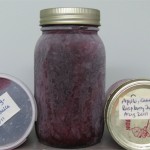 heated that and added it to blackberries I’d picked, and strained the juice and used that for sweetener. I also used raspberries and carrots. I don’t have a recipe, just go by taste. I put the juice into jars or plastic tubs, cover them and freeze them. Because the liquid expands while freezing, if you’re using screw-top jars, be sure to leave the lids loose until the liquid freezes, to avoid any messy explosions.
I have made apple butter in years past, but find I don’t use it.
Thanks! My 2 bits worth: I find the best way to preserve apples is to choose varieties carefully, and then to store them naturally, away from other fruits and vegetables, in a cool, slightly humid, dark place, with slight air exchange. Refrigeration is not the way to go. Better yet, varieties. These are some great keepers: Kandil Sinap, Maigold, Newtown Pippin, Winesap. There are many others. Look for hard late-season apples, starchy when picked, with firm flesh, and a colour on the green-brown side when fully mature, that will warm through the yellow spectrum later and make the reds shine, if they have them. The absolute best keeper I’ve found is the Kandil Sinap, but only by a hair over the Maigold. If you don’t mind wrinkles, these also keep well: Golden Delicious (old varietal stock), Royal Gala (for cooking purposes only, as they lose their aroma quickly), Belle de Boskoop (or Boskopf). Again, there are many others. Look for apples with a high sugar and acid content and dense but juicy cell structure, as well as waxy skins (but not Jonagolds, for instance, or anything with huge cells gushing with juice) . These are my absolute favourites for fresh: Ribston Pippin, Ambrosia, Spigold (even better than Jonagold, from New York), Golden Russet, Boskopf, Newtown Pippin (sun-ripened), Macoun (superior to the Spartan), and Cox Orange. There are many others. For juice, Wealthy. Mmm. For apple sauce, I find Sintas to have a lovely cinnamon taste, and, of course, the great Russian herself, the Yellow Transparent, is unbeatable, and freezing works very well with this sauce. The best cooking apple is a toss up between Gravenstein, Bramley’s Seedling, and Boskopf, but my bias leans towards Boskopf, because all those Apfelkuchen recipes that say “If you don’t have Boskopfs, don’t bother” are close to the mark. For upside down cake or pancakes, a royal gala or golden delicious will caramelize well. If you play your cards right, you can have fresh apples every day from the third week of July through mid-June, without a single kilowatt of electricity going into their preservation. Pretty cool.
Harold thanks so much for this encyclopaedic feedback – from one who clearly knows his apples!
I don’t actually have a cool, humid dark place in my home, so for me the fridge has to do. So it will be also for many apartment and condo dwellers I expect.
I have thought of using my garden shed for food storage, but the temperature is so up and down there; certainly much too hot right now; and I don’t want to tempt rodent life which down here near the water is ever-present. I do park a big tupperware tub outside my back door for storing winter veg like potatoes and winter squash but of course one does not store potatoes and apples together.
Seems to me what we need are community root cellars..!?