Skip to content

2006

Crumbling allegiances to British food

I get raised eyebrows by the pair when I respond to the question “what do you miss about Britain?” with “the food”. But it’s true. Somehow, perhaps in an effort to stem the flood of immigrants, a myth has been perpetuated that the only food available in the UK is overcooked vegetables, slabs of meat and inedible puddings with strange names. In reality, the countryside is dotted with gastro-pubs offering superb menus; London has the staggering range of cuisine you’d expect of a city of 7 million; and the array of produce and ingredients in supermarkets and specialty shops is the boon of proximity to the Continent and beyond.

That having been said, the Guardian recently offered a grisly list of traditional British dishes that are falling off the nation’s menus, either because they don’t suit the low fat high speed preparation needs of contemporary cooks or because their ingredients – offal (such as calves’ feet or pig cheeks) or game (such as rooks or hare) – are no longer popular.

I was sad to see fruit crumble among the Ten most threatened puddings:

  1. Calf’s foot jelly
  2. Junket
  3. Sussex pond pudding (suet and lemon)
  4. Kentish pudding pie (rice and pastry)
  5. Dorset dumplings (apples and suet)
  6. Lardy cake
  7. Simnel cake
  8. Malvern pudding (fruit crumble)
  9. Singin hinnies (fried scone)
  10. Spotted dick

For those who don’t number fruit crisps on their hit list, there’s a wonderful recipe for Peach and Blackberry Crisp (I made it with apples, blackberries and blueberries and it was fabulous) that has pecans in the topping.

Raspberries and blueberries

A nice campus to visit is Virtual University. Cheap (US$20 for up to 4) classes and one useful freebie that’s already underway this week: How to Prevent Identity Theft and Online Fraud. They have courses in PaintShopPro for anyone that has this cheaper-than-Photoshop application, and some writing classes (but no poetry, at least not this time).

I happened upon a leaflet promoting the Urban Farm Market and Urban Feast Stage which are being offered (free!) as part of Open Air 2006 right through till September. Upcoming on July 23 is featured chef Christopher Moore of the Union Club, July 30: Rick Choy from Hotel Grand Pacific; August 6: Mike Upward, James Bay Inn; August 13: Patrick & Christabele Simpson, The Marriott Inner Harbour. I fear I might be turning into a food demo junkie…

Fresh fruit abounds. I weakened at the sight of a flat of raspberries at the Red Barn Market last week and brought them home to my freezer. I have a couple of good recipes already. I tried the very tasty Gâteau au Yaourt à la Framboise from a wonderful blog, Chocolate & Zucchini which Bonnie sent me a while ago. At that point I was a little short on raspberries so I used half blueberries and it worked well. I’m going to try her blueberry coffee cake recipe next.

From the Lighthearted Cookbook, I have long been a fan of Raspberry-Yogurt Küchen, which has a shortbread base and berries smothered in a baked creamy yogurt topping: particularly nice I think if you make it ahead and served chilled. This time I substituted mostly loganberries, which seemed to me to lack a little zip. Here’s a slightly amended version (I no longer own the cookbook so I’m not sure where I deviated):

Base
1½ cups flour
½ cup sugar
1½ tsp baking powder
1/3 cup butter
1 egg
1 tsp vanilla
3 cups fresh or frozen raspberries
Topping
2 tbsp plain flour
2 cups plain yogurt
1 egg lightly beaten
2/3 cup sugar
2 tsp grated lemon rind
1 tsp vanilla

  • Mix flour, sugar, baking powder, butter, egg and vanilla. Mix well and press into a 10″ square cake pan or springform or flan dish. Sprinkle with raspberries.
  • In a mixing bowl, sprinkle flour over yogurt. Add egg, sugar, lemon rind and vanilla and mix until smooth. Pour over berries.
  • Bake in 350f/180c oven for 70 minutes or until golden.

Peace reigns, most of the time, in the foster animal kingdom:

Is nothing safe?

Appalled to see that a salmonella outbreak in the UK was traced to Cadbury’s chocolate bars! But relieved to see that the source was not the chocolate but the crumb base. So purists can rest easy and carry on with that therapeutic intake.

Yesterday I found the perfect activity for the first gentle day of our heat wave: a visit to Merridale Cidery. We did the self-guided tour to see where and how the cider was made, admired the acres of apple trees and then enjoyed a small tasting of half a dozen of their products. Apple juice was thoughtfully provided for our under-age companion, who was at an age to enjoy the faerie fixtures that were strategically placed to help her endure the tour.

Scrumpy and Traditional Cider were my favourites. In West Country dialect, “scrump” meant to steal apples, and so Scrumpy was the name for pilfered apple cider. At 11% alcohol it was described as a “sit down” cider, and mercifully Merridale has departed from the traditional recipe which calls for raw pork as one of the ingredients.

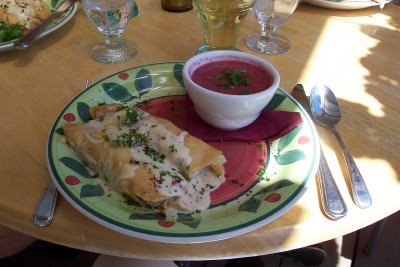
Merridale puts on a mean spread in La Pommeraie Bistro, where we sat outside on the covered veranda and admired the orchard. I had some very nice pulled pork and apple crepes and the soup of the day, a cold honeydew-raspberry concoction which the waitress accurately described as “a smoothie without all the sugar”. It was garnished with chopped mint and gently flavoured with dill and was just the thing for a warm summer day.

The perfect surprise for this melting heat we’re facing was the arrival of my copy of Loutro Poems, an anthology of poetry by writers who attended World Spirit poetry courses 200-2005, lavishly illustrated with colour photos. As if I could forget…

Boris, Billy, Ted and a nice roast chicken

A little awkward to post while being harassed by my desk ornament (yes, folks, Boris is back… he had the sneezes and needed another round of antibiotics so, well, umm…)

Been reading a new Billy Collins (The Trouble With Poetry and Other Poems, Picador 2006) and liked this bit, from Monday:

The proofreaders are playing the ping-pong
game of proofreading,
glancing back and forth from page to page,
the chefs are dicing celery and potatoes,
and the poets are at their windows
because it is their job for which
they are paid nothing every Friday afternoon.

And a little more from Ted Hughes:

Much has been said about the therapeutic value of uninhibited writing, and though no doubt that can go to the point where mere confusion enters, it is one way of talking about the pleasures and the healing effects of reading and writing poetry.

All imaginative writing is to some extent the voice of what is neglected or forbidden, hence its connection with the past in a nostalgic vein and the future in a revolutionary vein.

I had a revolutionary experience with a roast chicken on the weekend. Following the guidance of Lynne Rossetto Kasper, I rubbed a whole chicken with olive oil and then slathered on a paste of 1 tbsp minced rosemary, 1 large minced garlic and 1/4 tsp salt, stuffed a couple of sprigs of whole rosemary in the cavity, covered it in plastic and refrigerated it for 24 hours, and then roasted it at 350f at 20-25 mins/pound, the first half on its breast and the second half breast side up, basting it with cooking juices at intervals until the thickest part of the thigh read 170f on the thermometer. It was gorgeous. The finish was to drizzle it with a 3-4 tbsp artisan balsamic vinegar (or slice it first and and drizzle with balsamic). It was beautifully moist and well flavoured.

While I told Jennifer about this triumph, she reminded me that only a few weeks ago I had been reading to her about the use of salt on meats. A magazine I’m extremely fond of is Cooks Illustrated, which is a food nerd’s dream, featuring experiments from America’s Test Kitchen (something I’d never heard of before I started reading the magazine). In the August issue they were performing merciless experiments on barbecued chicken and explained (with diagrams) the effects of salting chicken for 3 or 6 hours. At 3 hours the flesh does not absorb the salt and you end up with dry chicken (which is why popular wisdom says not to salt roasting meats). But after 6 hours, the salt is drawn into the flesh and you end up with flavour from the salt and from any other water-soluble flavouring agents (e.g. herbs and spices but not oil-solubles like capsaicin, the hot element of chili peppers). They prefer salting to brining if you are dealing with chicken because they found brining made the skin soggy, and salting leaves it crispier.

Fry on Form and Anchovy Amnesty

A book that has, I’m told, not received the best of reviews lies open by my chair these days, and I’m enjoying it so far. The Ode Less Travelled is Stephen Fry’s guide to Unlocking the Poet Within. It’s a manual of metre, rhyme and form by someone who writes privately himself:

“I do not write poetry for publication, I write it for the same reason that, according to Wilde, one should write a diary, to have something sensational to read on the train.”

(If only we Canadians had trains to read on we might be better poets and diarists…?) He quotes Auden on the difficulties of writing free verse:

“The poet who writes ‘free’ verse is like Robinson Crusoe on his desert island: he must do all his cooking, laundry and darning for himself. In a few exceptional cases, this manly independence produces something original and impressive, but more often the result is squalor – dirty sheets on the unmade bed and empty bottles on the unswept floor.”

Lynne Rossetto Kasper has certainly produced something original and impressive in The Splendid Table, her 1992 guide to the cuisine of Emilia-Romagna, the Heartland of Northern Italian Food. Interesting and unusual recipes, including this pasta sauce (which I have only slightly tweaked) which she says comes from the cooks of Modena’s and Ferrara’s Jewish communities. It features a substance unfairly despised and misunderstood in North America: the amazing anchovy. Be not afraid, and you will be fed.

Lemon Anchovy Sauce (Bagnabrusca):
2 2-oz cans anchovy filets
1 cup cold water
6 tbsp extra virgin olive oil
1 large clove garlic, minced
1/2 cup water
2 large fresh tomatoes, peeled, cored and chopped
6 tbsp minced flat-leaf parsley
3 tbsp fresh lemon juice
Freshly ground black pepper to taste.

  • Rinse the anchovies and soak them in the cup of cold water for 10 minutes. Drain and coarsely chop.
  • In a 12-inch heavy skillet, heat the oil over medium heat. Add the garlic and saute until faintly golden but not brown.
  • Add the parsley and anchovies and heat briefly, 30 seconds or so. Immediately stir in the 1/2 cup water and cook over low heat about 2 minutes, until the anchovies melt (isn’t that the coolest thing??).
  • Blend in the tomatoes and lemon juice, raise the heat to medium, and cook 1 minute.
  • Generously season with black pepper and scrape the pan over hot drained pasta – tagliarini is recommended. Toss to coat. Sprinkle with a further tablespoon of chopped parsley and serve (without parmesan or other cheese).

Democratic poetry contest

Any of you out there seething with feelings of helplessness and impotent rage against competition judging… here’s your chance to set the world to rights. ChapterOnePromotions has an open poetry competition that you the voting public can judge. Just click on the ‘Open Poetry Competition’ link on the home page and make someone’s day, in the best possible way. Deadline for votes is July 15.