Skip to content

recipes

Better than a sandwich

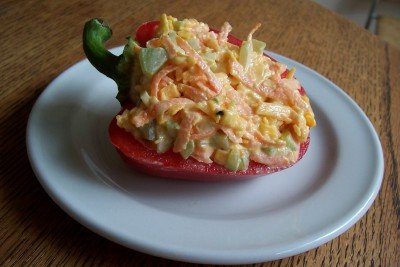
Stuffed peppers are usually cooked, but a long time ago I had a relative of this excellent raw lunch/snack and here is my version, which will stuff two small/medium bell peppers. I recommend red or orange as I prefer the sweetness. Gets a bit gooey if it has to travel, but will survive reasonably well till lunchtime if you refrigerate it. Or you can pack the stuffing separately from the pepper and stuff it when you are ready to eat. It makes a good sandwich filling or spread for toasted English muffins too.

1 medium carrot (about 3/4 cup) grated
3-4 oz cheddar cheese (about 1 cup) grated
1 small green onion, minced (optional)
1/2 rib of celery (about 1/3 cup) diced
1/3 cup mayonnaise, or to taste: just enough to glue everything together
Salt and pepper to taste

An interesting side note about peppers. Bell peppers contain a recessive gene which eliminates capsaisin, the compound responsible for the ‘hotness’ found in other peppers. Capsaisin is the active ingredient in some topical analgesics used for arthritis treatment, such as Capzasin-P.

Caryl Churchill’s play, A Number, is playing at the Belfry in Victoria at the moment. Her most famous play, Top Girls, is being broadcast on Saturday as the BBC Saturday Play. Worth a listen, and available for a week after broadcast.

Chicken salad and the mysteries of poetic craft

In a weak moment I bought one of those pre-barbecued chickens, basted in salt and lathered with a toxic red substance. Still, it left me with enough cold chicken for a good old chicken salad, a food that – like tuna casserole – was mysteriously absent from my upbringing and which I have embraced in later life. Here’s a perfectly straightforward recipe, based on one from the Fanny Farmer Cookbook:

2 cups cooked chicken, skinned and chopped
1 chopped green onion
1 rib celery, chopped
1/2 cup mayonnaise
2 tbsp plain yogurt
1 tbsp wine vinegar
Salt and ground pepper to taste

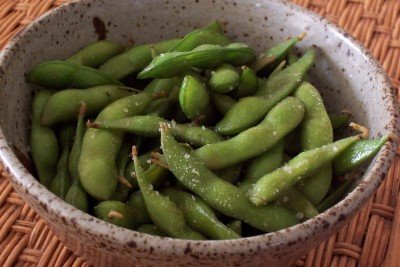
Combine mayonnaise, yogurt and vinegar and blend well; add seasonings. Toss chicken, onion and celery with dressing until well mixed. Serve as a salad, on a bed of greens, or as a sandwich filling, on toasted English muffins. Why mess with simplicity? Have it with a lovely bowl of Edamame, drizzled with sesame oil and dusted with salt.

It hardly needs saying that Mark Strand is not a chicken, or a salad, nor even simple, but interesting to know he is Canadian-born (PEI). I first came across his name as co-editor (with Eavan Boland) of the form poetry anthology, The Making of a Poem. He’s also published a handy little book of essays on poetry called The Weather of Words. I’m finding it heavy going, but there are always moments in any such collection, and so I soldier on. I thought this, from the start of Notes on the Craft of Poetry, was an interesting take on it:

“Each poem demands that I treat it differently from the rest, come to terms with it, seek out its own best beginning and ending. And yet I would be kidding myself if I believed that nothing continuous existed in the transactions between myself and my poems. I suppose this is what we mean by craft: those transactions that become so continuous we not only associate ourselves with them but allow them to represent the means by which we make art… To a large extent these transactions I have chosen to call craft are the sole property of the individual poet and cannot be transferred to or adopted by others. One reason for this is that they are largely unknown at the time of writing and are discovered afterwards, if at all.”

He quotes Orwell’s rules of good writing, and questions whether these or any rules can really be applied to poetry: “For the poems that are of greatest value are those that inevitably, unselfconsciously break rules…”

His argument against craft is that it cannot work as a defining or diagnostic concept, because poetry “cannot be understood so much as absorbed.” He seems to be an advocate for mystery, arguing that we not attempt to impose a structure on the process of creating poems, because to do that is to imply a common purpose for poetry, which it eludes, because a poem’s purpose “…is not disclosure or storytelling or the telling of a daydream; nor is a poem a symptom. A poem is itself and is the act by which it is born. It is self-referential and is not necessarily preceded by any known order, except that of other poems.”

Hail to the Queen

From the incomparable 1955 edition of the Good Housekeeping Cookbook – its pages starting to scallop at the edges, spine restored long ago with silver duct tape – and with a little customization, one of my mother’s triumphs: Queen of Puddings.

For pudding:
1 qt. milk
2 cups 2‑day old bread in 1/2 inch cubes
1/2 cup raisins, plumped in hot tea, sherry or spiced water for half an hour
2 eggs plus 2 yolks
1/4 cup granulated sugar
1/2 tsp salt
1/4 tsp nutmeg
1 tbsp vanilla
4 tbsp melted butter/margarine
For topping:
2 egg whites
1/4 cup sugar
1/3 cup blackcurrant or other fruit jelly

  • Heat oven to 350f. Grease 1‑1/2 quart casserole. In double boiler, heat milk until tiny bubbles appear around edges. Remove from heat; stir in bread cubes; set aside.
  • Break 2 eggs and 2 yolks into casserole; beat lightly with fork. Stir in 1/4 cup sugar, salt, nutmeg, vanilla, melted butter then fold in bread/milk mixture.
  • Set casserole in baking pan and place it in the oven. Fill the pan with warm water to 1 inch from top of casserole.
  • Bake, uncovered, 34‑50 minutes. Remove from oven.
  • Beat the egg whites until they form peaks; slowly add 1/4 cup sugar, beating till stiff.
  • Spread the jelly on the top of the pudding and then heap the beaten whites on top of that.
    Bake in pan of warm water 12‑15 minutes more, until the meringue is golden. Serve warm or cold.
  • Alternatively, heap the beaten whites/sugar directly on the pudding, leaving impressions in each serving. When you serve the pudding, put a dab of jelly in each impression.

I do not know of any poems already written about or featuring bread pudding, let alone queen of puddings, but if you try this recipe it may drive you to verse. The blessed Delia (I’ve just read that she baked the very cake seen on the cover of the Rolling Stones album Let It Bleed!) makes a version in individual ramekins, which is worth looking at if only to see how beautiful a dish it is.

Shriiink-wrapping culture & all about oats

So, the latest word is that the Cultural Section at Canada House is being ‘restructured’; our previous five representatives in performing arts and music, film and television, the visual arts and literature, have all been made redundant. Two new appointments will be made in Public Affairs, with responsibility for the entire cultural program.

On the one hand it’s a relief to know the program is not gone, but on the other hand, five experienced, well-connected and knowledgeable people have been jettisoned in favour of two new generalists. These are not interchangeable bolts that can be plugged in and out of a program, but dedicated employees taking their years of collective experience out the door with them. What a shocking waste.

Taking comfort in food and poetry then.

Madeleine sent me a stunning wee poem by Alden Nowlan, after we talked about the difficulties of making meaningful lives for our aged relatives. It’s called Aunt Jane, and it begins…

Aunt Jane of whom I dreamed the nights it thundered,
was dead at ninety, buried at a hundred.
We kept her corpse a decade, hid upstairs,
where it ate porridge, slept and said its prayers.

Speaking of porridge, I was interested to learn when I lived in Britain that there the word is used to mean any hot cereal, almost always oatmeal. But here in Canada, or at least as I understand it, porridge means hot cereal made of rolled oats. Our understanding of oatmeal is different too: what Brits call oatmeal we might mistake for oat bran, as it’s more finely ground than ours. And our distinction over use of the word porridge itself may be because we have so many commercially available hot cereals to choose from: Cream of Wheat, Sunny Boy, and my personal favourite Red River Cereal. Not to mention variations made with cornmeal, semolina and any combination of dried grains.

Continuing in this starchy vein, here’s an easy and simple sauce for pasta or better yet gnocchi, my current favourite comfort food. In a roasting pan, drizzle 3 garlic cloves (not peeled) and 2 large shallots, peeled and halved or quartered, with a tbsp of olive oil and salt and pepper and then roast for 20-25 minutes at 400, turning often, till golden brown. While you’re waiting, pan fry half a diced zucchini in olive oil till golden and set aside. Squeeze out the garlic and pop it with the shallots into a blender or food processor; whizz together with 1 large tin tomatoes with juices, 6 chopped basil leaves or 1/2 tsp dried basil, and 1 tsp balsamic vinegar. Sieve it so it’s smooth, and heat gently in a saucepan for about 10 minutes, until slightly thickened. Add the zucchini; heat through, season to taste, add 1 tbsp olive oil and serve over hot cooked gnocchi or pasta.
Call of the coulibiac


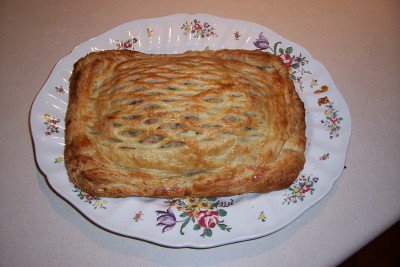
Cooked my first proper meal since my return last night: salmon coulibiac, which reminded me of my childhood favourite, kedgeree (my mother’s super simple version: mix hot cooked rice, chopped hard-boiled eggs, canned or leftover salmon, parsley and a good spoonful of butter). This grown-up puff-pastried incarnation tasted even better – with lemon, dill and mushrooms to zip it up a bit. It was easy to make but it took me a long time, here in the land of a thousand distractions. Apparently the beauty of it is you can make it ahead and then put it in the oven when your guests arrive.

We had it with an aubergine/eggplant pasta casserole I’d hidden in my freezer, and followed with leftover chocolate mousse cake from Thrifty’s.

Ok, so it was starch night at the hacienda, but on the other hand it was cold, wet and miserable outside. Starch keeps the rain out, I always think.


Here’s what the source of the mystery bark looked like before Tracy turned it into art.