Skip to content

poetry

Some words from literary editors

One of my co-colloquiists brought along the latest issue of Poets & Writers, in which is a topical article for all of us here, called Putting Your Poetry into Order. And an even more irresistible (to me) feature: Through the Eyes of the Editors, in which three literary magazine editors speak to us.

Stephanie Fiorelli discusses a fairly new magazine she co-founded, Avery, going for three years; unusually for a literary journal, it’s independent, non-profit and publishing nothing but short stories. She and her fellow editors also maintain a blog to open up some of what goes on to produce such a publication.

Essayist and poet David Hamilton, who’s been editing the Iowa Review for thirty years, talks about general changes and the impact of university-isation of literary journals over the years: escalating numbers of submissions (10,000 poems received each year of which 120-150 can be published); ‘go-team’ competitive sensibilities between academic-run journals.

Most interesting to me was the piece by poet Stephen Corey, who edits the Georgia Review (and who co-edited an anthology I highly recommend, Spreading the Word: Editors on Poetry) who said a number of thoughtful things. He estimates having received something like 200,000 poems, 50,000 short stories and 15-20,000 essays during his 25 year involvement with the magazine. He goes on to say

“that these statistics are misleading and unnecessarily intimidating, because the bulk of what we receive is not very good at all. The competitive pool is very small, and across the past 25 years I have not seen any appreciable increase in its relative size, despite burgeoning creative writing programs, spell-check and rudimentary grammar-check software, summertime writers conferences, private writing mentors, and online writing workshops.”

He says the number of non-fiction submissions has massively increased,

“except that most of the pieces we receive are not essays anymore, but autobiographical narratives and reminiscences that read more like sentimental journal entries than thoughtful and rigorous considerations of experiences”

And that although the number of poems submitted hasn’t changed much, the number of short stories has dropped, but perhaps this is because

“I think the publishing industry has worked over-time of late to eradicate the short story form, and I think some of the writing programs may have been helping too. Story cycles, linked stories, novels-in-stories – all these au courant designations are attempted end-arounds in the pro-novel, anti-short story game of book marketing.”

His advice to writers is in tune with the overall tone of our time: to slow down.

“Any person who writes one great poem or story or essay per year for twenty years will take his or her place on the short list of the finest writers of all time. Slow down. Read voluminously, year after year, both for pleasure and to be reminded of all that you must not do, and all that you must exceed, in order to make your own special, indelible mark… Never to be forgotten once read – isn’t that what we must seek?”

Scotland, a scary place

Even the horses wear tartan.

And you must always, always, watch where you step.

And the plants are so large they get their own right of way.

And the Scots are so hardy they take their baths outside.

Well. Beyond all that, the writing has gone well this week, but what I’ve been constantly enjoying is all the reading.

Here’s a great discovery, thanks to Sian who found it in The Faber book of Twentieth-Century Scottish Poetry: Elma Mitchell, who begins “Thoughts after Ruskin” this way:

Women reminded him of lilies and roses.
Me they remind rather of blood and soap,
Armed with a warm rag, assaulting noses,
Ears, neck, mouth and all the secret places:

Armed with a sharp knife, cutting up liver,
Holding hearts to bleed under a running tap,
Gutting and stuffing, pickling and preserving,
Scalding, blanching, broiling, pulverising,
– All the terrible chemistry of their kitchens…

And from the same anthology, I enjoyed “Chinese Poem” from Iain Crichton Smith, as I too have been wondering

When shall I see the city again,
its high towers and insurance offices,
its glare of unprincipled glass?

Rather too soon I am sure. And once I’m there perhaps I will be eating some of George MacBeth‘s material from “An Ode to English Food”:

…Fresh, tender and unbelievable English
duck. Such

luscious morsels of you! Heap high the
groaning platter with pink fillets, suckling pig and
thick gammon, celestial chef. Be generous with the
crackling. Let your hand slip with the gravy trough,
dispensing plenty. Yes, gravy, I give you your due,
too. O savoury and delightsome gravy, toothsome
over

the soft white backs of my English potatoes,
fragrant with steam. Brave King Edwards, rough-
backed in your dry scrubbed excellence, or with
butter, salty.

And another Scottish treasure I’ll be looking for is W.S. Graham, who died in 1986 but whose Nightfishing (1955) still gets hailed as a model of writing about the fishing life. He writes well about the cold, too, in “Malcom Mooney’s Land” which I read in hopeful anticipation of prairie blizzards (experienced from a warm and safe observation point) in my future…

From wherever it is I urge these words
To find their subtle vents, the northern dazzle
of silence cranes to watch. Footprint on foot
Print, word on word, and each on a fool’s errand.

From the rimed bag of sleep, Wednesday,
My words crackle in the early air.
Thistles of ice about my chin.
My dreams, my breath a ruff of crystals.
the new ice falls from canvas walls.

Just taking a last look round Edinburgh before I vanish back down south on Saturday and way back west on Tuesday. The city is, as you might expect, full of Christmas buzz, although the bus system is making me cranky and is a sterling example of the evils of privatisation. Here’s a challenge to all: in what other major city on the planet can you find multiple bus companies running separate services along many of the same routes, where the companies do not accept one another’s day passes, and where the bus drivers can only sell you day passes that work on that service? The maps (like those of Parma) are a confusing if colourful spaghetti-like maze and I suppose that the colourblind bus riders of Scotland have all long since given up and moved away. Or bought cars.

The main attractions for me today were to see the Joan Eardley exhibition I’d been hearing about, and to see what was up at the ethical Christmas fair on Princes Street. The sun is shining, the wind is blowing, and ever so occasionally, there’s a little smack of mist.

Food Food Poetry Poetry

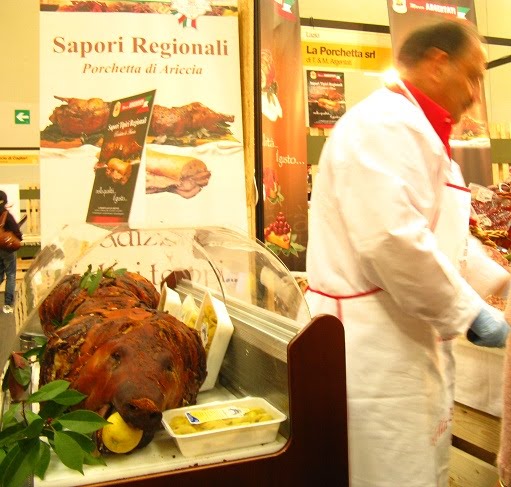
I braved the pelting rain to get to the Restaurant Show at Earl’s Court last Tuesday, where I saw lots of stands – including some small food producers I’d been learning about while working on our food producers’ database (which launched on Wednesday, yay!). It was lovely to meet the people and taste the food I’d been writing about. I then sat myself down at The Stage and watched some cooking demonstrations. The first was from Barny Haughton,
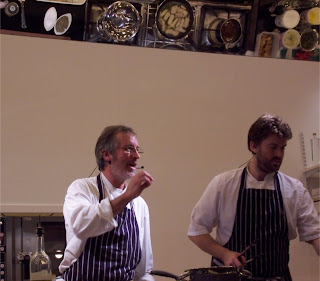
who talked about sustainability in the commercial kitchen: inviting people to use less popular, cheaper cuts of meat – if we’re going to be carnivores it’s more responsible to use the entire animal, which is a theme I’ve been hearing for some time – and sustainable fish varieties. He was followed by like-minded Cyrus Todiwala,
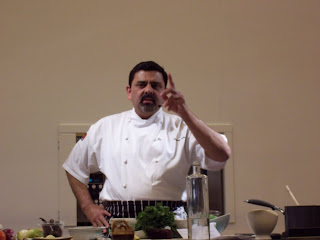
who was speaking on behalf of the Greener Food project. He’d been sent a big box of locally-raised, seasonal vegetables and told to make something of them. His beetroot with coconut salad was terrific, as was everything else he made. We were as heartbroken as he that he didn’t have time to make us his pigeon curry…

Then Ian Pengelley, another London chef, took the stage – by this time things were running very late and it got a bit chaotic. His aim was to show us how nicely champagne went with Asian foods, so we got to try a bit with some Thai beef salad, some sushi rolls and some seared scallops. And sure, we agreed! All very nice.
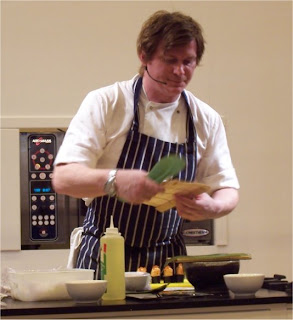
His sommelier was very entertaining – giving us a finale show where he decapitated the last bottle by strategic use of the base of a champagne glass. Definitely not one to try at home.

Then I had a couple of evenings to catch my breath before Friday’s Les Murray reading at Senate House – certainly one building that can accurately be described as neo-brutalist. This grey edifice loomed ahead of me in the dying light, and I sensed trouble ahead as I sought the room which my note to self said was “3rd floor Senate North”.

I entered from a sort of westerly door, I thought, so turned left, looking for north. I found a lift just around the corner, with a notice posted about talks and lectures — including the one I was after, so without anything more to go on, I entered and ascended to the 2nd floor, which was as far as this one went.

On the second floor there was another lift that went up to the 4th floor, but there was a 3rd floor button as well, so I pressed that and pushed my way out through a crowd of students to find myself on a near-deserted floor, where the only open door was to some special library – ancient civilisations or something, with an ominous No Exit sign on the entry.

Not a soul around, so I lugged myself and the bag I was escorting up to the fourth floor, where I found the crowd of students from the lift forming a lengthy queue for library card renewal. Beyond the security gates (only passable by library card holders of course) I spotted and hailed a friendly looking woman in a name badge who told me I wanted room N336. She told me to get back in the lift and go to the ground floor, along the hallway to a different set of lifts.

So back I got in the lift and descended to the ground floor where I found myself facing another set of card-operated barricades and a silver-haired defender of.. of.. whatever it was he was defending seated behind what I’m sure must have been a bullet-proof glass window. He told me I shouldn’t have come to the ground floor in this lift and that I should go back to the third floor as he presumed I was a member of the society for ancient civilisations or whoever it is who lives up there. No, I said, I was looking for the poetry reading in room N336. He said he knew nothing about a poetry reading or any such room, and couldn’t tell me whether I was actually in the north tower or not. After admonishing me again for coming down in that particular lift, and reinforcing his point that this was not an exit, he let me exit through the gate and I was back in the main hallway ready to search out the next set of lifts.

Which I found and ascended to find a big classroom with two doors (one marked 336 and the other 336A) but no other indication there was a reading there. I entered and found a bookseller setting up and three others sitting in wait, which seemed a bit sparse since it was only ten minutes to the reading, but down I sat. The room did in fact fill up nicely by the start time, and Les Murray started his reading. For the next hour, we were entertained by his poems and by the periodic rattling of the door knob closest to the reader (on the door labelled 336, in fact) followed by the covert entry of latecomers through the other door. There followed a wine reception and then it was time to slink off into the night.

I made a nerdy list of the poems he read, and here they are; rather unkindly he read from the Australian edition of his collected poems, so those who rushed the book table afterwards were not always able to find their favourites, but he sold quite a bit and did a little friendly book signing. I was happy he started us off with a food poem, and I liked (and remembered from past readings, I think), his cow poem, which he introduced by saying it was one of his favourite animals, and that he thought he was one of the few real Hindus of Australia. It was a poem from the point of view of the cow, which he observed is a ‘collective creature’ and thus difficult to find a pronoun for.

Beanstock Sermon; Glass Louvres; Words of the Glass Blowers; On Removing Spiderweb; Arial; Cows on Killing Day; Cell DNA; Contested Landscape at Forsayth; The Shield Scales of Heraldray; the Moon Man; Judged Worth Evacuating; Clothing as Dwelling as as Shouldered Boat; Visitor; Jellyfish; Reclaim the Sites; To One Outside the Culture; Melbourne Pavement Coffee; On the North Coastline; Me & Je Reviens; Japanese Sword Blades in the British Museum; The Mare Out on the Road; Birthplace; Sunday on a Country River; and then he finished with a few new poems.
Poetry poetry poetry

Sunday was another one of those floor-to-ceiling poetry readings, with 10 on the menu. Luckily two were unable to attend (a third likewise but she’d enlisted her sister to read in her place) so it was a little shorter than it would have been otherwise.

I’m sure I’ve moaned about this style of reading before; it is, I feel, far too common in today’s poetry programming to attempt to squeeze as many poets as possible into a single event. The reading turns into a marathon, and the one or two you came to hear are lost in the numbing volume of the whole. You don’t get enough of the ones you want to hear, and perhaps you hear too much of those you don’t. And everyone else just doesn’t register.

Magazine launches – where 5 or 10 people come and read a poem they’ve had published in that issue, with perhaps one other – are one thing, and I’m ok with them as long as someone keeps the readers moving along (when faced with a long list of readers, the eye of the audience turns naturally to the clock).

But on Sunday, we were at this particular two hour event to hear a few minutes each of 10 first collections by 10 different readers. Another problem I have with these events is that the readers are introduced in volume, and if you aren’t familiar with them, as I mostly wasn’t, by the time you’ve heard the list of credentials and the readers take the stage you lose track of who of the five poets this half you’re hearing and what their background is. None of them thinks to say their name, or give the bridge into their work as a well composed introduction is meant to do. I’d rather each poet were treated with singular dignity – introduced one at a time, giving the audience a moment to change gears – instead of being bulk processed. There, that’s my rant done for today.

We did have an impressive list of readers, and – my grievances aside – I can totally understand why these 10 readers were chosen to celebrate the Poetry School’s 10 years; the numbers have a nice symmetry and you don’t have to narrow what must be an enormous list of achievers down quite so much to a more manageable number.

Here’s the list: Chris Beckett, Melanie Challenger (represented by her very able sister), Claire Crowther, Helen Farish (not present), Martha Kapos, Sharon Morris, Roger Moulson, Daljit Nagra, Anne Ryland, Greta Stoddart (not present). A new poem of Stoddart’s, called Drawing Breath, did take my breath away, but with my increasingly taxed powers of concentration I confess that was the only poem I heard that stays with me. And it’s not the fault of the readers or the poetry. I guess I needed to pace myself better. Live and learn.

Next up was a more manageable one-man show, by CK Williams, who led us through umpteen drafts of one of his poems. Fortunately he didn’t bring all 255 versions of this single poem (actually I don’t think 255 was the final count, more of a midpoint) which changed title several times, shape certainly, and whose themes shifted in and out of focus while he tried out different images, many of which he was so fond of he got new poems out of them. There followed a good substantial Q&A; session hosted by Fiona Sampson. One of the last questioners asked for advice about how to – as he’d put it (quoting others) – create the poet who was to create the poem. His answer was simple: read poetry. But not everyday stuff, he added: read great poets.

Well. That was good. Then Monday I wandered over to the Troubadour which has changed so much since my day. Today’s Troub is a young noisy place. Well groomed couples were canoodling over their two-for-one happy hour cocktails (cocktails??) to the sounds of Bob Marley. The dark wood twosome booths are mostly gone. The place is twice as big now they’ve knocked it through and put in a deli next door. There are semi-integrated toilets where the genders meet around a big round sink and take turns watching the skin on their hands flap in the high power wind of the hand dryer. Nothing so new here, really. It’s been like this for a few years, but I sat and really looked at it for a while on Monday.

The most shocking change is the basement, where the poetry happens, and which I reflected I’ve now seen in three incarnations. The first, which I remember from circa 1988, was a dark, smoky room with a blanket hung over the door at the bottom of some steep steps; on poetry nights it seemed to be always dim and full of random crazies. The second was a cleaned-up version with a small stage, but a door down from the kitchen that sometimes opened inopportunely, and a guaranteed interruption by emergency siren on the road above at least once in every reading. Now we have a big L-shaped space with odd little private rooms out of sight of the stage that are – in poetry readings at least – never used. And a bar, so you don’t have to rush upstairs at the break for replenishment. And quite a few benches or chairs with backs nowadays, not just back-breaking stools.

The poetry programming has put on a little heft here too: no more one- or two-poet nights; four readers shared the stage on Monday. The star turn and concluding reader was CK Williams, whose Collected Poems is a serious doorstop not realistically in the purchasing (or more accurately carrying) range of a migrant like myself. Roz Goddard, Birmingham’s Poet Laureate, read first; then a southern voice, Janice Moore Fuller; then Brightonian Jackie Wills.

Leftovers in an empty town

I am in that expat no-man’s land of oddly categorised flours, strange leavening agents, unfamiliar baking pans and an oversized toaster oven to bake in, so I try to forgive myself the many baking failures I’ve experienced this year, even as I challenge myself to empty those cupboards before next weekend’s departure date for London. A good conjunction of contents and necessities as the restaurants and shops that aren’t closed now are likely to be next week. The price we pay for not living in a tourist town.

And even more prices to pay for sending mail through dear confusing Poste Italiane. Today I learned that:

  • it is cheaper to send packages to Canada than to England by surface mail
  • it is cheaper to send packages by expedited delivery to England than by surface mail
  • there is no book rate
  • there is a book rate, only it’s not called a book rate, it’s called M-Bag. There is a picture of an M-Bag on the information page about this service, but the bag isn’t something you need to buy in order to use the service. Or that’s today’s information anyway.
  • it says on their website that Poste Italiane offers a customs clearance service for non EU inbound parcels at 5,16 euro per item (blogger’s note: this ‘service’ delivers the package to the customs office, and is in addition to any duty that may or may not be charged by Italian customs, which presumably is an extra service to the grateful customer)(maybe the generous interpretation is that the word ‘service’ simply doesn’t translate easily into Italian?)

Stay tuned, it’s likely to get sillier still before I’m done.

I don’t recall exactly what led me back to Anne Carson’s amazing poem sequence, The Glass Essay, but I was thrilled to discover the whole thing on the (bless the living memory of Ruth Lilly) Poetry Foundation website. A gift and a half for a poet who lives halfway round the world from her own personal poetry library. If you can’t face reading the whole thing at one sitting (and I find it hard to stop once I start), check out HERO. Stunning.

Two day poems, a wine weekend and five days by the sea

The deadline approaches (postmarked application fees March 28) for throwing your pen into the ring for CV2’s ever popular two-day poem contest, something I’ve never got around to trying but always mean to do.

This year’s excuse: gosh I’d love to but I’m going to be in Verona attending Vinitaly..

And we’ve just returned from a week studying wine, olive oil, pork and seafood– and some pretty stunning scenery in the Marche. More later!