Skip to content

Parma

Innocent fun with hot beverages


Needing some fresh air, I took a walk around Oltretorrente, just across the river; BBC Weather said it was foggy and cold. Who can you trust?

I was trying to study some Italian this afternoon when I got distracted by La Stampa’s photo pages taken from LatteArt. So if you are good at decorating your cappuccino, you can send your photos in to the website, or you can refer to it for demos on making la foglia (leaf), il cuore (heart) or la mela (apple) designs on your cup at home. All you need is a steady hand. And good luck.

That got me thinking about other hot beverages.

  • Maybe once you’ve finished messing about with cappuccino you can move on to a spot of tasseography.
  • Did you know you can now earn a Tea Appreciation Certificate? (…Only in Canada you say?)
  • When I first moved to London and worked as a temp, there were still Tea Ladies to be found in many of the offices I worked in; indeed there was one in our company’s Johannesburg office as well. It was one of those jobs that should never have been phased out, since machines are lacking in character, sympathy and common sense. I loved meeting these ladies who were always kind to newcomers and who knew everyone in the office, and their drink preferences. It’s good to see there are still places in the world that employ them: I found positions advertised in Kuwait and Kuala Lumpur.
  • Did you know there’s a web page devoted to the Ovaltineys? On it you can hear that old standard “We are the Ovaltineys” (once heard, never forgotten).
  • Horlicks has a fun site with interactive information about sleep (hint: the answer to sleep problems is often a nice cup of Horlicks).
  • Sketos, metrios, glykos or vary glykos: how do you like your Greek coffee? Learn how to make it with a series of helpful photos.
  • Long ago I tried mate, after reading something that glamourised for me the gourd and bombilla used to drink it. Now it seems to be everywhere, often known as Yerba Mate, although this sounds slightly redundant as my reading suggests yerba (Argentinian spelling of hierba, or grass) is the raw ingredient, and mate is the hot beverage. I didn’t know it had quite so many names though: Erva mate; Congonha; Paraguay cayi; Paraguay tea; Jesuit’s tea; St Bartholomew’s tea; Hervea; K’kiro; Caminu; Kali chaye; Erveira; Hervea; Erva-verdadeira; Matéteestrauch.

Felice Anno Nuovo!


Saturday night in the duomo: Gospel in Cattedrale by Cheryl Porter – singing in English and preaching in fluent Italian.


With her International Gospel Messengers.


In Parma, New Year’s is all about the fireworks. Garbage cans were not the only things feeling a little nervous on Sunday night…


Just before…


…and after.


Dance of the broken bottles, Piazza Garibaldi.


The tree on Piazza Garibaldi.

Asian monster menu, and photos of Italy

We spent yesterday in Colorno, trying to eat our way through Asia. Amy, representing Hong Kong, gathered her pan-Asian army of chefs – Andy from Taiwan, Donghyun from Korea, Louisa from Australia – and together they fed us well, very very well. We are ready for the new year.


Amy’s Asian menu


Only the beginning… Thai carrot salad, sushi, beef with eggplant, rice…


A Korean favourite: Bi Bim Bap!

Spending the day digesting it all. Thought I’d try some feasts for the eyes for a change. A friend of a friend is a sublime photographer of the Tuscan landscape and many other things beside. Check him out: Fabio Muzzi. Phew. Photos so beautiful you want to eat them for breakfast.

I was nosing around to see what other photos were posted of this neck of the woods. A site called TrekEarth has a gorgeous selection of photos from all over the world, including this region, Emilia Romagna – a few beauties of Parma itself.

You can take a virtual tour of Parma in a number of 360 degree photos on the Comune di Parma website.

Cheese, more cheese

Travelling on Ryanair is … an experience. One of its peculiarities is that passengers are charged many hidden fees: for use of a credit card to make the booking, and for checking a bag, for example, and they give not so much as a cup of coffee away for free in-flight. So it’s not as cheap as you might first assume when you see 99 cent fares. But okay, so it’s the only game going direct from Parma airport to London, with your (count ’em) 15 whole kilos checked baggage allowance (which you’ve paid for the privilege of bringing). And then you get the thrill of rubbing up against your fellow passengers in the scrum at the boarding gate and you can try to out-run them on the tarmac for better seating. I won’t attempt to describe the experience of dragging (heavier than it sounds) 15 kg of suitcase without wheels (never again) through the seething inferno of holiday travellers at Stansted Airport on Christmas Eve. Brrr, may I remember enough to never do that again, and may I forget the rest.

For my return to Parma, I chose to alot a hefty corner of my 15 kg to a lovely smelly bag of cheese from the well-regarded and cunningly-named Cheeses, which has been doing a queued-out-the-door trade in Muswell Hill for some years. Not least because the shop is tiny – holds three thin customers at a time, with floor to ceiling shelves of this and that to look at while you wait. It has one modest display case which manages to hold a prime selection of farmhouse cheeses from Britain and beyond. I saw a piece of Parmigiano-Reggiano lovingly displayed and simply described (“exquisite” I think was all the sign said, or needed to say) and a bevvy of French beauties perched around it in various postures of diminishment, and beyond them a hearty selection of British cheeses.

The cheesemonger looked very weary – it was getting on to the evening of December 23 and his sign advertising baby wheels of stilton had probably lured a few dozen extra souls ithrough his doors – but he cut me some fine wedges of Cornish Yarg, Berkswell and aged Caerphilly. The women behind the counter were cheery and helpful and pointed me towards some Millers Damsel digestive biscuits to go with my selection. Luckily for my baggage allowance I managed not to come away with a slate cheeseboard or jars of chutney or tins of quince cheese to go with, nor even a fragile package of inky Charcoal Wafers, though I was sorely tempted, but they were recommended for brie, camembert or goats cheese.
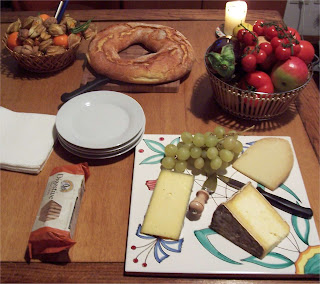
After a few days’ rest for the cheese, yesterday afternoon we gathered in my Parma kitchen to test our palates and practice our tasting terminology, yeah verily once more for England.

Yarg, I’d learned, was not an obscure Cornish word after all, it was the name of its early makers (Gray) turned around. A little disappointing to be disillusioned, but the cheese is made from a 13th century – and it seems a tried and true – recipe. Wrapped in nettle leaves, it looked very handsome, its ivory paste contrasting nicely with the dark green wrappings frosted by a pale mould. Lots of butter, rendered butter, and a bit of tangy sweetness – and perhaps a little pineapple? It had been described elsewhere as young with a fresh, faintly lemony taste; creamy under the crust, yet firm and slightly crumbly at the centre. And it was too. Many thumbs up for this one.
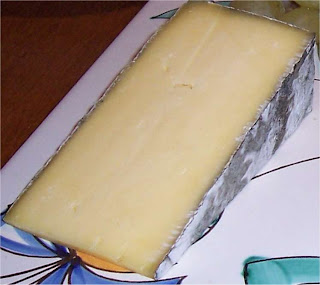
Next we examined the Berkswell, a ewe’s milk cheese made in the Midlands, and named for the village which took its name from the Saxon chief, Bercul, who was baptised in the ancient well at its centre. I read somewhere that it had been originally developed from a Caerphilly cheese recipe, although it bore little resemblance to the one we tasted after this. We admired its rind which has a tan, cobbled appearance – must be moulded in a net? We found its ivory paste smooth and firm, the tang and texture reminding us of cheddars of our pasts; a hint of animal aroma reminded us it was a sheep cheese, but the flavour was subtle and sweet. It struck us as being quite different in flavour from its Italian cousin pecorino, and people liked it for being a happy contrast to the Italian wonders all around us.
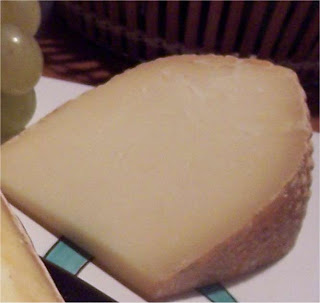
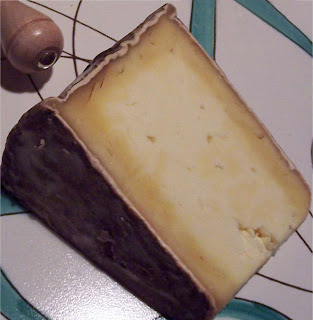
The last to fall under the knife was the aged Caerphilly; unusual, they told me at the shop, to find an aged version, as it’s usually eaten quite young. We noticed the moulds on the rind and the thick, even nail (undercrust) which when tasted was soft and silky in contrast to the dry, fine sponge of the centre. Its colour ranged from ivory in the centre to straw yellow in the nail. I’d read that it was eaten by Welsh miners to replace the salt they lost in their labours, but it wasn’t an overwhelmingly salty cheese. It had, when I unwrapped it, a whiff of ammonia but that didn’t linger after resting and cutting. It evoked aromas of yogurt most strongly, and for its texture Louisa dredged from her olfactory memory a comparison with a Greek cheese, like (but not) Halloumi. I suppose the salt content makes it a dryer cheese than most? Caerphilly is a sweet, crumbly cheese that’s nice in cooking; I remembered some Glamorgan Sausages I’d eaten at a New British restaurant once and they were a beautiful melding of salt, cheese and leek. Not nearly enough left over to cook with this time even if I wanted to…
London interlude

Just back from a week in London – a busy frantic expensive delightful week, and a week without email or internet. A novelty, but I’m glad to be back at the keyboard. I have a piece to post about the truffle hunt last weekend but will put that up in the next couple of days.

Merry… Oxo?

(from one of the dwindling number of antique dealers in Camden Passage, Islington, North London)


Quiz night at the Troubadour: I managed to crash the party five years after attending my last one. These are brilliant and entertaining evenings which feature themes, announced in advance so people can seek out a poem or write one for the event, and the readings are accompanied by ferociously difficult poetry quizzes. Last Monday was The Inexorable Sadness of Pencils. Here’s a taste of the quiz: What is Craig Raine describing when he says and the ground is full of pencil boxes? Name the Leeds-born author of these lines from The School of Eloquence… His home address was inked inside his cap/ and on every piece of paper that he carried. And who was he writing about?

I was happy to see Catherine Temma Davidson for the first time in a long time. Her excellent first novel, The Priest Fainted, (still in print!) has a special resonance for my foodie life these days. She’s working on a second novel and says food figures in that one too.

London poet Paul McLoughlin and poet-novelist Catherine Temma Davidson.


Steve Hatt, legendary fishmonger, on Essex Road, Islington.


Fighting the neverending battle against street crime, with a taste of the week’s fog in the background. Outside Turnham Green station, West London.


Hampstead Heath. A little teeny tiny bit of it.


The big cheese at Waitrose, Brunswick Centre, near Russell Square.


Paxton and Whitfield, on Jermyn Street, been around a year or two. Cheesemongers to gentlemen, they say (–so where do the ladies shop?) and handy to Pink’s and Fortnum’s where you might like to browse on your way to tea at the Ritz, perhaps?


What we did and didn’t eat at Amato in Soho. Beautiful cheesy quiche and interesting salads (some rather middle-aged broccoli in there but otherwise good). Gorgeous pastries to admire through the glass on your way out.


What would a visit to London be without a nod to Newton and a visit to the temple of knowledge – the British Library, one of my favourite places in the world. The caff’s not bad either.


A foggy night on Primrose Hill.


And: buon natale to one and all. How it was looking earlier this evening in the Piazza Garibaldi, Parma.

Barolo and back


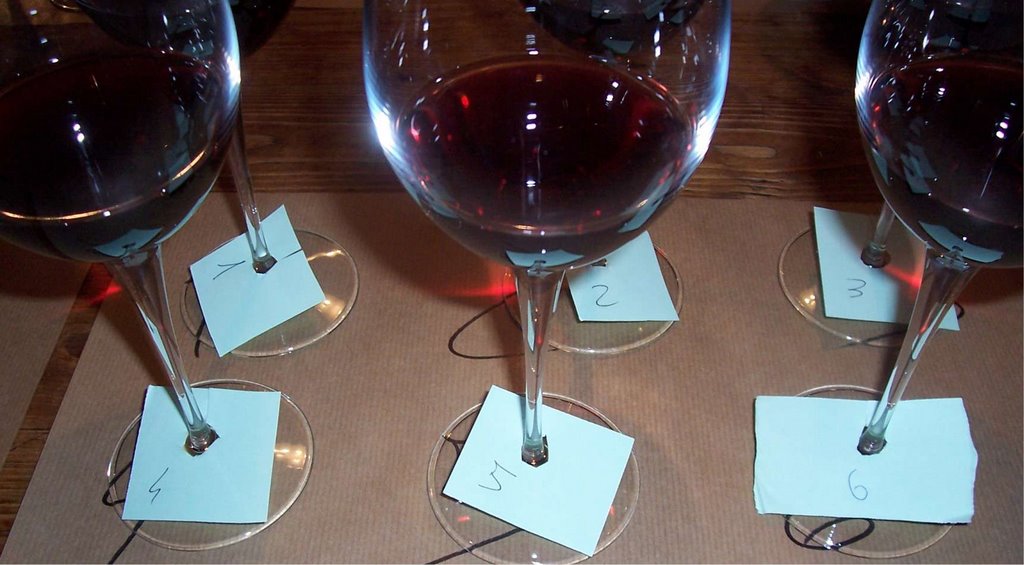
Lining up for the blind tasting

On Tuesday we attended a Barolo wine-tasting at a local enoteca (wine bar), called Ombre Rosse. We went through to a private room at the back where we rather swamped the place and probably startled the three locals who had come for the occasion.


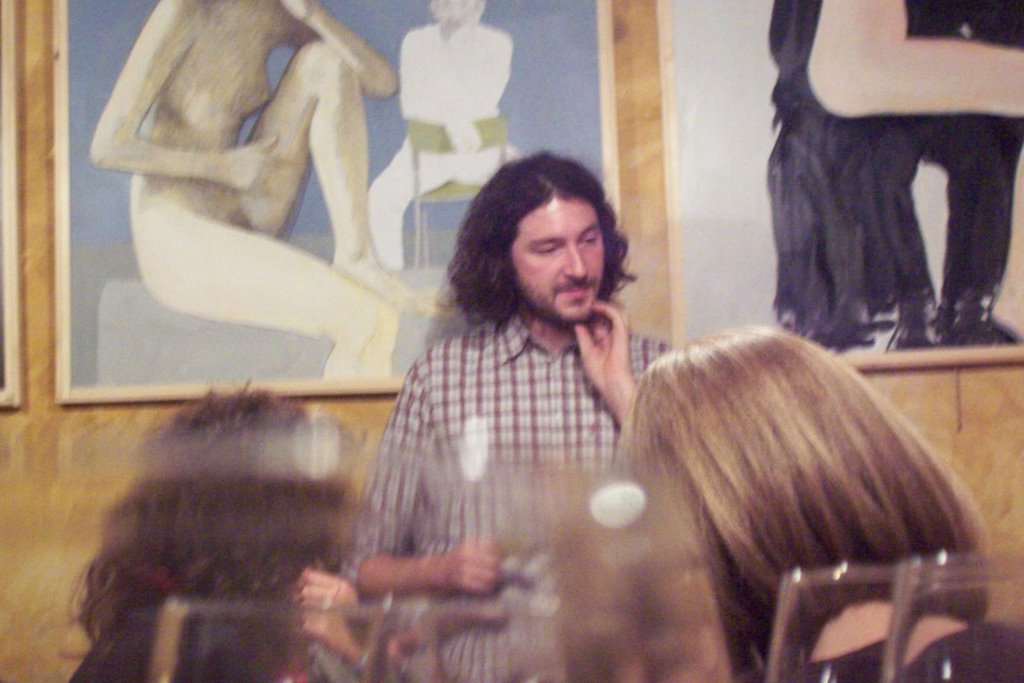
Our host explains the wines.

We did a blind tasting of six different Barolos – by wine producers: Bartolo Mascarello, Rinaldi, Aurelio Settimo, Clerico, Aldo Conterno and Montezemolo. As a complete wine rookie I had some trouble isolating the different scents and flavours, but did eventually manage to pull out cherries, black licorice, toffee, blackberry/blackcurrant, while others talked chocolate, nutmeg, panettone, candied fruits, raspberries, figs, mint and more. From different glasses, I hasten to add. After a survey by the proprietor, he disclosed that most of us preferred the fruitiest (and priciest I think, at about €50 a bottle), from Aldo Conterno.

We called it a night around 11.30, and left a large group still there savouring the dregs and gnawing on some chewy bread rolls the management had kindly brought in at the end. The evening was €30 and worth it for the education, the company (of course!) which included some more knowledgeable noses who led others of us, and the wine itself which goes for around €7 a glass.