Skip to content

Levenson & Cockburn at PEP; First work party at Haliburton Farm

Friday night’s PEP reading featured Vancouverian Christopher Levenson

and Victorian Grace Cockburn.

Saturday was the first work party of 2010 at Haliburton Community Organic Farm. There was work to be done

and workers to do it

Apple trees to be planted

A hoop house to move and then reassemble

Coffee break

Work started on the nursery greenhouse

Indoor work to be done

Lovely lunch

Workers large and small

Make hay while the rain holds off

Seedy Saturday

My first Seedy Saturday last weekend! The convention centre in Victoria was mobbed by earlybirds who arrived to browse the stands for seeds and information about all aspects of growing food and flowers.

Food was big, of course, and some interesting things on offer. A couple of places (Carolyn Herriot’s Garden Path, and Sooke Harbour House) offered a small and special tuber, Oca (Oxalis Tuberosa) which hails from the Andes is gaining some popularity in these parts for its ease of growth and its sharp flavour.

The mushroom growers were there, offering inoculated logs for sale; there was a talk about mushroom growing by local expert Justin Napier of Oystercatcher Mushrooms, which offered some revelations about the nutritional value of mushrooms (one point was that they offer vitamin D, and the content of that is related to how much sunlight they absorb).

Mason (blue orchard) bees were topical – a couple of places to buy the houses, and a talk by Steve Mitchell of Bee Haven Farm.

Yum! Jerusalem Artichokes (sunchokes) were on sale for eating and growing.

The dynamic duo of Brock McLeod and Heather Walker (Makaria Farm) were selling beans and grain and gave a talk called Growing your own pancakes (organic grains on a small scale). They’re running a grain CSA this year which sounds like a wonderful thing.

And the tireless farmers of Haliburton Farm were selling seeds, seedlings and the benefits of getting involved in a community farm.

I attended a crowded workshop on fruit tree pruning, by Philip Young who keeps the trees of Glendale Gardens in shape. Time was as always too short to cover everything we wanted to know but we got some good advice about winter and summer prunings, tools, tree renovation, and the difference between pruning for growth and pruning to encourage fruit. Recommended manual: The American Horticultural Society Pruning & Training by Brickell & Joyce.

Carolyn Herriot did a brisk trade in seeds and tubers, while promoting her latest book and eponymous talk (The Zero-Mile Diet)

Spring at Haliburton Farm; and the approach of the Enviropig

Out at Haliburton Farm, the seedlings are growing, some of them destined for the Seedy Saturdays that have begun on Vancouver Island.

The farm ducks are hard at work keeping the edible pests down…

and the last of Farmer Ray’s giant beets are going to feed happy animals somewhere in the area.

And once again Margaret Atwood‘s prescient novel Oryx & Crake comes to life. We won’t be eating pigoons just yet, but Enviropigs are on the Canadian horizon. It seems that genetic engineers are attempting to address the complaints of people living near factory farms by reducing the pesky smells of too many pigs being reared inhumanely. The obvious solution (reduce pig numbers) is no fun, so the industrialists prefer to splice mice genes into the pigs. Kind of misses the point… it won’t give the pigs better diets or living conditions, and it certainly won’t make those sewage lagoons disappear. All we end up with is the thin end of a wedge that will give us food animals created by lab rats: same issues as GE foods… do we have the faintest idea what other changes might have been triggered by this genetic manipulation, and what might that do to the bodies who consume them, today, tomorrow or next generation?

Deconstructing Cargill

Busy times. Let’s try to catch up.

A week ago last Sunday, a talk by Jon Steinman,
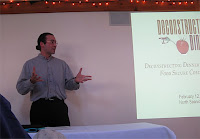
out at Muse Winery, was an attempt to draw together the gist of several years’ worth of radio (Deconstructing Dinner). He illustrated some of his concerns by deconstructing one of the agricultural multinationals who control the full spectrum of our food supply in Canada: Cargill. (The Deconstructing Dinner program upon which this is based: part 1 is here and part 2 is here.)

Cargill was established in 1865, in Minnesota. In Canada its headquarters are in Winnipeg. Here are the pies in which you’ll find its fingers:

Beef: Cargill owns 40% of the slaughter capacity in Canada (one of two companies that control 80% of capacity). It operates only two facilities: High River Alberta and Guelph, Ontario, which between them slaughter 5,400 cattle each day. Narrowing the field of operation in this way is undoubtedly cost-efficient for the company, but it shows very clearly the risks to consumers: any problem in one of those plants has grievous repercussions for consumers and meat producers alike, a point proven by the Maple Leaf experience, where we saw how large was the reach from a single production plant. And how great could be the financial repercussions for the company.

Animal feed: Cargill owns Nutrena, the largest feed company in the world, which makes pet food as well as feed for horses and pigs, chickens and cattle; and in 2000 they bought out their competitors, Agribrands Purina (not the pet food Purina, which is owned by Nestle).

Plant breeding: Cargill owns Renessen, partnered with Monsanto, producing such delights as genetically engineered corn. ‘Nuf said.

Fertilizers: Cargil is the largest phosphate producer in the world, operating with agricultural firm IMC Global as Mosaic, and is the second largest potassium producer.

Natural gas: Cargill is one of the world’s major traders and transporters of natural gas (an essential element in fertilizer production).

Salt: Cargill is the world’s largest salt producer and sells such products as water softener as well as manufacturing, agricultural and the Diamond Crystal retail salt brand.

Grain: Cargill commands 17% of the world’s grain trading.

Canola: Cargill operates the largest canola oilseed crushing plant in the world, in Clavet, Saskatchewan (selling under the trade name Canola Harvest).

Eggs: Cargill supplies most of the food service (Sunny Fresh) egg and breakfast products in Eastern Canada through its Kitchen Solutions brand.

Sugar: Cargill is partnering with Imperial Sugar Company to build the world’s largest sugar refinery, in Louisiana.

Malting: Cargill is a partner in Prairie Malt and is one of the two companies that control 75% of malting in Canada.

Chocolate: Cargill owns the production and processing of chocolate, and brands like Peter’s, Gerkens Cocoa, Veliche and Wilbur.

That’s some of what they own. They have many other interests including cotton, grain (through AgHorizons), High-Fructose Corn Syrup and other corn derivatives, frozen desserts, and ethanol.

And that’s only one company. Which is one extremely large reason why it feels safer to buy from small producers whenever possible.

More milk; lady carpenters; syrup of a different stripe

In my continuing quest to understand the elusive factors in meat production and climate change, I came across an archived broadcast of BBC journalist Simon Parkes‘ investigation into the carbon footprint of milk in Britain. It’s an interesting story and the factors that affect methane production are not always what you might think. (Download RealPlayer if your media player has trouble with .ram files)

On Friday I was attended Kate Braid‘s reading at Planet Earth Poetry. She’s published two books this past year, and she treated us to readings from both: Turning Left To The Ladies – about her past as a construction worker; and A Well-Mannered Storm: The Glenn Gould Poems. Making reference to the passing of PK Page, she also read Page’s poem, “The Filled Pen” and another by Rumi.

And on Saturday I attended some of the Big Leaf Maple Syrup Festival in Duncan, which was positively mobbed by visitors of all sizes, and who wouldn’t be drawn by the twin attractions of sugar and train rides? I missed out on the train, but took in the syrup tasting, held in the old school house at the Forest Discovery Centre

hosted by Mara Jernigan

for Slow Food, using this Maple Products Flavour wheel as a guide to aromas and flavours. We sampled half a dozen local syrups and one Easterner for comparison.

A producer panel gave us a chance to hear from some of the Sap Suckers, who spoke about the ins and outs of tapping maples, as well as evaporation,

bottling and hygiene issues. One of the best we tasted, I thought, turned out to be a science project by a local schoolgirl!

It’s a different flavour from the commercial maple syrup, which is smooth and sweet with no real aftertaste. This stuff has more complex flavours, and, I thought, quite a bit of green twig on the finish. As the participants attested, many of them voting for the Eastern version, we tend to prefer what we’re used to, and if that is a fairly bland sweet taste, that’s what we’ll go for. Bitterness is a hard sell in North America, which doesn’t feature much from that part of the palate in its cultural preferences. The flavour wheel itself was developed around Quebec syrups, so maybe it needs a couple more spokes for Western ones.

More fishiness

Fish are ever-topical these days. Last week’s BC Supreme Court ruling that froze out new fish farm licenses for another 10 months is a victory for those opposed to the farms on the grounds they are insufficiently regulated to protect the ocean environment, and in particular the wild salmon whose numbers are shockingly low for reasons that many believe are tied to sea lice infestations from the farms. The predictions of possible extinction for pink salmon in the Broughton Archipelago are still out there, so the federal government’s takeover of fish farm regulation had better make for some swift improvements.

One of last year’s Slow Food newsletters included an article about seafood sustainability by Victoria-based fish expert John Volpe, who puts his finger on the problem (or one of them): “Seafood often remains a blind spot in the otherwise educated consumer’s knowledge base.”

A few articles to shed a bit more light, including one about trawling; one for chefs, from the Culinary Institute of America; one about oysters; and one from the New York Times (still free for the moment) about balancing health with seafood sustainability.

There is a lot of information out there about climate change’s effect on the ocean which is worth knowing about; I predict the dual ills of warming and acidification will soon put those all-you-can-eat seafood buffets of yore into the history books alongside the excesses of Rome.

On a more positive note, thanks to Marci for pointing me towards Todmorden, West Yorkshire, which has a dazzling website showing off the town’s efforts towards sustainable food production. One of their projects is aquaponics, which combines food and fish in a truly virtuous circle of water. Check it out: