Skip to content

Piemonte Monday

We had four busy days exploring Piemonte (Piedmont), in north-western Italy. We made an early start from Parma and lunched in Pollenzo, at the campus cafeteria of the first and other campus of our university, and were able to exchange notes with a couple of students on the degree course, which lasts three years and has a much higher enrollment (60) than our master’s program. The first group of students in this program is due to graduate this year, after many travels and many experiences. It’s an expensive proposition, but even so the tuition only covers half the expenses: with tours stretching as far afield as India, Australia and Scotland, it can be pricey and complicated to administer.

After lunch we met the first of two winemakers from the region. Michele Chiarlo specialises in two famous Piemonte grapes: nebbiolo and barbera. I had fallen in love with Barbera wine this year so was thrilled to taste a couple of excellent examples, and some excellent Barolo, while hearing about the winery’s operations from oenologist Stefano Chiarlo. The interesting details he explained included setting the corks (only natural ones – like others we’d met, he maintained that artificial materials don’t work in wines that need to age in the bottle more than three years) with the bottles upright; after two weeks, the bottles are all turned by hand into the horizontal position. He feels this keeps the cork in better condition for aging.

After the tour and the tasting, we had a particular treat when he took us up into the hills to see a barbera vineyard. He told us about the green harvest, which is the pruning, over the summer, of excess grapes, so that the plants can pour their energies into producing more concentrated flavours in the remaining bunches. He also explained that the vineyard had originally been owned by Tuscans, who brought the cypress trees in the background, which are now about 250 years old.

His family are art lovers, and there were some very cool things to see alongside the grapes.

New takes on an old tradition which posted heads on every road, as protection against malady. Note the ubiquitous rose bushes which here too play their important role in predicting fungal attacks.

They also host a summer festival in the vineyard, with music and wine.

That evening we were treated to dinner in a special osteria, the Ristorante ‘Belbo Da Bardon’ where we had some excellent meat-filled pasta, some very tender veal with broad beans, and a lovely slab of creme caramel.


Food for hungry brains – Capra and Counihan

Recently I posted a link to Time’s What the World Eats feature (and later found a related article), and have since found an NPR radio feature on the book (Hungry Planet) that these images come from. The NPR page features some interesting background and interviews with the photographers, who enlisted an impressive list of writers to flesh the book out, including Marion Nestle, Alfred W. Crosby, Francine R. Kaufman, Charles C. Mann, Michael Pollan, Carl Safina, and even our upcoming lecturer Corby Kummer.

Last week we had four things to occupy our minds. Still reeling from Serge Latouche‘s lectures, we were offered some therapeutic time in the kitchen with Barny Haughton, as previously reported. Then we had two head-spinning days with Fritjof Capra, a day of gelato, and a concluding meeting with Carole Counihan. I have covered the gelato day separately.

Speaking mainly from his book, The Hidden Connections: A Science for Sustainable Living, Capra explained his theories about food’s systemic role, from the molecular to the environmental level. In brief, he said his view was all about ecosystems; that every living thing – even a cell – is part of a system, and we consider anything in isolation at our peril.

He also expanded on the point that had brought him to Carlo Petrini’s attention: that living things are divided and defined by food. For example, the two categories at the base of the kingdoms, bacteria and protists (single celled nucleated mechanisms), ingest food through semi-permeable cell membranes; the intake of food actually determines the molecular (biological) identity of the cell. Distinctions between the other three kingdoms – fungi, plants and animals (humans) – are also through food. Plants are defined through photosynthesis; fungi send enzymes outside the organism, digest the food outside the organism and then ingest it in digested form. Animals ingest and then digest food. In the human realm: biologically we are animals, but for us food also has its cultural dimension – which we share through communal, social and cultural events. So, he argued, you need to understand cognitive as well as cultural elements to fully understand human relationships with food.

He talked as well about the globalised world: its foundation on the whims of electronic investors, which he described as a global casino. No longer, he said, are companies measured by ‘bricks and mortar’, but by their place in ‘analyst expectations’ – which can change in a moment with immeasurable impact on the lives of the real people who work for those companies, while enriching a global elite. Like us, he had been greatly affected by the film Life Running Out of Control, and its message about our unprecedented destruction of and genetic tampering with existing life forms.

So: to survive on this planet, we must change the rules of the game, he says. The underlying principle that making money is the only company value is outdated and dangerous. Human values are not laws of natures; they can be changed. He urges us to consider a new global civil society, built on networks and an underlying pair of basic values: human dignity – the right to shelter, housing, food, security, free speech, educational and religious freedoms; and ecological sustainability.

Implementing this kind of change includes three areas: addressing the negative impact of globalisation, reshaping governing rules and institutions, through such organisations as the International Forum on Globalisation; agroecology, reshaping food and agriculture, oppositn genetically modified foods and promotion of sustainable agriculture through such organisations as Slow Food; and ecodesign, redesigning technology, buildings and physical structures for sustainability, through such institutions as the Rocky Mountain Institute.

It was a relief to have some tangible resources to explore and find concrete ways to counter the bleak global vision we’d been thinking and talking about. It made me think some more about what and how I think about food; and sustainability and ecosystems have got to have more to do with the total picture.

Barny Haughton had asked if we felt optimistic about the potential for people, companies, countries to change, even in the midst of unassailable evidence of environmental damage. He didn’t get much of an answer, but he himself observed rather bleakly that from his experience he thought people unlikely to change unless forced to do so.

Indeed. We can talk till we are blue in the face about the need for change, but will we give up our cars, our pre-packaged convenience foods, our comfortable heat and cold, our plastics and fossil fuels? Just one more little car ride to the mall when we could have walked. Just one glass bottle we can’t be bothered to wash for the recycling. Just one more package of pre-washed salad with individual portions of inedible dressing, all in full plastic armour. Who else can stop it?

We had concluding food anthropology meetings with Carole Counihan, who shared her research into food cultures in the San Luis Valley of Colorado, and had us share our mini-research (observation studies of local food-related places) with her. Mine was the quirky and I think laudable Progetto Latte, one of several interesting enterprises of the Bertinelli family.

Gelatorama

We spent Thursday at Gelato U, learning some things from the gelato equipment manufacturer Carpigiani, near Bologna. What did we learn? Hard to say. In a course really designed for companies who’d bought the incredibly expensive (25,000-35,000 euros for the basic gelato maker) equipment, we were given recipe after recipe for making four or five kilos of gelato at a time.
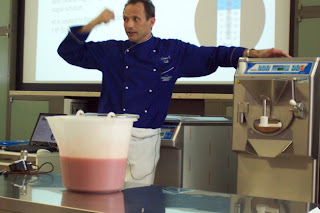
The instructor began with some distinctions between “ice cream” and “gelato”. Ice cream, he said, was made in high volumes, and so could not use fresh ingredients, but tended to use industrial flavourings. Gelato on the other hand, could be and was made artisanally (his definition of artisanal: not necessarily made at home, or even by hand, but in small quantities), with fresh ingredients. Another main difference was the over-run, which was 100% in ice cream and more like 45-50% in gelato; this turned out to mean the volume of air pumped into the final product by the industrial — err, artisanal? mixer/freezer. And a final difference was the fat and sugar ratio: gelato is lower in fat but higher in sugar than ice cream. He observed that higher fat doesn’t automatically result in a softer product, since fat freezes solid, so the serving temperature will have more to do with its texture than anything.
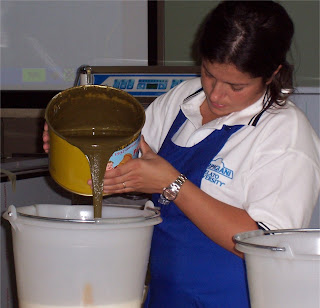
After dutifully noting all that down, we had to wonder anew what was really meant by ‘fresh ingredients’ when we watched the making of gelato. Yes, fresh fruit was used. But so was a powder which included stabilisers and emulsifiers, and protein, in the form of milk powder. And we were told that although fresh milk is a good ingredient, you could as easily use UHT or sterilised milk. To add fat, you could use fresh cream, but you could also use butter (as long as it was industrially-produced butter, made by centrifuge, and not the lower-tech kind made by skimming, as this could introduce bacteria into the mix). And all kinds of calculations come in when adding sugar: dextrose, sucrose, fructose all have different degrees of sweetness which must be balanced with the sugars introduced by fruit or other flavourings. The instructor spoke fondly of the companies who have laboured long to save the gelato maker the toil and trouble of crushing his own pistachios, and produced a neat tin of flavouring ready to pour. Here we see a nice can of hazelnut going into the mix.
The original gelato recipe, which originated (in Italy!) consisted of: milk, sugar and egg yolks. Apparently eggs are not used much now, because they make the gelato taste, well, eggy. Which is apparently a bad thing when you want to make it taste of many other things. So, gelato makers have isolated the functions that eggs served (fat to add texture and bind ingredients, protein to add structure, emulsification to smooth things out) and introduced powdered substances that may include alginates, pectins, starches, xanthan gum, gelatin, lecithin, guar gum and carageenan (identified by E numbers). The one gelato flavour that is still allowed to taste, or at least look, eggy is Crema, which is really only ‘custard’ flavour, and I had to wonder if fresh eggs are ever involved…
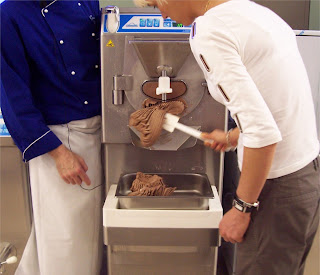
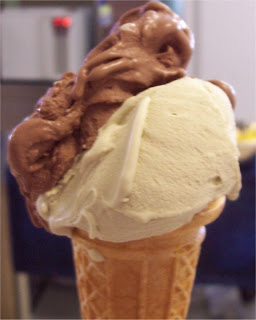
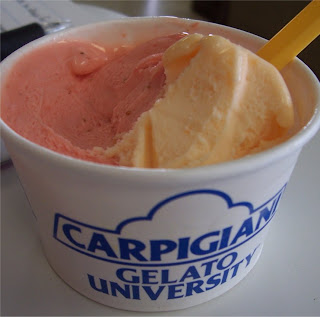
We sampled both sorbet (below, in lemon) and gelato (above, chocolate). In the demonstration we saw, the mix for the gelato needs to be ‘aged’: the milk, cream, stabilisers, emulsifiers, protein and sugars are combined, heated to 85 degrees celcius and then cooled, ideally overnight, before adding flavourings. This improves the texture, allows the mixture a longer shelf life (three days) and improves the flavours. Quite, well, all those powders after all; we did not learn whether if you used old fashioned ingredients like milk, eggs and sugar, the flavours would meld without aging.

A few other distinctions we learned: sorbet (sorbeto, sorbetto) is gelato made with water instead of milk; granita is gelato without the air (from mixing), stabiliser and emulsifier (it’s slush, basically); and semi-freddo (aka gelato caldo or gelato alto) is made with vegetable fat. Not sure about the last definition; I think the term semi-freddo, or indeed semifreddo, is used differently by different people: I’ve seen it used for various frozen desserts.
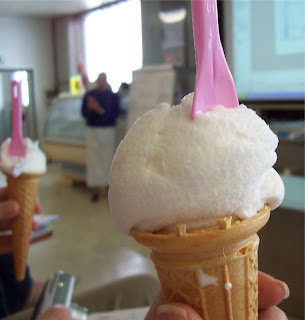
The verdict? Disappointing. The flavours ranged from bland to unbalanced, the texture fatty. The words “artisan-made gelato” will not impress any of us in future, since all they mean (as in fact we’d heard as well from another of our lecturers) is that the seller has mixed his batch of formula, from what we know now are bags of stabilisers and powdered milk, and poured it into his expensive machine in small quantities, and put it into the display case at what we hope are frequent intervals. The skill, I suppose, lies in the chemical skills of the mixer, the kind of milk and cream used, and the intensity, purity and freshness of the flavourings. Further research at Grom, K2 and other favourite outlets will be needed. We are all off to Piemonte next week and I hope will have occasion to revisit the excellent cafe/gelateria in Bra that we stopped in on a cold day back in March, which features some dazzling Presidia flavours.

We cook lunch

Having spent the weekend in the environmental vale of despond, we faced Monday with chef Barny Haughton, who talked about the efforts he and his more-than-a-restaurant Bordeaux Quay are making to live and work sustainably, modelling good behaviour as a restaurant and educational body. They aim to be carbon neutral within five years, having already invested in sustainable infrastructure and culinary techniques and following local food procurement policies (“if it grows in the West Country”, he says, “we don’t buy it elsewhere”).

Tuesday, we all cooked together under Barny’s watchful hand, becoming one happy appetite making a communal lunch. We had been sent to the morning market to come in with a vegetable (or something) to contribute, and we had quite a feast: stuffed mushrooms, risotto milanese (made with fresh chicken stock), saltimbocca with salsa verde (with fresh herbs, anchovies, mustard, lemon, olive oil) aubergine towers, aioli with crudites, and a zucchini frittata.


In the process of making saltimbocca Barny explained a bit about the veal education campaign, which is to try to communicate to people who drink milk or eat cheese that they are actually forcing the production of veal, which it has become unfashionable to eat. If they then refuse to eat it, you end up with the situation as it is in England where the calves that are needed to initiate milk production are either shot and buried on the farm or shipped to Italy. This is not to minimise the brutality that has been exercised on veal calves in the past, but to say that veal is to beef what lamb is to mutton; people who eat lamb without qualm should be equally prepared to eat veal rather than perpetuate the waste of life that exists now amongst a confused public.


More anthropology, and the décroissance finale

Friday morning’s lecture was based on a couple of readings we’d done: one on punk food culture in Seattle, and the other on fast food outlets in China (Of hamburger and social space: Consuming McDonalds in Beijing). A lot of interesting stuff came out of it. We started with Lévi-Strauss’s culinary triangle, which places the concepts of cooked, raw and rotten at its points; the discussion was about what those ideas represented in a counter-culture which had quite naturally (being counter-culture) adopted opposites, so was raw (vegan) instead of cooked (processed, industrialised, omnivorous) and included rotten (foods retrieved from supermarket dumpsters or stolen from markets). And for the second article we talked about it in the context of Sidney Mintz‘s observation that eating differently transforms you – so to eat like an American in Beijing provided a kind of local version of cultural transformation.

In the afternoon we had the second half of the décroissance lecture, and the theories and political actions needed to counteract it. It was a little disappointing to learn there were no simple, effective solutions to a problem that’s been growing since the industrial revolution. The complexity of the economic rat’s nest that holds it all together is not likely to be untangled with a single stroke. Too many vested interests, too many power relationships. A population too tied to the comforts, rules and products of a growth economy, and too unaware or unwilling to see our individual connection to the larger problem.

And an infrastructure that doesn’t support it. It may be possible to live – as I did for 13 years – without a car in a city with a large public transport system; but if you live in a small town, for example, how do you manage? There are towns in every country that have no public transportation, or transportation that runs once a day or less. So people who move to the country to live a healthier life or be greener often find they use their cars far more than they ever did in city life: they are likely to get less exercise than they would in a city where they had to walk between transport stops or were able to use bike lanes rather than risk their lives on narrow country roads. What does that do to the environmental balance I wonder.

And as for downshifting our lives: it all sounds good. We should be wasting less, polluting less, growing more of our own food. But do the people who live in tower blocks have that option or is it reserved for those who can afford the luxury of a house with a garden?

What do we do with all those people living in urban centres, who are there after all because there simply isn’t enough land for them to have their own patch?

Or with those who are a couple of generations beyond having learned to cook their own bread, sew their own clothes or repair furniture –which nowadays is made of self-destruct particle board? Who maybe have to hold two jobs just to pay the rent and feed their children and haven’t the luxury of stepping off the merry-go-round in order to learn how to cook anything from scratch instead of buying frozen pizzas and processed foods, let alone why it should matter to the rest of the world what and how they eat?

We received this interesting link from a Unisg alumnus: What the World Eats is somewhat terrifying when you look at the amount of processed and packaged foods on everyday tables around the world.

Well, on with the show. Today we have a first meeting with Barny Haughton, of Bordeaux Quay, Bristol, talking about culinary techniques; later in the week we’ll have the Austrian-born American physicist (author of The Tao of Physics) Fritjof Capra.

Back in the classroom: anthropology and décroissance

Returning from stage is always a bit of a culture shock, but come Wednesday morning we had shaken off bus-lag and were back in our places (with bright shiny faces) at the University of Gastronomic Sciences. Everything was pretty shiny, in fact, as it was raining – bucketing down – and Torrente Parma was looking like a torrent of latte, not the sparse trickle we’d left behind only ten days earlier.

We met our new instructor of the week, Carole Counihan, who has us paddling swiftly down the byways of foodways, gender and the anthropology of food. We’re talking about the preservation of food cultures through anthropological methods, like interviews and observations. We’ll be trying an observation of our own in the next week.

The other instructor this week was economist Serge Latouche, who came from Paris to tell us about décroissance, which argues that civilization can no longer be founded on infinite economic growth. He picked up the thread where An Inconvenient Truth left off.

Referring often to the ideas of Romanian economist Nicholas Georgescu-Roegen, he spoke at some length about the implications of unchecked growth on every aspect of our lives. Where food is concerned, a growth economy means the food industry is encouraged to force consumers to consume (or at least buy) more than they need so that profits can continue to grow, which of course requires industrialised food production and massive waste. You could take that to mean that if we buy into this pattern, we’re complicit in building populations of spiritual and physical obesity. And their harvests of waste, illness and pollution.

He spoke of three evils of the growth economy: advertising; programmed obsolescence; and credit.

Advertising’s crime is creating desire for products that are not needed; its job is to generate additional growth by nurturing a chronic sense of discontent and inadequacy in the target audience. A successful campaign will create cycles of insatiable demand and overproduction. The victims are vulnerable people who can be brainwashed into feeling inadequate, and the most vulnerable of those are children, already subject to excesses of advertising through television, but also through corporate sponsorship within their schools. He also singled out the mailshots that he says create up to 50kg of unwanted paper per household in Italy, with attendant issues of deforestation and pollution.

Programmed obsolescence forces consumers to replace items rather than repairing them. The lifespan of a computer is two years or so, and after that it simply stops working (or one year and one month in the case of my dead Acer laptop); the corporate solution – and the one that we consumers have implicitly consented to – is to dump these dead machines on foreign shores, all toxic chemicals and non-biodegradeable parts. Gone are the days when you could be self-reliant in your own home with a few good wrenches and screwdrivers; nowadays you can’t even diagnose the problems with most of our appliances and cars unless you have computer diagnostics. We will persuade people – shame them, mock them – that wearable clothes can no longer be worn because they are no longer fashionable. And what was I reading recently, that talked about the loss of the verb “darn” – that the very idea of repairing a hole in a sock had become passé in a culture that simply threw old clothes away because they were cheaper to replace?

Credit, he said, attacks consumers by encouraging them to consume even when they are unemployed or unable to afford what they are manipulated into wanting. He cited some depressing figures: in France, 80% of the population is indebted to the amount they will earn this year and next; Americans owe what they will earn until 2010. And, unsurprisingly, it seems that Canadians, too, owe more than they earn. It got me wondering who pays for the debt of the one in 53 American households that declare bankruptcy (and presumably go on to assume more debt as soon as they’re legally able, since credit helps to fund bank profits growth), and what implications that will have for all of us down the line if the debts are ever called in.

There was of course much more said, and I look forward to the next installment this afternoon, and some time to digest it all.