-
A week of summer
This week’s excitement was helping out Terralicious, the gardening & cooking school at Haliburton farm. There was a hungry crew to feed lunch to, while they worked to restore the wetlands area that’s attached to the farm and which the university uses to study amphibians and other wetlands wildlife.
Tubs of farm-grown lettuce to wash.

Some sage butter for the squash pasta sauce:


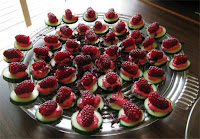
Rather beautiful appetizers: cucumber slices topped with berry cream and tayberries
and anchovy butter and radish.
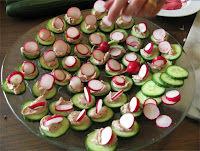
Much enjoyed.
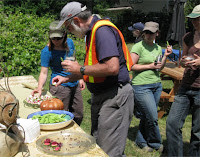
Two kinds of pasta sauce; the squash and sage, and/or the arugula pesto with sautéed tomato halves.
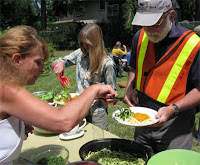
And for dessert, some divine crumble, of rhubarb and berries and apples, before
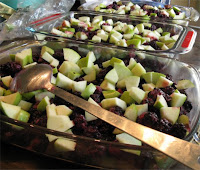
and after, with a dollop of ginger cream.

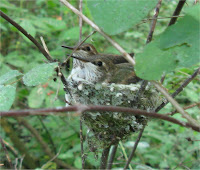
Meanwhile, in the park, a couple of hummingbird babes are nearly ready to fly…
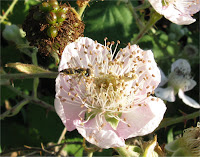
Blackberries (Himalayan) getting pollinated…
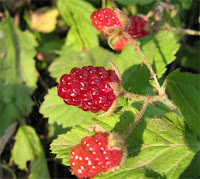
Blackberries (Trailing) getting ready to pick…
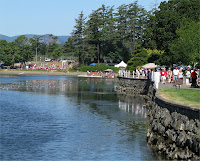
Canada Day was fine… many namesake geese on the Gorge, gorging in the sun.
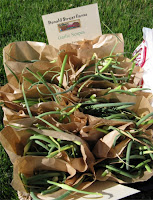
Some garlic scapes on offer
and a bit of Morris dancing.

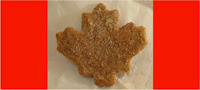
And here’s my little tribute to the day… Anton scored a couple of free treats from the dog biscuit lady.
-
Bees knees and labelling of GMO produce – it exists!
I was trying to regain a bit of poetry in my life by looking through a birds & bees-ish poetry collection that’s been by my bed for a few weeks now. I belong to the Poetry Book Society which brings surprising books into my life every few months. This one was Weeds and Wild Flowers, by Alice Oswald, which is a beautiful-looking book as well as another skilled collection of poetry. See how she describes a snowdrop:
A pale and pining girl, head bowed, heart gnawed,
whose figure nods and shivers in a shawl
of fine white wool, has suddenly appeared
in the damp woods, as mild and mute as snowfall.
She may not last. She has no strength at all,
but stoops and shakes as if she’d stood all night
on one bare foot, confiding with the moonlight.
…And as for bees, Seeds of Diversity Canada has a campaign going to try to find out just what pollinators we have out there. Pollination Canada has a downloadable kit to allow you to be a Pollinator Observer and take measure of the bees, beetles, birds and other critters out there helping plants to propagate. There’s another organization, the North American Pollinators Protection Campaign, which also aims to help endangered pollinators.
Back to the battles with crawlies: Haliburton has been fighting wireworms
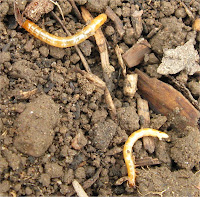
for a while. Lately these little devils have developed a technique of attacking cucumber seedlings by crawling up the stem and sucking the life out of them, so they end up keeling over like this:
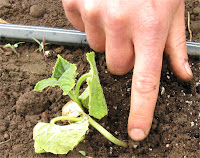
The organic solution is to use potato bait, for a wireworm loves nothing so much as a nice feed of spud. So the farmers have been cutting potatoes into pieces, skewering them with wooden skewers, and burying them near the seedlings they’re trying to protect. Every so often you just pull them up by the skewer and pick out any perpetrators for a swift dispatch. Results:

Meanwhile, I was thunderstruck – delightedly so – to learn that despite the best efforts of our legislators, there is in fact labelling of genetically modified foods in North American produce sections! Who knew? But if you check the Produce PLU – A User’s Guide 2006, you will find the following right there on page 17:
Q How is organically grown produce coded on a PLU label?
A The number 9 is added to the front of the regular four digit PLU code. (e.g. an organically grown banana would be 94011.)Q How is genetically engineered produce coded on a PLU label?
A The number 8 is added in front of the regular four digit PLU code. (e.g. a genetically engineered vine ripe tomato would be 84805.)We owe this to the International Federation for Produce Standards, for establishing PLU (Price Look-Up) codes, which are 4- or 5-digit numbers primarily used on fresh produce items and typically appear on a small sticker applied to the individual piece of fresh produce (info from the Produce Marketing Association). My lingering question is how much GMO produce actually gets labelled in this way, when it’s still something that is only, by law, done voluntarily in this country.
-
Of organic compost, and of meatlessness
The business about what gets called “organic” when it comes to compost horrified me so much that I asked for guidance from my new best friends at the appropriately-named farm & garden suppliers Integrity Sales. They were helpful and sympathetic. The key, they said, is to look for OMRI (Organic Materials Review Institute) certification (was relieved to discover my favourite soil amendment, Sea Soil, is OMRI certified.. and guaranteed free of sewage sludge).
So I guess “organic” is one of those loophole words, like “fair trade“, that has been pounced upon for marketing purposes. Anyone can use the word, and a lot of opportunists will do so, counting on public ignorance of what it should properly mean, to make a quick buck. So you have to be alert and remember to look for certification.
Bernadette posted a link to the Meatless Monday website: a grand idea, I thought. It describes itself thus:
Meatless Monday is a non-profit initiative of The Monday Campaigns, in association with the Johns Hopkins’ Bloomberg School of Public Health. Our goal is to help reduce meat consumption 15% in order to improve personal health and the health of our planet.
Which, given what I’d read in Food Matters, by Mark Bittman, back in January (he quoted an FAO statistic, that “global livestock production is responsible for about one-fifth of all greenhouse gases – more than transportation”) is a nice, easy-to-remember way of reducing consumption. (Hopefully people are not simply replacing meat with fish in this day and age.)
I’d think the meatless Mondays should be added to any meatless Fridays our Catholic friends might already be practising, of course. And speaking of religion, anyone wanting to go for the weight control and health benefits of the Mediterranean Diet should be aware that the people studied for this (Cretan men in the 1960s) were actually eating very little meat to start with, and reducing their meat consumption in large part because of the numerous fasting days prescribed by the Greek Orthodox Church.


Latest Posts
- Sublime
- Good weather for reading
- The world, the world
- Sublime launch!
- Planet Earth Poetry – Readings by Volunteers, Victoria 2026
- Poetry at the Goldfinch
Aldeburgh Poetry Festival Barny Haughton BBC BC poets Berkswell blackberries Black Stilt Bologna book launch Borough Market Carlo Petrini Catalonia Cyrus Todiwala dairy Daunt's Books Dijon Edinburgh Fanny Bay Feast of Fields Food and Morality food history food journalism Jenna Butler lardo Malahat Review Michael Pollan Okanagan olive oil tasting olive trees Omnivore's Dilemma Our Food Our Future Oxford Parmigiano-Reggiano Planet Earth Poetry poetry poetry readings Poetry videos prosciutto salumi Sean O'Brien Suffolk ticks Wendy Morton Wired Writing Yvonne Blomer
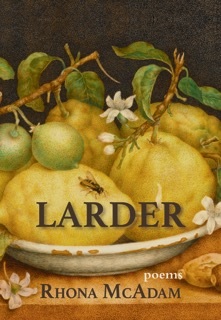
In her latest collection, Rhona McAdam navigates the dark places of human movement through the earth and the exquisite intricacies lingering in backyard gardens and farmlands populated by insects and pollinators, all the while returning to the body, to the tune of staccato beats and the newly discovered symmetries within the human heart.
“…A beautiful, filling collection, Larder is a set of poems to read at the change of the seasons, to appreciate alongside a good meal, and to remind yourself of the beauty in everything, even the things you may not appreciate before opening McAdam’s collection….”
Rhona McAdam is a writer, poet, editor, and Registered Holistic Nutritionist with a Master’s in Food Culture from Italy and a deep-rooted passion for ecology and urban agriculture. Her work spans corporate and technical writing to poetry and creative nonfiction, often exploring the vital links between what we eat and how we live. Based in Victoria, BC, and available via Zoom, Rhona is always open to new writing commissions, readings, or workshops on nutrition and the culinary arts.