-
Manitoba potato farming and a bit more about GMO labelling
I’ve split myself into two blogs – I wanted to see if I could prune some of my more garden-specific thoughts into my Random Garden blog – but then there’s farming which has to do with food and also growing things, so it’s going to be a little difficult to know what to post where for a while here.
I happened upon a story about Manitoba potato farmers that I wanted to share; it’s coverage of a new film that looks interesting:
Food sovereignty and the fate of the family farm are big issues for all of us who eat. I also recommend farmer Jonathan Wright’s ground-up account of what it’s like to try to farm sustainably in Alberta; part one, part two, and part three. And a visit to their farm here.
I read that Whole Foods is now planning to take on non-GMO labelling. Well, I guess had the recession not slowed its growth it might have reached the size of a small country so perhaps it makes sense that this should be where the initiative comes from, if governments won’t do it. Whatever else, it will certainly give the chain an enviable marketing edge in North America.
-
Organic Islands
This last was a spectacularly warm weekend in Victoria, perfect for the fifth Organic Islands festival. On Saturday the Terralicious team talked us through a sneaky way to ply your family with vegetables.
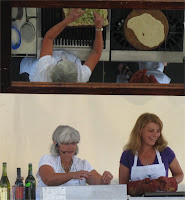
Tina and Dayle concocted a couple of lovely pizza combinations, with fennel and potato as the main stars.
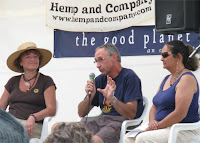
Then there was a talk on the topic of Reviving the Vancouver Island Diet. Food security by any other name, it featured a crew of familiar faces and voices. Local farmer and writer Tom Henry

spoke about the need for Canadians to pay a fair price for their food – to allow local farmers to produce it; to encourage politicians to help small local meat producers raise and humanely/ locally slaughter food animals; and he stressed the importance of staying on top of local politics where these might impinge on food security – citing a potential loophole in Metchosin’s secondary suite provisions that could allow the unscrupulous to subdivide farmland.
He appeared with Carolyn Herriot, talking about food security, the power of the land to provide a living, and her irritation with corruption in local politics; she has a long-standing mistrust of the nutritional value of foods reared hydroponically and so felt affirmed, if shocked, to read recently that greenhouses block the UV light needed to form antioxidants in vegetables.
Bill Code talked about the power of food to heal, and the community value of the Island Farmers Alliance; and Jen Fisher Bradley championed food collectives, debt forgiveness (student loan debts/young farmers) and the Vancouver Island Diet.
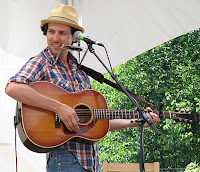
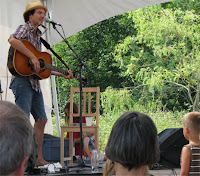
After too much sun, an organic hot dog and a dribbly cornetto di gelato, it was time to crowd beneath the tent to hear Jeremy Fisher play some old and some things from his new cd Goodbye Blue Monday.
-
Canlit magazines – the quest for survival
There has been a fair amount of coverage of the plight of Canada’s literary magazines over the past few months, which risk an untimely end if the wrong-headed Canada Periodical Fund comes into being as proposed in February: their long-term fate still hangs in the balance. The conditions of the fund are that support will only be provided to journals with paid subscriptions of more than 5000, which rules out pretty much every literary journal in the country. The summer break is a good time to carry on reminding our legislators of the importance of these publications, and that they cannot survive if pitted against for-profit publications.
In these crazed times where market-happy management grads attempt to reduce every aspect of life to a business model, we need to wake up and admit that not everything – certainly not culture, not food production – can or should be run on a ruthlessly corporate model; and that you may cripple or ruin some of your most essential industries by imposing “efficiencies” and cost-cutting measures upon them.
Literary magazines are hugely important to Canada. They’re the first place we’ve seen so many of our literary greats in print; they carry a permanent legacy of our literature’s evolution – the paper and ink of print publication, blending more and more with an online presence; and they simply cannot survive in our under-populated country without the aid of grants, any more than can our literary publishers.
If you’re a Canadian, please take a moment to sign the online petition that The New Quarterly has set up; or print off the pdf version from Arc. You can also join the Facebook group: Coalition to Keep Federal Support of Literary, Scholarly and Arts Magazines.


Latest Posts
- Sublime
- Good weather for reading
- The world, the world
- Sublime launch!
- Planet Earth Poetry – Readings by Volunteers, Victoria 2026
- Poetry at the Goldfinch
Aldeburgh Poetry Festival Barny Haughton BBC BC poets Berkswell blackberries Black Stilt Bologna book launch Borough Market Carlo Petrini Catalonia Cyrus Todiwala dairy Daunt's Books Dijon Edinburgh Fanny Bay Feast of Fields Food and Morality food history food journalism Jenna Butler lardo Malahat Review Michael Pollan Okanagan olive oil tasting olive trees Omnivore's Dilemma Our Food Our Future Oxford Parmigiano-Reggiano Planet Earth Poetry poetry poetry readings Poetry videos prosciutto salumi Sean O'Brien Suffolk ticks Wendy Morton Wired Writing Yvonne Blomer

In her latest collection, Rhona McAdam navigates the dark places of human movement through the earth and the exquisite intricacies lingering in backyard gardens and farmlands populated by insects and pollinators, all the while returning to the body, to the tune of staccato beats and the newly discovered symmetries within the human heart.
“…A beautiful, filling collection, Larder is a set of poems to read at the change of the seasons, to appreciate alongside a good meal, and to remind yourself of the beauty in everything, even the things you may not appreciate before opening McAdam’s collection….”
Rhona McAdam is a writer, poet, editor, and Registered Holistic Nutritionist with a Master’s in Food Culture from Italy and a deep-rooted passion for ecology and urban agriculture. Her work spans corporate and technical writing to poetry and creative nonfiction, often exploring the vital links between what we eat and how we live. Based in Victoria, BC, and available via Zoom, Rhona is always open to new writing commissions, readings, or workshops on nutrition and the culinary arts.
