-
Does food matter? And the birds and the bees.
So does food matter? If so, to whom? Why not to everyone? How do you make people care, or what should you expect them to do to prove they care? I’ve been asking myself many such questions in recent weeks.
I’ve been to two less-than-crowded gatherings lately, organised with the purpose of showing politicians in the provincial election that the voting public cares deeply about its food and about agricultural issues affecting food production. Apparently the current government correctly deduces that the public is not concerned enough to show up en masse, and so neither must they. No Liberal politicians bothered to accept the invitation to come and defend the government’s record at the legislature rally or the all-candidates forum on food security last week.
It’s odd, because if you ask around, you do find a lot of people out there who do seem to care, and who are acting on their concerns by buying local foods, supporting local farmers, growing their own food; vegetable seeds and starts are selling in record numbers; restaurants and shops that specialise in local foods are springing up like weeds. But then again, when I peek in the carts of my fellow shoppers in grocery stores, I see convenience foods; imported out-of-season fruits and vegetables; highly processed foods laden with hfcs, preservatives and fats; cases of pop, and generally a totally unsustainable lifestyle carrying on around me. And a miniscule percentage of the public turning up at food and agriculture rallies.
Farming Today, the straight-on BBC Radio 4 program on farming issues, talked honeybees last week. You can catch the full week’s worth – which includes an interesting exchange about the part that pesticide group neonicitinoids may play in unexplained bee deaths – for another six days. This week it’s on to chickens…
It’s definitely turned into spring here. My new mason bee house filled up a week after I mounted it on the fence
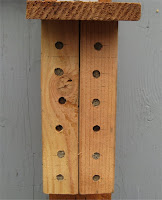
so I’ve added some high-density housing
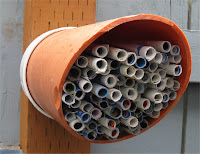
along the lines of what Haliburton uses; I think I need to cut the tubes down in mine so they’re better protected from the elements.


Haliburton has also brought in some wireworm specialists to help with integrated pest management in the fields. They’re young but willing.

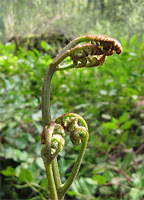
And finally, a walk through the woods proves the arrival of spring: Trillium in bloom
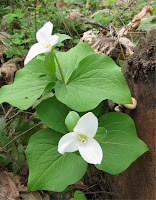
and food on the hoof: salmonberry
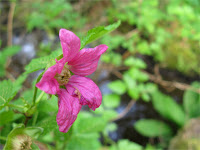
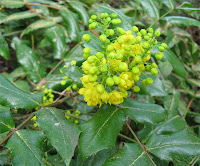
and oregon grape both in flower.
Arrrrr…
-
Rocksalting in Vancouver and Blue Orcharding in Victoria
Had a nice weekend in Vancouver, starting with a place in the Rocksalt reading which was part of the Main Street Literary Tour, in celebration of BC Book & Magazine week. We hung out in the Cafe Montmartre,
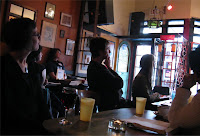
being hosted by Trevor Carolan
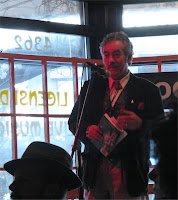
till Mona Fertig got there from another event she was doing in West Vancouver.
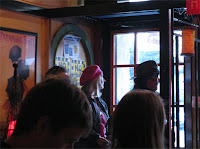
Had a little beer tasting on Saturday. My trio was porter, raspberry wheat beer and Rickard’s White wheat beer (my favourite)

Sunday’s treat was a walk through North Vancouver. Here’s how the allotment gardens look:
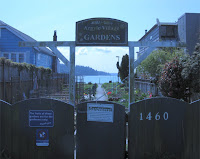
One question. Why?

Str(eat) art, Vancouver style.
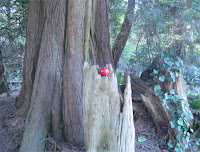
How they tell it in Deep Cove:
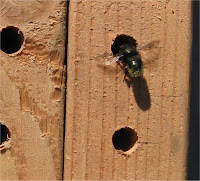
Back home, and this lovely afternoon I took stock of the Blue Orchard (Mason) Bee (Osmia lignaria) house I’d put up on Thursday:

— a couple of dwellings already dwelt in, with lots of action in others. Holy pollen, mama’s home!
Hanging out on the fence.
-
Food politics and a spring bee check
The rally at the legislature on Saturday was warmly attended by groups including COG:
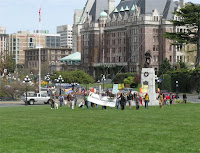
The cavalry rode round and round the grounds:
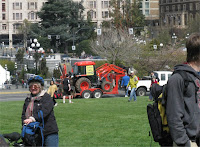
There was a pleasing diversity of age and slogan:


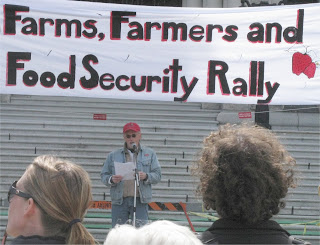
with some rabble-rousing by Brent Warner
NDP candidate Lana Popham
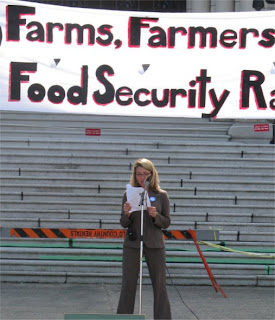
farmer, beekeeper and food activist Linda Geggie
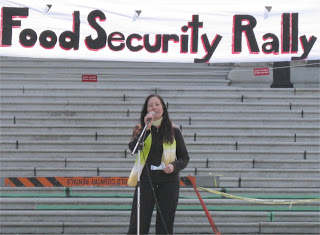
organic farmer Heather Stretch
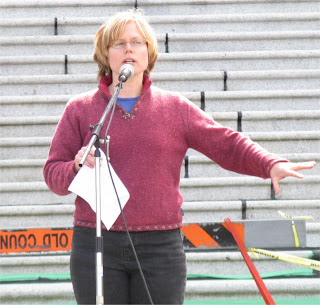
and farmer-writer-editor Tom Henry
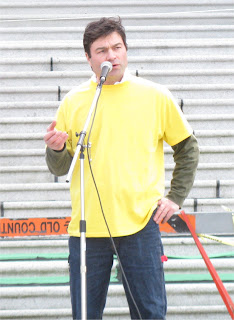

There’s another opportunity for Islanders make their food interests visible to politicians, at a gathering on Thursday April 30.
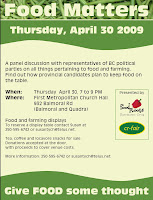
More information at the BC Food Systems Network website; including the Food Security Election Primer which is a terrific tool to use on any visiting electioneers, and a handy fact sheet on the issues for educating yourself, your friends and neighbours.
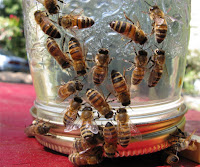
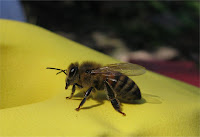
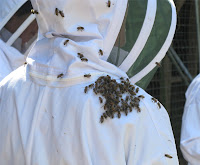
I spent yesterday morning following a spring bee inspection with some of my bee-owning classmates from last year’s bee-keeping class, led by Larry & Marilyn, who kindly lent me a bee suit for the occasion. I had a few curious customers stop by to admire my gloves.
Some of the girls hang out on their mom’s shoulder.
Saw lots of crazy comb, including one with a donut hole in the middle:


Here are a couple of queens (the long orangy ones; one of them is marked in red; colours are agreed on each year so you can tell how old the queens are):


I brought along some of the honey I’d bought in Italy for people to sample; one of the varieties evoked some discussion about rhododendron honey, which is said to produce Mad Honey Disease. And here’s a poem featuring death, rhodos and bees (but not mad honey disease).


Latest Posts
- Sublime
- Good weather for reading
- The world, the world
- Sublime launch!
- Planet Earth Poetry – Readings by Volunteers, Victoria 2026
- Poetry at the Goldfinch
Aldeburgh Poetry Festival Barny Haughton BBC BC poets Berkswell blackberries Black Stilt Bologna book launch Borough Market Carlo Petrini Catalonia Cyrus Todiwala dairy Daunt's Books Dijon Edinburgh Fanny Bay Feast of Fields Food and Morality food history food journalism Jenna Butler lardo Malahat Review Michael Pollan Okanagan olive oil tasting olive trees Omnivore's Dilemma Our Food Our Future Oxford Parmigiano-Reggiano Planet Earth Poetry poetry poetry readings Poetry videos prosciutto salumi Sean O'Brien Suffolk ticks Wendy Morton Wired Writing Yvonne Blomer
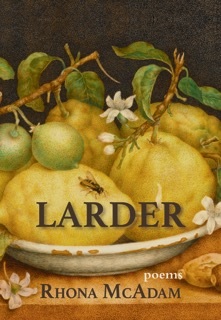
In her latest collection, Rhona McAdam navigates the dark places of human movement through the earth and the exquisite intricacies lingering in backyard gardens and farmlands populated by insects and pollinators, all the while returning to the body, to the tune of staccato beats and the newly discovered symmetries within the human heart.
“…A beautiful, filling collection, Larder is a set of poems to read at the change of the seasons, to appreciate alongside a good meal, and to remind yourself of the beauty in everything, even the things you may not appreciate before opening McAdam’s collection….”
Rhona McAdam is a writer, poet, editor, and Registered Holistic Nutritionist with a Master’s in Food Culture from Italy and a deep-rooted passion for ecology and urban agriculture. Her work spans corporate and technical writing to poetry and creative nonfiction, often exploring the vital links between what we eat and how we live. Based in Victoria, BC, and available via Zoom, Rhona is always open to new writing commissions, readings, or workshops on nutrition and the culinary arts.