-
Real Canadian ploddledygook
It’s certainly not food and not quite poetry, but there is a useful new word in the English vocabulary: ploddledygook. It may look unpronounceable but it is certainly recognisable to anyone who’s heard a police officer of any stripe or nationality interviewed within the last couple of decades.
We’ve had lots of examples in the emotionally bankrupt testimony given by the RCMP officers at the Dziesanski inquiry, where their version of events has been visibly contradicted by the amateur video available on Youtube. The tone of the testimony has given appalled listeners some important lessons in how to alienate your public and rob your profession of dignity. Some of the statements reported by the press include:
Cpl. Robinson’s testimony: “I didn’t articulate it well,” said Robinson… “I’m blending the whole interaction.”
or Const. Rundel: “Mr. Dziekanski went from non-compliant behaviour at the luggage to what training has taught us is a resistant behaviour where he has directly disregarded a command and fled from us … and took up a combative stance” and “I don’t believe that the language barrier was a problem in that instant, due to the fact that he responded to the direction of the hand signal and the verbal ‘No’”
or Const. Millington: “The person that it’s applied against is supposed to fall immediately and it’s supposed to immobilize them…It did not have that effect so I felt it was necessary to fire it again…He was in a combative stance, as we call it, and was approaching the officers I believe with the intent to attack…After the first one, when he fell to the ground, I interpreted that to be he didn’t feel the full effects” and “We acted in accordance to our training…Of course I never intended this result. I never intended for Mr. Dziekanski to pass away.”
It’s sad and galling to see Mounties use language like this, to distance themselves from the events they’re describing. I know in these libellous times it’s the norm for representatives of any profession to excise the humanity from any public speech, but I don’t have to like it. I can still long for plain-spoken testimony, a simple apology, some expression of regret for what happened.
-
Agriculture rally, the FLR, hoop houses and food-borne pathogens
This Saturday afternoon, April 18th, at 1.30pm, there’ll be a Farms, Farmers & Food Security rally at the BC legislature, a proper foodie kick-off to the May 12 provincial election. There are many related issues we’d like our politicians to be better informed about, including the
- decline of agriculture in BC
- lack of support for local food production
- unaffordable farm land
- vanishing meat processing capacity
- erosion of ALR
- food crisis affecting all of us
- many other food security issues
The Forest Land Reserve, the taller cousin of the Agricultural Land Reserve, is open to similar abuses by money-grabbing developers, and has been in the news lately. The Capital Regional District attempted to undo the damage done by the provincial government, which released the lands from the FLR in 2007, and protect the area from development, but the BC supreme court said no, and the appeal won’t be heard until June.
Yesterday’s fun was helping to build a hoop house at Haliburton farm
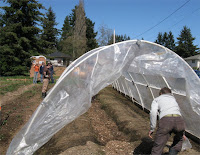

and then attending a talk by Ed Ishiguro
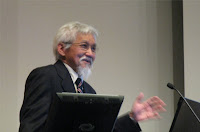
about food-borne illnesses (and common pathogens salmonella, listeria, campylobacter and e.coli). Ishiguro has spent many years exploring e. coli 0157:H7 and had interesting things to say about the dramatic – unprecedented – rise in food-borne pathogens over the past forty years or so, coinciding rather dramatically with the rise of industrial food production, whose profit-driven livestock overcrowding methods have not just allowed but actually facilitated the spread of pathogens. He is also adamant that the low-dose feeding of antibiotics to all our industrial food animals (too low to prevent disease, as he says farmers are led to believe, but rather used to make them grow faster) has caused the antibiotic-resistant diseases that are infecting our hospitals. A no-brainer you might think, and yet governments in North America have been lead-footed in their response; he cited encouraging (though he felt not yet convincing) research results from Denmark where a ban on antibiotic growth promoters have actually caused antibiotic-resistant diseases to decline, and more treatable ones to emerge.
Some good background as I prepare for tomorrow’s Foodsafe class…
-
Worm bins, writers and online learning
A weekend ago I attended a composting course at the Compost Education Centre where we looked at several different ways of composting: 3 bin methods; backyard composters – both horizontal tumblers and vertical Earth Machines -; and digesters that can hold kitchen scraps and dog waste…
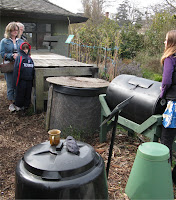
and even the worm bin benches they use for seating

in the straw bale classroom.
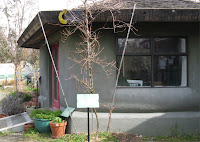
Then there was a regional meeting of the Writers Union of Canada in Nanaimo, where the potluck table was groaning

and the talk was largely about the pros and cons of the Google Book Settlement. There seems to be a move among many of Canada’s writers to opt out of the settlement, and to pull their books from Google to protest intellectual property abuses – and associated injury to the cultural and financial interests of writers – by vastly profitable corporate monoliths like Google. We have until May 5 to opt out, or until April 2011 to pull our books from the digitization machine.
Last week’s Planet Earth Poetry will likely be the last I get to this busy season, and I was happy to hear some excellent poems from Yvonne Blomer
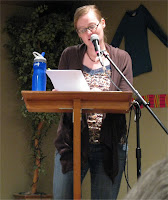
reading with the touring Brian Bartlett

Some food-related courses start up later this month, at the Virtual University, perhaps the solution for people too busy to get to sit-down classes. For $20US you can spend 4 or 5 weeks studying nutrition, herbalism and natural remedies, or organic gardening.


Latest Posts
- Sublime
- Good weather for reading
- The world, the world
- Sublime launch!
- Planet Earth Poetry – Readings by Volunteers, Victoria 2026
- Poetry at the Goldfinch
Aldeburgh Poetry Festival Barny Haughton BBC BC poets Berkswell blackberries Black Stilt Bologna book launch Borough Market Carlo Petrini Catalonia Cyrus Todiwala dairy Daunt's Books Dijon Edinburgh Fanny Bay Feast of Fields Food and Morality food history food journalism Jenna Butler lardo Malahat Review Michael Pollan Okanagan olive oil tasting olive trees Omnivore's Dilemma Our Food Our Future Oxford Parmigiano-Reggiano Planet Earth Poetry poetry poetry readings Poetry videos prosciutto salumi Sean O'Brien Suffolk ticks Wendy Morton Wired Writing Yvonne Blomer
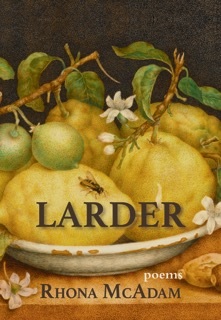
In her latest collection, Rhona McAdam navigates the dark places of human movement through the earth and the exquisite intricacies lingering in backyard gardens and farmlands populated by insects and pollinators, all the while returning to the body, to the tune of staccato beats and the newly discovered symmetries within the human heart.
“…A beautiful, filling collection, Larder is a set of poems to read at the change of the seasons, to appreciate alongside a good meal, and to remind yourself of the beauty in everything, even the things you may not appreciate before opening McAdam’s collection….”
Rhona McAdam is a writer, poet, editor, and Registered Holistic Nutritionist with a Master’s in Food Culture from Italy and a deep-rooted passion for ecology and urban agriculture. Her work spans corporate and technical writing to poetry and creative nonfiction, often exploring the vital links between what we eat and how we live. Based in Victoria, BC, and available via Zoom, Rhona is always open to new writing commissions, readings, or workshops on nutrition and the culinary arts.