Lots of fish

Two fishy events last week. The first was an enlightening visit from a veterinarian, Valentina Tepedino, whose topic was fish quality. We embarked on a preprandial nightmare into nematodes and parasites (anisakis), poisons (tetrodoxin) and various aspects of fish fraud. Here is a small fraction of what she talked about.

Fish fraud, she said, is huge in Europe; as much as 80% of the tuna sales in Europe are fraudulent, with lower grade fish (bluefin) being passed off as the more expensive yellowfin or albacore, and it can happen because the fish are not sold whole where the identifying dorsal, pectoral and anal fins cannot be seen.

Likewise there is well documented fraud involving other fish varieties; a farmed fish, Pangasius, a sort of catfish, is often passed off for sole. It’s so cheap to produce that with strategic employment of some equally cheap labour, it can be filleted to resemble sole and sold for many times its market value. Solea senegalensis, a farmed variety from Senegal, is often sold as the much more expensive Dover sole; it takes skill and experience and a close look at the whole fish, skins and gills included, to distinguish one for the other.

Another big fraud is passing farmed fish off for wild. Though there is a popular misconception that all our cod is wild, the Norwegians have in fact developed a highly successful farming industry. Salt cod (bacalau) is popular in markets like Italy, Spain and Portugal, but much of what reaches the market is either farmed or one of many cheap varieties such as pollock and hake that are almost indistinguishable from cod once decapitated, dried and salted.

And there is the fish product known as “surimi” which is pulverised whitefish (often those cheap farmed staples, pollock and hake) coloured with paprika and reformed into imitation crab, lobster, prawns, eels (anguilla). But often only a percentage of this is actually hake or pollock, as it’s often mixed with even cheaper ones.

One key area where it becomes dangerous to substitute one fish for another is in the area of, for example, pufferfish, which can be passed off as monkfish, as the two are nearly indistinguishable when skinned and decapitated. But pufferfish carry the lethal neurotoxin tetrodoxin which can cause death in as little as five minutes, an risk that eaters of Fugu undertake voluntarily, but not something the average monkfish eater would expect. One instance of this kind of fraud in Italy was enough to ban the sale of monkfish without heads, so that consumers can be sure which fish they are buying.

As always it’s a case of buyer beware, and educating yourself about the sometimes huge and complex issues to to with identification, sustainability, aquaculture and fishing methods. Websites such as Sustainable Seafood, Fishonline, the Marine Conservation Society, MareinItaly and Fishbase are good starting points.

So, thus armed, I was interested to see what was on display at Slow Fish in Genova yesterday, a good mid-sized exhibition with lots of tastings and workshops.

One of the most popular points was the enoteca and bistro where you gained admission by buying a cotton nosebag (actually a glass holder, equipped with a wineglass ready to be filled from over a thousand different bottles). There was a selection of food, including oysters and shellfish and other seafood tastings, some pasta dishes, and some local and Presidia products: focaccia, gelato, candied fruit and sugared almonds from Romanengo, and Huehuetenango coffee.

We were excited to experience a rare tasting of the Portonovo Wild Mussels we’d heard so much about – but never seen – during our visit to Le Marche.

Everyone and his (well behaved) dog was there..

Tagged , , , | 3 Comments


Journalism, food geography and a mighty fine picnic

We had the entertaining guidance of the Guardian‘s very own Matthew Fort to speak to us last week. I have been to many a talk on how to write and on selling your writing, but it never hurts to have a few stern reminders from a guy at the top, like: you can’t call yourself a writer if you don’t write every day. His chief tip is to try to elicit three reactions from the reader: ‘I never thought of that’; ‘that’s really useful’; and ‘I really enjoyed that’.

One side-comment he made stayed with me: British food shops are shooting themselves in the foot by keeping bankers’ hours; the only food shops open at times when their customers are able to shop are the supermarkets, and so they win the business. A remark that goes for other places as well; but he praised Italian food shops for staying open in the evening so that working shoppers could patronise them on their way home. Here in Parma most shops open between 8.30 and 9.30 and close for a very long lunch (12.30 till as late as 4.30) but then reopen for evening trade, until about 7 or 7.30 – which is indeed convenient, seen in that light. Not the first thought in my mind when I finally emerge to do my shopping on Saturdays around noon, but I guess that’s my choice.

We finished our week with Colin Sage, an environmental geographer and crusader for raw milk Irish cheeses. He talked to us about food geography, and specifically about some of the regulatory issues around raw milk cheeses that are helping to draw a scientific noose ever more tightly round the food we are able to buy. He referred us to Marion Nestle, a name that’s been coming up in various places and readings, and mentioned a useful article by our hero Michael Pollan about the rise of a whole new evil that goes by the handle of nutritionism. And he left us with the suggestion that maybe it’s time to grow our own food.

He called on us to shift away from thinking of ourselves as simply consumers having our choices limited and being passive recipients of what might be less and less a ‘whole food’ and more and more a nutrition product. We need, he says, to become food citizens with an active role in asserting values and creating an environment for our own sustenance. Increasing transportation costs mean there will be a higher and higher cost for our food: the current system is unsustainable. We need to be responsible and involved in how and where food is sourced, and grow some of our own food if we can. He advocates alternative food networks: perhaps develop small scale cooperatives for sharing food resources. Fair trade needs to go further than chocolate or coffee, and develop in such areas as fruit that we’ll never be able to grow in northern climates.

Oddly enough I had been listening to a Food Programme piece from last February on much the same theme, where the speaker, Colin Tudge, advocated a “world-wide food club” – a cooperative relationship between good farmers who really want to produce good stuff, artisans, bakers and brewers who are prepared to produce good food from it, and people who are willing to pay for good food properly produced.

Colin Sage has also spent time looking at the structures around our food governance, and is uneasy with his findings. The bodies that research and govern our food supply are suspect: there are well publicised funding relationships between business and research (academics and scientists) and government which is problematic for impartiality: when funding determines what is being studied and how the results may be released, that limits what we can truly investigate and report in all that we need to know about our food. The ‘cosy relationship’ that exists between business and regulatory bodies in terms of who heads them (but where do you find the expertise to head regulators if not in the industries they come in to regulate?) can be causing problems again in impartiality. And food sovereignty means that countries that need to feed themselves are using their own resources to grow export crops, which are more lucrative, but create a world in which food is being grown as animal feed or fuel while their own populations suffer hunger and malnourishment. Sobering stuff; the more so when so much of it is literally echoing down this year, repeated with variations by our speakers and in our readings.

With all that on our minds it could have been hard to gather the strength for a Labour Day picnic in the park but we managed. We spread our blankets on a sunny day in a quiet, walled garden overhung by chestnuts in full flower with a few bouncing dogs in the background – and later in the afternoon some curious soundtracks (Frank Sinatra?) coming from the puppet show in the courtyard of the Castello dei Burattini. One by one we set down our wares, explaining why they were not adequate, which ingredients we’d been unable to find or adapt, why the recipes had not worked as we had hoped, why they didn’t look the way they were supposed to; and one by one we ate the offerings with delight and mutual encouragement. Even halfway through our year it can be a scary thing to share humble food among our ever-more gastronomically enlightened selves. But we all agreed we must do it more often.

Tagged , , , , , | 3 Comments


Crete part 4: phyllo finale

The Crete trip was drawing to a close. We moved along to Rethymnon on Saturday, via the National Agricultural Research Foundation in Messara, where we had a talk from another gracious speaker, Dr Manolis Kambourakis

who talked about some of the issues supporting the growth in organic olive farming in the Messara Valley; the most urgent of which was the degradation of natural resources such as water.

We enjoyed another Cretan lunch, complete with koukouvaja (rusks with tomato and fresh cheese), tzatziki, halloumi and Greek salad. Afterwards he took us to a viewpoint to see the ancient ruins of Phaistos and the sweep of the valley with its new crop of greenhouses.

On to a cooking demonstration by our evening’s host, Othonas Hristoulakis,
who showed us how our meal would be shaping up. Salad, halloumi, baked feta and lamb with artichokes were on their way, with a lovely little fried pastry with candied oranges to finish.


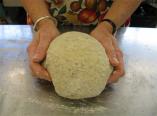
But first — as we had come to understand, there is always one more thing to see, just as every meal has one more course we weren’t expecting. We navigated a few narrow streets away from the restaurant to watch a demonstration of the noble art of phyllo making. The rounds of pastry have been made in large circles; the fun comes in when it’s stretched in a seemingly effortless process, much like making a bed and tugging the sheets gently until they cover the required space. Forty or fifty years of practice is all it takes…


We had a day off on Sunday, and some of us spent it at the beach in south Crete: first at Palm Beach, near the Preveli monastery,

and then a scary drive along a narrow gravel cliffside road to Ligres, where a fabulous beach beckoned while our seafood was grilling.


And then, by gum, it was our last day. We dropped into the village of Maroulas to visit a herbalist, Marianna, where we bought remedies for all that ailed us,


and then pressed on back to Amari where we met again our friend Katarina the potter, who welcomed us with cheese and raki and biscuits made from wine must, and warm cheese fritters we ate with honey. She showed us some of her wares and let us have a go.


Finally: supper in Rethymnon, the night of Too Much Food…

After which a group of hardy souls managed an hour or two round a beach fire before heading back to the hotel to rest up for morning.

And as if a 4am departure wasn’t enough to tell us it really was over, we had to face this abomination on Aegean Airlines at breakfast time. At least the yogurt was good.

Tagged | 3 Comments


Crete part 3: shepherds, cheese and village feast


One morning we ascended a steep, gravel road and shortly found ourselves a lot of the way up a mountain, at an open-air milking parlour.

The goats were corralled and driven at intervals by a pair of well trained dogs towards the shepherds who wrangled them into position, milked them and sent them off to spend the day on the mountainside.


Our host models the traditional shepherd’s bag – which used to include one essential you don’t see much nowadays: a mending kit to allow them to stitch up their boots and clothing to get through the weeks and months they might have had to spend in the mountains.

He produced platters of fresh cheese, home made biscuits, and a bottle of raki. We were told we had to eat all the cheese. So we ate cheese.

And we ate cheese.

And we ate a bit more cheese.

And then we were down to the last piece of cheese. And when that was gone, it was time to see how it was made, so we descended again and visited – what else? – a local cheesemaker.

The milk has been coagulated, the curds have been cut, and then put into baskets to drain and firm up into cheese.

Afterwards, we were offered a very tasty gruyere-style cheese, Graviera, served with rusks (paximathia) and raki. And then, full of cheese, were called away to lunch.

Talk about a village welcome!
Men make fire..


Popi, who organised the cooking, read us a poem of welcome. The four-line poem is a popular and traditional poetic form on Crete, and ideally sized for inscription on the blades of the knives that form part of the traditional costume for men.


We were walked around the room, meeting the people behind the dishes, admiring the dishes, and finally eating the dishes. As Kostas said, the beauty of the event was not just the generosity of the welcome or the extent of the food that had been prepared for us, but the fact that it had been made from what these men and women had grown, raised or foraged themselves.


We had a cooking demo – how to make wild greens pies (Kalitsoùnia).


Lots of wine to sample.

We tasted many new things, and some we’d already tried; snails finally broke free of the leaves and plants we’d been seeing them on, everywhere, and rolled right onto our dinner plates. So much food! So many impossible choices. This was one affair where we couldn’t try a little of everything, not even close.


Xerotigana

Afterwards, the men kicked up their heels.

We had a last drink, and wended our way towards a couple of hours’ relaxation before supper.

Tagged | 2 Comments


Crete part 2: Amari Valley; wild greens, pastry and sing for your supper


It may have felt on the wintry side at times, but we were in Crete at a perfect time to catch the full glory of wildflowers.

Our Thursday morning was spent gathering wild greens from the hillside, and preparing them for lunch. Kostas led us up the trail and he, Aris (a cave specialist and companion on many of our outings) and Lambros (owner of the taverna where we were based) showed us what treasures we were trampling and filled us in on some of the legends, food and folk medicine around the greens we were collecting and observing.


Giant fennel, not really fennel – in fact its poisonous cousin – but Ferula communis makes a dandy walking stick when it dries out, and it’s a handy torch as well. As Prometheus discovered, and used it to steal fire from Zeus to give to mortals.


Jutta, a visiting German botanist who happened to be there with her botanist husband, tells us about the curative powers of Sambucus nigra, Elderflower. She said the tree and its flowers were considered lucky, and the flowers used to be hung above a cradle to protect the child. When I told her I’d heard elderberry wine was a popular concoction, she said the berries are edible only after cooking -which I guess happens during winemaking – and are otherwise toxic.


Some frilly midget beans; so so tasty. Pan-fry them (in Cretan olive oil!) and then put them in your omelette.


Wild asparagus: very hard to spot by amateur foragers, but lovely to nibble on raw and a favourite for omelettes.


A shepherd we passed on the way up the slopes. I never saw the sheep, but then some people saw the sheep and not the shepherd. Anyway; nice view.


The greens basket, filling, filling. We harvest fava (broad) beans and artichokes on a nearby field.


Sorting the greens; the bowl on the left has asparagus fern fiddleheads; the one on the right has frilly beans.


A kind of summer kitchen outside the taverna had a handy oven like many we saw in Crete, ideal for roasting potatoes.


Women make food.


Men make fire.

Everybody eats omelettes; there’s also a sweet omelette (not in this picture) made with elderflower.

The finale: salad with raw artichoke, wild greens, borage flowers; boiled wild greens with fava beans and artichokes; potatoes roasted in goat fat; lentils; wild greens omelettes.

After lunch we departed for nearby Aghia Fotini, where we had a cooking demonstration, all about making stafidoto (filled cookies), baklava…

and these lovely Loukoumàdes (breakfast donuts), fried in olive oil and drenched in cinnamon syrup, Cretan honey and sesame seeds. At last, I thought, I have the secret to the Cretan diet: you start your day with donuts and raki and you will live forever.

Katarina the potter, who we were to visit later on, came to the town hall and presented us with a branch of rosemary from her garden which we were to wear behind one ear, as a kind of instant wreath. It showed our fellowship and was also intended to give us clear thinking in the meeting, which was much needed after all those donuts.

We had a presentation by Aris about caves, flora and fauna; there was a brief presentation by a local man who told us, among other things, about the tendency in this area to uproot old olive groves and replace the healthy, hardy local varieties of olives with dwarf varieties better suited to mechanical harvesting and producing olives with flavour more in keeping with contemporary tastes. Kostas told us a little more about MedASH, and its work to encourage hotels to compost their landscaping waste, to educate children in organic planting. His discussion of soil health included the memorable description of soil as the “stomach of the plant”; growing things are really all one organism, he said; roots tangle in the earth, and microorganisms connect them.

And after that… ack. More food?!? Supper that night in Gerakari village started with a quick demonstration of some of the things we’d be eating: fava bean puree, raw artichokes.

Wild onions and raw artichokes…

Boiled favas and artichokes…

A nice bit of lamb…

After the meal, singing and more singing. Everyone had to take a turn, by country. The Americans were a hit with “Comin’ Round the Mountain” to which they added a “yee-haw” chorus which so delighted our hosts they asked for an encore. Alas the three Canadians discovered we had only our national anthem in common, so that’s what we sang .

After the singing we were rewarded with ice cream with local cherries on top.

1 Comment