Skip to content

Uncategorized

Sharing Food & Knowledge; Hali work party; Food Matters! and Planet Earth

Last week was a busy one for Vancouver Island’s food security community, with two significant meetings and a last Seedy Saturday on top.

Tuesday about 50 of us gathered at the university for Sharing Food and Knowledge, a meeting of people involved in food and educational issues convened with the support of UVic’s Office of Community Based Research (OCBR). We had a speedy stream of presentations, kicked off by one from Linda Geggie, introducing the afternoon with an overview of the OCBR’s Capacity-Building Project, which includes UVic and five Vancouver Island post-secondary institutions. Areas of interest include food security and sustainability, and the group aims, among other things, to capture, share and meet research requests by working with interns and researchers. They’ll also do a survey of programs and curricula as well as identifying areas of research already underway.

Other speakers included Steven Earle, from Vancouver Island University, speaking on peak oil and the future of food production on Vancouver Island. Some of the looming consequences of our current situation that he identified include

  • reduced food supply
  • increasing food prices
  • rationing of oil
  • conflict
  • less available food for all
  • and less transported food

He was asked to provide some ideas about what needs to be done on the Island, and these include

  • farm without chemical fertilizers and pesticides
  • move away from mechanical farming and increase farm labour
  • care for the soil
  • improve water efficiency
  • plant winter crops and storable summer crops
  • use open pollinated vs hybrid seeds – i.e. practice seed saving
  • practice mixed farming
  • and buy local

Tom Child also spoke about his work studying environmental contaminants in the marine foods of coastal first nations in BC. Food sources he’s studying include harbour seals, dungeness crabs, sockeye salmon and butter clams. The highest PCB and PBDE levels he found were in seals (makes sense to find these things at the higher end of the food chain), but the sockeye has the highest consumption so its contamination levels will be the most important.

and Fiona Devereaux, who talked about the Feasting for Change project, which is part of the Aboriginal Diabetes Initiative

and aims to restore knowledge about aboriginal food traditions by putting youth and elders together to talk about traditional foods.

Wednesday was another work party at the farm

where preparations include moving strawberry runners into new beds:

Thursday evening a group of us got together to share some food and hammer out vision and mission statements for the Food committee of the Victoria Transition Town initiative.

Friday was Food Matters! – a day of workshops and local food hero celebrations. The meeting was held at the Native Friendship Centre and attracted lots of foodie folk from thither and yon. The day started with workshops, including one on community kitchens operating in Victoria. Some of these are participant-run, where people gather to share bigger cooking tasks, like canning, for largely social reasons (with some education picked up along the way) while others are funded and incline towards helping people on low incomes learn to manage food and nutrition through communal cooking. In both cases, participants work together to prepare meals or dishes on a large scale that are divided into portions to take home.

A lunch followed, which was a little disappointing – I played count the seasonal vegetables in the veggie wrap and came up with… one: asparagus, which is seasonal in California just now. It also featured zucchini, red pepper and eggplant (at best these last two will have come from BC greenhouses at this time of year, but that’s not an ideal source either). The halibut chowder

was both seasonal and delicious and was the work of Carrie Pollard (who runs the HEAL – Healthy Eating Active Living – program at the centre)

and the VNFC’s own community cooking enterprise: this brings locals together to prepare a soup each Friday for the centre’s Friday soup kitchen, which provides soup, bread and fruit to people who wish to participate. (But of course I have recently seen End of the Line and any fish consumption is now troubling to me.)

Linda Geggie read an excerpt from farmer-poet-novelist-memoirist Brian Brett’s Trauma Farm – a happy coincidence as later that evening I learned that Brian will be reading in Victoria next week.

There was a talk by Gilbert Wilkes called Demystifying New Media: how media can help us reach and engage our audiences and each other. This covered a lot of ground and was particularly focused on ways foodies could use feeds and aggregators to filter food information.

At the end of the day I wandered out to see the garden that volunteers from the centre and the community have been building, and it is in enviable shape, all the raised beds waiting to be filled:

Friday night was Planet Earth Poetry, with three featured readers: Michael Kenyon, from Vancouver/Pender Island; local poet Michael Bond,
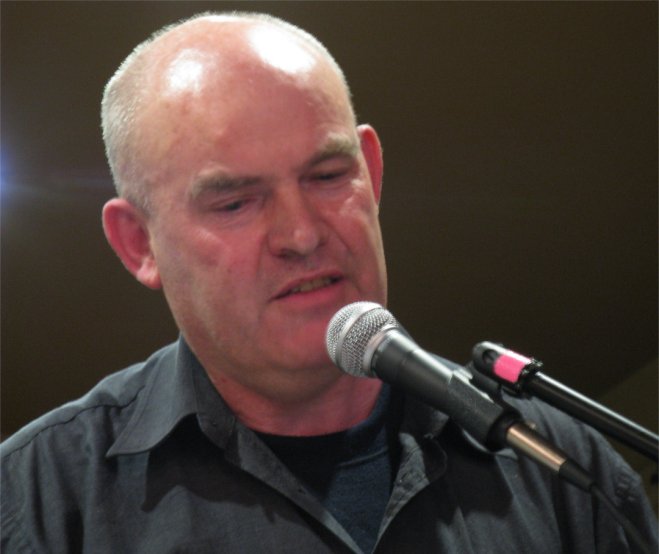
who gave us his first full reading, after several years of popular appearances at the open mic; and Richard Lemm,

wrapping things up.

Dirt! and Raw food

A screening I attended of Dirt! The Movie last Wednesday turned out to be more than it seemed. One of the Sooke Awareness Film Night offerings, it was held in a local school where we encountered a hall full of people and stalls,

offering seeds, seedlings,

vegetables, snacks,

awareness

and even tips on mushroom growing before the screening. The film itself was very watchable, and although it did talk about the dangerous loss of topsoil happening around the world (the scenes of coal strip mining were particularly appalling) and the risks of erosion, desertification and pollution that go hand in hand with this, it offered a good number of optimists and activists working to improve the situation. The film’s advice: do what you can; plant trees; replenish the soil you work with; and be aware of dirt’s role in our lives.

Sunday’s entertainment was a trip to Esquimalt, where VIVA‘s monthly Raw Vegan Potluck event regularly attracts 30 or 40 people

who bring all manner of dishes to share


Hemp cheese… raw vegan chocolate balls… nettle sweet potato casserole with edible salmonberry blossoms


Blueberries & bananas in cashew cream… raw vegan zucchini pasta with pesto… and strawbs.

The society also offers a raw food lending library, and a vendor was there selling ingredients, cookbooks

and tools of the trade.

Each meeting features a speaker: this month it was raw food nutritional advisor Shawna Barker, who teaches, consults, cooks and sells raw foods (at her Living Foods kiosk and through a Meals on Wheels enterprise). Her theme was Nutrition 101, with some extra nutritional tips for raw foodists (mostly around getting enough vitamin B12 – her top tip was to use an algae marketed as E3 Live).

I enjoyed it – though like all potlucks you get pot luck with the food. But some was very good and the requirement for ingredients labels means you can really know what you’re eating; some of the participants provided recipes rather than straight labels, which would be helpful for some of the more complicated dishes. Because to novices, preparing raw food can be very complicated indeed. My main qualm about this way of eating is the dependence on imported ingredients; very few of the dishes were local or seasonal (I brought a brussels sprout slaw, and there were several other salads featuring seasonal greens) though my personal favourite – kale chips (dressed and dehydrated) – was definitely seasonal, and disappeared quickly. By the time I reached it there were only a few crumbs in the bottom of the bowl, but they were tasty. Here’s one I took earlier!

Did we really have to wait for the data? Livers and kidneys: The health costs of Genetically Modified crops and High Fructose Corn Syrup

A sweet little article about whether the body’s seasonal health needs can be satisfied by eating seasonal foods is a timely one, in light of a couple of recent stories about risks to kidneys and livers by things we must have known we shouldn’t be eating. It’s not completely helpful to those of us above the citrus growing belt – article observes that colds and flu coincide with citrus and kiwi harvest – but it’s a nice idea. (Though winter vegetables like broccoli and squash do contain vitamin C as well) And the bottom line is that eating fresh vegetables and fruits is always the best way to go.

Because processed foods are getting more and more bad press. High Fructose Corn Syrup (HFCS – or by its additive names, dextrose, glucose-fructose, fructose-glucose or isoglucose) was rumbled by Michael Pollan and many others for its role in increasing the heft of its consumers. Now, in addition to its contribution to obesity levels, it has been identified as damaging to human livers in people who already have liver disease.

Avoiding HFCS is difficult, if you buy processed foods, because it has been embraced by food processors for its cheapness (thank you US farm subsidies), and can be found in foods including (but not limited to) soft drinks, fruit drinks, sports drinks, flavoured yogurts, frozen dinners, frozen desserts, canned food, breads, muffins, cakes, stuffing mixes, breakfast cereals, pancakes, waffles, cookies, crackers, ice cream, children’s vitamins, cough syrup, candy bars, ketchup, relish, mustard, barbecue sauce, drink mixes, jams, jellies, syrups, meats, salad dressings, sauces, marinades and snack foods and chocolate bars.

Assuming you successfully dodge products containing HFCS, you can now start trying anew to avoid genetically modified foods, because there is evidence that GM crops are harmful to kidneys and livers. Indeed, this has only been proven in animal tests, but who wants to be the human lab rat?

Kidney disease is of course linked to obesity (see HFCS, above). Then again, it might be pure coincidence, but the rise in kidney disease over the past ten years coincides pretty neatly with the increase in unlabelled GM food ingredients (found in about 60% of our processed foods nowadays, according to a 2004 CBC article) like corn, canola, dairy, soy, potatoes, rice and now sugar beet products into North American diets: worth a bit of independent study, I’d think. We know already that Health Canada does not require independent testing on GM food safety for human consumption, but relies on the studies that the producers choose to release.

So. You know what to do. Get your copy of Michael Pollan’s Food Rules, consult your GE-free shopping guides and a good basic cookbook, and get thy processed foods behind thee.

BTW: was I the only one who found the beverages consumed in the movie Juno disturbing, particularly when the consumer was pregnant? Without wanting to know what was in the blue liquid whose surplus the character disposed of at various points, the ingredients in the jug of what she drank before her pregnancy test (amounting to 1539 calories, by the way) are:

Water, High Fructose Corn Syrup and 2% or Less of Each of the Following: Concentrated Juices (Orange, Tangerine, Apple, Lime, Grapefruit). Citric Acid, Ascorbic Acid (Vitamin C), Beta-Carotene, Thiamin Hydrochloride (Vitamin B1), Natural Flavors, Food Starch-Modified, Canola Oil, Cellulose Gum, Xanthan Gum, Sodium Hexametaphosphate, Sodium Benzoate To Protect Flavor, Yellow #5, Yellow #6.

Daily bread

In her book English Bread & Yeast Cookery, Elizabeth David, writing in 1977, makes a point of value to us in these days when we are so distanced from our food supply: that for every ounce of bread we eat (a thin slice), an ounce of grain has been grown, harvested, transported (often long distances) to mills, cleaned, dried, conditioned, ground into flour, treated, stored and finally delivered to bakeries and bread factories.

Wanting to get closer to my bread, I attended an artisan bread-making class last weekend, and here’s what I did at school that day….

Started off with lessons on yeast. Active dry yeast is the yeast of choice since it’s reliable and durable (can be stored for years in a freezer, though officially has a 3 month shelf life)

But fresh yeast is preferred by purists (assuming they are making bread in volume, since a cake only keeps for a month) – can be hard to find though.

Instant yeast comes in big granules; what the purists don’t like about it is that coating on the granules means you’ll get about 25-30% dead yeast together with the live cells, meaning you need to use about twice as much as active yeast, and soak in water, for reliable results.

Moving on from yeasts, we were introduced to sourdough and rye starters

Rye is particularly valued, because of its high amylase content, stable at high (baking) temperatures. Amylase is an enzyme – also present in seeds (contributing to germination) and saliva – which converts starch into sugar; starch is what hardens during baking to create firm, airy loaves. Since amylase breaks starch down during baking, rye contributes a moist, dense texture in bread. We didn’t use the rye starter in this class, but I hope to take the next installment which is all about fermentation techniques.

Then there was Poolish – which originated in French kitchens (the name a nod to the Polish bakers who probably introduced it). Simple to make and only needing a night to ferment, it is gooey and puffy, and went into our baguettes:

and Biga, an Italian starter, which is thicker and sturdier than Poolish, and used later that day to make ciabatta.

We watched our instructor – Martin Barnett – make a Challah dough

while he explained why it is better to weigh ingredients than go by volume (a cup of plain flour is not the same as a cup of whole wheat, etc.) and paused at intervals to demonstrate different stages of gluten development

stopping only when it had advanced to the stage when you can make a window to read through. Then he covered it and left it to carry on with its first rising (primary fermentation).

Lessons learned, we proceeded to make buttermilk seed bread

and some dough for baguettes.

Some of us made ciabatta, and others (like us) Tuscan loaves; then we readied our ingredients for wholemeal brioche and went for lunch (pizzas we assembled ourselves on fresh pizza dough). After lunch we put our bread into loaves, and then made the brioche dough, rolled it flat, buttered it and sprinkled it with sugar, cinnamon and raisins; rolled it up

and cut it into buns

which were baked and then brushed with apricot glaze

and some lemony icing.

We rolled our baguettes and popped them into forms to rise

and then started reaping the bounty. Ciabatta

baguettes

and our seed and Tuscan olive breads. Not a bad haul for 8 hours’ work.

Nutrition Month; Season with lead, phthalates and a pinch of salmonella…

March is Nutrition Month in Canada, and the theme is “Celebrate Food, from Field to Table”. The Vancouver Island Health Authority’s suggestions for ways to celebrate include:

  • Plant a garden in your backyard, a container garden on your balcony, or herbs on your windowsill.
  • Get children involved in preparing food and eat family meals often. When kids take part in meals, they are more likely to make healthier choices.
  • Enjoy fresh food in season. Shop at local farmers markets and farm gates. Freeze or preserve local fruits and vegetables to eat a greater variety throughout the year.

Tips for supporting your community to grow a local food system:

  • Start, support or get involved with a local community garden project to grow food close to where you live.
  • Join a community kitchen group to cook and enjoy meals with friends.
  • Work with your local school board to create ways to showcase local foods either in the classroom, school cafeteria or schoolyard.
  • Encourage your grocery store to carry more local foods.

Meanwhile. as people have been discovering with the recall of North American food products containing Hydrolyzed Vegetable Proteins, a little can mean a lot to food safety. Time magazine’s recent article about the lead content of Indian spices is another argument for buying or using local – including the seasonings in your foods. Many spices and herbs are sold in organic versions which, of course, cost more – but what we’re learning nowadays about the dangers of even tiny amounts of toxins in our foods show why it can sometimes be critical to pay more for less.

Food Safety and the Browning of the Green Revolution

The Canadian Food Inspection Agency has a Food Safety website where you can see the latest hazards, recalls and alerts. It is a nightmarish list of undeclared milk and wheat and egg, product tampering, prosecution bulletins, and instances of Salmonella and Listeria Monocytogenes. All of which have to do with commercial food processing products and facilities. If nothing else, it affirms the value of staying away from processed foods and cooking with fresh, organic ingredients wherever possible.

And speaking of organics, the Organic Center, out of Boulder, Colorado, has posted The Browning of the Green Revolution, (which summarizes the full paper – available here – published in the open access Journal of Environmental Quality) that found adding artificial nitrogen to soil actually depletes nitrogen, and has a diminishing effect on soil fertility. Just as Dirt! The Movie and a thousand other sources will tell you, the authors find that:

Half a century after the onset of input-intensive agriculture, many of the world’s most productive soils have been degraded and cereal production is increasingly exceeded by grain demand for a burgeoning human population.

Plug this into what we know about world food shortages and you get a rather obvious conclusion:

This dilemma warns of the critical need to reevaluate nitrogen fertilizer management and usage, and may ultimately require a transition toward agricultural diversification utilizing legume rotations, instead of further intensifying inputs under the auspices of another Green Revolution. An inexorable conclusion can be drawn: the prevailing system of agriculture does not provide the means to intensify food and fiber production without degrading the soil resource.

I wonder who’s listening… Will our government be able to untangle itself from the knots of influence it’s bound itself to with agri-business multinationals and actually plan for an enduring agricultural industry that produces food for generations to come, or will we stick with short-sighted methods that feed us and starve the future? The problem is that the future appears to be upon us.