Skip to content

Fish for supper


Where it all began, at the Fish Works on Regent’s Park Road in Primrose Hill.


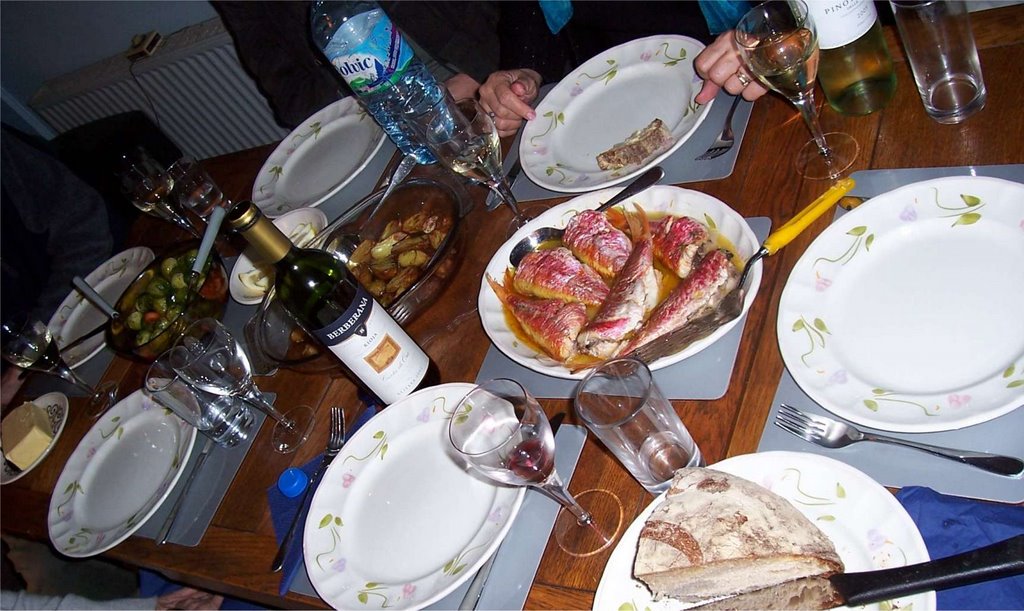
A lovely table in a lovely flat.


Starting in style: marinated anchovies from Sainsbury’s, plus artichoke salad and Lebanese Coleslaw from the Green Valley.


Red mullet hits the table and we fall over in delight. A little thyme and wine and olive oil in the preparations. Lovely with steamed new season brussels sprouts ‘n carrots, and baby roast potatoes with rosemary. Thanks Leah!


Quick before it’s all gone… cheese from Neal’s Yard cheese shop in Covent Garden. The stilton in particular caused some happy moans…

A day in the country


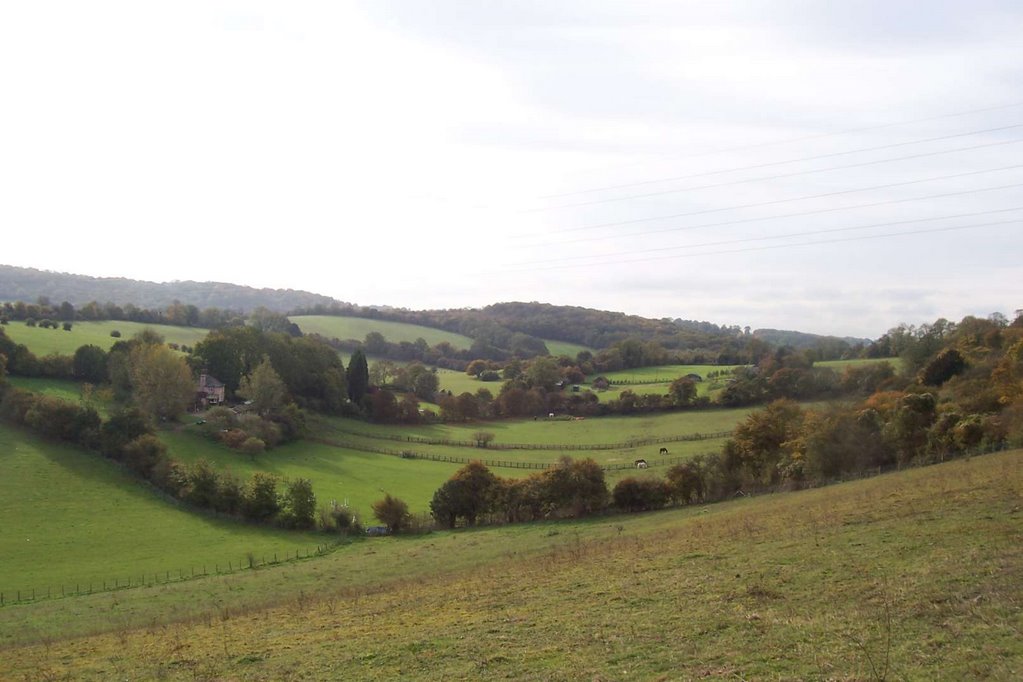
Evidently we defied death and ivy for the sake of a pleasant perambulation through Kent on a dry and breezy Friday afternoon.

Set off from (truly and appropriately) Sole Street station and walked a wide circle to reach a pretty flint church at Luddesdown (home of Luddesdown Organic Farms, we surmised from some posted literature along the path). Some restoration work was in progress on one of the churchyard’s walls:

And flint was everywhere in the fields, crusted in chalk, so it almost seemed we were stepping over bones.

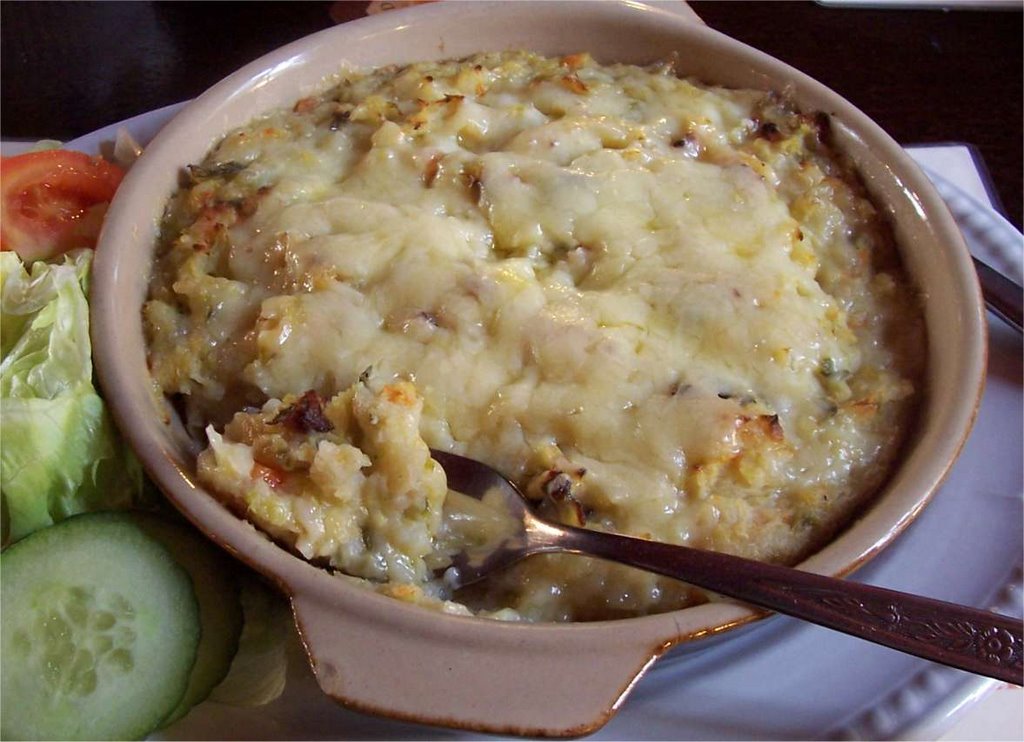
And then, we spied a pub. It was the Golden Lion – unfortunately for my conscience a Greene King pub – and its entertainment poster (promising “themed food night’s” and referring us to “local paper’s and in house flyers”) certainly begged for help from Lynne Truss. But all that aside, I highly commend its amazing and enormous Bubble ‘n Squeak, smothered in excellent cheese and perfectly seasoned. Oh, and cheap (just under £3)! This dish takes many forms, but here it was made from mashed potatoes, cabbage, carrots, onions and – perhaps, because it is usual – a little bacon or ham.

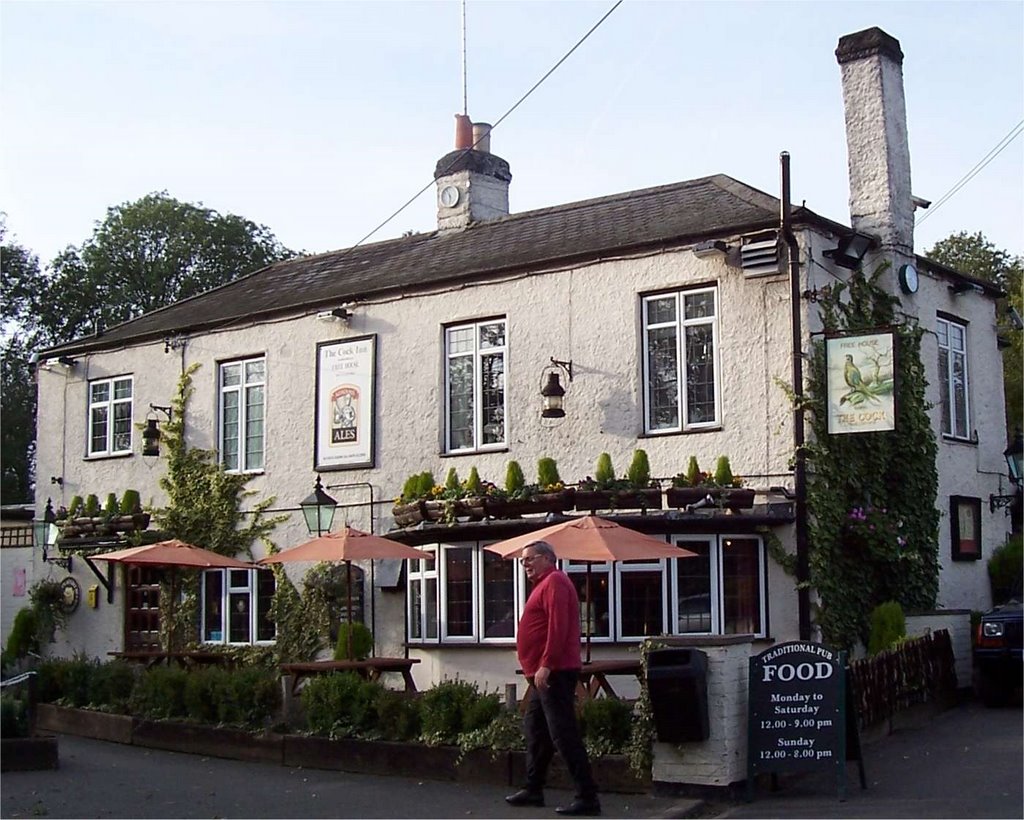
Just up and around the bend on Henley Street, The Cock Inn, but we were making for the train and couldn’t stop again.

After all that walking, a stroll through Rochester where the cathedral seems to rise between the walls of the castle where Dickens wanted to be buried. Sadly for him, Queen Victoria felt his remains would be better placed in Westminster Abbey and there he remains, in Poets’ Corner.

Back to London and a final sprint round the Power and Taboo exhibition at the British Museum. Too limp to go further we collapsed in gratitude before some excellent Thai food at the Thai Garden Cafe on Museum Street.

Nancy Breaks Her Silence


What a lovely audience — in The Crypt at St Mary’s Islington, November 9.

Back in London one more time. I can’t think when I last read with Nancy, but I suppose it was sometime in the nineties, that long lost decade when we shared this city and all its ups and downs. After long silences from both of us we have both published new collections this year. Hers, Writing With Mercury, is the long-awaited successor to Maria Breaks Her Silence (1989). A jazzy ol’ cover on the new book by and as a tribute to her friend Elaine Kowalsky, who was killed by a car last year when she was crossing the street on her way to a birthday party – a sad and sudden end.


Nancy’s fetching scarf, beautiful book and inspiring reading.

Nancy and Mike have been running this Islington-based, more or less bi-monthly readings series Poetry in the Crypt for some years now and it’s a feel-good venture, no pay for the poets and all proceeds going to the St Mary’s homelessness project. Normally there is an open mic as well as a feature reader or two, but not tonight due to the addition of music to the bill. It was good fun with a generous audience (in all senses) and more people I wanted to catch up with and meet than I managed to talk to. Sold out of all the copies of Cartography that I’d schlepped across the ocean for the occasion which was very good news for my baggage weight; maybe not such good news in case I do more readings before my year is up! Anyone who wants one can find it on ABE or Amazon.ca (it comes up in Amazon.com and Amazon.co.uk as well, very mysterious) or of course try ordering from your local bookshop.

Mike at the mic.

All in all a wonderful evening. I even enjoyed even being heckled by fireworks – a timely volley of them went off just as I was reading the lines “I feel sometimes that everything happens to me” in my traditional final poem Another Life to Live at the Edge of the Young and Restless Days of our Lives.

Aubergine to Zucchini

Now that I’m back in England I’m having to revive my English vocabulary. Aubergine not eggplant. Courgette not zucchini. Bicarbonate of soda not baking soda. Chips not fries.

So for lunch yesterday we had one of my favourite soups, which is either Zucchini and Rosemary or Courgette and Rosemary depending on which side of the Atlantic you eat it. It’s equally good on both, a pretty green colour and very warming on a winter’s day. A handy recipe to have in case your guests include vegetarians or the wheat/gluten-intolerant, as it can be made with vegetable broth or cubes and is self-thickened with potato.

Courgette/Zucchini and Rosemary Soup

2 tablespoons butter
1 tablespoon olive or other oil
1 large onion, chopped, or equivalent number of shallots
2 cloves garlic, sliced (or 1 tsp garlic granules, or 2 tsp freeze-dried chopped garlic)
2 teaspoons fresh rosemary, minced
6 cups chicken or vegetable stock (1-1/2 UK pints water plus 6 Oxo chicken or vegetable cubes)
1 large potato (russet or King Edward – a floury rather than waxy one), peeled and sliced
3 medium courgettes/zucchini, chopped or cubed

  • Melt butter with oil in heavy large saucepan over medium high heat. Add onion; cook until translucent but not brown, about 5 minutes.
  • Mix in garlic and rosemary and stir well.
  • Add stock and potato; bring to boil. Reduce heat and simmer 10 minutes, until potato just done.
  • Add sliced zucchini; simmer until tender, about 15 minutes.
  • Working in batches, puree in blender. Season with salt and pepper.

End of Aldeburgh

Where did it all go? One minute the weekend dizzies delightfully before us, the next it’s over. Sunday was a modest blur, beginning with the hugely popular reading by the Joy of Six, whose venue – like that of many other events – was full with a queue of hopefuls. TJOS is in fact five people, all well established poets in their own rights. André Mangeot, Andrea Porter, Anne Berkeley, Peter Howard and Martin Fugura write and perform together, reading a combination of individual and group work. The hands down favourite piece for Sunday’s hall of poets was Poets’ Retreat, from Martin Figura’s 2005 collection ahem, and read by the group. If there was a sub-species of poet from whom this hilariously sinister poem did not take the mickey I don’t know which it would be:


The concrete poets, for obvious reasons, were less quick
and paid the price. But they have found a certain peace
and are with their own kind holding up the flyover
at the Junction with the A66.

Following a less than swift cup of tea in the White Lion, we set off for the finale reading: the ever wonderful Vicki Feaver, an incredibly good German poet, Durs Grunbein, reading with his unfortunately almost inaudible translator Michael Hofmann, and – once more to the microphone – Sharon Olds reading work selected by and on behalf of her friend Philip Levine.

Supper was a delicious trip to the Crown and Anchor in Orford, proving ground for Ruth Watson’s imaginative food in a cosy and friendly hotel which has in the past delighted the likes of Nigel Slater. We sipped some sublime old sherry while considering the menu, deciding upon guinea fowl on a pea and chervil risotto; a towering portion of crisp, juicy pork belly on a well seasoned kindling of vegetables;

and a perfectly pan-fried fillet of hake on saffron mash with fresh spinach. The desserts were not so successful, the pumpkin cheesecake a bit watery – maybe not sieved? – but for whatever reason a bit too vegetable-textured for my taste.

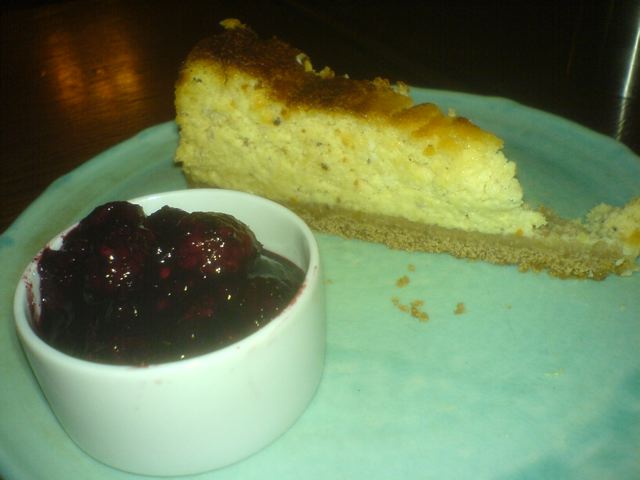
The cheesecake looking a bit lonely with its luscious loganberry companion at its side, after half of it had been spirited away to another plate… and I found the bitter chocolate souffle cake pretty much inedible – hard and uninteresting even with a darling little pot of cream to pour over it. I’d been reading up on the pudding recipes beforehand (the chocolate one came from Something for the Weekend) but not carefully enough, as I thought there would be some give to the texture. Oh well. Everything else was so good it was overkill anyway. And it did look quite majestic.

More Aldeburgh Poetry

Saturday was a long ‘un. After our workshop (and fish pie) we dashed off to Aldeburgh to attend the conversation with Sharon Olds. Michael Laskey presided, in place of Philip Levine who’d had to cancel, and did an admirable job of getting some background from a poet who’s been reviled and revered in equal measure, it seems.

Laskey asked her about some of the “strongly felt and strongly put” criticism that must have made her career deeply uncomfortable at times, from, as she said, “critics who were at pains to tell me why what I did was not poetry.” Although she’d been writing for many years, she’d taken a long time to publish her poems, which she’d really never thought anyone but she would see (her first collection came out when she was 37). She’d tried to learn to cope with the hardest criticism: over time she was able to drop one phase of her response to it – the four parts of which were to burst into tears, throw up, fly into a rage, and finally fall asleep. At one point she actually made a chart listing her poems, with the negative adjectives attributed to each, and tried to learn from this what emotions certain themes were raising in her critics. It’s hard to imagine anyone surviving the kind of battering she’s had on the public stage; how much does prescriptive criticism really help? Give me instead the school of thought that says if you don’t like it, don’t read it — and move on.

In terms of process, she said she’d historically always written very quickly and often in single drafts with little or no changes, a process of gathering, and at a certain point “the gates open and the poem comes out.” She says she revises more nowadays, and her editing rule is to write the draft and then “remove half the adjectives and a third of the self pity, so the poem doesn’t have to carry so many rocks in its pockets.” She remarked on the danger of place-holders: words she’d stuck in her lines while she tried to think of something better, which to her surprise began to resonate with the music and sense of the poem so that it would become difficult to get rid of them later. She spoke of the importance of the “objective correlative” – an object that correlates to some emotion in the poem – without which the poem might blather on, self-absorbed, talking about itself too much instead, let’s say, of the tiny pair of scissors.

Her aims in the bigger world of poetry are to increase poetry’s reach and to help it to join with the wider communities in which we live. She said she’d been inspired by Jean Kennedy Smith’s founding of Very Special Arts in the 1970s, and that her dream – attempted when she was Poet Laureate of New York State – had been to try to encourage every writing MFA program to reach out to jails, mental institutions, hospitals, special schools, hospices and introduce writing programs in these. She feels it is a profound way to extend the usefulness and place of poetry into a larger world, and create a community for poetry – as well as a means of providing teaching experience to writing program graduates.

Next on the bill was the Master Class Poetry Workshop, led by Vicki Feaver with Michael Laskey co-hosting. Following a time-tested format, the Aldeburgh master classes present poems selected from the work of experienced but not necessarily widely published poets which are discussed first by the workshop leader, then the other participants, and finally by members of the audience, before the poet may – if wished – say a few words in response. The participating poets were Julia Bird, Administrator of the Poetry School, up and comer Valeria Melchioretto, and Sam Riviere – whose nicely turned poem “The Kiss” seemed the most technically interesting, being written in paired statements, employing some of the constraints of the palindrome:

the more she thought
she’d keep it to herself – he’d never know
exactly how it happened (she didn’t know)
and he’d see replays of her face
opening and reaching towards his face

.. and so on. Useful quote du jour from Vicki Feaver: “One test of a good poem is to ask if it’s about more than one thing.”

Finally we moved into our third and final event of the day, once again balancing on the brink of perishing hunger and fatigue, and by now more than well burdened by books. We were all delighted by the Scottish poet Alastair Reid, unknown to all of our group but historically much published and apparently all out of print – a situation the festival organisers had deftly dealt with by publishing a fine little chapbook that many of us snapped up. He was a delightful reader and a name to look out for. He was followed by a distinguished Spaniard, Joan Margarit, whose passionate recitations in Catalan were interlaced with softer renderings of the English translations by Anna Crowe; best bits were his daring to read two translations himself, expressive and entirely well spoken. Final reader up was Sharon Olds, who read mostly new work, including poems of humour and wry digs at her critics, in her usual gracious manner and clear, simple style.

Enough food for the mind: off we went to our long awaited meal at 152, where 10 of us shared a groaning board. Pot-roasted pheasant for me, with braised red cabbage (with fennel? anise? some unusual and not unsuccessful seasoning) and a glass or two of tempranillo, followed by my dish of the day: coffee creme brulee. A perfect ending.