Skip to content

Rhona

Bletting the last persimmon

Today I slap down a mighty poetic gauntlet to you all. Who cares to write a poem using the word blet, or bletting?

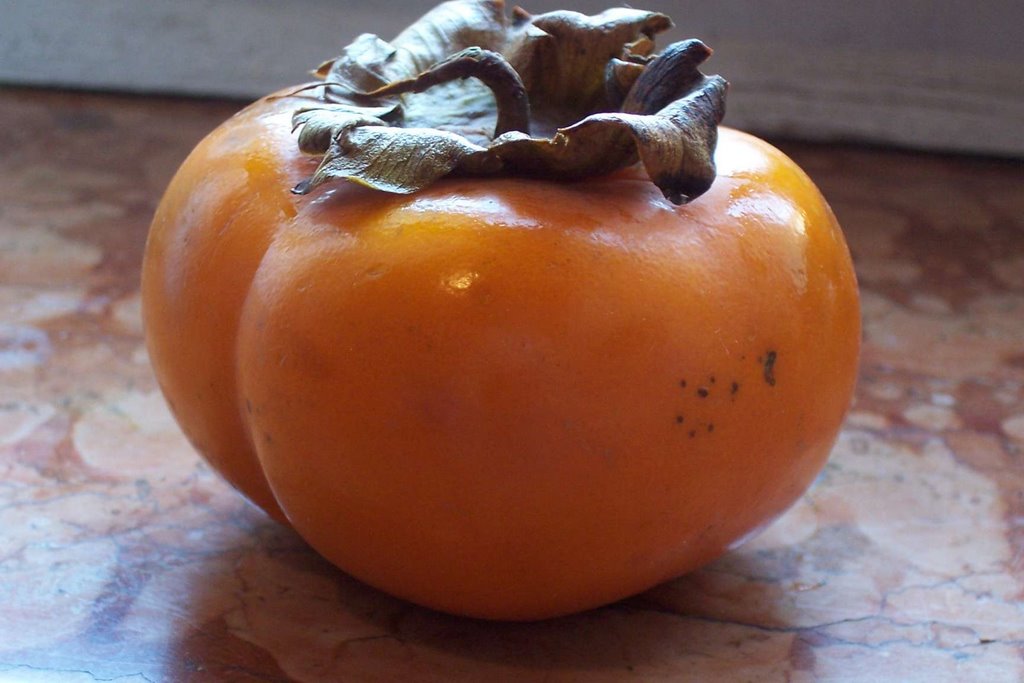
While I was in England last month, Sue, her mum and I were discussing persimmons and sharon fruit at some considerable length, as you so often do while lingering over a beautiful tricoloured fruit salad of pomegranate seeds, blueberries and sharon fruit. Well perhaps linger isn’t quite the word for it. The moment my spoon hit the empty bowl for the last time I was off to find out what makes a persimmon different from sharon fruit. Here’s what I’ve found out so far.

Persimmon (y’all knew that means “a dry fruit” in the Algonquin language, right?) is the family of fruit to which the sharon fruit belongs. It is divided into two types, the astringent and non-astringent, with a further sub-category of types which can have their astringency altered (in either direction) by pollination.

Astringent persimmons can still be eaten once their astringency (think soul-puckering dryness) has been removed, by (aha) bletting — a word coined in 1839 from the French world blessi, which denotes a particular type of bruised appearance found in fruits such as the medlar and the persimmon. The process is known as ammezzimento in Italiano.

Chemically speaking, bletting brings about an increase in sugars and a decrease in acids and tannins (tannins cause the unripe fruit to be puckery). In some cases bletting is simply a ripening process (the fruit is exposed to light frost for a few days after it is ripe), but in others there is a chemical process (water, alcohol or carbon dioxide treatments) used commercially to remove the astringency. Opposite to what we expect of some fruits, the persimmon can be stored at room temperature or softens more quickly if refrigerated.

Sharon fruit is a non-astringent persimmon, which means it doesn’t have to be as completely soft and ripe as other varieties in order to be enjoyed in, for example, a fruit salad. There is a trademarked version which is grown in Israel, but Spain and South Africa are also big producers, and it’s also grown in China, Japan, Korea, Italy, Greece, Turkey, USA, New Zealand, Australia, Chile, Brazil, Georgia and Iran (other forms of persimmon are grown widely in many other countries). It is rich in Vitamin A (Beta Carotene – for healthy skin, mucus membranes and night vision) as well as glucose, sodium, potassium, magnesium, iron, calcium and Vitamin C, and clocks in at only 71 calories per 100 grams.

The persimmon tree comes from the Ebony family (Ebenaceae), and it is sometimes grown as a wood rather than a fruit: its unusual heartwood has been used for veneer and specialty items, while its strength and shock resistant qualities have made it a popular choice for textile shuttles, billiard cues and heads for driver golf clubs. In some species (Diospyros ebenum) the wood is jet black, while in others (Diospyros virginiana) it is light-coloured and fine-grained, and in still others (Diospyros celebica) it is striped. The leaves of Diospyrus melanoxylon, also known as coromandel ebony or tendu, are used in India to make bidi cigarettes.

Known to the ancient Greeks, its scientific name, Diospyros, means “food of the Gods” (lit. “the wheat of Zeus”). The fruit variety known as the date plum (Diospyros lotus) is one of several fruits reputed to have been the ‘lotus’ of the so-called lotus-eaters of Homer’s Odyssey.


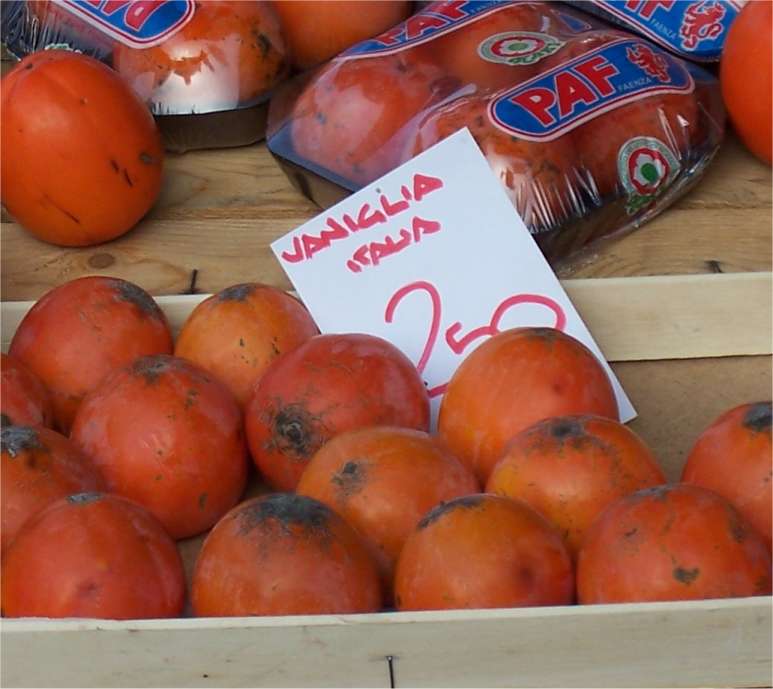
The familiar orange-coloured species which began in China and later introduced to North America and Europe is the kaki (cachi, cachi vaniglia or cachi mela in Italian) fruit (Diospyros kaki). Other varieties of the fruit you might encounter: black sapote (D. digyna, native to Mexico – starts green and ripens to black), mabolo or velvet-apple (D. discolor, a bright red variety from the Philippines), date-plum (D. lotus), fuzzy persimmon (D. pubescens), Texas persimmon (D. texana – once used by Native Americans as a dye to tan hides) and American/Common persimmon (D. virginiana) or “pawdad”.

A list of varieties that might be handy to learn:
* Astringent (need to be custard-soft to be edible): Eureka, Hachiya, Honan Red, Saijo, Tamopan, Tanenashi, Triumph (sold as Sharon Fruit when the astringency has been removed);
* Nonastringent (can be eaten when firm): Fuyu, Gosho/Giant Fuyu/O’Gosho/Hanagosho, Imoto, Izu, Jiro, Maekawajiro, Okugosho, Suruga;
* Nonastringent, but astringent if seedless: Chocolate, Gailey, Hyakume, Maru, Nishimura Wase

Well, there you have it. Interested parties may wish to start planning now to attend the annual persimmon festival held each September for the past sixty years in Mitchell, Indiana.

Meanwhile, we lucky parmigiani can bring home daily celebrations from Gelateria Grom, whose offerings include gelato di caco, very nice with some fresh slices of fruit!

Thorns in the cheese and elsewhere


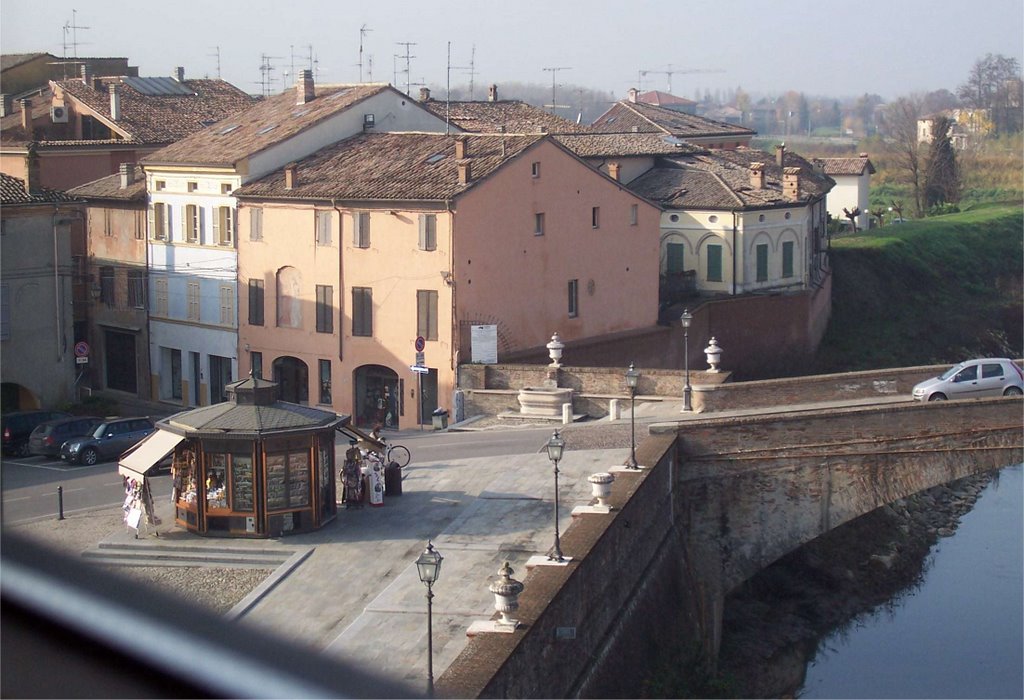
Piazza Garibaldi, Colorno

Interesting fact learned the other day: the tool used to break the curd during the making of a parmigiano-reggiano cheese is called a spino, meaning thorn-bush, after the hawthorne bushes traditionally used in the process. We are looking forward to our first field trip to see the process for ourselves in the next week or so.

The week is flying by as we compare notes on our various degrees of illness and ease into life in this new country, new course of study. Tomorrow the public services have conspired to allow those of our class living in Parma to experience our first public transit sciopero (strike), and so our morning will be spent competing for taxi service to get us to classes on time. This will be swiftly followed by a train strike on the weekend. Bemused travellers in this country will have noticed alternate train and other schedules posted ‘in caso di sciopero’. Such is their regularity that you can consult a calendar of them to plan your movements accordingly.

Cheese technology, dragon sausages and rocket soup


Hmm… what’s wrong with this picture…


Enjoying the walk back to class. Postprandial view: fountain at the Reggia di Colorno.

Week two has started at the University of Gastronomic Sciences, and we’re deep into microbiology and the technology of cheese. A classmate has thrown down the gauntlet and invited me to find poetry in that.. but first I must master the terminology. No easy thing. But perhaps by the end of the week I’ll know my triglycerides from my diglycerides and my casein from my hydrolytic enzymes. Yessir… thank the lords ‘n ladies of technology for Wikipedia is all I can say. And bless the foresight and generosity of Douglas Goff for creating the Dairy Science and Technology website.

And thank heavens for email. One of my correspondents reliably informs me that at the moment a company in the UK is being hauled over the coals for calling their product “Welsh Dragon Sausages” on the grounds that it is not a true description of the contents. Apparently a commentator on this topic noted that it had blown the cold wind of fear into the makers of shepherd’s pie, angel cakes and chocolate brownies.

Owing to my continuing throat ailment I stayed in tonight and had some nourishing soup. Not chicken soup which I’m sure really does cure everything, but some rocket soup, a kind of vegetable jet fuel I’m hoping, and nice to eat while you catch up on the story of Elizabeth Smart and George Barker:

Rocket Soup

1 tbsp butter
1 large shallot, minced
1/4 cup minced fresh fennel
1 small carrot, minced
1 medium potato, diced
3 cups vegetable broth
2 cups rocket

  • Melt the butter in a saucepan on medium and add the shallot, cooking for a couple of minutes until soft.
  • Add the fennel and carrot and cook gently on low heat about 10 minutes.
  • Add the potato and then the broth. Bring to the boil and then simmer another 5-10 minutes until the vegetables are soft.
  • Add the rocket, cover and cook another few minutes until the rocket has wilted. Season with salt and pepper.
  • I was lacking a blender, but it could (should?) be blended/pureed at this point or served as is.

Random walking and eating

A day of major excitement yesterday as we hopped the bus to Euro Torri to pick up some essentials at Media World and Brico and then wandered under the road to Ipercoop. Such wonders I have seen, and indeed carried home on my back.

I was intrigued by the Ipercoop’s Salvatempo, a magical wand you can employ if you are the fortunate holder of a carta sociocoop; you carry it round the store with you, pointing it at your groceries and making joyful beeping sounds, saving many tedious minutes of operazioni ripetitive.

This weekend I am suffering from il mal di gola, so have not been up to much, but here are some snaps from recent days.


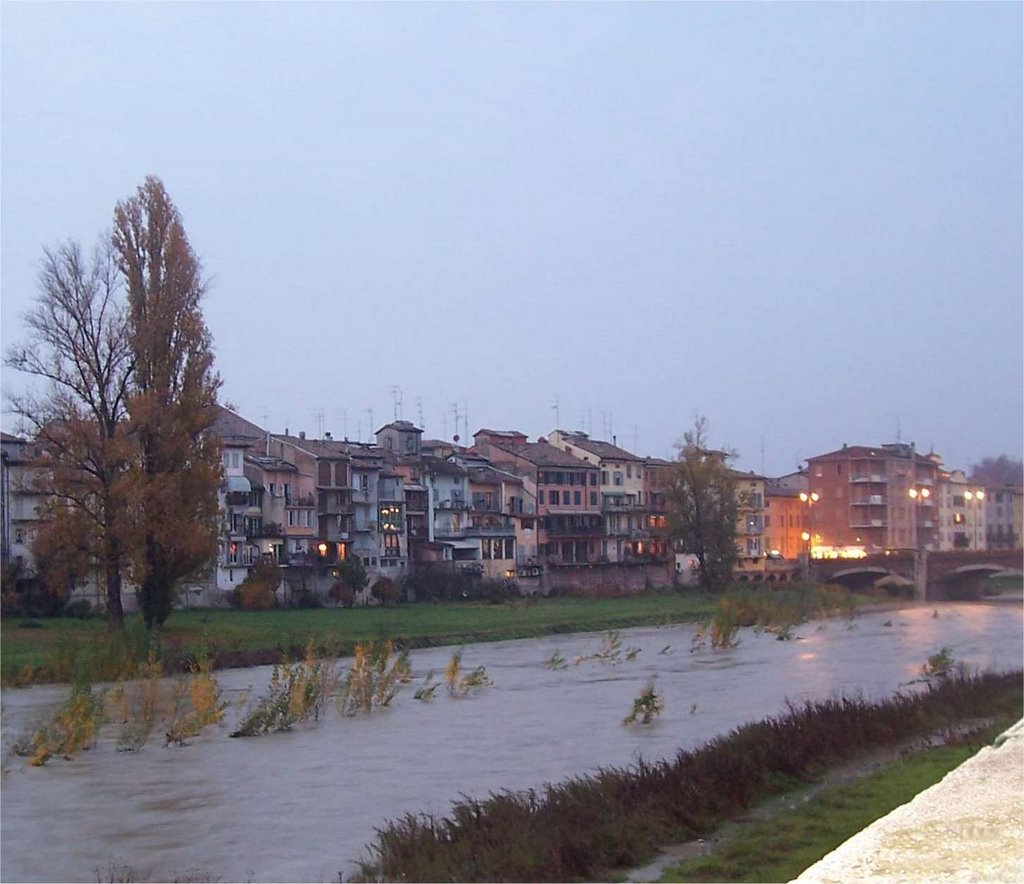
Parma Torrente after a few days’ rain: feeling much more itself.


Sadly for this one’s living relatives, you can find such delicacies as pesto di cavallo or bistecca di cavallo on the menus round here.


My this was good: carpaccio of swordfish (pesce spada).

Classes in Colorno


Just another street in Parma.

Busy busy. We started classes on Wednesday. A morning of introductions where we met the faculty and staff of the university, counted our nationalities (11) and listened to 25 highly condensed life stories The teaching and administrative staff gave us a flavour of the year ahead including our field trips (stages) to France, Spain, Crete and different parts of Italy. After an introductory lunch in the ALMA cafeteria (provided by its cooking students) we had an afternoon of Italian lessons – a fairly typical mix of excruciating embarrassment and hilarity.


The back of the Reggia di Colorno, the building that houses the Colorno campus.

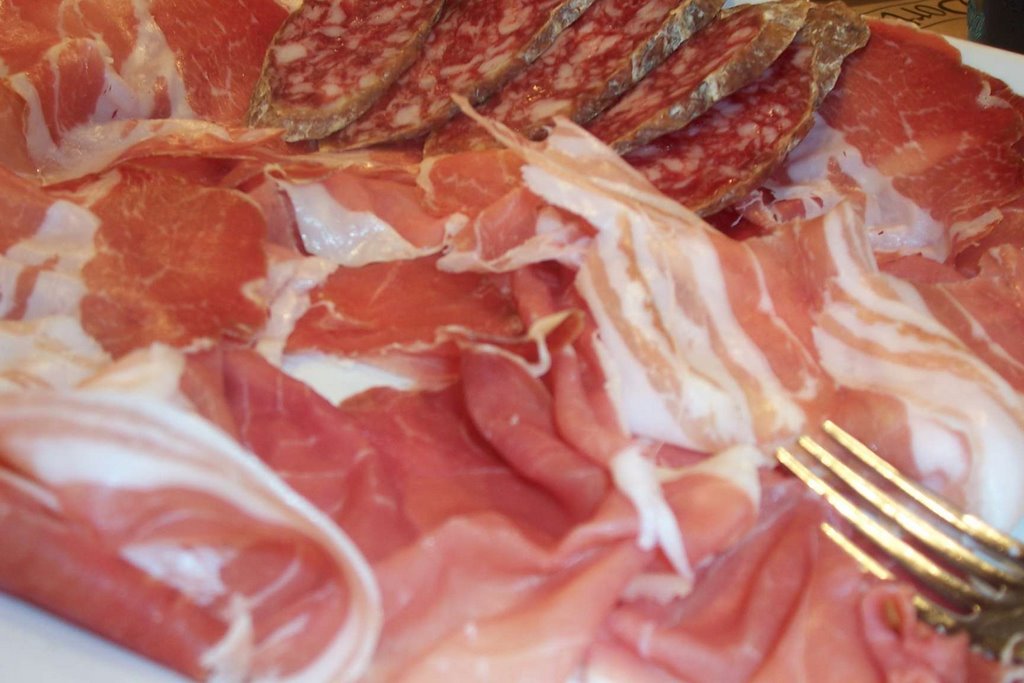
That evening the group was invited to an impromptu welcome gathering in Colorno where we had, naturally, a pretty stunning selection of nibbles – heavy of course on the cheeses and cured meats. Most of the students live in Parma, and it’s going to be a challenge for us to get together in the evenings with buses stopping at 6pm and taxis running €25-30 a pop. We are learning about the interesting and somewhat time consuming experience of calling Parma’s taxi dispatch service late at night, and how sometimes random the taxis’ arrival can be.


Not a bad view out the classroom window…

Day two we plunged into language classes and in the afternoon had a presentation by Cinzia Scaffidi, director of the Slow Food Study Centre in Bra. Among the many programs and projects of the movement she described, we warmed to her discussion of the Slow Fish event we’ll be taking in next May, in Genoa.


And the view out the other classroom window.

Thursday ended with American Thanksgiving dinner (Giorno del Ringraziamento) for 60, courtesy the students of the Italian masters’ program, one of the cooks and the ovens – big enough to hold two 30lb turkeys – of ALMA, and the owners of the Pub in Colorno. During the meal I asked the director of the Colorno campus, Carlo Catani, if it was true what I’d heard, that we could expect on average to gain 5kg over the course of the year. Of course not, he scoffed: on your stages (field trips), you will be much too busy to eat!


One turkey down, one turkey left.

We’ve started receiving books as well – Jane Grigson’s Vegetable Book, and Italian Cuisine: a Cultural History by Alberto Capatti and Massio Montanari. And on with the first lecture on cheese technology today, which was a crash course in the fundamentals of organic chemistry. Head spinning with talk of peptide bonds, triglycerides, protein domains and butyric and linoleic acids… I’m well ready for the weekend now.

Tartufo in Savigno


Ooh.. so glad I wasn’t driving.. where to start with this one?

Hitting the ground running, so to speak, I was invited to visit a visiting friend in Bologna, whose hostess – doing some research for her property business – whisked us off into the Apennine countryside to see a few sights before hitting the main event, a truffle (tartufo) festival in Savigno.

Three days of truffles and mulled wine (vin brule/vino caldo) had obviously warmed everyone (and their dog) into a mellow crowd. We wandered around admiring used leather coats, antiques and knick-knacks, truffle spades; little moss thrones and glass domes holding nuggets of black and white truffles; truffle oil, truffle cheese/polenta/rice/you name it, vintage cars, cauldrons of hot wine, caldarroste – ovens of roasting chestnuts, and much else besides. The place was heaving with visitors. And the tables were still, late on the last day, still heaped with cheese, meats, vegetables…


Chestnuts rocking and roasting.


Cheese, cheese, cheese!


Lotsa lovely squash, from an organic farm.


Tower of power: no disputing the real thing, and thrilling to be in its home town. I tasted both 12 month old and 36 month old Parmigiano-Reggiano… and wanted to take it all home with me.

As we wandered, I was introduced to a cook from Centro Natura, a vegetarian restaurant (and much else besides) in Bologna. Must make a visit there. She said they develop the menu each morning, based on the ingredients to hand, and accommodate both celiacs and more relaxed vegetarian diners alike each day.

And tonight I dined at La Filoma in Parma where as we considered the menu we were presented with a glass of prosecco and a plate of airy, crunchy, heavenly cheese fritters, before diving into a warm fish salad (fish, potatoes, courgettes/zucchini, tomatoes) and then (for me) a melting pair of beautifully seasoned pork medallions, and for my dining companion a tender leg of rabbit.