-
Breaking bread with Capital Nuts
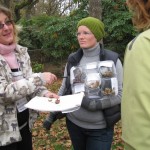
Read Full Post: Breaking bread with Capital Nuts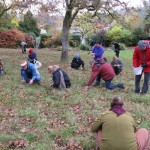 I attended a workshop yesterday organized by the Victoria Transition Capital Nut Project in Playfair Park, a restored Garry Oak Meadow in Victoria. It attracted a couple of dozen brave souls willing to stand in the November chill and learn how to make Garry Oak acorns edible. Being the proud custodian of a very large
 tree myself, and being overshadowed by a number of others, I thought it would be a worthwhile skill. We were led through the process by ethnoecologist and wild food forager Abe Lloyd.
We learned about defects to watch for. Sprouted acorns (Garry Oaks are white oaks, a class of tree whose seed germinates in the autumn) are not necessarily a problem, although they are often cracked, which may allow insects or mould into the nut. Acorns with caps still in place when they fall are no good because the cap usually covers some mould. A small hold indicates that a worm has eaten the contents and left the premises. Spotting – especially dark discolouration – can indicate damage. The best way to find out is to open the nut (they are soft enough to crack with your teeth) and check. This time of year – October or November – is the best for hunting acorns. Early falls (August, September) are usually unripe or damaged nuts so should be avoided.
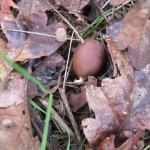
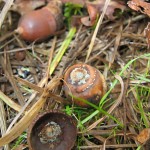
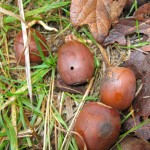
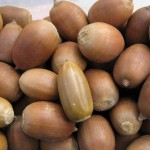
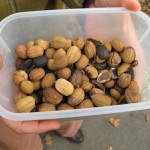
He showed us some samples – with a couple of English Oak acorns for comparison (there are a few of these trees in Victoria, though Garry Oaks are the native species). The ones that were still in their shells had been dried; his guideline for readiness was when the shell could be cracked easily by hand or nutcracker (or hammer). The shelled samples included some black ones which he said were still fine, but he’d hastened the drying process and discoloured them (they can be dried on racks, with fans or with a dehydrator). After drying, he ground them to flour in a blender. Because they have an oil content of about 10% they’re not well-suited to grain mills that use stone grinders, as they might gum them up (there is less oil in flour grains like wheat).
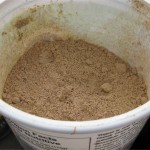
As it circulated, Abe invited us to have a sniff and a taste of the flour. We could smell the sugars in the flour, but it tasted bitter, because of the high tannin content in these acorns. The next step was to leech out these tannins, by soaking the flour in water for four or five days, pouring the liquids off morning and night, and then tasting the final product to check for bitterness. The colour of the liquid changes, growing lighter as the tannins are removed. The final sludge can be used straight away as a batter for flatbread, or dried and used with flour for flavour (bearing in mind it is low in glutens so wouldn’t make great yeast bread on its own).
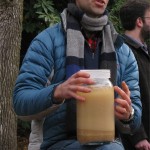
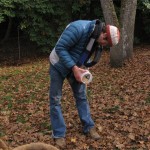
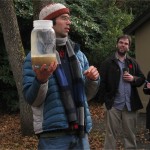
Abe demonstrated his flatbread technique. He usually adds maple syrup to sweeten the bread a little, but it worked well without.
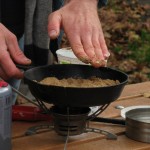
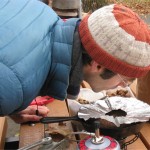
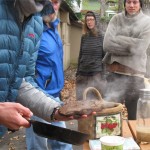
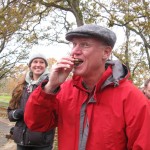
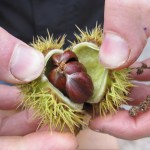
A morsel of hot acorn flatbread: just the ticket. Someone had brought some Spanish chestnuts – the edible variety which unfortunately don’t have quite enough time to ripen in our temperate climate. And local agrologist Kendell Neilsen was on hand with a sample of hazelnuts she’d gathered in the area.
-
Reading at Malahat Review Fall Launch Wednesday November 9
Read Full Post: Reading at Malahat Review Fall Launch Wednesday November 9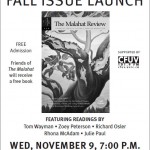 Next Wednesday, November 9 The Malahat Review is holding its fall launch party at The Well in Victoria. The launch party is one of the things I really love about this magazine: never more than in these days of precarious arts funding, every literary publication deserves celebration. On this occasion I am delighted to be reading with Tom Wayman • Zoey Peterson • Richard Osler • Julie Paul.
I have crossed paths with Tom Wayman numerous times over the years, and did so again yesterday when we shared the airwaves on CFUV radio, being interviewed by Colin Dower and Brian Mason. Tom was asked about his passion for work poems: he’s edited a couple of anthologies of these, and my poem “The Grievance” (from Creating the Country) was included in the “Less Like Ants” section of Paperwork, back in 1991. He also included “Infinite Beasts” (from Hour of the Pearl) in The Dominion of Love, an anthology of Canadian love poems published in 2001.
The publication of “Dowsing Stick” in Issue 176 marks my fourth appearance in Malahat Review since 1984, and I’m happy to be back in its pages. Hope to see you at the launch! 7:00 p.m. Wednesday, November 9th at The Well, 821 Fort Street, (between Quadra and Blanshard), Victoria BC. FREE Admission.
-
Readings & mushrooms & quince
Read Full Post: Readings & mushrooms & quinceOn Wednesday I went along to Bolen Books to hear Lynn Coady reading with Douglas Gibson. Gibson was in good form, spinning tales I hadn’t heard on my last listen, from WO Mitchell’s farewell joke, to respectful admiration of Alice Munro, to the dangers of crossing Montreal streets with Pierre Elliot Trudeau. Coady read a mesmerizing passsage from The Antagonist, which I must get my hands on one of these days when I can force myself to sit down and read something.
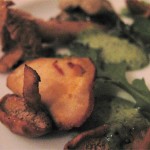 Last night I joined about 50 others to enjoy wild mushrooms, many of them unearthed earlier that day by participants in a foray led by our mycophilic host Sinclair Phillip. The chefs of Sooke Harbour House were given the challenge of coming up with a menu to suit the finds (on top of regular restaurant duties and, I think they said, a reception as well). They more than managed to offer us four fine courses, starting with a Matsutake broth in which were floating the selfsame pine mushrooms, surrounded by assorted wild morsels, a bit of nettle emulsion and a few nasturtium petals and shuagiku leaves.
Second course was a trio of tasties: porcini quinotto topped with boletes; pear-poached white chanterelle; and a bear’s head and spot prawn herbal salad with pickled hedgehogs.


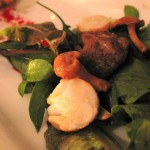
Third course, the “wild plate”, included morels (from Eric Whitehead) stuffed with polenta; a venison croquette of Sidney Island fallow deer (these are culled annually, a fellow diner told me) with shallots and hunter’s stew (made from assorted foraged mushrooms) ; a pretty triangle of beet-mushroom terrine; and boletus grilled in leek oil with Red Fife “soil”. And the finale was Kabocha squash pie accompanied by an amazing candy cap mushroom ice cream, candied chanterelles and a darling meringue mushroom. The jelly that topped the pie was made from a delicious mushroom reduction (from the icecream making).


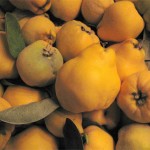
Back in my own kitchen, it’s preserving time and I’m wearingmy fingers to the bone making quince everything.
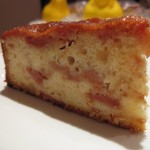
My lunch today was a modest harvest feast: a tomato-mustard tart, some fresh sauerkraut which made itself while I was away in Banff, and a crunchy baby cucumber from the garden; then a slice of yesterday’s Sticky Quince & Ginger Cake – part of my ongoing quest for new ways to use quince.
Latest Posts
- (no title)
- Sublime and Twisted Readings coming up!
- Sublime
- Good weather for reading
- The world, the world
- Sublime launch!
Aldeburgh Poetry Festival Barny Haughton BBC BC poets Berkswell blackberries Black Stilt Bologna book launch Borough Market Carlo Petrini Catalonia Cyrus Todiwala dairy Daunt's Books Dijon Edinburgh Fanny Bay Feast of Fields Food and Morality food history food journalism Jenna Butler lardo Malahat Review Michael Pollan Okanagan olive oil tasting olive trees Omnivore's Dilemma Our Food Our Future Oxford Parmigiano-Reggiano Planet Earth Poetry poetry poetry readings Poetry videos prosciutto salumi Sean O'Brien Suffolk ticks Wendy Morton Wired Writing Yvonne Blomer
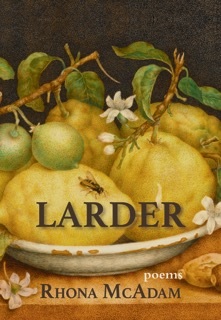
In her latest collection, Rhona McAdam navigates the dark places of human movement through the earth and the exquisite intricacies lingering in backyard gardens and farmlands populated by insects and pollinators, all the while returning to the body, to the tune of staccato beats and the newly discovered symmetries within the human heart.
“…A beautiful, filling collection, Larder is a set of poems to read at the change of the seasons, to appreciate alongside a good meal, and to remind yourself of the beauty in everything, even the things you may not appreciate before opening McAdam’s collection….”
Rhona McAdam is a writer, poet, editor, and Registered Holistic Nutritionist with a Master’s in Food Culture from Italy and a deep-rooted passion for ecology and urban agriculture. Her work spans corporate and technical writing to poetry and creative nonfiction, often exploring the vital links between what we eat and how we live. Based in Victoria, BC, and available via Zoom, Rhona is always open to new writing commissions, readings, or workshops on nutrition and the culinary arts.