-
Watching food
Read Full Post: Watching foodMostly a visual week, this. We’ve had a series of talks on food television from the Swiss film maker Annette Frei Berthoud, who’s been showing us various clips (including a bit from Mondovino) and documentaries. We had one yesterday about cacao growers in South America, which talked about Kallari organic cocoa from Ecuador, and the Presidia product cacao nacional.
A couple of classes were cancelled this week and replaced with documentary screenings. Monday we had a Canadian film that our Don worked on, On the Road to Bocuse d’Or. Yesterday saw the return of Stefano Sardo who showed us several things including the Sierra Club’s neat little education tool, The True Cost of Food, and then the wordless and sobering Our Daily Bread which is something to see if you have ever wondered whence cometh those tomatoes, pork chops, apples, eggs, cucumbers..
Most shocking to me in Our Daily Bread was seeing the industrialisation of work: evidently the design of industrial food production facilities builds in the isolation of its employees. These are not jolly production lines where the workers banter across the conveyor belts or bond over coffee break; here we have blank-faced drones in full hygiene kit arranged so they never face one another and probably couldn’t speak if they did for the factory noise and the ear protection; handling fruit, vegetables, chicks, piglets, animal corpses and a whole lot of machines in an efficient, dispassionate flow. Do they take breaks together or are they always sent off in sequence so as not to interrupt the production chain? I wondered how the designers of these factories had managed to divest from their consciences and their planning all those great 20th century concepts like job satisfaction, employee motivation, team-building; they’ve stripped these jobs down to a cold essence. The perfect 21st century environment for an alienated 21st century workforce?
-
Lots of fish
Read Full Post: Lots of fish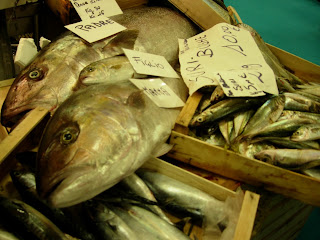
Two fishy events last week. The first was an enlightening visit from a veterinarian, Valentina Tepedino, whose topic was fish quality. We embarked on a pre–prandial nightmare into nematodes and parasites (anisakis), poisons (tetrodoxin) and various aspects of fish fraud. Here is a small fraction of what she talked about.
Fish fraud, she said, is huge in Europe; as much as 80% of the tuna sales in Europe are fraudulent, with lower grade fish (bluefin) being passed off as the more expensive yellowfin or albacore, and it can happen because the fish are not sold whole where the identifying dorsal, pectoral and anal fins cannot be seen.
Likewise there is well documented fraud involving other fish varieties; a farmed fish, Pangasius, a sort of catfish, is often passed off for sole. It’s so cheap to produce that with strategic employment of some equally cheap labour, it can be filleted to resemble sole and sold for many times its market value. Solea senegalensis, a farmed variety from Senegal, is often sold as the much more expensive Dover sole; it takes skill and experience and a close look at the whole fish, skins and gills included, to distinguish one for the other.
Another big fraud is passing farmed fish off for wild. Though there is a popular misconception that all our cod is wild, the Norwegians have in fact developed a highly successful farming industry. Salt cod (bacalau) is popular in markets like Italy, Spain and Portugal, but much of what reaches the market is either farmed or one of many cheap varieties such as pollock and hake that are almost indistinguishable from cod once decapitated, dried and salted.
And there is the fish product known as “surimi” which is pulverised whitefish (often those cheap farmed staples, pollock and hake) coloured with paprika and reformed into imitation crab, lobster, prawns, eels (anguilla). But often only a percentage of this is actually hake or pollock, as it’s often mixed with even cheaper ones.
One key area where it becomes dangerous to substitute one fish for another is in the area of, for example, pufferfish, which can be passed off as monkfish, as the two are nearly indistinguishable when skinned and decapitated. But pufferfish carry the lethal neurotoxin tetrodoxin which can cause death in as little as five minutes, an risk that eaters of Fugu undertake voluntarily, but not something the average monkfish eater would expect. One instance of this kind of fraud in Italy was enough to ban the sale of monkfish without heads, so that consumers can be sure which fish they are buying.
As always it’s a case of buyer beware, and educating yourself about the sometimes huge and complex issues to to with identification, sustainability, aquaculture and fishing methods. Websites such as Sustainable Seafood, Fishonline, the Marine Conservation Society, MareinItaly and Fishbase are good starting points.
So, thus armed, I was interested to see what was on display at Slow Fish in Genova yesterday, a good mid-sized exhibition with lots of tastings and workshops.
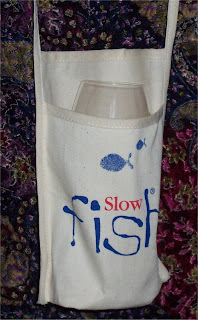
One of the most popular points was the enoteca and bistro where you gained admission by buying a cotton nosebag (actually a glass holder, equipped with a wineglass ready to be filled from over a thousand different bottles). There was a selection of food, including oysters and shellfish and other seafood tastings, some pasta dishes, and some local and Presidia products: focaccia, gelato, candied fruit and sugared almonds from Romanengo, and Huehuetenango coffee.
We were excited to experience a rare tasting of the Portonovo Wild Mussels we’d heard so much about – but never seen – during our visit to Le Marche.

Everyone and his (well behaved) dog was there..

-
Journalism, food geography and a mighty fine picnic
Read Full Post: Journalism, food geography and a mighty fine picnicWe had the entertaining guidance of the Guardian‘s very own Matthew Fort to speak to us last week. I have been to many a talk on how to write and on selling your writing, but it never hurts to have a few stern reminders from a guy at the top, like: you can’t call yourself a writer if you don’t write every day. His chief tip is to try to elicit three reactions from the reader: ‘I never thought of that’; ‘that’s really useful’; and ‘I really enjoyed that’.
One side-comment he made stayed with me: British food shops are shooting themselves in the foot by keeping bankers’ hours; the only food shops open at times when their customers are able to shop are the supermarkets, and so they win the business. A remark that goes for other places as well; but he praised Italian food shops for staying open in the evening so that working shoppers could patronise them on their way home. Here in Parma most shops open between 8.30 and 9.30 and close for a very long lunch (12.30 till as late as 4.30) but then reopen for evening trade, until about 7 or 7.30 – which is indeed convenient, seen in that light. Not the first thought in my mind when I finally emerge to do my shopping on Saturdays around noon, but I guess that’s my choice.
We finished our week with Colin Sage, an environmental geographer and crusader for raw milk Irish cheeses. He talked to us about food geography, and specifically about some of the regulatory issues around raw milk cheeses that are helping to draw a scientific noose ever more tightly round the food we are able to buy. He referred us to Marion Nestle, a name that’s been coming up in various places and readings, and mentioned a useful article by our hero Michael Pollan about the rise of a whole new evil that goes by the handle of nutritionism. And he left us with the suggestion that maybe it’s time to grow our own food.
He called on us to shift away from thinking of ourselves as simply consumers having our choices limited and being passive recipients of what might be less and less a ‘whole food’ and more and more a nutrition product. We need, he says, to become food citizens with an active role in asserting values and creating an environment for our own sustenance. Increasing transportation costs mean there will be a higher and higher cost for our food: the current system is unsustainable. We need to be responsible and involved in how and where food is sourced, and grow some of our own food if we can. He advocates alternative food networks: perhaps develop small scale cooperatives for sharing food resources. Fair trade needs to go further than chocolate or coffee, and develop in such areas as fruit that we’ll never be able to grow in northern climates.
Oddly enough I had been listening to a Food Programme piece from last February on much the same theme, where the speaker, Colin Tudge, advocated a “world-wide food club” – a cooperative relationship between good farmers who really want to produce good stuff, artisans, bakers and brewers who are prepared to produce good food from it, and people who are willing to pay for good food properly produced.
Colin Sage has also spent time looking at the structures around our food governance, and is uneasy with his findings. The bodies that research and govern our food supply are suspect: there are well publicised funding relationships between business and research (academics and scientists) and government which is problematic for impartiality: when funding determines what is being studied and how the results may be released, that limits what we can truly investigate and report in all that we need to know about our food. The ‘cosy relationship’ that exists between business and regulatory bodies in terms of who heads them (but where do you find the expertise to head regulators if not in the industries they come in to regulate?) can be causing problems again in impartiality. And food sovereignty means that countries that need to feed themselves are using their own resources to grow export crops, which are more lucrative, but create a world in which food is being grown as animal feed or fuel while their own populations suffer hunger and malnourishment. Sobering stuff; the more so when so much of it is literally echoing down this year, repeated with variations by our speakers and in our readings.
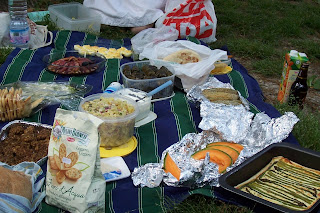
With all that on our minds it could have been hard to gather the strength for a Labour Day picnic in the park but we managed. We spread our blankets on a sunny day in a quiet, walled garden overhung by chestnuts in full flower with a few bouncing dogs in the background – and later in the afternoon some curious soundtracks (Frank Sinatra?) coming from the puppet show in the courtyard of the Castello dei Burattini. One by one we set down our wares, explaining why they were not adequate, which ingredients we’d been unable to find or adapt, why the recipes had not worked as we had hoped, why they didn’t look the way they were supposed to; and one by one we ate the offerings with delight and mutual encouragement. Even halfway through our year it can be a scary thing to share humble food among our ever-more gastronomically enlightened selves. But we all agreed we must do it more often.


Latest Posts
- Writers at Word!
- Sublime and Twisted Readings coming up!
- Sublime
- Good weather for reading
- The world, the world
- Sublime launch!
Aldeburgh Poetry Festival Barny Haughton BBC BC poets Berkswell blackberries Black Stilt Bologna book launch Borough Market Carlo Petrini Catalonia Cyrus Todiwala dairy Daunt's Books Dijon Edinburgh Fanny Bay Feast of Fields Food and Morality food history food journalism Jenna Butler lardo Malahat Review Michael Pollan Okanagan olive oil tasting olive trees Omnivore's Dilemma Our Food Our Future Oxford Parmigiano-Reggiano Planet Earth Poetry poetry poetry readings Poetry videos prosciutto salumi Sean O'Brien Suffolk ticks Wendy Morton Wired Writing Yvonne Blomer
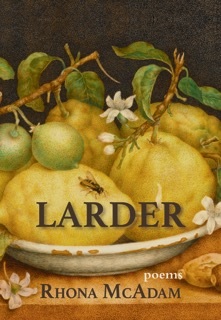
In her latest collection, Rhona McAdam navigates the dark places of human movement through the earth and the exquisite intricacies lingering in backyard gardens and farmlands populated by insects and pollinators, all the while returning to the body, to the tune of staccato beats and the newly discovered symmetries within the human heart.
“…A beautiful, filling collection, Larder is a set of poems to read at the change of the seasons, to appreciate alongside a good meal, and to remind yourself of the beauty in everything, even the things you may not appreciate before opening McAdam’s collection….”
Rhona McAdam is a writer, poet, editor, and Registered Holistic Nutritionist with a Master’s in Food Culture from Italy and a deep-rooted passion for ecology and urban agriculture. Her work spans corporate and technical writing to poetry and creative nonfiction, often exploring the vital links between what we eat and how we live. Based in Victoria, BC, and available via Zoom, Rhona is always open to new writing commissions, readings, or workshops on nutrition and the culinary arts.