-
Easter break
Well it’s nearly over, our two weeks of blissed out sunshiny whateveritwaswedid. Most of my classmates took off for foreign shores: Copenhagen, New York, Istanbul, Montreal, Seoul… I stayed in Parma, mostly, just to be different. And just to have a look round the galleries and museums and churches which I haven’t done, waiting as I’ve been for a visitor to do it with. And I finally had one and here are some of the things we did:
Visited Osteria del Gesso, one of the local thumbs-up dineries. I had a very good meal there, but an even better one a night or two later at Ristorante Mosaika, a little placed I’d walked by a few times and had been wanting to try. We both had selected menus (I had the meat, Meli had the fish) and they were, in our favourite word, celestiale. They started us off gently with some deliriously fresh and beautiful balsamico-drizzled buffalo mozzarella, and delicate rounds of crostini with fresh green pesto; moved us smoothly on into starters (a wonderful rabbit terrine, and a salt cod puree whose salad came with a stunning soy-wasabi dressing) and pasta (gorgeous gnocchi draped with lardo, and a delightful tagliatelle freckled with fresh green herbs and strewn with shellfish)
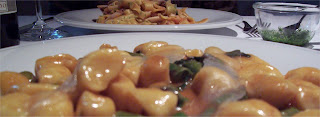
and mains (tender white sea bass with clams and olives, and for me, meltingly pink lamb);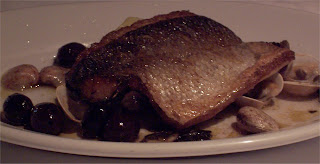
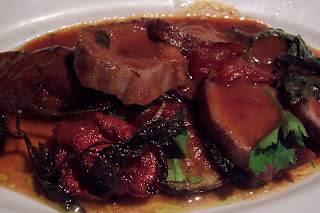
polished us off with warm, soft chocolate cake…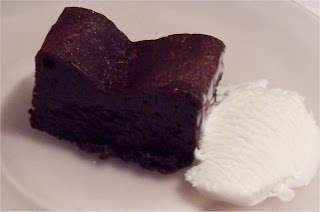
and for me a nest of perfectly ripe strawberries tossed in citrus and served with gelato.To work all that off, we went nutria-spotting, checked out some puppets, popped our heads into the Baptistry, the Duomo, and every other church we came upon, except the desanctified ones (which were several); had walks in the Parco Ducale and Parco della Cittadella, sampled gelato from Grom and K2, had a drink in Web ‘n Wine, saw the Aga Khan masterpieces exhibition and peeped round the corner into the Teatro Farnese.
Then a day in Bologna, where we saw the Museo Civico Medievale and the Museo Morandi, the Chiesa San Stefano, the Basilica di San Petronio, and still had time to stumble upon an excellent pizzeria and have a sampling of gelato (from Gelateria Gianni, branches which seemed to materialise at every turning). We expired on a sofa somewhere and had a drink and a few olives before returning to Parma. Where we planned our assault on Milan the following day.
Of course we visited first the Duomo, and then wandered about looking for lunch, which we found at Bellavista Cafe – the food was excellent – the seafood plate disappeared a little too quickly to capture;
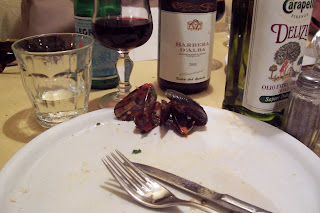
the pizzas looked amazing as they went by; the apple cake was delightful.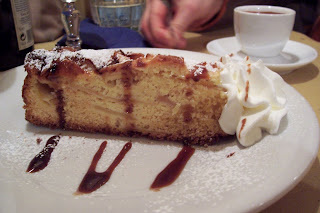
We then ambled through the Castello Svorzesco for most of the afternoon and never really got to the end of it. Meli had an hour to sprint round the Pinacoteca di Brera while I rested my feet and sipped a spremuta d’arancia.And then Meli took to the skies from our very own Aeroporto G. Verdi, where the approach roundabout must have the best topiary ever:

-
A few surplus and possibly excessive words on waste
There’s obviously something in the air right now; there was a well-portioned segment of the BBC program You and Yours about consumer food waste on Wednesday.
The core of the discussion was a recently released survey by the UK recycling and waste management organisation WRAP, that revealed that about one-third of food people buy in Britain is thrown away; half of it is edible. (That doesn’t include the food that is wasted by consumers when eating at restaurants, and by the food service industry itself, a whole new discussion I’d like to hear about.)
The survey suggested a lot of waste is down to several controllable factors: fridges may not be set cold enough to keep the food properly; people do not eat perishables quickly enough; and they simply buy more than they can eat, because they shop without planning or making shopping lists, and they shop for informal eating rather than prepared meals. Food retailers can manipulate us into buying more than we need through over-packaging, or by discounts or two-for-one deals.
The waste is not simply financial, it is also environmental, since the food industry alone produces about a quarter of the world’s total carbon emissions. Consumer waste is compounded by supermarket waste – when we pick through the shelves to find the freshest products by their sell-by dates, we contribute directly to this of course – and by industrial waste at the farming and factory end of things.
As we’ve certainly heard time and again this year, the speakers agreed that one of the big underlying causes of waste is the cheapness of our food; and I know it doesn’t feel all that cheap when you look at the prices in the shops and compare them with prices a few years ago, but it is a relative thing. Where, Lord Haskins observed, fifty years ago we used to spend thirty percent of our disposable income on food, we now spend less than ten percent. It’s the same as cheap clothes, he said: if it’s cheap, we don’t value it, and it becomes disposable. (I’ll bet there are roughly equal numbers of people in this world today making crumbs and croûtons out of stale bread as there are darning holes in socks that are otherwise wearable.)
Food historian Ivan Day pointed out that there’s a whole branch of British cuisine, a pudding tradition, based on recycling bread: he cited treacle tart, bread and butter pudding, and a Tudor pudding called whitepot that’s made with cream and dates and cinnamon. We don’t make the time to make those traditional puddings nowadays, he said. We’d rather chuck the bread and buy our puddings from the supermarket.
The speakers also agreed that there isn’t as much common knowledge about food nowadays, which means they aren’t always sensible about what they throw away and how long to keep things. Honey keeps for years, but industry is obliged to date it. Yogurt was mentioned as a food that was created in order to stabilise milk for storage; its use-before date can be safely ignored if you keep it refrigerated and use your nose and eyes to see if it’s still edible. If it’s not bubbling or mouldy, it’s safe to eat, it just might not taste its best. They talked about salad bags: pre-washed salads and vegetables are usually washed in chlorine and the water that remains in the bag can turn the produce swampy if you don’t eat it promptly.
Interestingly, WRAP’s CE Liz Atkins said the survey revealed that about ninety percent of consumers don’t think they are wasteful; a further third simply don’t see food waste as a problem. She suggested that if we got control only over the food we could have eaten, it is equivalent environmentally to taking one in five cars off the road. We’re all at fault, she said, it does matter, and we can make a difference individually. Now let’s start with that list…
-
Bean-o-rama
Having suddenly realised the end is nigh, or at least that there is a risk all the food in our cupboards might not get eaten before the end of July, I was moved to take out a bag of soja nera and apply it to a recipe for Black Bean Soup. Anything with oranges in it sounds good to me, happy here in orange heaven. And I am becoming well known for my interminable soup making, I think.
So I dumped the beans in a pot full of water and soaked them for about 8 hours as is my custom. Then I drained them and put them in another pot of water and cooked them for about two hours. They were cooked, but they weren’t all that soft, so I cooked them a while longer. And another while. And another. Four and a half hours later they were still stubbornly al dente. I sent a couple of electronic cries for help into the ether. I got sympathy and solidarity by return.
I know I’ve cooked black beans to a comforting semi-sludgy texture before, but I think I’ve also had this problem before. And clearly, so have other people. Something in my memory said it’s a problem to cook them with salt, it keeps them from mushing up, but I hadn’t added any salt; I wondered if it might be the weird mineral content of Parma’s water (Acqua di Sulfur more than Acqua di Parma most days). What should I do? I toyed with the idea of draining the beans and cooking them a while longer in some distilled water, but I wondered if their structure had already been changed irreversibly. So I left them sulking overnight in their cooking water.
In the morning they were still firm and shapely. I turned to Harold McGee, in one of my classmates’ favoured texts, On Food & Cooking, and there was the answer! He describes a condition called Persistently Hard Beans, in which they can take an abnormally long time to soften or never do. He says there are two possible reasons: in one, caused by growing conditions on the farm (high temperature, high humidity and low water supply), the outer seed coat gets very hard, preventing water from moving into the interior. The other is a fault from storage: beans that were normal when harvested undergo a structural change if stored for long periods in warm temperatures and high humidity – exactly Parma’s summer climate.
There is no cure for either condition, alas, but he says you can avoid the first by making sure you pick through and discard the smallest beans. In the second case you cannot identify the culprits until you have tried to cook them. After that, the unsoftened beans will be (obviously) smaller than their properly hydrated companions and you can pick them out if you have the time and patience.
Or you can serve them on rice to really hungry guests and hope nobody notices, for la fame muta le fave in mandorle (hunger makes hard beans sweet). And if you serve enough wine with them you will know that il vino è poesia in bottiglia (wine is bottled poetry). And by the end of the evening when you all look like a sack of old beans, you can all beam at one another and observe gli amici sono come il vino: migliorano con l’età (friends, like wine, get better with age). Amen to that.


Latest Posts
- Sublime
- Good weather for reading
- The world, the world
- Sublime launch!
- Planet Earth Poetry – Readings by Volunteers, Victoria 2026
- Poetry at the Goldfinch
Aldeburgh Poetry Festival Barny Haughton BBC BC poets Berkswell blackberries Black Stilt Bologna book launch Borough Market Caerphilly Carlo Petrini Catalonia culatello Cyrus Todiwala dairy Dijon Edinburgh Fanny Bay Feast of Fields ferries Food and Morality food journalism Michael Pollan olive oil tasting Omnivore's Dilemma Our Food Our Future Oxford Parmigiano-Reggiano persimmons Planet Earth Poetry poetry poetry readings Poetry videos prosciutto salumi Sean O'Brien sensory analysis Suffolk ticks tortelli di zucca Troubadour Wendell Berry Wendy Morton Yvonne Blomer
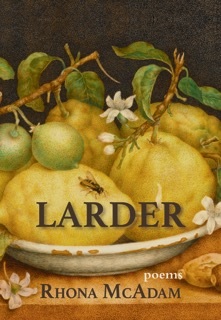
In her latest collection, Rhona McAdam navigates the dark places of human movement through the earth and the exquisite intricacies lingering in backyard gardens and farmlands populated by insects and pollinators, all the while returning to the body, to the tune of staccato beats and the newly discovered symmetries within the human heart.
“…A beautiful, filling collection, Larder is a set of poems to read at the change of the seasons, to appreciate alongside a good meal, and to remind yourself of the beauty in everything, even the things you may not appreciate before opening McAdam’s collection….”
Rhona McAdam is a writer, poet, editor, and Registered Holistic Nutritionist with a Master’s in Food Culture from Italy and a deep-rooted passion for ecology and urban agriculture. Her work spans corporate and technical writing to poetry and creative nonfiction, often exploring the vital links between what we eat and how we live. Based in Victoria, BC, and available via Zoom, Rhona is always open to new writing commissions, readings, or workshops on nutrition and the culinary arts.