-
Visitations and celebrations
Read Full Post: Visitations and celebrationsThe week has been largely social, beginning with my return from London on Monday. Tuesday we arrived in Colorno to find the morning class cancelled, so filled the time with a British and Irish cheese tasting – Berkswell, Caerphilly, Double Gloucester, Durrus, Stilton, Swaledale and even a little Vignotte, just because, well why not, we’re off to France this weekend. I’d brought some Dunkerton’s Cider to wash things down, and some oat cakes and digestives and Cornish wafers.
A big party on Tuesday night, which started with a rooftop aperitivo party – passing through a nicely decorated laundry line – here it is with Jess the artiste:

and on to an al fresco dinner at the Santa Chiara Trattoria, which featured traditional starters including torta fritta with culatello and prosciutto, and a parmesan torte drizzled with balsamico.
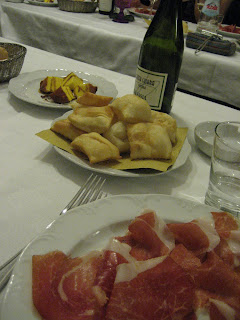
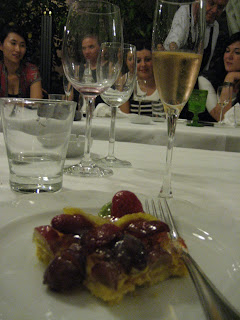
I was indulged in my year-long project to try every Barbera wine I can find (and this one was lovely). Then had a nice bit of duck followed by a fruit tart, as well as toasts and songs in many languages.
Next, I was blessed by visiting Canadians, although the difficulties of arranging a nice time became somewhat operatic in everything except musical elegance.
The day of departure the Parma B&B;, found online and booked a couple of weeks earlier, cancelled my friends’ stay… I guess on the positive side at least they actually let them know they were pulling the rug before arrival, but it was nearly impossible to arrange a room at such short notice, and so instead of a charming centrally located abode, they ended up in an airport hotel with a higher than expected taxi bill and no place to eat except the hotel restaurant. Not much of a welcome to Parma. (If anyone wants the name of that b&b; in the interests of avoiding them in future, get in touch.)
After that, Geoff’s plane from Canada was caught up in a strike and his connection to Milan was cancelled so he had a bonding experience with some similarly afflicted fellow travellers in their circuitous route through Geneva and onwards by train, while his lovely wife kept vigil in the Milan train station all day.
The whole week has been a kind of precis of what can go wrong here when you try to make plans.
I had tried to book a restaurant for the supper I thought we’d have together in Parma on arrival night, but the one I tried had, according to its website, closing days of Tuesdays and Wednesday lunchtime. I tried to phone but the phone was on fax. I tried emailing a reservation, but didn’t hold out much hope for a reply, so I stopped by Wednesday evening but the place was shuttered with no indication of opening times posted on the door. So I gave up. Luckily, as it turned out.
I then attempted to book a rental car, and thought I’d try to support local businesses by booking locally. After my opening remarks and my first “scusi?” to the voluminous reply, the helping hand at Maggiore used it to put the phone down on me. I gave up and went to Hertz, booked online and hey presto.
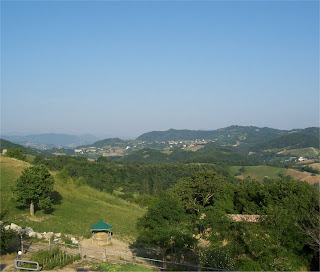
I also attempted to book an agriturismo we’d found online, which had nice pictures of its room but no room rates posted. So I tried emailing them (in pidgin Italian) to ask about room rates, but there was no reply, so I had a more fluent friend call on my behalf (grazie Corrie) and succeeded in landing the rooms. Which turned out to be first rate and we had a perfect stay at the gorgeous and welcoming Campo del Pillo. The owner was friendly and generous; when he saw us tucking into an al fresco antipasti of Pecorino Sardo and wild boar salame, he sniffed manfully and returned moments later with some 30 month old parmigiano-reggiano, drizzled with 35 year old balsamico, and accompanied by organic salame and spalla cruda.
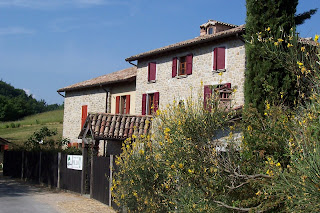
A bella vista out the windows:
And the old grey mare…

Next on the agenda was attempting to book dinner at a Slow Food recommended restaurant, Il Capolinea. After numerous attempts over two days with failed phone connections, I finally got through. After my opening remarks, the other end hung up on me. Let’s say the sound quality was bad. In any case, I phoned back, and this time he heard me out and took my booking.
And we had a fantastic meal in very friendly and capable hands; a mixed starter of pork salad (insalatina di maiale), vegetable frittata, pickled onions, salame and culatello,

followed by roast lamb (coscia d’agnello biologico al forno) and roast beef (drizzled with balsamico),
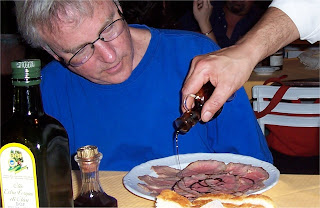
accompanied by a comfortable selection of vegetables, followed by four star desserts: stunningly good fresh strawberries with gelato and balsamico; and chocolate mousse so good I wanted to lick the plate. Afterwards we made friends with a neighbouring table and were rewarded with a glass of nocino; and after that the proprietor brought us some beautiful dessert wine and exquisite almond macaroons.
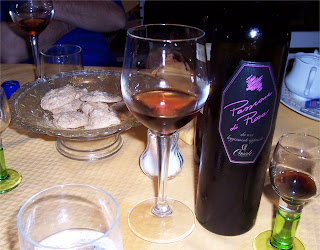
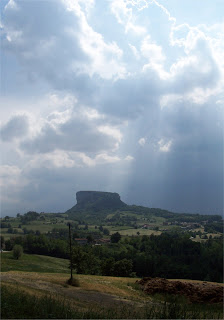
Awesome. We discovered later that Castelnovo ne’ Monti is in fact a Slow City, so we were destined for a good meal no matter what, but I think we struck it lucky nonetheless. Scenic place, with its characteristic tabletop mountain, La Pietra di Bismantova, which is said to have inspired Dante’s Monte del Purgatorio.
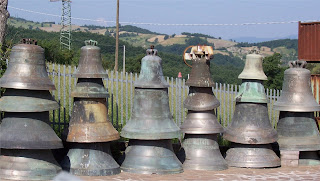
We also discovered that the town is known as the City of Bells because of a long-standing bell foundry (Capanni Bells) where they’ve been ringing the changes since 1500.
On the way home today we paid a visit to the Museo del Sughero (cork museum) in the pretty Appenine spa town of Cervarezza Terme.

-
London break
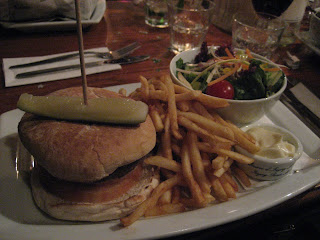
Read Full Post: London breakLondon was mercifully cool and damp after a hot week in Parma, and it was wonderful to catch up with the old gang in the Shackleton Room of the Troubadour where we dined on Brompton Burgers and fish and chips. The food, I’m afraid, looked more promising than it tasted, but the service was excellent and the private room a fortunate thing as there was a lot of youthful exuberance beyond the doorway. London restaurants can be deafening. (But at least they will be smoke free come July!)
We followed with a very large cake from Patisserie Valerie:
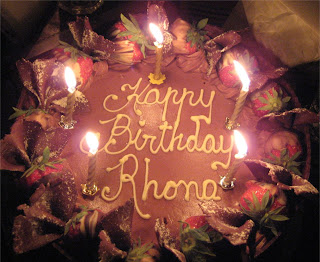
Says it all, really.The next day my kind cousin took me to a Chiswick treasure, Fish Hook, which used to be a South African specialty restaurant (Fish Hoek as it was then) whose niche turned out to be just too narrow for the neighbourhood. In its new incarnation, it serves well priced lunch specials like this one: asparagus veloute with cockles and pea sprouts…
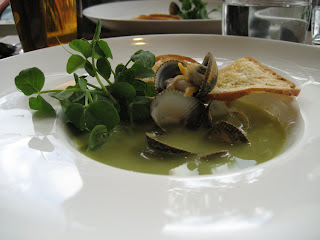
…followed by perfectly cooked sea bream…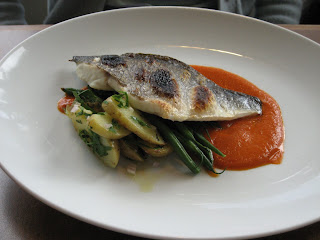
… and – living as I do in gelato country I was curious to see how English versions compared – home-made ice creams (vanilla, caramel and chocolate). The comparison? I think I may actually prefer the local gelato here in Parma; the ice cream tasted … thicker and more dense. Still good, though. Might need further research.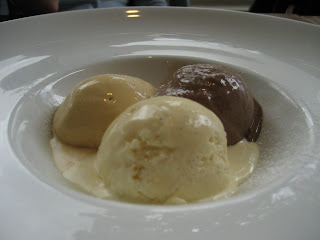
I had a very good supper, surprisingly good, from a Lebanese takeaway called Elias, on Turnham Green Terrace. Lamb shish, tahini, hoummus, felafel, pita bread and a few other things – all incredibly good and carefully prepared before my very eyes. And a fresh apple, carrot and ginger juice to wash it down. Perfect.
Then on Sunday I was reunited with my old writing group and we had a delightful poetry workshop (and excellent lunch of bits and pieces from Carluccio’s) before a few of us headed off to a Poetry School talk by Michael Schmidt about value judgements in poetry at the dangerously wonderuful London Review Bookshop.
Sallied out of there with a few more food books (In the Devil’s Garden; The Cheese Room; Last Chance to Eat; and even a small poetry anthology, Open-Mouthed) and dined on Indian (balti curries, for a thoroughly British experience) at Annapurna.
And back to sweltering Parma. On with the week….
-
Industrial pasta, arab influences and the spoken word
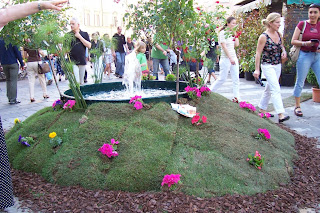
Read Full Post: Industrial pasta, arab influences and the spoken wordPhew, a week seems to have got away from me. Wandering round Parma on Sunday the 13th, I came upon a big party right around the corner, on strada Farini, which had been closed to traffic and lined with street vendors, with nearby gardens and galleries open to viewing. All good street parties in Parma seem to involve strategic use of turf, and this one was no exception, going a step further, adding a fountain:
If the week before was visual, last week was, well, audio-visual. We divided most of our time between Barbara Santich, visiting from Adelaide to tell us about Medieval food history, and Simon Parkes, from the BBC Food Programme, visiting from London to talk about food radio.
We kicked off the week with an all-day tour of the Barilla Pasta factory near Parma on Monday. Oh no, we thought, a dreary day of PowerPoint presentations followed by endless trailing around to see more large shiny machines… but happily there was more to it than that.
Though we did commence, as all 21st century students surely do, by sitting helplessly in a room for half an hour or so, watching a series of mildly concerned staff members take turns having a go trying to persuade the projector to talk to the laptop, and when that didn’t work, trying another laptop, another staff member, another cable, and so on. Enough time had fallen off the clock to convince the plucky marketing chap to plunge in, armed only with a box of spaghetti and a head full of company history. He did very well off the cuff, and by the time the technology was awake he’d covered a good chunk of time.
We had technical talks too, which luckily followed a not-too-distant class in pasta technology, so we were old hands at distinguishing common wheat from durum, and were already aware of the legislation requiring the use of durum wheat for Italian dried pasta; we knew about different gluten actions in each, and of course familiar with potential major flaws in dried pasta. We heard about the work of the research department to produce the perfect balance of protein, gluten and yield in its various strains of durum. We heard that Barilla buys a large percentage of Italy’s durum production, and some of the rest from the US, where it has both mill and pasta factory. And we did see some big machines that were churning out a lot of strands of spaghetti, and were treated to a large lunch of pasta.
Back to the halls of learning on Tuesday, in Barbara Santich’s classes we enjoyed a walk through Medieval foods: heard about some of the foods that were prepared for feasts and how banquets began; and reviewed the astonishing number of days set aside each year for fasting and religious observance that affected foods. We looked at some recipes that had made their way down the years from early cooks such as Apicius, and talked about some of the spices that have pretty much disappeared from Italian food, like dill, cumin, mint, coriander and asafoetida; heard about the influence on cuisine from Arab traders who introduced such foods as citrus fruits, buckwheat, cane sugar, spinach, eggplant and lots of spices to the Mediterranean.
Next, Simon Parkes had us work on a six minute radio piece, which was a challenge to complete in two days. One night, really. It involved the use of some sound editing software which worked better for some of us than others but we had fun with it and enjoyed listening to the final products on Thursday afternoon.
And at that point I flew away to London for the weekend.


Latest Posts
- Writers at Word!
- Sublime and Twisted Readings coming up!
- Sublime
- Good weather for reading
- The world, the world
- Sublime launch!
Aldeburgh Poetry Festival Barny Haughton BBC BC poets Berkswell blackberries Black Stilt Bologna book launch Borough Market Carlo Petrini Catalonia Cyrus Todiwala dairy Daunt's Books Dijon Edinburgh Fanny Bay Feast of Fields Food and Morality food history food journalism Jenna Butler lardo Malahat Review Michael Pollan Okanagan olive oil tasting olive trees Omnivore's Dilemma Our Food Our Future Oxford Parmigiano-Reggiano Planet Earth Poetry poetry poetry readings Poetry videos prosciutto salumi Sean O'Brien Suffolk ticks Wendy Morton Wired Writing Yvonne Blomer
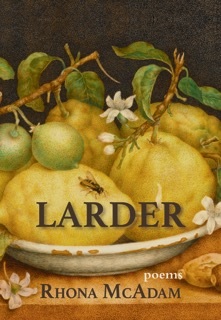
In her latest collection, Rhona McAdam navigates the dark places of human movement through the earth and the exquisite intricacies lingering in backyard gardens and farmlands populated by insects and pollinators, all the while returning to the body, to the tune of staccato beats and the newly discovered symmetries within the human heart.
“…A beautiful, filling collection, Larder is a set of poems to read at the change of the seasons, to appreciate alongside a good meal, and to remind yourself of the beauty in everything, even the things you may not appreciate before opening McAdam’s collection….”
Rhona McAdam is a writer, poet, editor, and Registered Holistic Nutritionist with a Master’s in Food Culture from Italy and a deep-rooted passion for ecology and urban agriculture. Her work spans corporate and technical writing to poetry and creative nonfiction, often exploring the vital links between what we eat and how we live. Based in Victoria, BC, and available via Zoom, Rhona is always open to new writing commissions, readings, or workshops on nutrition and the culinary arts.