-
Say cheese
GK Chesterton did, at length, and spawned a memorable quote:
Poets have been mysteriously silent on the subject of cheese.
And then there’s Clifton Fadiman, who observed:
A cheese may disappoint. It may be dull, it may be naive, it may be oversophisticated. Yet it remains cheese, milk’s leap toward immortality.
And if you have feta and parmesan cheeses on hand you might enjoy, as I did recently, some Potato, Artichoke and Feta Cheese Latkes.
Went to a couple of readings lately, which were indeed mysteriously cheeseless. On Friday, Acorn-Plantos winner Christine Smart read with the always excellent Don McKay
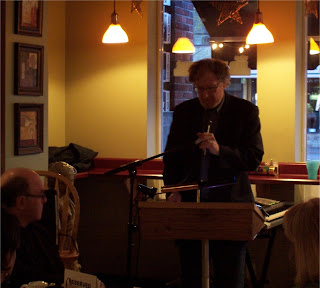
at the Red Brick Cafe in Sidney, where we had some very pleasant accordion music to enjoy in the before after and interval periods.
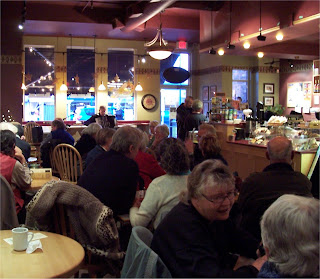
And then on Saturday to the Rona Murray Prize-giving, where we heard from the 8 shortlisted poets. DC Reid was introduced by organiser Peter Such
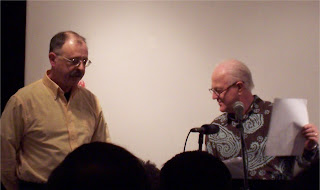
and Barbara Pelman read,
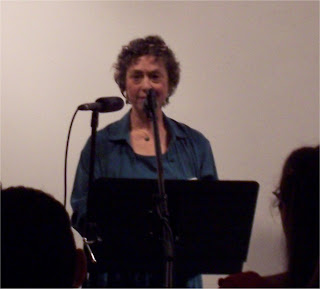
and so did Patricia Young, whose lizard poem shared the prize with an excellent villanelle by Marlene Grand-Maitre.
-
Some reading and looking
The Soil Association‘s recent report that showed crop yields for GM crops are actually no better and often worse than non-GM has coincided with a similar study published in the US, but so far neither report appears to have been found worthy of comment in GM-friendly Canada.
Were you questioning whether organic is really worth it? Here’s one writer who finds that organic foods are more nutritious than those raised by industrial methods (and an article of divided opinion, that still thinks they’re worth it). (And if you wonder why organic food costs so much, check out these regulations, covering permitted substances and the standards and principles which Canadian organic producers will have to follow from December of this year in order to qualify to use the Canada Organic logo.)
Can’t help wondering why this is news: recent headline from the Globe & Mail:
Schools that cut fat and sugar saw dramatic resultsI liked Wendell Barry‘s summation of what to do, what to do in this confusing and frightening world, in the panel discussion I mentioned yesterday (Fast Food World: Perils and Promises of the Global Food Chain):
I think the way to begin is to ask yourself what you know about your own economy, your own food economy. Ask yourself where your food came from and what the cost of production was, what’s the ecological cost and the human cost. And I think the result of that exercise is that you don’t know very much at all… And I think when you come to that point, when you understand your ignorance of your own economy, you’ll understand that the only way to become knowledgeable about it is to exert your economic force in support of local production.
This selfsame Wendell Barry has a sobering article entitled Faustian economics: Hell hath no limits in the most recent issue (May 2008) of Harper‘s, which you can read excerpts from here.
And (thanks Bonnie) I just saw some amazing work by Seattle-based former corporate lawyer turned artist Chris Jordan. Called Running the Numbers: An American Self-Portrait, he describes the project this way:
This series looks at contemporary American culture through the austere lens of statistics. Each image portrays a specific quantity of something: fifteen million sheets of office paper (five minutes of paper use); 106,000 aluminum cans (thirty seconds of can consumption) and so on.
-
Televisualess, with eggplant
I have been living for a couple of years now without television, which has been freeing; it has, as I’d hoped, freed up more time for reading, cooking and walking. I still watch stuff on tv-like screens, but now I rent movies and watch videos online. I suppose that has narrowed the field from which my media heroes are drawn, but if it has there’s one person I’m glad I’ve been able to see in a number of documentaries. She speaks clearly, simply and – although the message is terrifying – with hope and vision.
Here’s an interview with the awesome Vandana Shiva, who has put the plight of Indian farmers into the public spotlight, can explain beautifully the perils of seed patents (covered by Vanity Fair in the May/08 issue!) and biodiesels, has put her money where her mouth is through her foundation, Navdanya, and among her many other activities, now sits on the board of Slow Food International:
And now, if you have a couple of hours to spare, here’s Fast Food World: Perils and Promises of the Global Food Chain, a fascinating panel discussion from way back in 2003, featuring just about everyone I admire together on one stage: Vandana Shiva together with Carlo Petrini, poet Wendell Barry, Michael Pollan, Eric Schlosser and a charming introduction from Alice Waters.
If you’re still hungry after that, I wandered into a wonderful website that is all about aubergines, or eggplants, or melanzane. It includes a recipe for Tumbet, which we had in Spain; I tried Rose Elliot’s version the other day, which was very good, but I think this is closer to the one I fell in love with.


Latest Posts
- Sublime
- Good weather for reading
- The world, the world
- Sublime launch!
- Planet Earth Poetry – Readings by Volunteers, Victoria 2026
- Poetry at the Goldfinch
Aldeburgh Poetry Festival Barny Haughton BBC BC poets Berkswell blackberries Black Stilt Bologna book launch Borough Market Caerphilly Carlo Petrini Catalonia culatello Cyrus Todiwala dairy Dijon Edinburgh Fanny Bay Feast of Fields ferries Food and Morality food journalism Michael Pollan olive oil tasting Omnivore's Dilemma Our Food Our Future Oxford Parmigiano-Reggiano persimmons Planet Earth Poetry poetry poetry readings Poetry videos prosciutto salumi Sean O'Brien sensory analysis Suffolk ticks tortelli di zucca Troubadour Wendell Berry Wendy Morton Yvonne Blomer
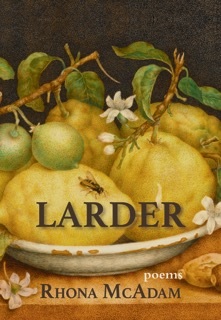
In her latest collection, Rhona McAdam navigates the dark places of human movement through the earth and the exquisite intricacies lingering in backyard gardens and farmlands populated by insects and pollinators, all the while returning to the body, to the tune of staccato beats and the newly discovered symmetries within the human heart.
“…A beautiful, filling collection, Larder is a set of poems to read at the change of the seasons, to appreciate alongside a good meal, and to remind yourself of the beauty in everything, even the things you may not appreciate before opening McAdam’s collection….”
Rhona McAdam is a writer, poet, editor, and Registered Holistic Nutritionist with a Master’s in Food Culture from Italy and a deep-rooted passion for ecology and urban agriculture. Her work spans corporate and technical writing to poetry and creative nonfiction, often exploring the vital links between what we eat and how we live. Based in Victoria, BC, and available via Zoom, Rhona is always open to new writing commissions, readings, or workshops on nutrition and the culinary arts.