-
Crabs ‘n tomatoes ‘n poets ‘n sand
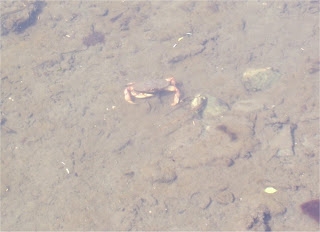
I was shocked the other day to see this guy running underwater, up the Gorge, heading (ultimately) for the ocean I guess. Looks like he mighta lost one claw to the soup pot, but the rest of him was all there.
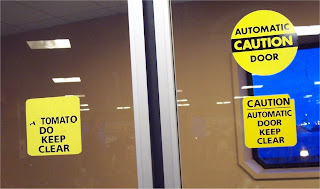
A separate door for tomatoes on BC Ferries. They think of everything.
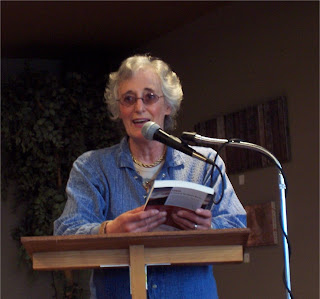
Wendy in fine fettle, introducing a new anthology – Crossing Lines – and a reading by Allan Briesmaster and his daughter Clara Blackwood at the Black Stilt on Friday.
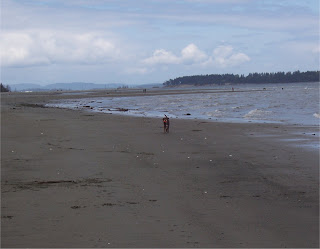
An afternoon to let your ears flap in the breeze: a windy day on Island View Beach.
-
Wendell Berry’s rules for healthy functioning of sustainable local communities
I happened upon a web page that listed farmer-poet-essayist-novelist Wendell Berry‘s 17 rules for the healthy functioning of sustainable local communities (and here’s a place you can read some of his poems):
1. Always ask of any proposed change or innovation: What will this do to our community? How will this affect our common wealth?
2. Always include local nature – the land, the water, the air, the native creatures – within the membership of the community.
3. Always ask how local needs might be supplied from local sources, including the mutual help of neighbours.
4. Always supply local needs first (and only then think of exporting products – first to nearby cities, then to others).
5. Understand the ultimate unsoundness of the industrial doctrine of ‘labour saving’ if that implies poor work, unemployment, or any kind of pollution or contamination.
6. Develop properly scaled value-adding industries for local products to ensure that the community does not become merely a colony of national or global economy.
7. Develop small-scale industries and businesses to support the local farm and/or forest economy.
8. Strive to supply as much of the community’s own energy as possible.
9. Strive to increase earnings (in whatever form) within the community for as long as possible before they are paid out.
10. Make sure that money paid into the local economy circulates within the community and decrease expenditures outside the community.
11. Make the community able to invest in itself by maintaining its properties, keeping itself clean (without dirtying some other place), caring for its old people, and teaching its children.
12. See that the old and young take care of one another. The young must learn from the old, not necessarily, and not always in school. There must be no institutionalised childcare and no homes for the aged. The community knows and remembers itself by the association of old and young.
13. Account for costs now conventionally hidden or externalised. Whenever possible, these must be debited against monetary income.
14. Look into the possible uses of local currency, community-funded loan programmes, systems of barter, and the like.
15. Always be aware of the economic value of neighbourly acts. In our time, the costs of living are greatly increased by the loss of neighbourhood, which leaves people to face their calamities alone.
16. A rural community should always be acquainted and interconnected with community-minded people in nearby towns and cities.
17. A sustainable rural economy will depend on urban consumers loyal to local products. Therefore, we are talking about an economy that will always be more cooperative than competitive.
-
Fast Food David, recent poetry readings, and some offal news about chicken feed
This one has been doing the email rounds; a cautionary vision for us all:

Wednesday saw Karen Solie at Open Space Gallery, where she stunned us with the strength of new work. An interview with Tim Lilburn afterwards revealed that she has been reading, among others, Denis Johnson and John Ashbery.
On Friday we heard new work from Joelene Heathcote at Planet Earth Poetry.
And.. just when you might have thought sanity about animal feed was at last prevailing, this creepy story that shows so clearly we have not not not learned our lessons yet: the EU would like to feed pigs to chickens. This is upsetting moslems, animal rights groups and, I should think, most sane consumers whose memory of the causes of BSE has not yet faded.
If that upsets you, maybe you should settle your nerves with a calming snack of home-made yogurt, with a spoonful of the best honey you can find.


Latest Posts
- Sublime
- Good weather for reading
- The world, the world
- Sublime launch!
- Planet Earth Poetry – Readings by Volunteers, Victoria 2026
- Poetry at the Goldfinch
Aldeburgh Poetry Festival Barny Haughton BBC BC poets Berkswell blackberries Black Stilt Bologna book launch Borough Market Caerphilly Carlo Petrini Catalonia culatello Cyrus Todiwala dairy Dijon Edinburgh Fanny Bay Feast of Fields ferries Food and Morality food journalism Michael Pollan olive oil tasting Omnivore's Dilemma Our Food Our Future Oxford Parmigiano-Reggiano persimmons Planet Earth Poetry poetry poetry readings Poetry videos prosciutto salumi Sean O'Brien sensory analysis Suffolk ticks tortelli di zucca Troubadour Wendell Berry Wendy Morton Yvonne Blomer
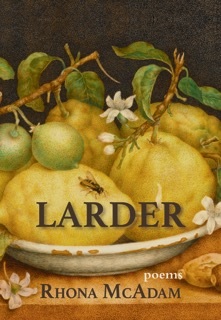
In her latest collection, Rhona McAdam navigates the dark places of human movement through the earth and the exquisite intricacies lingering in backyard gardens and farmlands populated by insects and pollinators, all the while returning to the body, to the tune of staccato beats and the newly discovered symmetries within the human heart.
“…A beautiful, filling collection, Larder is a set of poems to read at the change of the seasons, to appreciate alongside a good meal, and to remind yourself of the beauty in everything, even the things you may not appreciate before opening McAdam’s collection….”
Rhona McAdam is a writer, poet, editor, and Registered Holistic Nutritionist with a Master’s in Food Culture from Italy and a deep-rooted passion for ecology and urban agriculture. Her work spans corporate and technical writing to poetry and creative nonfiction, often exploring the vital links between what we eat and how we live. Based in Victoria, BC, and available via Zoom, Rhona is always open to new writing commissions, readings, or workshops on nutrition and the culinary arts.