-
Some words from literary editors
One of my co-colloquiists brought along the latest issue of Poets & Writers, in which is a topical article for all of us here, called Putting Your Poetry into Order. And an even more irresistible (to me) feature: Through the Eyes of the Editors, in which three literary magazine editors speak to us.
Stephanie Fiorelli discusses a fairly new magazine she co-founded, Avery, going for three years; unusually for a literary journal, it’s independent, non-profit and publishing nothing but short stories. She and her fellow editors also maintain a blog to open up some of what goes on to produce such a publication.
Essayist and poet David Hamilton, who’s been editing the Iowa Review for thirty years, talks about general changes and the impact of university-isation of literary journals over the years: escalating numbers of submissions (10,000 poems received each year of which 120-150 can be published); ‘go-team’ competitive sensibilities between academic-run journals.
Most interesting to me was the piece by poet Stephen Corey, who edits the Georgia Review (and who co-edited an anthology I highly recommend, Spreading the Word: Editors on Poetry) who said a number of thoughtful things. He estimates having received something like 200,000 poems, 50,000 short stories and 15-20,000 essays during his 25 year involvement with the magazine. He goes on to say
“that these statistics are misleading and unnecessarily intimidating, because the bulk of what we receive is not very good at all. The competitive pool is very small, and across the past 25 years I have not seen any appreciable increase in its relative size, despite burgeoning creative writing programs, spell-check and rudimentary grammar-check software, summertime writers conferences, private writing mentors, and online writing workshops.”
He says the number of non-fiction submissions has massively increased,
“except that most of the pieces we receive are not essays anymore, but autobiographical narratives and reminiscences that read more like sentimental journal entries than thoughtful and rigorous considerations of experiences”
And that although the number of poems submitted hasn’t changed much, the number of short stories has dropped, but perhaps this is because
“I think the publishing industry has worked over-time of late to eradicate the short story form, and I think some of the writing programs may have been helping too. Story cycles, linked stories, novels-in-stories – all these au courant designations are attempted end-arounds in the pro-novel, anti-short story game of book marketing.”
His advice to writers is in tune with the overall tone of our time: to slow down.
“Any person who writes one great poem or story or essay per year for twenty years will take his or her place on the short list of the finest writers of all time. Slow down. Read voluminously, year after year, both for pleasure and to be reminded of all that you must not do, and all that you must exceed, in order to make your own special, indelible mark… Never to be forgotten once read – isn’t that what we must seek?”
-
Bugged
Tuesday it was bees: we had a most thrilling hive inspection as our last field trip.

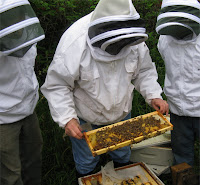

We got to see some varroa mites, how to check for the tell-tale odour of foulbrood,
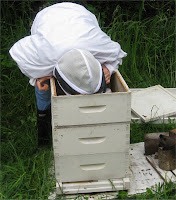
what a hive about to swarm looks like, how you graft a queen cell, how you mark a queen,
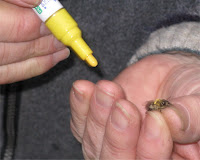
how you split a hive, and how you recapture a swarm that hasn’t left yet. It was not the best time of day (evening) or the best weather (a bit damp) but the bees bore it as best they could, and brave Larry showed us how an experienced bee-man can handle even cranky bees without nets or gloves…
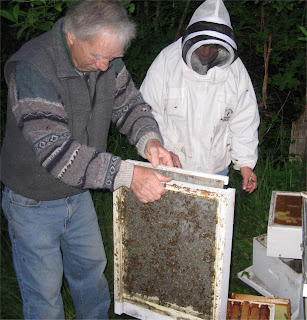
..on account of he had very kindly lent me his jacket and veil. And has spent his entire life around bees. I feel hardly qualified to have my own hives just yet, but will spend a little more time hanging out with bee-folk and see how I feel next year.
Then, on to Saskatchewan where I’m participating in the Sage Hill spring poetry colloquium at St Michael’s Retreat Centre in the Qu’Appelle Valley,

where the ticks are active if not biting (phew). They’ve been crawling over us night and day, even those of us who haven’t gone outside let alone into long grass. This evening I found one hiding on my person. Here she is practicing her backstroke in a drop of water, before sinking into the last hot bath of her life.

Our colloquium leader Erin has researched the subject thoroughly, and apparently it’s unwise to try to crush them (even if you can) in case they’re carrying a disease which you can then spread on yourself by accident. So I think scalding is quick and merciful.
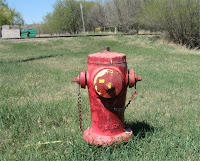
Anyway, there are eight of us here from all across Canada, all with manuscripts in progress. We’ve been having a good time doing poetry exercises and plunging into some hard editorial graft. Between meals, walks (in the short grass, thanks) and strolls into town. Where there is surprising variety in fire hydrant, I happened to notice.



-
Gordon’s seasonality campaign & Delia’s chicken comments
Gordon Ramsay caused a bit of a flutter by proposing that out-of-season fruit and veg be outlawed in Britain. A little light counter-attack from readers of his restaurant menus, but aside from the dessert menus he seems to be sticking pretty well to his principles. I was glad to see him coming down on ex-saint Delia Smith who has been flogging a re-edition of an old book of hers from the seventies which promotes use of ready-made food, which by now we should know is less healthy and more expensive than learning to cook from scratch.
She also made some rather ill-advised comments about supermarket chicken which made feathers fly. Supporters say it’s her working class roots, and that she was just showing sympathy for people who simply can’t afford organic food. But although she concedes she doesn’t like “the way battery chickens are reared,” it strikes me that in describing battery chickens as “nutritious food” she doesn’t seem to grasp the public health risks – increased and dangerous overexposure to antibiotics that come to us through chicken meat, the salmonella and e. coli risks – and the issues around over-consumption of meats by Western consumers.
Most of the cookbooks we’ve all grown up with are meat-based, and so it’s unsurprising to find someone who’s made a living writing them (though her Vegetarian Collection cookbook is excellent) promoting that same unimaginative thinking about feeding the poor.
So my rhetorical question of the day: is it better to invite low-budget shoppers to buy cheap (because inhumanely reared with unhealthy production standards) meat or to point them towards other ways of cooking which use more economical sources of protein?


Latest Posts
- Sublime
- Good weather for reading
- The world, the world
- Sublime launch!
- Planet Earth Poetry – Readings by Volunteers, Victoria 2026
- Poetry at the Goldfinch
Aldeburgh Poetry Festival Barny Haughton BBC BC poets Berkswell blackberries Black Stilt Bologna book launch Borough Market Caerphilly Carlo Petrini Catalonia culatello Cyrus Todiwala dairy Dijon Edinburgh Fanny Bay Feast of Fields ferries Food and Morality food journalism Michael Pollan olive oil tasting Omnivore's Dilemma Our Food Our Future Oxford Parmigiano-Reggiano persimmons Planet Earth Poetry poetry poetry readings Poetry videos prosciutto salumi Sean O'Brien sensory analysis Suffolk ticks tortelli di zucca Troubadour Wendell Berry Wendy Morton Yvonne Blomer
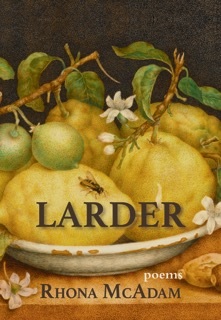
In her latest collection, Rhona McAdam navigates the dark places of human movement through the earth and the exquisite intricacies lingering in backyard gardens and farmlands populated by insects and pollinators, all the while returning to the body, to the tune of staccato beats and the newly discovered symmetries within the human heart.
“…A beautiful, filling collection, Larder is a set of poems to read at the change of the seasons, to appreciate alongside a good meal, and to remind yourself of the beauty in everything, even the things you may not appreciate before opening McAdam’s collection….”
Rhona McAdam is a writer, poet, editor, and Registered Holistic Nutritionist with a Master’s in Food Culture from Italy and a deep-rooted passion for ecology and urban agriculture. Her work spans corporate and technical writing to poetry and creative nonfiction, often exploring the vital links between what we eat and how we live. Based in Victoria, BC, and available via Zoom, Rhona is always open to new writing commissions, readings, or workshops on nutrition and the culinary arts.