-
Snow, sun and BC books & magazines
We had a shock snowfall on Saturday
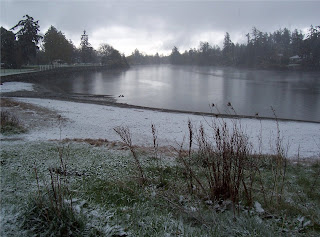
but were back to normal (aside from snow on them thar hills) the very next day

and now it is just onward chilly spring.
I went to a reading on Sunday by four local writers in celebration of B.C. Book and Magazine Week. David Leach, Kerissa Dickie and John Threlfall were scheduled readers, and we got a surprise poetry boost from John Barton as one other reader couldn’t make it. A cold room, sparse audience and much discussed dearth of alcoholic beverages at the bar (it being Sunday, this being Victoria) made it less than cosy, but I reckon there are worse ways to spend a Sunday evening.
-
Monsanto movietime
Came across this documentary (The World According to Monsanto) which appeared on Arte in France on March 11 of this year. Worth a look if you had any curiosity about what Roundup is, who runs Monsanto, how the company influences decision making in its favour, what effect genetically-modified organisms are having and will have on food and other crops, and on the ability of farmers – particularly in the developing world – to survive the company’s economic might.
**April 27 update: mysteriously, the video has disappeared from Google Video, but for now at least catch it while you can, serialised on Youtube; part 1, part 2, part 3, part 4, part 5, part 6, part 7, part 8, part 9, part 10, part 11. What a funny old world. Monsanto exerting influence on public comment? I cannot help but wonder.**
Downloadable iPod version also available. (And you can buy a copy of the dvd (English soundtrack available) from Arte.) I found when I watched it on my laptop, the video kept sticking, but I could prod it along by clicking the play indicator arrow along the bottom of the viewing screen.
-
Global food & expensive wine
I just stopped myself from cheering when I read a newspaper report about global food and farming in an English paper on the plane ride home. The very next day A Friend (thank you, friend) sent me a link to The Guardian‘s coverage of the piece. Since the report’s release on April 15, it’s also been in the New York Times, Le Monde, der Spiegel and many others. But as of Thursday, there does not appear to be any coverage at all of this story in the Canadian press, other than a brief preview on the CBC news site. Perhaps it will break soon.
The report is a 2500 page plan for a global agriculture capable of seeing the world through the next 50 years. The study was the result of five years’ work by the International Assessment of Agricultural Science and Technology for Development (IAASTD for merciful short) with input from some 400 experts; the organisation is funded by participating countries and by a serious group of international agencies (FAO, GEF, UNDP, UNEP, UNESCO, the World Bank and WHO).
The report concluded that neither genetically-modified crops nor industrial food production are workable ways to feed the world; that the only way forward is to employ methods such as organic and small-scale agriculture. It must surely by now seem obvious to most of us, and is thankfully proposed in this report, that to survive in the world as it now is, we must grow our food sustainably: in ways that are less dependent on fossil fuels; make use of locally available resources, natural fertilizers and traditional seeds; and aim to preserve the soil and water supply. The report is critical of the whole biofuel madness: as we are already seeing, using food crops for biofuels is only going to worsen food shortages and price rises.
It should surprise no one that in light of these findings, Australia, the United States and Canada are the countries questioning some of the language in the report’s concerns about biotechnology, especially genetically modified foods. But these are the very countries which must make immediate changes if the world is to feed itself. So…. what happens next?
Summaries of the report are here, on the IAASTD’s website , and there is “a faithful summary of the leading scientific report” on GreenFacts. Unesco has some information and there are presentations and documents of all shapes and sizes about the report on the IAASTD’s Press Materials page.
Meanwhile, an interesting study of wine-drinking concludes that expensive wines do not bring more pleasure to drinkers unless they know what the price tag says. Although it concedes that educated palates do not find a negative correlation between wine and costliness, this overall trend – that expensive wine is actually less enjoyable if you don’t know what it costs – was revealed after more than 6,000 blind tastings were analysed by the American Association of Wine Economists.


Latest Posts
- Sublime
- Good weather for reading
- The world, the world
- Sublime launch!
- Planet Earth Poetry – Readings by Volunteers, Victoria 2026
- Poetry at the Goldfinch
Aldeburgh Poetry Festival Barny Haughton BBC BC poets Berkswell blackberries Black Stilt Bologna book launch Borough Market Caerphilly Carlo Petrini Catalonia culatello Cyrus Todiwala dairy Dijon Edinburgh Fanny Bay Feast of Fields ferries Food and Morality food journalism Michael Pollan olive oil tasting Omnivore's Dilemma Our Food Our Future Oxford Parmigiano-Reggiano persimmons Planet Earth Poetry poetry poetry readings Poetry videos prosciutto salumi Sean O'Brien sensory analysis Suffolk ticks tortelli di zucca Troubadour Wendell Berry Wendy Morton Yvonne Blomer
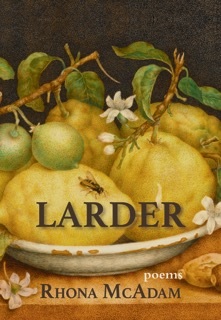
In her latest collection, Rhona McAdam navigates the dark places of human movement through the earth and the exquisite intricacies lingering in backyard gardens and farmlands populated by insects and pollinators, all the while returning to the body, to the tune of staccato beats and the newly discovered symmetries within the human heart.
“…A beautiful, filling collection, Larder is a set of poems to read at the change of the seasons, to appreciate alongside a good meal, and to remind yourself of the beauty in everything, even the things you may not appreciate before opening McAdam’s collection….”
Rhona McAdam is a writer, poet, editor, and Registered Holistic Nutritionist with a Master’s in Food Culture from Italy and a deep-rooted passion for ecology and urban agriculture. Her work spans corporate and technical writing to poetry and creative nonfiction, often exploring the vital links between what we eat and how we live. Based in Victoria, BC, and available via Zoom, Rhona is always open to new writing commissions, readings, or workshops on nutrition and the culinary arts.