-
Poets in Paris
 So finally the Iambic Cafe dusts itself off and drags itself to its weary feet, slightly jetlagged but coming round. Sunday’s arrival in London was enlivened by the rather leisurely delivery of my baggage, but after that it was clear sailing and I was greeted by faltering sunshine on the cobblestones.
 Off to Paris on Tuesday, arriving by Eurostar in good time, and then an evening of bilingual readings at the Delaville Cafe, courtesy Ivy Writers Paris, comfortably accommodated and efficiently organized by expat poet Jennifer Stills. It featured Belgian poet Constance Chlore and Parisian Dominique Maurizi, as well as Saskatoon’s own Mari-Lou Rowley, shown here with Christmas tree..
 We passed a relaxing Wednesday afternoon wandering around the 18th arrondissement, mostly towards Montmartre, admiring the food in the windows, prowling its shops and pausing for a leisurely coffee. Hills and steps there are many, but the sun came out from time to time and warmed the way.


Entertainingly, we passed a couple of goats gnawing on a grass fence we’d passed several times – and found we’d discovered a little pocket of urban agriculture, apparently lush in the summer but a bit bare now, with chickens pecking trackside near Porte de Clignancourt.
Our wanderings ended with a delightful dinner at the Bistrot Poulbot. Pour moi, saumon tartare, dorade , and (how could I not) a lovely confection involving lashings of my namesake Valrhona chocolate.
-
Kelp, acid-alkaline, omnivorous environmentalism & brain food
 It is possible to leave a nutrition conference freaked out about the state of the world, and in dire need of a good remineralizing kelp treatment. But ditto an environmental (literature) conference or just about any other kind of conference nowadays I suppose. Still, we must make the best of where we are, so a nutrition conference is a good place to take in ideas about both cautions and actions to get our bodies through. (And to get a kelp treatment if that will help you in the meantime.)
Chris Kresser has evoked much hand-wringing and teeth-gnashing in his cogently-argued dissection of the acid-alkaline theory, which has been the foundation of much nutritional training over recent decades. The theory holds that: (1) the foods we eat leave behind an ‘ash’ after they are metabolized, and this ash can be acid or alkaline; (2) we should eat more alkaline foods than acid foods, so that we end up with an overall alkaline load on our body, making us less vulnerable to conditions such as cancer and osteoporosis; and (3) that the pH of our blood can be determined by testing pH strips in our saliva or urine.
It is worth noting that although there is little agreement on which foods are acid and which alkaline (a red flag there?) the alkaline lists tend to heavy on fruits and vegetables, while acid foods include animal products, so the theory is a particular favourite with those who advocate vegetarian or vegan diets. And those would emphatically not be people attending a Weston A. Price conference (poles apart: see the veg view vs the WAPF view).
Kresser allows that foods do metabolize into ash, but dismisses the idea that what we eat affects our blood pH (except in metabolic disorders such as ketoacidosis, aka DKA, not to be confused with ketosis). And although the pH of saliva and urine may indeed be altered by diet, their pH has nothing to do with blood pH, which is regulated by the kidneys. He suggests that health improvements may follow any improvement in diet (and it’s pretty easy to work out what those are – fresh, whole foods vs refined carbs) rather than being caused by acidity or alkalinity of what’s been consumed.
For the full explanation, I recommend reading Kresser’s two-part article on the subject. He was, inevitably, asked why – if it is so obviously flawed – the theory is still taught and promoted, and he replied that it takes time for science to nudge belief into change. And not least when there are vested interests at work. He quoted Upton Sinclair: “It is difficult to get a man to understand something, when his salary depends on his not understanding it.”
Speaking of (former) vegans, Lierre Keith (The Vegetarian Myth) revealed that her talk last weekend was the first she’d done that had not inspired pre-event death threats. She was there to make an impassioned plea for environmental responsibility, a cause that should straddle, but instead divides, vegetarian from omnivore. She described human agriculture as the “death of the living world” – its destruction of ecosystems and soil fertility, the biological corners cut to improve financial returns on large scale production, and the misuse of farmland to grow crops for factory farming or fuel.
When you buy a soyburger, she observed, “you’re actually giving money to the people causing the problem.” In the Weston A Price way, she referred to the health of traditional peoples as proof of the damage we’ve done to modern bodies: how European explorers noticed the good health of the populations they encountered, and how poor health inevitably follows modernization of our diets. “Cancer, like insanity, spreads with civilization” (Stanislas Tanchou)
Mark Schauss gave a couple of interesting talks. His research into nutrition and cognitive decline was comprehensive and detailed. One of his big messages was on the consistency he sees in research findings about the role of the two most heavily consumed excitotoxins (MSG and aspartame) in plaque development in Alzheimer’s. Both of these are hard to avoid if you eat processed or packaged foods, since manufacturers play shell games with the naming. For MSG, see the comprehensive list from Truth In Labeling. For Aspartame, beware NutraSweet of course, as well as its new name, AminoSweet.
He repeated an idea I’ve yet to see proven, that artificial sweeteners cause an insulin response similar to ingesting sugars, and lead as surely to insulin resistance and type 2 diabetes. While I think there are lots of good reasons to stay away from artificial sweeteners, I await compelling evidence for this one.
Few could argue with his main message though: the more artificial the diet, the worse the gut, and a bad gut means poor communication along the gut-brain axis. Which means poor cognitive function. And of course, daily exercise is the first best thing you can do to keep your mind fit and healthy.
-
Nourishing Indiana
 Here in the curious world of the conference hotel, if you can find the stairs, they won’t necessarily take you where you want to go. And they are bleak enough to discourage the faint-hearted. I enjoyed a good fifteen minute cardio workout yesterday, travelling with a well-intentioned Marriott employee who tried in vain to help me find the elusive “up-stairs” to get one floor above.
Never mind, there are plenty of long hallways to cover finding my way from
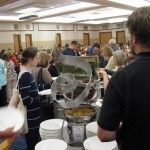 room to meal to conference at the 51st instance of the Weston A Price annual conference in Indianapolis, where we “Focus on Food”. Which is invariably excellent and plentiful at these conferences. Here’s the happy queue at last night’s turkey dinner – birds donated by Fields of Athenry Farm (the farmers and producers are always credited in the menus found in our programs) and replete with several ferments (sauerkraut, fermented cranberry relish, sourdough bread, fermented herbal tea) and grass-fed butter.
Yesterday’s sessions were mostly all-day affairs. I spent most of mine fiercely concentrating on the rapid-fire thoughts and slides of Stephanie Seneff, whose talk covered Pesticides, Antibiotics, Vaccines & Pharmaceuticals at dizzying speed (see her web page to download her slides, as well as find links to her research).
She walked us through research papers a-plenty to illustrate her points. She is a strong advocate of sulfur – it’s one of the least discussed yet most common mineral in the body after calcium and phosphorus and plays a huge role in amino acid development (essential, in short, for protein in the body). The American population tends to be deficient in it (esp. vegetarians and those on low protein diets), and chronic acetaminophen (Tylenol) use further depletes sulfate.
Glyphosate (Roundup) is implicated in many conditions, contrary to studies which claim it to be harmless. For licensing purposes, glyphosate is only tested in isolation, but Roundup contains many other ingredients designed to enhance its effects (up to 1000x); and of course it’s only studied for 90 days, whereas its health effects are cumulative. Seneff had tracked some interesting correlations: glyphosate use tracks closely with autism rates, anemia, sleep disorders, breast cancer rates, kidney disease and more.
Glyphosate has been found in breast milk, urine and water. That it hasn’t been found sooner is probably a product of the few labs willing to test for it.
Seneff explained that the reason glyphosate affects human health is its effect on beneficial gut bacteria, which serve a protective role in the body. Glyphosate blocks the production of tyrosine, tryptophan, and phenylalanine – three essential amino acids formed on the shikimate pathway. This pathway, the argument goes, “is only found in plants and microorganisms, never in humans” – however, it is found in our gut bacteria, which help to synthesize amino acids. Glyphosate also inhibits cytochrome P450 (CYP) enzymes which in humans help to break down toxins.
The best way to avoid glyphosate is to eat certified organic foods, including many sulfur-containing foods (and have epsom salt baths – which allows you to absorb sulfur and magnesium through your skin).
She had a lot to say about statins as well – I strongly recommend anyone taking these have a look at her slides and do their own research. The gist was that they may protect you from heart attacks, but they will cause heart failure – a long and limiting way to go – as well as weakening many other body systems.
I ended yesterday with a talk by naturopath Louisa Williams, who spoke about antibiotic-resistant bacteria. She believes these to be causing many chronic disorders (pain, anxiety, depression, fatigue, movement disorders, memory loss, constipation/diarrhea) and contributing to others (cancer, Crohn’s meningitis, multiple sclerosis, Parkinson’s, Pertussis, Sarcoidosis, Lyme’s…) . The gist is that antibiotic over-use has created resistant bacteria, which then mutate into cell wall defective (CWD) bacteria. These lack the structure that allows antibiotics and our own immune systems to recognize and deal with them.
Diagnosis is difficult. Treatment includes the usual detox protocols (removing environmental and dietary toxins); stop ‘feeding the fire’ by taking antibiotics except for acute conditions (even over-using microbial oils such as oregano will lead to problems); seek constitutional homeopathy remedies; and heal the gut with plant polysaccharides (mannose – though she felt the amounts needed exceeded what could be obtained through diet) and special probiotics.


Latest Posts
- Sublime
- Good weather for reading
- The world, the world
- Sublime launch!
- Planet Earth Poetry – Readings by Volunteers, Victoria 2026
- Poetry at the Goldfinch
Aldeburgh Poetry Festival Barny Haughton BBC BC poets Berkswell blackberries Black Stilt Bologna book launch Borough Market Caerphilly Carlo Petrini Catalonia culatello Cyrus Todiwala dairy Dijon Edinburgh Fanny Bay Feast of Fields ferries Food and Morality food journalism Michael Pollan olive oil tasting Omnivore's Dilemma Our Food Our Future Oxford Parmigiano-Reggiano persimmons Planet Earth Poetry poetry poetry readings Poetry videos prosciutto salumi Sean O'Brien sensory analysis Suffolk ticks tortelli di zucca Troubadour Wendell Berry Wendy Morton Yvonne Blomer
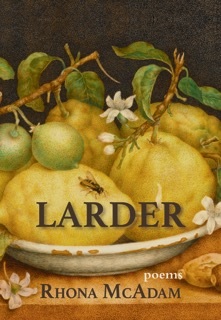
In her latest collection, Rhona McAdam navigates the dark places of human movement through the earth and the exquisite intricacies lingering in backyard gardens and farmlands populated by insects and pollinators, all the while returning to the body, to the tune of staccato beats and the newly discovered symmetries within the human heart.
“…A beautiful, filling collection, Larder is a set of poems to read at the change of the seasons, to appreciate alongside a good meal, and to remind yourself of the beauty in everything, even the things you may not appreciate before opening McAdam’s collection….”
Rhona McAdam is a writer, poet, editor, and Registered Holistic Nutritionist with a Master’s in Food Culture from Italy and a deep-rooted passion for ecology and urban agriculture. Her work spans corporate and technical writing to poetry and creative nonfiction, often exploring the vital links between what we eat and how we live. Based in Victoria, BC, and available via Zoom, Rhona is always open to new writing commissions, readings, or workshops on nutrition and the culinary arts.