-
Nuts & Seeds
Blighty walnut Already I am falling behind. Weekend before last was a nutty, seedy time, marked by intermittent rainstorms and – for my part – a missing battery from my camera, so the photos are few.
On the Saturday morning, some of the Gorge Tillicum Urban Farmers went out to Bailiwick Farm, where Barbara Brennan led us round her nut tree orchard. We went nose to nose with a herd of alpacas, dodged the hanging fruits of a bumper kiwi crop, and got some honest advice about how not to make one’s fortune from growing nuts, .
Piñons , aside from being slow growing, yield sticky cones that are messy to harvest and whose nuts are difficult to extract and hull. In addition to which, despite advice to the contrary, the juvenile pines did in fact turn out to appeal to the tastes of the resident alpacas, so they were looking a bit nibbled.
Hazelnuts, on the other hand, are easier to grow and harvest. Maybe a bit too easy: the squirrels and crows got Bailiwick’s entire crop this year. The walnuts have done pretty well, and although the crows and squirrels helped themselves, there was still a fair crop left. Unfortunately some of that had been hit by a blight, so the Brennans were going to have to sift through the nuts that they had managed to harvest. And walnuts are not a huge money-spinner either.
The crop that was doing well for them was kiwi, which grows well in our climate, and our amazing growing season this past summer had yielded an excellent crop, still a couple of weeks from harvest. Kiwis store well, too, so can be sold right through the winter.
 On Sunday I went to Fernwood to join in the Seeds of Diversity Canada annual meeting which marked the organization’s 25th anniversary. It’s been an important presence in this crazy world where seeds have been removed from the natural order to become patented commodities, and there was much passion in the voices of members invited to pass their issues on to the board.
I attended a seed saving workshop in the morning, led by the very able Michelle Smith, from of Northwind Farm, Cape Breton. She talked about the value and principles of growing open-pollinated seeds. This practice offers plants a gradual adaptation to local conditions, strengthens the plant lines (since you save only seeds from the best plants) and frees growers from having to purchase hybrid seeds (which don’t grow true if harvested and saved).
Of course it’s not a simple process, since plants can cross (squash and brassicas for example will cross readily within their respective plant families) so there are planting or isolation distances to take into consideration; and you’ll need to know your plant families. Seed savers grow a number of the same plants (minimum population) from which to save seeds in order to preserve genetic diversity. You need to know if your plant is wind, insect or self-pollinating, as that will affect how it reproduces and what conditions you may need for producing seeds. And you’ll need to take season extension into consideration: seeds ripen well after most crops are harvested, so if you’re in a climate where the plants may freeze before you get the seeds, you’ll have to find ways to keep them warm or bring them inside.
The keynote speaker who followed an excellent lunch (ah the season of butternut squash soup…) was the always popular Linda Gilkeson, with a talk on all-season growing. She drew on her science background and peppered the discussion with notes on seed needs – for example, she warns that the number of winter cauliflower varieties has dwindled from over a dozen 20 years ago to only two at present. The story is the same for most vegetables: fewer varieties commercially available.
Most seed companies grow to sell in high volumes, and in reaching a wider market will grow seeds poorly suited to many climactic regions. Less profitable and harder to grow plants will fall by the commercial wayside. So the message to all backyard growers is that the seeds we save really do matter: our small work with local varieties helps to keep them strong and well-adapted, and most importantly, available within our regions.
-
Announcing Ex-ville
 Dear readers,
I have been a sleeping blogger for these many months, but have awakened just as the leaves fall and the books launch.After a suspenseful summer, I am more than pleased to report that my sixth full-length poetry collection, Ex-ville, has at last made its way to the printers and will soon be available from the good folks at Oolichan Books, and better bookstores near you.
Sporting a dynamite cover (from a photo by the marvellous Cherie Westmoreland) it includes poems never before seen as well as many that have appeared in such journals as Acumen, the Antigonish Review, Contemporary Verse 2, Descant, The Malahat Review, Prism International and Vallum, and some anthologized in the likes of Force Field: 77 Women Poets of BC, Poems from Planet Earth, Rocksalt and Walk Myself Home. I humbly hope you like it.
Over this silent summer I’ve been preoccupied by many things, not least the final months of study which have culminated in yet another string of letters to squeeze onto a business card. These letters are satisfyingly close to my own name, and I am now Rhona McAdam, R.H.N. I have enjoyed my time at the Canadian School of Natural Nutrition and will be able to keep my ties there as an instructor (Eco-Nutrition) going forward.
I continue to ponder the future of this blog – whether it can span food, poetry and holistic nutrition, or whether some other tool is needed. Meanwhile, for those wanting to follow my food security and urban agriculture interests, find me at my Digging the City page on Facebook; likewise I add literary notes and links to my Facebook writer page. See you here, there and everywhere!
-
London Books

Reading at the RA Still a few more bits and pieces to share from my time in London, back in March, before this month, like the past couple, get away from me.
I went to a number of events while in town. One, a reading at the Royal Academy, was themed to reflect the architectural exhibit, Sensing Spaces. Poets were commissioned to write poems inspired by the pieces and then come along and read them one evening, in and around the exhibition. The affair was a mixed success, from my point of view out there in the audience. The show carried on around the readings, with bemused art-lovers pausing to
 puzzle over who these people were and what they were doing. The reading spaces were not always ideal, as in the one shown above, which was a large, cavernous room with a bar – attracting a fair amount of traffic and chat and requiring the poets to bellow above the din. Which not everyone can manage, and it doesn’t always serve the poem’s quiet purpose. Another, shown here, was more intimate and atmospheric, but not always in the best way, as it featured a pebble floor which made, well, pebble sounds when anyone moved or walked over it. Still, a tip of the hat to organizers for trying to include poetry – which is incompatible with many features of our rushed, noisy lives.
 A quieter event was Carrie Etter’s launch of Imagined Sons. Most pubs in England have function rooms, mostly above the main tavern. The Yorkshire Grey in Clerkenwell had one that was perfectly sized and situated, and offered what looked like pretty good food too. A goodly throng assembled to wish Carrie well with her most recent poetry collection. We were treated to Carrie’s reading of a number of these moving and imaginative reflections on the unanswerable question of what becomes of a child given up for adoption, and how the act haunts a teenaged birth mother throughout the rest of her life.
Other events included a visit to Poetry in the Crypt, which was, as always, a packed-out event
 in which poets waive their reading fee and all monies raised are given over to charity. The readers du jour were Clare Best, Robert Chandler and Jean Sprackland, who gave generously of their words, alongside many fine readers from the floor. On my way to the venue, in the crypt of St Mary’s Church in Islington, I noticed other audiences spilling out of pub doorways, as the Six Nations Rugby match was on.
And finally, right at the end of my visit, I was able to attend a book laun
 ch by an old friend from way back, Stephen Watts, who was launching his beautifully titled collection, Ancient Sunlight. He read in his characteristically powerful style, from a collection that travels around London and Europe but remains rooted in his personal web of humanitarian and political concerns. A good literary finale, although it meant I had missed Jenny Lewis reading from Taking Mesopotamia in Oxford. And illness kept me from the launch of Heart Archives by Sue Rose. But I managed to get to quite a lot over a relatively short visit. Always so many reasons to return!


Latest Posts
- Sublime
- Good weather for reading
- The world, the world
- Sublime launch!
- Planet Earth Poetry – Readings by Volunteers, Victoria 2026
- Poetry at the Goldfinch
Aldeburgh Poetry Festival Barny Haughton BBC BC poets Berkswell blackberries Black Stilt Bologna book launch Borough Market Caerphilly Carlo Petrini Catalonia culatello Cyrus Todiwala dairy Dijon Edinburgh Fanny Bay Feast of Fields ferries Food and Morality food journalism Michael Pollan olive oil tasting Omnivore's Dilemma Our Food Our Future Oxford Parmigiano-Reggiano persimmons Planet Earth Poetry poetry poetry readings Poetry videos prosciutto salumi Sean O'Brien sensory analysis Suffolk ticks tortelli di zucca Troubadour Wendell Berry Wendy Morton Yvonne Blomer
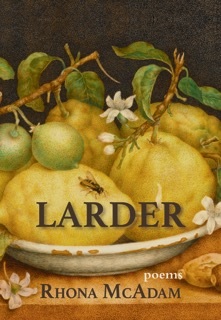
In her latest collection, Rhona McAdam navigates the dark places of human movement through the earth and the exquisite intricacies lingering in backyard gardens and farmlands populated by insects and pollinators, all the while returning to the body, to the tune of staccato beats and the newly discovered symmetries within the human heart.
“…A beautiful, filling collection, Larder is a set of poems to read at the change of the seasons, to appreciate alongside a good meal, and to remind yourself of the beauty in everything, even the things you may not appreciate before opening McAdam’s collection….”
Rhona McAdam is a writer, poet, editor, and Registered Holistic Nutritionist with a Master’s in Food Culture from Italy and a deep-rooted passion for ecology and urban agriculture. Her work spans corporate and technical writing to poetry and creative nonfiction, often exploring the vital links between what we eat and how we live. Based in Victoria, BC, and available via Zoom, Rhona is always open to new writing commissions, readings, or workshops on nutrition and the culinary arts.