-
Jerusalem 3 and back to drizzle
Read Full Post: Jerusalem 3 and back to drizzleWhoosh and here I am back from Israel, touched down briefly in London en route to Parma where I’ll be until I wrap up my Italian chapter in about two week’s time. I left London in a grey drizzle, and arrived to the very same in Parma.
The last day or so in Jerusalem was as rich as the rest of the week. Monday night four of us went for supper at a friend’s place, where we gathered under the stars on a terrace garlanded by flowers and herbs and overlooking a valley of lights. We were sat down with some good Israeli wine and bread, tahini, olives, salad and conversation, before a platter of goulash with rice and okra arrived, a bowl of parsley and lemon salad hard on its heels. When we had eaten, drunk, talked and laughed enough we drove off into the night.
Tuesday I had deemed museum day, but the museum played a trick on me and changed its hours, not opening until 4pm, a bit too late for me to start in on a place I’m told you needed to spend a few days to see properly. So I opted for the more manageable Museum of Islamic Art, which took me a couple of hours to see. It gave a good overview of its subject and included some beautiful tiles, jewellery, glass items, paintings, clocks and rugs. The display of enormous pieces of Yemeni wedding jewellery was really something: the tour guide said that when fully decked out a bride might be unable to stand unaided, and that this was considered a bonus, since neither would she be able to flee the ceremony. The changing exhibition space was on this occasion filled with examples of Anatolian kilim rugs, with a scrolling video showing the wool being shorn, carded, spun, dyed and woven these ones mainly by Yoruk tribeswomen.
Then out into the burning heat of day where Yaron, our dinner host from the night before, sped up in his chariot (white is, unsurprisingly, the colour of choice for Israeli automobiles) and whisked me away to the Hebrew University where we had a bite to eat in the surprisingly good university cafeteria (I opted for one more go at Israel’s national dish – Falafel!) and then we walked around the lush gardens and well kept campus admiring the flowers and contrast to the world outside its walls. We stopped in at the National Library, also on this campus, where there was a display of the library’s Haim Gouri archive, including a documentary the poet, soldier and film-maker had made about the attempts by Holocaust survivors to get to Israel through the British naval blockade of the country immediately after WW2. Tens of thousands were interned by the British on Cyprus until 1948 when Israel had the challenge of accommodating vast numbers of immigrants into a newly formed country.
And the challenges never stop in Jerusalem. The Montefiore Windmill
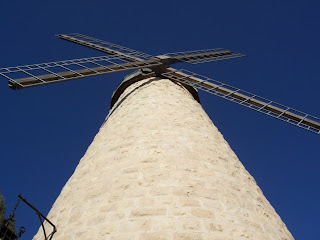
was built in 1857, to provide flour milling for the locals when civic planners tried to lure some of the population out of the Old City, which was becoming overcrowded. Depending on which sources you believe, the new neighbourhood, Yemin Moshe, either never actually used the windmill because, well, there wasn’t enough wind where it was set; or used it until more modern equipment made it obsolete. (Still, it makes a handsome landmark and has been turned into a museum to its maker, the surrounding houses used as artists’ and writers’ spaces.)
The area was populated but then gradually fell into decline, but in recent years has been upgraded into some of the top real estate in town, with some stunning views across to Mount Zion
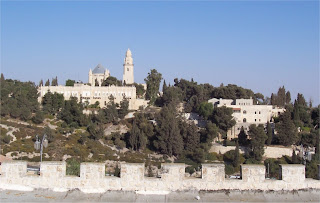
and beyond. In fact three wedding parties were there being photographed while we walked around. And an ironic photo that must be, to my visitors’ eyes, depending on the angle you choose: you could end up with the green and tranquil Hinnom Valley (also known as Gehenna, the Valley of Hell, it has a particularly complex history)
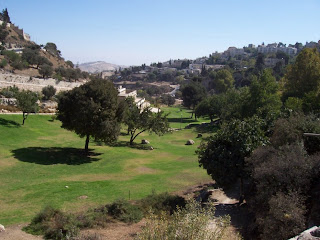
in the foreground and the Separation Wall behind it.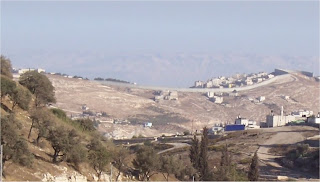
I guess you either embrace such monumental contradictions in Jerusalem, or go mad. Or both.
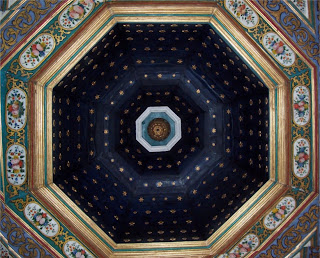
Well. Back home for a final supper with Susan whose wounded toe prevented her from joining us on an evening visit to the American Colony Hotel, a fabulous gift of a tour for my last night in Jerusalem. It began as a Christian utopian colony, founded in 1881 out of family tragedy by the Spaffords, a Chicago couple whose American followers were joined by Swedes; in the early 1900s they began providing accommodations to guests of Baron Ustinov (grandfather of Peter); then by turns during and after WWI provided war relief, food and medical services; was devastated by plagues of locusts in 1915; and served as an orphanage and even now provides medical treatment and outreach for Jerusalem’s Arab children and their families. It became a hotel in the 1950s and as such served as a neutral meeting point for Jews and Arabs, together with diplomats and foreigners, and continues today as a posh hang-out for UN staff, visiting dignitaries and pop celebrities. It’s a gorgeous place, but it was dark and the only photo I managed was this ceiling shot from a meeting room upstairs:
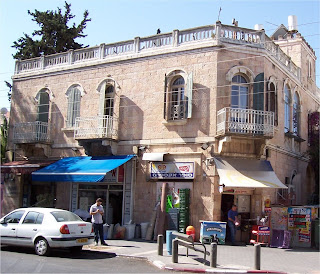
And then it was Wednesday and time to pack my bags. I went for a last walk along Bethlehem Road before the airport transport arrived to take me to Tel Aviv. Here’s a shop in a building of the typical blonde Jerusalem stone – blessedly cool in the fiercest heat – showing an interesting contradiction of cultures. (Ben & Jerry get around…)
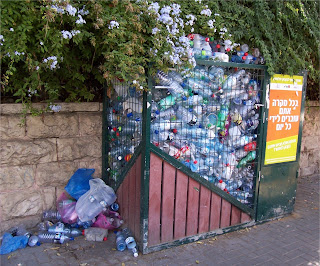
Recycling is more a vision than a reality just now. It seems the program is on hold and when the plastic bottles pile up high enough they get tipped in with the garbage.
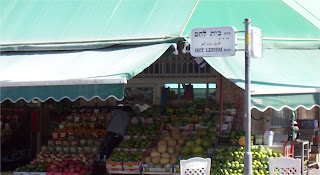
Corner fruit shop where I bought a couple of my giant pomegranates for breakfast; if you look closely at the back of the shop on the right you’ll see the ubiquitous juicer — so you can get your hit of ultra-fresh juice. And of course the street signs are trilingual.
-
Jerusalem 2
Read Full Post: Jerusalem 2The visit has hardly begun and it’s already nearing its end. As everyone’s been telling me, a week isn’t nearly long enough to see Jerusalem properly, but my host and her friends have been doing their best to show me as much as possible. It’s been a lot of fun and given the autumnal chill in all my other homes, it’s been wonderful to enjoy some October heat and sun.
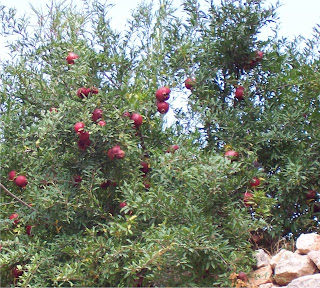
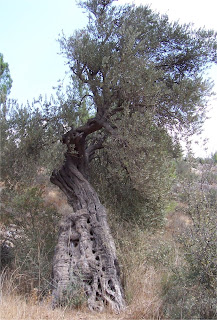
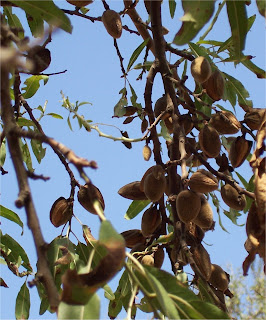
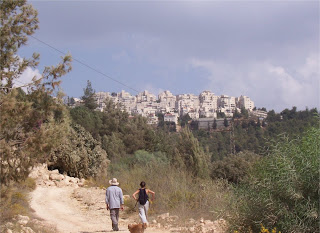
Saturday was one such day; hot, but not too hot, and so we packed up the dog and headed to the hills for a walk past pomegranate,
olive
and almond trees.
The area we drove past to begin our walk was one of the suburbs, a community like all such places with restrictions on who can live there — your eligibility is determined by a graphology test. These are used widely here, for everything official including screening job applicants.
After our walk we stopped very briefly outside the walls of the Old City so I could slip in and see the Western (Wailing) Wall – divided like so many things here into separate sections for men and women – and fairly busy, it being Shabbat. Other restrictions are in place on this day which stretches from sundown on Friday to sundown on Saturday: no machines are to be used, which include light switches and vehicles, so there are few cars on the road, and no public transportation.
After sundown, then, we had about 20 of Susan’s friends arrive to have a poetry night – all were asked to write or bring a poem and about half a dozen did read poems, some of them written for the occasion. It was delightful and I enjoyed meeting everyone – a very friendly and interesting group of writers, teachers, social workers, academics and more, whose origins included Scotland, England and the US. We ate and read and drank and even sang for a while and then they all trickled out again into the warm evening air. My uninvited guest was another monster migraine which hammered away all night before slipping away in the morning.
So, off we went with Bailey dog for another walk,
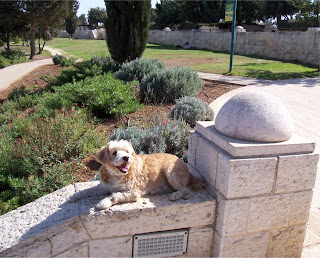
this time to Gabriel Sherover Promenade
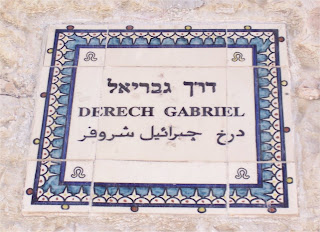
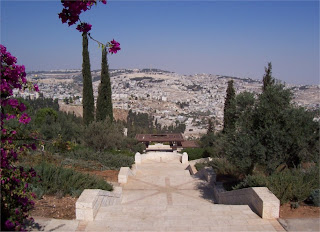
– a park built in 1989 on wasteland that had marked the division between Jews and Arabs until the Six Day War in 1967, and which overlooks all of Jerusalem, across the tops of Palestinian villages to the Separation Wall. The place commemorates the benefactor’s son Gabriel, who died of Aids in the 1980s. It’s beautifully maintained with a team of gardeners and maintenance workers who surpass what can be done in most municipal parks, but is little used, and on our walk around noon on Sunday – the schools are on strike and yet not a parent or child to be seen here – we met nobody but gardeners. Apparently its location above the Palestinian villages mean that it is a genuinely dangerous place by night, and an uneasy one by day. Sure can’t argue with the quality of the views from here though.
Then we had lunch with more of Susan’s friends, some leftover salads from the party, and afterwards went to meet another friend – a Scottish antiquities dealer – for a strong, cardamon-laced cup of coffee and the opportunity to watch him negotiating in Arabic over some oil lamps and pottery pieces, which was highly entertaining. While we waited for our coffee to brew, the Palestinian seller told us some of its local etiquette – whether or not you drink your host’s coffee will say much about your position on whatever else happens to be on the social or business table at the time; wryly he downed his second cup and left his wares in the buyer’s hands. I had a look at some ancient coins, rings, pottery and glass, and then was whisked away by my companions to do some more sight-seeing. We had a look in the Anglican School compound,
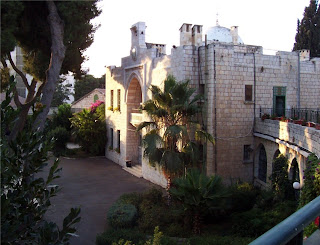
once a hospital, with various wards named after their benefactors,
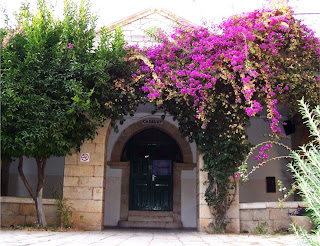
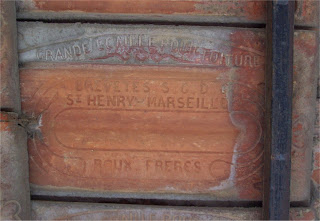
bits of it roofed in French tile,
walked through the garden of Hunt house, where the sign said the poetess Rachel lived in a small house on the grounds until 1925. Then on through to the Ethiopian Church,
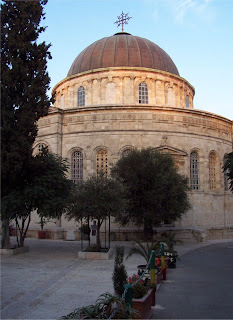
where a service was underway, and we entered and shoelessly crept around the circumference enjoying the painted blue dome and many paintings of the Lion of Judah who also guards the door. Across the road is the home of Eliezer Ben-Yehuda, the father of modern Hebrew, whose commemorative plaque keeps getting removed by ultra-orthodox Jews who believe Hebrew should be reserved for worship only, not wasted in daily conversation. Then past the big signs marking Mea She’arim district, warning about conservative dress for women, and up and down the streets for a while until there was no time left on the parking meter. On the way home we drove through some of the more interesting neighbourhoods – past the Islamic Art Museum and the President’s home.
Monday I walked through the Old City. I entered the Jaffa Gate and went through the Armenian Quarter until I reached a falafel stand at the edge of the Jewish Quarter, where I rested briefly until yet another man approached me offering his services as a tour guide and I gathered my strength and guidebook for another wander. This building, like so many others, was restored by benefactors who get their names etched in stone (these were from Toronto – there’s a not insignificant Canadian presence among buildings and benefactors in town).
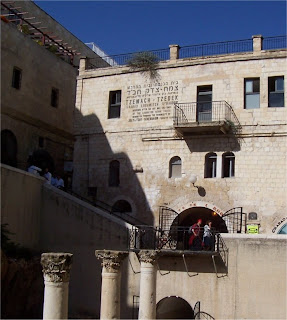
Plunged down some stairs and followed the crowds into the Muslim Quarter
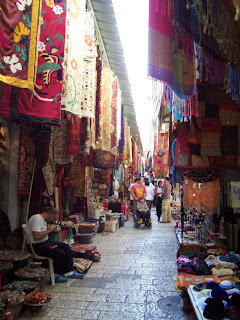

and suddenly found myself (along with several tour groups and a couple of groups of Israeli soldiers getting their cultural training)
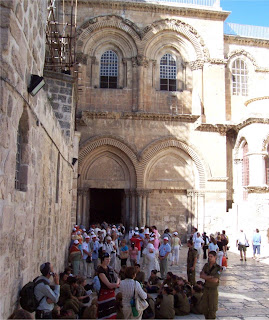
at the Church of the Holy Sepulchre (if you look closely under the second window in the picture above you’ll see the Immovable Ladder which has occupied this position since the first photos were taken) —
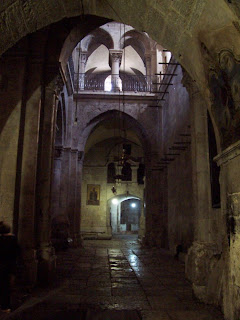
which is at the start of the Christian Quarter, so a well-rounded, four-quartered day. I spent an hour or so in the church (here’s the Stone of Unction)
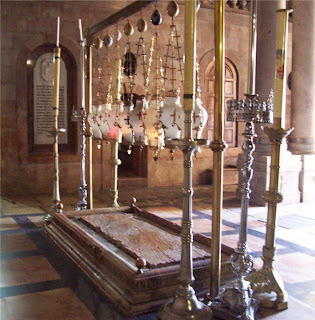
which was, like most historic places in today’s world, whether holy or not, subjected to the whirr and click of cameras and the strobing of flashbulbs (as they used to be known). (If it matters to my readers, I have turned the sound off on my camera and use no flash, particularly in settings like this one.) I was surprised they allowed cameras at all: they are strict on many other things, like the wearing of shorts and sleeveless blouses by women. Though I followed one woman wearing shorts and baseball cap and sporting a particularly large and obnoxious camera which she was deploying as close as possible to everything including the altar here in the Chapel of Calvary,
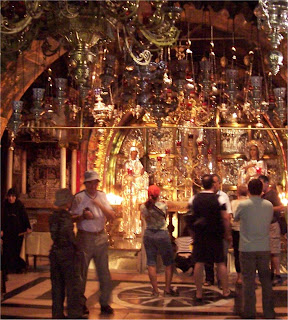
as oblivious to the worshippers – some of them prostrate – around and behind her as was her tour guide. The one thing I did see a priest come over and reprimand a seated woman for was crossing her legs; apparently crossing your arms is just as bad. Rules, rules.
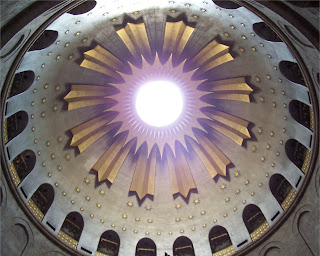
All done, I headed back to Jaffa Gate and paused to look at some postcards. When I asked how much they were I was told 2 shekels. I shook my head and walked off; “It’s too much?” said the trader, “I agree with you, too expensive. You can have them for 1 shekel.” Deals, deals. On my way out I was offered another tour guide and asked if I wanted to know where to shop. Enough!
This was the view from above Wolfson Garden: a pair of horses graze in the foreground, and on the hill, the wall curls away in the distance.
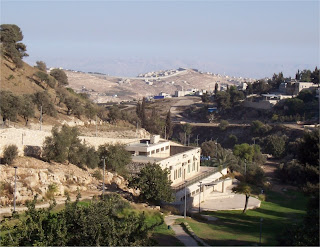
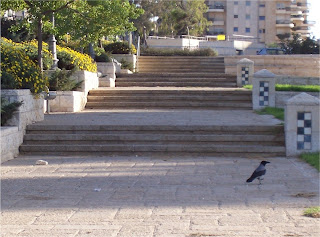
Even the crows are divided here: natty grey and black plumage.
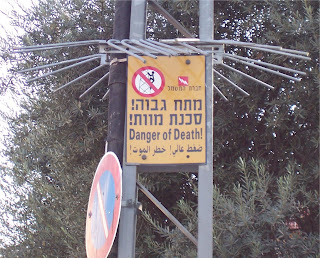
And another version of my favourite sign.
-
Jerusalem 1
Read Full Post: Jerusalem 1After a desperately early start (0245 wake-up time) I left Heathrow on Thursday morning, landed at Zurich, and took off again — so that after a few hours, this…
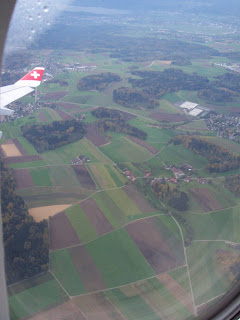
gave way to this, and we landed at Ben Gurion Airport, Tel Aviv.
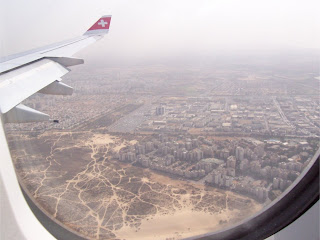
I caught a shuttle bus driven by an authentically wild Israeli driver who carried a dozen or so of us at a lively pace towards Jerusalem, and who during a hectic hour while he was busy doing his filing, shouting into his mobile and writing on bits of paper – sometimes simultaneously – had undertaken the further responsibility of encouraging all the other drivers with toots from his horn, and periodically swung swiftly around them while they paused at corners and stop signs to show them how it was done.
Fortunately when I was dropped in my turn, Susan and Bailey the dog were waving a welcome from the balcony and I was ushered inside a large airy flat. After feeding and watering I was ushered out again to try to find our friend and driver who was stuck in traffic around the corner. The reason he was stuck was apparently due to a “suspicious object” at a nearby bus stop. A child soldier with a machine gun held us back while it was being sorted out, and soon enough we were on our way. I had a fabulous tour of the city by night,
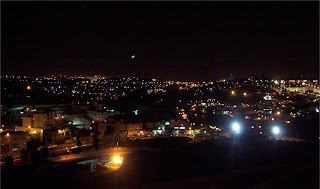
and a pause on the Mount of Olives (Robert Maxwell’s in there somewhere, apparently)

before driving down past Gethsemene and its splendid churches. Susan volunteered the interesting fact that “Gethsemene” actually means olive press.
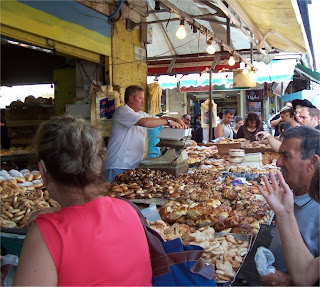
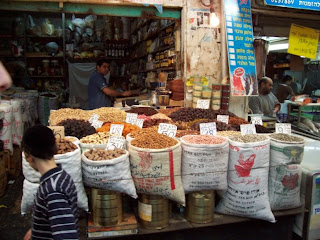
Friday, she said, was an excellent day to visit The Shuk (market), as everyone is rushing around doing their shopping before everything – shops, transportation, the works – shuts down for the sabbath that starts at dusk.
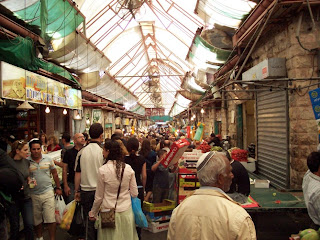
And it was busy indeed. Everything you could need.. bread, tomatoes..
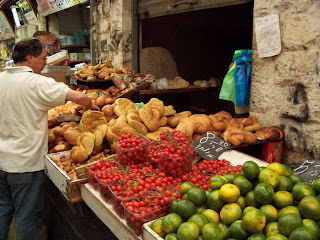
tea…

nuts, fish…
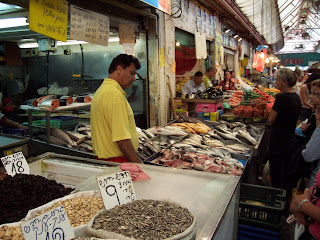
pastries…
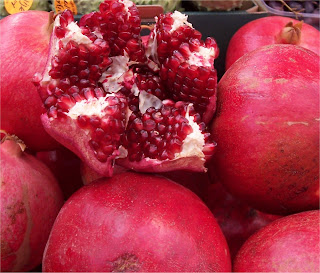
enormous pomegranates..
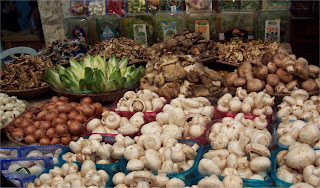
many mushrooms…
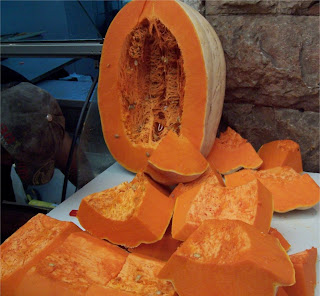
squashes twice the size of a man’s head…
nuts, spices, honey…
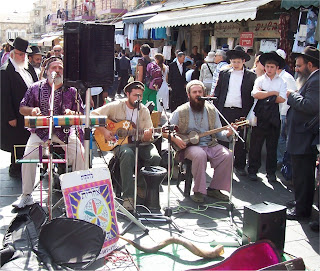
and a few musicians.


Latest Posts
- Writers at Word!
- Sublime and Twisted Readings coming up!
- Sublime
- Good weather for reading
- The world, the world
- Sublime launch!
Aldeburgh Poetry Festival Barny Haughton BBC BC poets Berkswell blackberries Black Stilt Bologna book launch Borough Market Carlo Petrini Catalonia Cyrus Todiwala dairy Daunt's Books Dijon Edinburgh Fanny Bay Feast of Fields Food and Morality food history food journalism Jenna Butler lardo Malahat Review Michael Pollan Okanagan olive oil tasting olive trees Omnivore's Dilemma Our Food Our Future Oxford Parmigiano-Reggiano Planet Earth Poetry poetry poetry readings Poetry videos prosciutto salumi Sean O'Brien Suffolk ticks Wendy Morton Wired Writing Yvonne Blomer
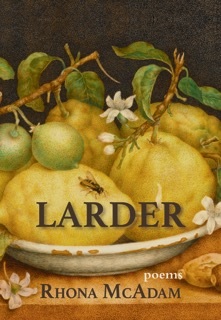
In her latest collection, Rhona McAdam navigates the dark places of human movement through the earth and the exquisite intricacies lingering in backyard gardens and farmlands populated by insects and pollinators, all the while returning to the body, to the tune of staccato beats and the newly discovered symmetries within the human heart.
“…A beautiful, filling collection, Larder is a set of poems to read at the change of the seasons, to appreciate alongside a good meal, and to remind yourself of the beauty in everything, even the things you may not appreciate before opening McAdam’s collection….”
Rhona McAdam is a writer, poet, editor, and Registered Holistic Nutritionist with a Master’s in Food Culture from Italy and a deep-rooted passion for ecology and urban agriculture. Her work spans corporate and technical writing to poetry and creative nonfiction, often exploring the vital links between what we eat and how we live. Based in Victoria, BC, and available via Zoom, Rhona is always open to new writing commissions, readings, or workshops on nutrition and the culinary arts.