-
Nourishing Indiana
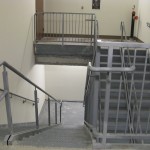 Here in the curious world of the conference hotel, if you can find the stairs, they won’t necessarily take you where you want to go. And they are bleak enough to discourage the faint-hearted. I enjoyed a good fifteen minute cardio workout yesterday, travelling with a well-intentioned Marriott employee who tried in vain to help me find the elusive “up-stairs” to get one floor above.
Never mind, there are plenty of long hallways to cover finding my way from
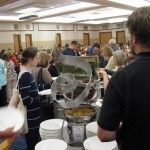 room to meal to conference at the 51st instance of the Weston A Price annual conference in Indianapolis, where we “Focus on Food”. Which is invariably excellent and plentiful at these conferences. Here’s the happy queue at last night’s turkey dinner – birds donated by Fields of Athenry Farm (the farmers and producers are always credited in the menus found in our programs) and replete with several ferments (sauerkraut, fermented cranberry relish, sourdough bread, fermented herbal tea) and grass-fed butter.
Yesterday’s sessions were mostly all-day affairs. I spent most of mine fiercely concentrating on the rapid-fire thoughts and slides of Stephanie Seneff, whose talk covered Pesticides, Antibiotics, Vaccines & Pharmaceuticals at dizzying speed (see her web page to download her slides, as well as find links to her research).
She walked us through research papers a-plenty to illustrate her points. She is a strong advocate of sulfur – it’s one of the least discussed yet most common mineral in the body after calcium and phosphorus and plays a huge role in amino acid development (essential, in short, for protein in the body). The American population tends to be deficient in it (esp. vegetarians and those on low protein diets), and chronic acetaminophen (Tylenol) use further depletes sulfate.
Glyphosate (Roundup) is implicated in many conditions, contrary to studies which claim it to be harmless. For licensing purposes, glyphosate is only tested in isolation, but Roundup contains many other ingredients designed to enhance its effects (up to 1000x); and of course it’s only studied for 90 days, whereas its health effects are cumulative. Seneff had tracked some interesting correlations: glyphosate use tracks closely with autism rates, anemia, sleep disorders, breast cancer rates, kidney disease and more.
Glyphosate has been found in breast milk, urine and water. That it hasn’t been found sooner is probably a product of the few labs willing to test for it.
Seneff explained that the reason glyphosate affects human health is its effect on beneficial gut bacteria, which serve a protective role in the body. Glyphosate blocks the production of tyrosine, tryptophan, and phenylalanine – three essential amino acids formed on the shikimate pathway. This pathway, the argument goes, “is only found in plants and microorganisms, never in humans” – however, it is found in our gut bacteria, which help to synthesize amino acids. Glyphosate also inhibits cytochrome P450 (CYP) enzymes which in humans help to break down toxins.
The best way to avoid glyphosate is to eat certified organic foods, including many sulfur-containing foods (and have epsom salt baths – which allows you to absorb sulfur and magnesium through your skin).
She had a lot to say about statins as well – I strongly recommend anyone taking these have a look at her slides and do their own research. The gist was that they may protect you from heart attacks, but they will cause heart failure – a long and limiting way to go – as well as weakening many other body systems.
I ended yesterday with a talk by naturopath Louisa Williams, who spoke about antibiotic-resistant bacteria. She believes these to be causing many chronic disorders (pain, anxiety, depression, fatigue, movement disorders, memory loss, constipation/diarrhea) and contributing to others (cancer, Crohn’s meningitis, multiple sclerosis, Parkinson’s, Pertussis, Sarcoidosis, Lyme’s…) . The gist is that antibiotic over-use has created resistant bacteria, which then mutate into cell wall defective (CWD) bacteria. These lack the structure that allows antibiotics and our own immune systems to recognize and deal with them.
Diagnosis is difficult. Treatment includes the usual detox protocols (removing environmental and dietary toxins); stop ‘feeding the fire’ by taking antibiotics except for acute conditions (even over-using microbial oils such as oregano will lead to problems); seek constitutional homeopathy remedies; and heal the gut with plant polysaccharides (mannose – though she felt the amounts needed exceeded what could be obtained through diet) and special probiotics.
-
Food and science
 I’ve been grappling with the ins and outs of food for some years now, and my current concerns about how we should be eating for the health of the planet and ourselves have led me into some interesting places.
Recently I’ve been trying to understand who to believe in this “studies have shown” game. I thought Ben Goldacre cracked it for me in his TED talk about publication bias. There is another skeleton in the cupboard of health research though, and that of course is the question of vested interests.
A recent study on high protein diets and aging suggests (well, actually shouts) that high protein diets (especially animal foods) in middle age are dangerous, but as soon as you turn the corner to 65, they are necessary. In the interesting detail found in the paper’s funding, we can see that one of the named authors, Valter D. Longo, has equity interest in L-Nutra, a company that develops “medical food”. This medical food, it should not surprise us to learn, is a plant-based meal substitute, so there is a whiff of “follow the money” in the study’s conclusions. He appears to be the study’s designer (most? of the co-authors are his students)
Zoë Harcombe has analyzed this study and given a thoughtful assessment of its strengths and weaknesses. It’s a headline grabbing concept, she says, but the study doesn’t actually prove its case. She’s going to run the mortality numbers herself and see what they show.
-
Nuts & Seeds
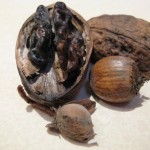
Blighty walnut Already I am falling behind. Weekend before last was a nutty, seedy time, marked by intermittent rainstorms and – for my part – a missing battery from my camera, so the photos are few.
On the Saturday morning, some of the Gorge Tillicum Urban Farmers went out to Bailiwick Farm, where Barbara Brennan led us round her nut tree orchard. We went nose to nose with a herd of alpacas, dodged the hanging fruits of a bumper kiwi crop, and got some honest advice about how not to make one’s fortune from growing nuts, .
Piñons , aside from being slow growing, yield sticky cones that are messy to harvest and whose nuts are difficult to extract and hull. In addition to which, despite advice to the contrary, the juvenile pines did in fact turn out to appeal to the tastes of the resident alpacas, so they were looking a bit nibbled.
Hazelnuts, on the other hand, are easier to grow and harvest. Maybe a bit too easy: the squirrels and crows got Bailiwick’s entire crop this year. The walnuts have done pretty well, and although the crows and squirrels helped themselves, there was still a fair crop left. Unfortunately some of that had been hit by a blight, so the Brennans were going to have to sift through the nuts that they had managed to harvest. And walnuts are not a huge money-spinner either.
The crop that was doing well for them was kiwi, which grows well in our climate, and our amazing growing season this past summer had yielded an excellent crop, still a couple of weeks from harvest. Kiwis store well, too, so can be sold right through the winter.
 On Sunday I went to Fernwood to join in the Seeds of Diversity Canada annual meeting which marked the organization’s 25th anniversary. It’s been an important presence in this crazy world where seeds have been removed from the natural order to become patented commodities, and there was much passion in the voices of members invited to pass their issues on to the board.
I attended a seed saving workshop in the morning, led by the very able Michelle Smith, from of Northwind Farm, Cape Breton. She talked about the value and principles of growing open-pollinated seeds. This practice offers plants a gradual adaptation to local conditions, strengthens the plant lines (since you save only seeds from the best plants) and frees growers from having to purchase hybrid seeds (which don’t grow true if harvested and saved).
Of course it’s not a simple process, since plants can cross (squash and brassicas for example will cross readily within their respective plant families) so there are planting or isolation distances to take into consideration; and you’ll need to know your plant families. Seed savers grow a number of the same plants (minimum population) from which to save seeds in order to preserve genetic diversity. You need to know if your plant is wind, insect or self-pollinating, as that will affect how it reproduces and what conditions you may need for producing seeds. And you’ll need to take season extension into consideration: seeds ripen well after most crops are harvested, so if you’re in a climate where the plants may freeze before you get the seeds, you’ll have to find ways to keep them warm or bring them inside.
The keynote speaker who followed an excellent lunch (ah the season of butternut squash soup…) was the always popular Linda Gilkeson, with a talk on all-season growing. She drew on her science background and peppered the discussion with notes on seed needs – for example, she warns that the number of winter cauliflower varieties has dwindled from over a dozen 20 years ago to only two at present. The story is the same for most vegetables: fewer varieties commercially available.
Most seed companies grow to sell in high volumes, and in reaching a wider market will grow seeds poorly suited to many climactic regions. Less profitable and harder to grow plants will fall by the commercial wayside. So the message to all backyard growers is that the seeds we save really do matter: our small work with local varieties helps to keep them strong and well-adapted, and most importantly, available within our regions.


Latest Posts
- Sublime
- Good weather for reading
- The world, the world
- Sublime launch!
- Planet Earth Poetry – Readings by Volunteers, Victoria 2026
- Poetry at the Goldfinch
Aldeburgh Poetry Festival Barny Haughton BBC BC poets Berkswell blackberries Black Stilt Bologna book launch Borough Market Carlo Petrini Catalonia Cyrus Todiwala dairy Daunt's Books Dijon Edinburgh Fanny Bay Feast of Fields Food and Morality food history food journalism Jenna Butler lardo Malahat Review Michael Pollan Okanagan olive oil tasting olive trees Omnivore's Dilemma Our Food Our Future Oxford Parmigiano-Reggiano Planet Earth Poetry poetry poetry readings Poetry videos prosciutto salumi Sean O'Brien Suffolk ticks Wendy Morton Wired Writing Yvonne Blomer

In her latest collection, Rhona McAdam navigates the dark places of human movement through the earth and the exquisite intricacies lingering in backyard gardens and farmlands populated by insects and pollinators, all the while returning to the body, to the tune of staccato beats and the newly discovered symmetries within the human heart.
“…A beautiful, filling collection, Larder is a set of poems to read at the change of the seasons, to appreciate alongside a good meal, and to remind yourself of the beauty in everything, even the things you may not appreciate before opening McAdam’s collection….”
Rhona McAdam is a writer, poet, editor, and Registered Holistic Nutritionist with a Master’s in Food Culture from Italy and a deep-rooted passion for ecology and urban agriculture. Her work spans corporate and technical writing to poetry and creative nonfiction, often exploring the vital links between what we eat and how we live. Based in Victoria, BC, and available via Zoom, Rhona is always open to new writing commissions, readings, or workshops on nutrition and the culinary arts.
