-
Poets in Paris
 So finally the Iambic Cafe dusts itself off and drags itself to its weary feet, slightly jetlagged but coming round. Sunday’s arrival in London was enlivened by the rather leisurely delivery of my baggage, but after that it was clear sailing and I was greeted by faltering sunshine on the cobblestones.
 Off to Paris on Tuesday, arriving by Eurostar in good time, and then an evening of bilingual readings at the Delaville Cafe, courtesy Ivy Writers Paris, comfortably accommodated and efficiently organized by expat poet Jennifer Stills. It featured Belgian poet Constance Chlore and Parisian Dominique Maurizi, as well as Saskatoon’s own Mari-Lou Rowley, shown here with Christmas tree..
 We passed a relaxing Wednesday afternoon wandering around the 18th arrondissement, mostly towards Montmartre, admiring the food in the windows, prowling its shops and pausing for a leisurely coffee. Hills and steps there are many, but the sun came out from time to time and warmed the way.


Entertainingly, we passed a couple of goats gnawing on a grass fence we’d passed several times – and found we’d discovered a little pocket of urban agriculture, apparently lush in the summer but a bit bare now, with chickens pecking trackside near Porte de Clignancourt.
Our wanderings ended with a delightful dinner at the Bistrot Poulbot. Pour moi, saumon tartare, dorade , and (how could I not) a lovely confection involving lashings of my namesake Valrhona chocolate.
-
Teeth, nails, tongue, skin
Mark Schauss gave a couple of interesting talks. His research into nutrition and cognitive decline was comprehensive and detailed. One of his big messages was on the consistency he sees in research findings about the role of the two most heavily consumed excitotoxins (MSG and aspartame) in plaque development in Alzheimer’s. If you eat processed or packaged foods, both of these are hard to avoid since manufacturers play shell games with the naming. For MSG, see the comprehensive list from Truth In Labeling. For Aspartame, beware NutraSweet of course, as well as its new name, AminoSweet. He repeated an idea I’ve yet to see proven, that artificial sweeteners cause an insulin response similar to ingesting sugars, and lead as surely to insulin resistance and type 2 diabetes. I think there are lots of good reasons to stay away from them, but I await compelling evidence for this one. I do appreciate his main message thought, a plea for more attention paid to the gut microbiome: the more artificial the diet, the worse the gut, and a bad gut means poor communication along the gut-brain axis. Which means poor cognitive function. And, he added, exercise is the best thing you can do to keep the mind active.
-
Kelp, acid-alkaline, omnivorous environmentalism & brain food
 It is possible to leave a nutrition conference freaked out about the state of the world, and in dire need of a good remineralizing kelp treatment. But ditto an environmental (literature) conference or just about any other kind of conference nowadays I suppose. Still, we must make the best of where we are, so a nutrition conference is a good place to take in ideas about both cautions and actions to get our bodies through. (And to get a kelp treatment if that will help you in the meantime.)
Chris Kresser has evoked much hand-wringing and teeth-gnashing in his cogently-argued dissection of the acid-alkaline theory, which has been the foundation of much nutritional training over recent decades. The theory holds that: (1) the foods we eat leave behind an ‘ash’ after they are metabolized, and this ash can be acid or alkaline; (2) we should eat more alkaline foods than acid foods, so that we end up with an overall alkaline load on our body, making us less vulnerable to conditions such as cancer and osteoporosis; and (3) that the pH of our blood can be determined by testing pH strips in our saliva or urine.
It is worth noting that although there is little agreement on which foods are acid and which alkaline (a red flag there?) the alkaline lists tend to heavy on fruits and vegetables, while acid foods include animal products, so the theory is a particular favourite with those who advocate vegetarian or vegan diets. And those would emphatically not be people attending a Weston A. Price conference (poles apart: see the veg view vs the WAPF view).
Kresser allows that foods do metabolize into ash, but dismisses the idea that what we eat affects our blood pH (except in metabolic disorders such as ketoacidosis, aka DKA, not to be confused with ketosis). And although the pH of saliva and urine may indeed be altered by diet, their pH has nothing to do with blood pH, which is regulated by the kidneys. He suggests that health improvements may follow any improvement in diet (and it’s pretty easy to work out what those are – fresh, whole foods vs refined carbs) rather than being caused by acidity or alkalinity of what’s been consumed.
For the full explanation, I recommend reading Kresser’s two-part article on the subject. He was, inevitably, asked why – if it is so obviously flawed – the theory is still taught and promoted, and he replied that it takes time for science to nudge belief into change. And not least when there are vested interests at work. He quoted Upton Sinclair: “It is difficult to get a man to understand something, when his salary depends on his not understanding it.”
Speaking of (former) vegans, Lierre Keith (The Vegetarian Myth) revealed that her talk last weekend was the first she’d done that had not inspired pre-event death threats. She was there to make an impassioned plea for environmental responsibility, a cause that should straddle, but instead divides, vegetarian from omnivore. She described human agriculture as the “death of the living world” – its destruction of ecosystems and soil fertility, the biological corners cut to improve financial returns on large scale production, and the misuse of farmland to grow crops for factory farming or fuel.
When you buy a soyburger, she observed, “you’re actually giving money to the people causing the problem.” In the Weston A Price way, she referred to the health of traditional peoples as proof of the damage we’ve done to modern bodies: how European explorers noticed the good health of the populations they encountered, and how poor health inevitably follows modernization of our diets. “Cancer, like insanity, spreads with civilization” (Stanislas Tanchou)
Mark Schauss gave a couple of interesting talks. His research into nutrition and cognitive decline was comprehensive and detailed. One of his big messages was on the consistency he sees in research findings about the role of the two most heavily consumed excitotoxins (MSG and aspartame) in plaque development in Alzheimer’s. Both of these are hard to avoid if you eat processed or packaged foods, since manufacturers play shell games with the naming. For MSG, see the comprehensive list from Truth In Labeling. For Aspartame, beware NutraSweet of course, as well as its new name, AminoSweet.
He repeated an idea I’ve yet to see proven, that artificial sweeteners cause an insulin response similar to ingesting sugars, and lead as surely to insulin resistance and type 2 diabetes. While I think there are lots of good reasons to stay away from artificial sweeteners, I await compelling evidence for this one.
Few could argue with his main message though: the more artificial the diet, the worse the gut, and a bad gut means poor communication along the gut-brain axis. Which means poor cognitive function. And of course, daily exercise is the first best thing you can do to keep your mind fit and healthy.


Latest Posts
- Sublime
- Good weather for reading
- The world, the world
- Sublime launch!
- Planet Earth Poetry – Readings by Volunteers, Victoria 2026
- Poetry at the Goldfinch
Aldeburgh Poetry Festival Barny Haughton BBC BC poets Berkswell blackberries Black Stilt Bologna book launch Borough Market Carlo Petrini Catalonia Cyrus Todiwala dairy Daunt's Books Dijon Edinburgh Fanny Bay Feast of Fields Food and Morality food history food journalism Jenna Butler lardo Malahat Review Michael Pollan Okanagan olive oil tasting olive trees Omnivore's Dilemma Our Food Our Future Oxford Parmigiano-Reggiano Planet Earth Poetry poetry poetry readings Poetry videos prosciutto salumi Sean O'Brien Suffolk ticks Wendy Morton Wired Writing Yvonne Blomer
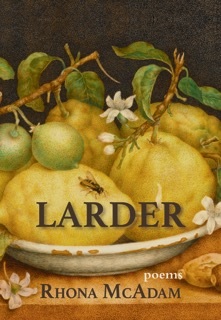
In her latest collection, Rhona McAdam navigates the dark places of human movement through the earth and the exquisite intricacies lingering in backyard gardens and farmlands populated by insects and pollinators, all the while returning to the body, to the tune of staccato beats and the newly discovered symmetries within the human heart.
“…A beautiful, filling collection, Larder is a set of poems to read at the change of the seasons, to appreciate alongside a good meal, and to remind yourself of the beauty in everything, even the things you may not appreciate before opening McAdam’s collection….”
Rhona McAdam is a writer, poet, editor, and Registered Holistic Nutritionist with a Master’s in Food Culture from Italy and a deep-rooted passion for ecology and urban agriculture. Her work spans corporate and technical writing to poetry and creative nonfiction, often exploring the vital links between what we eat and how we live. Based in Victoria, BC, and available via Zoom, Rhona is always open to new writing commissions, readings, or workshops on nutrition and the culinary arts.