Skip to content

writing conferences

More Aldeburgh Poetry

Saturday was a long ‘un. After our workshop (and fish pie) we dashed off to Aldeburgh to attend the conversation with Sharon Olds. Michael Laskey presided, in place of Philip Levine who’d had to cancel, and did an admirable job of getting some background from a poet who’s been reviled and revered in equal measure, it seems.

Laskey asked her about some of the “strongly felt and strongly put” criticism that must have made her career deeply uncomfortable at times, from, as she said, “critics who were at pains to tell me why what I did was not poetry.” Although she’d been writing for many years, she’d taken a long time to publish her poems, which she’d really never thought anyone but she would see (her first collection came out when she was 37). She’d tried to learn to cope with the hardest criticism: over time she was able to drop one phase of her response to it – the four parts of which were to burst into tears, throw up, fly into a rage, and finally fall asleep. At one point she actually made a chart listing her poems, with the negative adjectives attributed to each, and tried to learn from this what emotions certain themes were raising in her critics. It’s hard to imagine anyone surviving the kind of battering she’s had on the public stage; how much does prescriptive criticism really help? Give me instead the school of thought that says if you don’t like it, don’t read it — and move on.

In terms of process, she said she’d historically always written very quickly and often in single drafts with little or no changes, a process of gathering, and at a certain point “the gates open and the poem comes out.” She says she revises more nowadays, and her editing rule is to write the draft and then “remove half the adjectives and a third of the self pity, so the poem doesn’t have to carry so many rocks in its pockets.” She remarked on the danger of place-holders: words she’d stuck in her lines while she tried to think of something better, which to her surprise began to resonate with the music and sense of the poem so that it would become difficult to get rid of them later. She spoke of the importance of the “objective correlative” – an object that correlates to some emotion in the poem – without which the poem might blather on, self-absorbed, talking about itself too much instead, let’s say, of the tiny pair of scissors.

Her aims in the bigger world of poetry are to increase poetry’s reach and to help it to join with the wider communities in which we live. She said she’d been inspired by Jean Kennedy Smith’s founding of Very Special Arts in the 1970s, and that her dream – attempted when she was Poet Laureate of New York State – had been to try to encourage every writing MFA program to reach out to jails, mental institutions, hospitals, special schools, hospices and introduce writing programs in these. She feels it is a profound way to extend the usefulness and place of poetry into a larger world, and create a community for poetry – as well as a means of providing teaching experience to writing program graduates.

Next on the bill was the Master Class Poetry Workshop, led by Vicki Feaver with Michael Laskey co-hosting. Following a time-tested format, the Aldeburgh master classes present poems selected from the work of experienced but not necessarily widely published poets which are discussed first by the workshop leader, then the other participants, and finally by members of the audience, before the poet may – if wished – say a few words in response. The participating poets were Julia Bird, Administrator of the Poetry School, up and comer Valeria Melchioretto, and Sam Riviere – whose nicely turned poem “The Kiss” seemed the most technically interesting, being written in paired statements, employing some of the constraints of the palindrome:

the more she thought
she’d keep it to herself – he’d never know
exactly how it happened (she didn’t know)
and he’d see replays of her face
opening and reaching towards his face

.. and so on. Useful quote du jour from Vicki Feaver: “One test of a good poem is to ask if it’s about more than one thing.”

Finally we moved into our third and final event of the day, once again balancing on the brink of perishing hunger and fatigue, and by now more than well burdened by books. We were all delighted by the Scottish poet Alastair Reid, unknown to all of our group but historically much published and apparently all out of print – a situation the festival organisers had deftly dealt with by publishing a fine little chapbook that many of us snapped up. He was a delightful reader and a name to look out for. He was followed by a distinguished Spaniard, Joan Margarit, whose passionate recitations in Catalan were interlaced with softer renderings of the English translations by Anna Crowe; best bits were his daring to read two translations himself, expressive and entirely well spoken. Final reader up was Sharon Olds, who read mostly new work, including poems of humour and wry digs at her critics, in her usual gracious manner and clear, simple style.

Enough food for the mind: off we went to our long awaited meal at 152, where 10 of us shared a groaning board. Pot-roasted pheasant for me, with braised red cabbage (with fennel? anise? some unusual and not unsuccessful seasoning) and a glass or two of tempranillo, followed by my dish of the day: coffee creme brulee. A perfect ending.

Aldeburgh Poetry

Another day, another meal. We had a gorgeous fish pie for lunch today, mid-poetry workshop. Tammy attributes the recipe to Clodagh who pinched it from Sophie Grigson. The world’s simplest fish pie, but success entirely depends on using absolutely fresh fish. (A doctor/scientist I met on the bus in London a couple of days ago adds that it must be a Sea Fish, for the iodine, which you need for a healthy thyroid.) Take your fresh fish and lay it in a buttered baking dish; mix up dry bread crumbs, lots of fresh parsley, some chopped garlic, salt and pepper and sprinkle it over the fish. Drizzle with melted butter. Squeeze lemon juice over all and bake at 220c for about 20 minutes until the fish is just done and topping is golden.

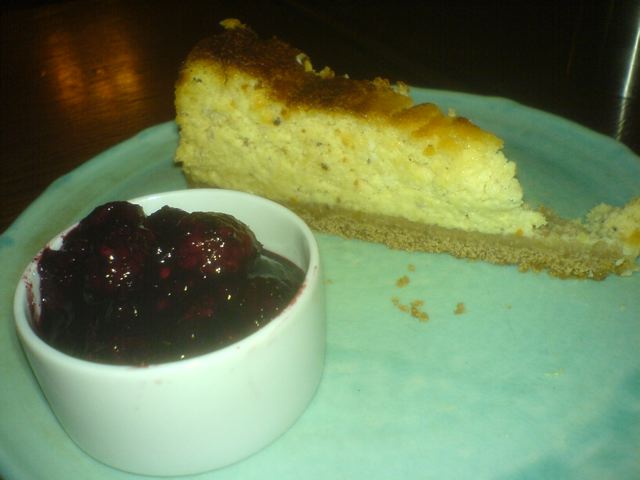
A slice of fondly remembered Suffolk Gold Cheese.

We had an entirely local meal in fact. Fish from the last hut on the left, on the seaside in Aldeburgh; local greens (rocket, Belgian endive, radicchio); local new potatoes. We finished with the cheese which was heavenly, particularly the St. Andre/vignotte, which is a lot like eating butter (it’s triple cream, but who’s counting).

Last night’s start to the poetry festival included a free session, an excellent idea that didn’t quite work. Various festival guests are invited to present 15 minute “Close readings” of poems. Last night’s was Sharon Olds, presenting “Those Winter Sundays” by Robert Hayden. The reading wasn’t quite close enough for my taste, although I like the poem, but I think it’s a hard one not to like. We then went on to Jubilee Hall to hear three readers: Nick Laird, who’d won last year’s Jerwood Aldeburgh Prize (part of which is a featured reading at the following year’s Aldeburgh); John Powell Ward and Jenny Joseph, who was not wearing or reading anything purple. She did read a six minute poem towards the end of her set, which we debated later: is it better not to warn the audience that you’re going to do this? I didn’t mind the warning (sorry) but did mind that she chose this one to read next to last, when we were perishing from frozen bums and looking forward to a late supper. We didn’t get out till just before 10pm.


We had been forewarned that last orders at our restaurant were at 10pm, so we had to sprint down dark streets to secure our plates at The Lighthouse. Ah, succulent Irish oysters with shallot vinegar; an excellent taramasalata; some gorgeous looking calves’ liver with bacon; a crisp dirigible of halibut on home-cut chips; hot scallop salad; roasted cod – it all paraded by, and some of it even stopped at our table. The rioja was perfect. A nibble of Mike’s walnut tart with butterscotch ice cream was enough to prove the excellence of the sweets. We’d earlier witnessed – but passed on – some brutally beautiful desserts in Orford: hot lemon cake with spooning cream; pineapple ice cream served frozen in a wedge of pineapple.

WOTS happening

Spent last weekend across the water in Vancouver, a long way to go for a nine minute reading, but we do what we can to help the cause. Anyway I was lucky to be first and actually get my nine (and I did count ’em) minutes; as too often happens with multiple-reader events, those at the end of the program got squeezed for time. I was appearing with the Poets In Transit gang at the Word on the Street, and what a spectacular day we had for it. I read with Jen Currin, Marya Fiamengo, Kevin Roberts, Gena Thompson and finally Elise Partridge – who graciously but very sadly for us only read two poems. A wonderful thing this PIT program, and, we learned really only in existence thanks to the hard work of poet and anthologist Sandy Shreve, who introduced the event.


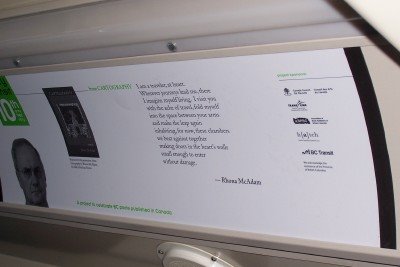
My poem as it will appear on better buses near (some of) you. Don’t know who is mr grumpy on the left or what he has to do with it all.


Packing them in at the Poet’s (sic) Corner (Lynne Truss, where are you?)


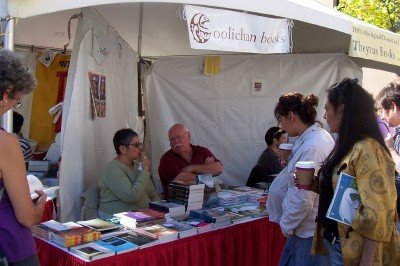
The Oolichaners (Hiro Boga and Ron Smith) brace themselves as another mob of book buyers approaches. I pushed my way to the front of the crowd and came away with a gorgeous new cookbook, Just Chicken: 100 Easy Recipes from India by Sharda Pargal.


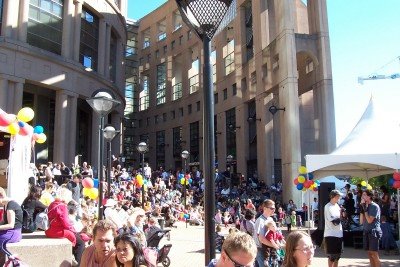
Lots and lots at WOTS. Cool library building, huh?


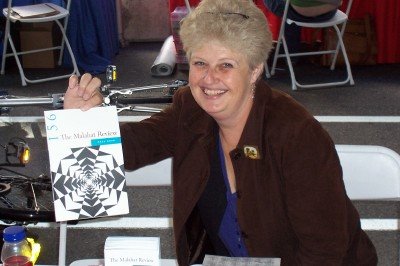
Rhonda Batchelor holding the latest – hot, hot, hot! – issue of Malahat Review.


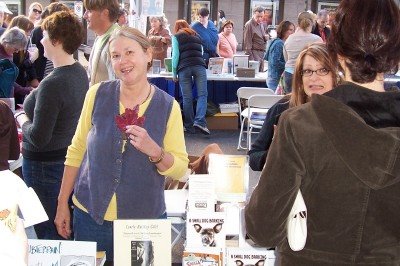
A stylish Heidi Greco stars at the sub-Terrain stand with some local autumn foliage. Next door neighbour Anvil Press had wonderful news about the shockingly good novel Stolen, by Annette Lapointe: she has just been nominated for a Giller Prize.

Ottawent

So, party’s over, and I’m back at the trail’s end/beginning.

League of Poets AGM ended after two more days of meetings and readings and meetings and readings. By the end of Saturday’s banquet I could not have eaten another bite or heard another word.

We had a keynote address on Saturday night by longtime member (indeed present at the founding meeting of the League) Margaret Atwood. She was in droll mood and after a charming and carefully bilingual introduction by Pauline Michel, she launched into a quip-packed 40th anniversary address, on the subject of Why Poetry? (Her lecture will, they tell us, be printed in full in a future issue of Prairie Fire.)

She said she’d joined the League back “when poetry was top dog,” when, like her, many of today’s Canadian novelists were beginning their careers — as poets. Recounting a couple of sweetly sordid anecdotes, she remarked that back then the poets – mostly male – were living in the afterglow of Dylan Thomas and John Berryman, and self-destructive acts were part of the job description. She felt that these days she’d send aspiring poets to plumbing school: there’s always a demand for your services; it’s easier to think about poetry when doing something with your hands; and it’s nice and dark under the sink.

So then she got to her question. Though we no longer think we can conjure rain, or even mildew, or have our heads chopped off for writing poetry, we are in a tamer age than when words were more potent. Why then do we do this poetry thing, whether written or oral, or is it built in?

Instead of providing answers, she offered what she called some potentially interesting sidelights.
1. Reading, writing and speaking are all located in different parts of the brain.
2. If the speaking part of your brain is knocked out, the singing part may still remain.
3. Words have their own address book in our brain: we recognise that John Smith is a different thing from a carrot. Poetry can serve as an aide-memoire (to prove her point, she had us filling in the blanks of Alligator pie; Alligator pie )
4. Music, poetry and mathematics are more closely related than poetry and prose. There’s a system of pattern recognition at work that’s connected to music and math – and of course she was speaking here of rhymed and metered verse rather than “that which resembles prose”.
5. Fire and grammar are what distinguish humans from other life forms. Only humans cook their food, and having reduced the time we would have spent digesting unprocessed food, we have thus liberated up to five hours per day for other pursuits. And though animals may communicate through noise, they lack grammar. The dog can and does think in past and future tense, but no dog is likely to question where the first dog came from, and where do dogs go when they die.

Oral cultures, she went on, swam in a sea of language; but now we live on comparatively dry shores, extruding our brains into other technologies, and so that part of our brain has probably shrunk. Technology and numbers are said to represent ‘the real world’ – as opposed to the obsolete world that poets occupy. But we make what we long for, and destroy what we fear, as we have always done; these things have not changed, and we know this because we have poetry. Human imagination drives the world: it directs what we do without our tools, and poetry is part of the way we sing our being.

There followed the banquet (some very good grilled chicken or cedar-planked salmon) and awards ceremony. I was thrilled that Suzanne Buffam won the Gerald Lampert Award for her wonderful book Past Imperfect. She read the lovely poem Please Take Back the Sparrows.

The winner of the Pat Lowther Award was Sylvia Legris, for Nerve Squall, reviewed with considerable venom in the Globe and Mail earlier that day. A tragic waste of newspaper space for the single review of poetry on offer, and a badly ill-judged match of reviewer to subject, as the reviewer himself admits: “Those who enjoy linguistic foreplay, and the pinball wizardry of caroming words, will favour this book. Those like me will find that it all adds up to narcissistic inconsequence.” Well, it’s not my cup of tea either, but if it was good enough to engage the not inconsiderable intellects of the juries of both the Griffin and the Lowther awards, and prove itself the stand-out over hundreds of other collections, it can’t be as bad as all that. It would have been far more useful to hear from a critic able to explain just what that power was, in the context of all its competitors. Surely the Globe could have scraped the barrel a bit harder and found a reviewer who could deal with the book in its own terms?

A more interesting article in the Globe and Mail about the origins of ABE, the online treasure trove for book lovers.

League Day One

Day one of the League of Canadian Poets AGM (and 40th anniversary celebration) was meet ‘n greet — lots of people I haven’t seen since my first League AGM in 1993, and some I have met along the way. We had an open mic (asking for trouble, I read the Rhonda Poem, but it didn’t – as I feared – initiate a rash of “d” word mishaps) which rattled along despite the looong list of participants. It was a great way to introduce ourselves to our fellow bards. After lunch there were a couple of afternoon workshops.

I went to the poet laureate panel, which featured Pauline Michel (Poet Laureate of Canada), Louise Halfe/Sky Dancer (PL of Saskatchewan), Lorri Neilsen Glenn (PL of Halifax) and Alice Major (PL of Edmonton) plus Cyril Dabydeen who had been the second (and second last) PL of Ottawa. They spoke about their various duties and the many surprises that awaited them when they took up their laureates.

Michel spoke at length, in beautifully written English, and occasionally burst into song, about what and why she does what she does. For her the job of the poet (“we are all poet laureates”) is to promote writing as a means of artistic expression: “what is not expressed either implodes or explodes” she said; “but where do the arts firt into a culture where a good living is more imnportant than a good life?” She had managed to get funding for an assistant to schedule her events, a role that was fulfilled during the term of the first PL – George Bowering – by his wife; the requests come thick and fast and Michel said she thought three years should be the minimum length of the term to allow enough time to see through her various projects and duties.

Louise Halfe spoke first in Cree, and sang in her language as well. She assumed the Saskatchewan mantle from the province’s first PL, Glen Sorestad, and has relished her ability to reach audiences and communities that she is uniquely able to connect with. A former social worker and addictions counsellor, she says she no longer practices but has incorporated her work into her art. She remarked that once again she was the “lone Indian in the room” and that she is expected to represent all the Indians of Canada, regardless of the fact there are many nations.

Lorri Neilsen Glenn, the second PL in Hlaifax, is a year into her four year term. She has a Cree grandmother and Quebecois grandfather and has lived in Halifax for 22 years, “which of course makes me a newcomer” she said. Her appointment coincided with a cut to the municipal arts board, which was shortly followed by the resignation of the cultural officer, so she has struggled without a helping hand to coordinate her duties and help her obtain funding for events. Like the others on the panel she observed the role could easily be full time if she allowed it – though the $1200 stipend would make that tricky. She hopes to help prove that “there is more to Nova Scotia than lobster traps and people who say ‘buddy’ and ‘arse’.”

Alice Major, the first PL in Edmonton, spoke about the politics of her role. She said on her first (of potentially three) command commissions she was asked to write something for a gathering which included the premier. “What,” she asked, “can one say to Ralph Klein?” But because she was there by invitation by the supportive city council who had worked so hard to create the role she was occupying, she put her politics in her pocket and wrote something suitable to the occasion. “Nice,” said Ralph as she walked back to her seat. Her second commission she titled “The hockey poem I thought I’d never write” – a work dressed to impress her audience, it was printed in the Edmonton Journal the following day and then hit the national papers the day after. “All these volumes of verse I have written, which no more than 500 people will ever see” she mused, “and the poem that makes the national papers is the hockey poem.”

The second and last workshop I went to was about poetry in health and mental health institutions. Shirley Serviss kicked things off by describing her work at the University of Alberta Hospital in Edmonton. Working 15 hours a week at this, she is part of a group of professional artists – poets, visual artists and musicians – who are based there, together with volunteers (including poet Ted Blodgett who comes by to play the lute for patients). She described some of her efforts which take the form of anything from transcribing poems to the white boards that seemingly cover every wall, to dispensing poems to doctors, nurses and patients, to bedside work encouraging patients to talk about their lives so she can write them poems, or helping them to shape the words themselves. When she undertook an MA in Theological Studies she had thought she wanted to do a hospital chaplaincy but she prefers this work, which she has had incredibly positive feedback on from family and patients alike. She thinks it fills a gap in patient care as well. “They can turn chaplains or counsellors away,” she said, “but we disarm them: all I’m doing, after all, is giving them a thought for the day.”

Ronna Bloom is a psychotherapist who has given many workshops to health practitioners. She described one of her popular ones on overcoming personal blocks, which works well on people even if they are not writers. She is careful to explain to participants that the exercise will not solve anything, but it might give them extra information about what is blocking them in their lives or work. She pointed out that blocks are there for a reason, and it’s important to remember we might love the places we’re stuck, so her workshops are not about simply kicking them away. She says she knows the things that won’t work, and these include guilt, denial, willpower, or moving house or countries. Her workshop aims to help participants get a good clear look at their block by making it larger. She alluded to a principle of martial arts which suggests that you cannot overcome an opponent by fighting them; but if you join the opponent, you can use that energy to defeat them. And so her workshop starts by allowing participants to describe what they love and hate about the block. They write about what they really want. Ronna then reads them a poem of hers which is a blessing, and asked to write one that blesses some aspect of themselves.

Ron Charach is a psychiatrist who also writes poetry. His poetry column in the Medical Post elicited enough poetry to engender an anthology by Canadian medical practitioners, and he’s had poems in such oblique markets as The Lancet. He discussed research that had been done into connections between poets and mental illness, and ended by giving us a handy prescription to assure mental soundness to allow us to carry on writing.

  • Get enough sleep and natural light;
  • avoid substance/alcohol abuse;
  • keep some structure in your life;
  • pace those overwhelming projects;
  • maintain your relationships;
  • take all threats of suicide seriously;
  • don’t hesitate to get professional help.

Ottawhere

I left West Sussex yesterday, on a scorching cloudless morning and landed in Ottawa drizzle, with temperatures on the monitor dropping from 19 to 14 in the time it took to taxi toward the terminal. This trip has been a see-saw ride from hot to cold and back again. I am staying in a b&b; in the heart of Ottawa, and from the conveniently supplied pc in the lobby I can gaze between the high-rises up at the leaden skies and count the intermittent umbrellas before making my move up the road toward the National Library.

I dined Wednesday night in the Swan Inn in Fittleworth, described a bit snootily on a Real Ale website as an “Impressive 14th-century coaching inn with pretensions as a quality hotel.” Well be that way then. I thought it was charming in appearance, whatever its pretensions, with oil paintings set in panels all the way around the dining room, each with a tiny name plaque underneath. Given the number of similar views it on display looked like a long ago group of local painters might have contributed works. The art, sadly, was better than the service, and the roast Sea Bass better than the sea trout fillets, and the creme brulee far superior to the bread and butter pudding, but I had a wonderful meal with my beloved aunt and cousin and a charming gentleman to round out the numbers.

Said gentleman had just turned 88 and was a long retired Desert Rat with many travels to many places since those days. He and my aunt and cousin were all on the same cruise a year ago, steaming toward St Petersburg on a Swan Hellenic discovery tour of the Baltic, but they said the operators are sadly headed for merger with P&O; later this year. Their charm apparently is the small size of the ships and the excellence of the lecturers. Gentleman mentioned the Hebridean Princess as a good alternative, but my aunt said they are spectacularly expensive. Very plush too from the looks of it. One day my cruise will come…

The day before, dear cousin and I had driven down from London after a hearty lunch at the Gourmet Burger Kitchen in Chiswick, where you can get a mountainous Aberdeen-Angus beef burger (with tomatoes, red onion, tomato relish and garlic mayo) guaranteed to give you a good mandibular work-out and leave you well fed and covered in burger goo. I am surprised they haven’t thought to hand out hot towels…

I flew across the ocean yesterday afternoon on Zoom, another budget airline with Canadian roots. It was quite pleasant and the crew were helpful and kindly. We managed three movies in a six and a half hour flight: some nail biting Harrison Ford film, followed by the Steve Martin Pink Panther, followed by the new King Kong, whose vertiginous finale was a bit of a questionable idea coming as it did just before we began our descent into Ottawa airport. Such was the scale of amusement on offer that disappointingly my seatmate did not manage to get to her Hello magazine with its full and exclusive coverage of Angelina and Brad’s new arrival, so I landed unenlightened on that score, but it was still a pretty reasonable flight back to Canada.

Poetry doings this morning and more news from the front to follow, and so to all a good day.