-
Crete part 1: snail tales from central Crete
Read Full Post: Crete part 1: snail tales from central Crete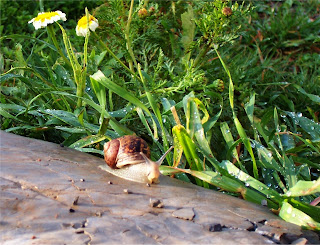
We’ve just returned from a fantastic week on Crete, which I’ll attempt to document by day, with a very selective sampling from the 700+ photos I returned with; best I can do since I can’t share the feeling of being there.We were hosted by the excellent and encyclopedic Kostas Bouyouris, agronomist and co-founder of the Mediterranean Association for Soil Health, who led us through Cretan food products in an enlightening and hands-on week of visits.
Our first stop was at the village of Kroussonas, where a group of women got together to start a baking cooperative; they now have a kitchen, shop and catering business. Seventeen of them get together to make traditional Cretan pastries and other baked goods, including one of our favourites: fried (in olive oil of course) pastries filled with wild greens.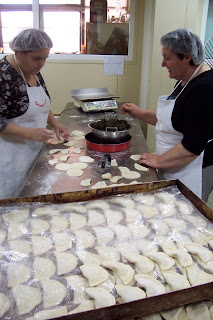
Also beautiful, beautiful hand-decorated breads for weddings and other celebrations: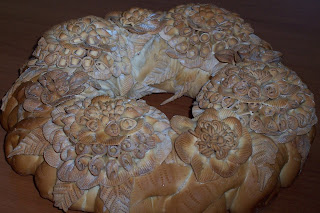
There was a pause when a pickup truck laden with vegetables pulled up, and we waited for some of the bakers to do their produce shopping, Cretan style. I thought this was so clever: have one guy in a truck come to the village, instead of everyone in the village driving to the shops.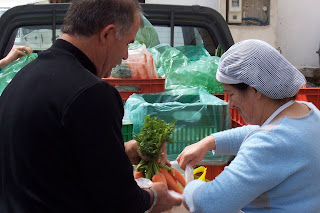
We pressed on through staggering landscapes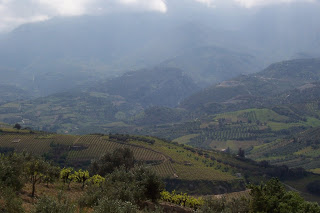
to Gangales, in the south of Crete, to visit the Melko pasta factory where we were particularly interested to watch them make xinohondros, a traditional “pasta” made of cracked wheat, mixed with acidified fresh sheep and goat milk, cut by hand, shaped into portions and dried. It’s cooked with oil, tomato, potato, onion and celery and often with snails, and as it’s a kind of fortified pasta-cum-thickener, is one of the foods served during periods of religious fasting.
We had a tart and nourishing soup made from this pasta for supper, followed by many other traditional dishes including a platter of boiled goat.
Day two began as had day one, with luscious bowls of fresh yogurt, honey, bread, sesame halwa and strong coffee. We trooped upstairs to have a talk from another inspiring Cretan agronomist, Sotites Bampagiouris, who talked us through the enterprise known as Bio Forum, a ten-year-old economically viable organic farming enterprise.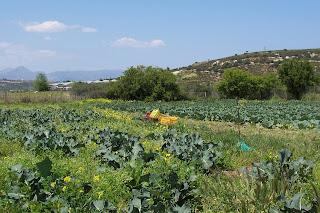
A marvel of thrift and economy, Bio Forum creates composting heaps made of olive leaves (by-product of the olive harvest), and straw bales from mushroom cultivation, among other organic matter. They don’t use manure for these since the compost is used on vegetables and would therefore come into direct and possibly dangerous contact with food; manure can be used for composting fruit trees.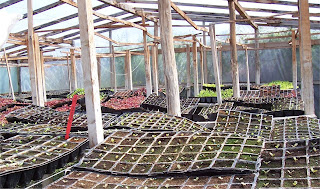
Seeds are nurtured in greenhouses and then transplanted when they are big enough to stand up against the weeds and insects.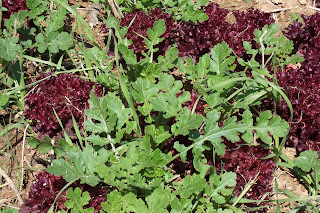
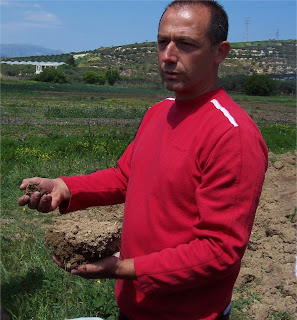
Weeds are not automatically seen as enemies in this field: they act as wind screens, provide a refuge for insects that would otherwise head for more edible homes, help to create an anchor for topsoil through their root systems, and act as natural compost when the soil is turned after harvest. These greens were plump, spicy and delicious; members of the mustard family are particularly useful in areas where soil is compacted as their roots help to break it up, and provide salad greens while they’re at it.After an organic fruit break at the farm, we zipped off to the Boutari winery, Fantaxometocho (“domain of the phantoms”), for a tour and lunch. The Cretan operation is only three years old, although the mainland company has been going since 1879. On Crete, the vinyards are totally organic, and, even more shocking to me, the vines are grown without irrigation. They say this makes for a lower yield, but a better wine since the plants produce healthier, sweeter grapes with more concentrated aromas; irrigation plumps the grapes up but also waters down the contents. Their late harvested grapes produce a delectable sweet wine which we were lucky enough to sample at lunch.
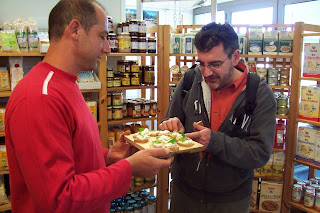
On the way to our new base in the Amari valley, we stopped for a retail moment in one of the Bio Forum outlets in Iraklion; Don samples a little cheese with basil.
Supper at Aravanes taverna where we began with a salad of lettuce and wild greens, fresh cheese, olives, bread… and went on to have tart rice, lentil stew and more boiled goat.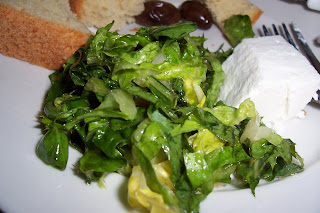
We finished with baklava we had brought from a pastry shop which we were to return to the next day for a cooking demo. More than ready for bed we crashed….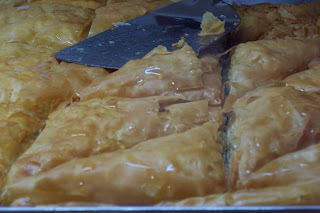
-
Bologna, Mantova, Parma
Read Full Post: Bologna, Mantova, Parma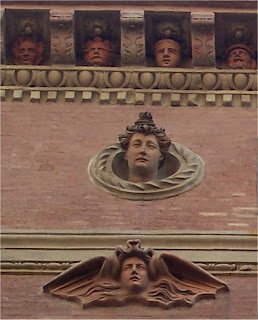
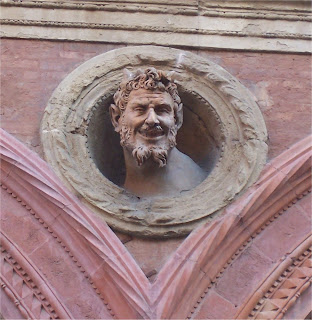
A few more pictures from Bologna, where the walls have faces…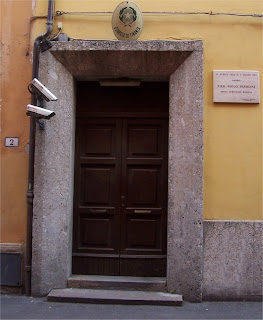
Bologna birthplace of murdered poet and film-maker Pier Paolo Pasolini.On Thursday I thought I should make a little extra effort to get to Mantova/Mantua, which I’d wanted to see for a while. I seem to have managed to time my visit with that of every school aged teen in Northern Italy; the place was thronged, mobbed and ringing with the particular, unrestrained, and unmissable presence of the massed Italian adolescent. A sound that is even more penetrating, I was to discover, when situated inside a palace or town square. Yeesh. Worst of all, whether or not it was down to their presence, I found that the Ducal Palace’s Camera degli Sposi was closed for the day, except to those with reserved tickets. Bummer and a half. I bought the postcard but somehow it was not the same.
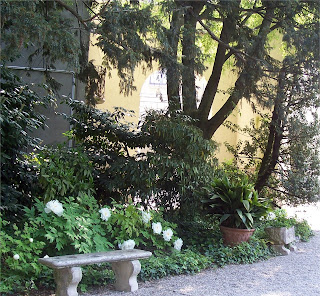
I did wander around the pretty garden of the Palazzo d’Arco, and because you cannot go through the rooms alone I had an odd and silently escorted tour of my own. I liked the kitchen, whose walls were covered in pots and pudding molds, and was grateful not to have to think about polishing a collection of that size.
Pizza Primavera, in Mantova: rocket and tomatoes.

Mantova, lots of water.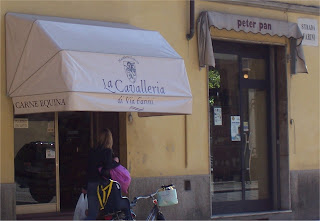
The other day in Parma. A lot of horse meat on sale here.. what would Peter Pan say?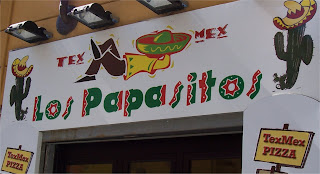
And what about these guys: before I found them, they went out of business. Parma not ready for Tex Mex pizza? -
Easter break
Read Full Post: Easter breakWell it’s nearly over, our two weeks of blissed out sunshiny whateveritwaswedid. Most of my classmates took off for foreign shores: Copenhagen, New York, Istanbul, Montreal, Seoul… I stayed in Parma, mostly, just to be different. And just to have a look round the galleries and museums and churches which I haven’t done, waiting as I’ve been for a visitor to do it with. And I finally had one and here are some of the things we did:
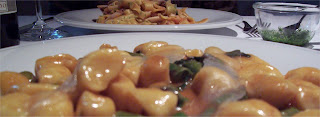
Visited Osteria del Gesso, one of the local thumbs-up dineries. I had a very good meal there, but an even better one a night or two later at Ristorante Mosaika, a little placed I’d walked by a few times and had been wanting to try. We both had selected menus (I had the meat, Meli had the fish) and they were, in our favourite word, celestiale. They started us off gently with some deliriously fresh and beautiful balsamico-drizzled buffalo mozzarella, and delicate rounds of crostini with fresh green pesto; moved us smoothly on into starters (a wonderful rabbit terrine, and a salt cod puree whose salad came with a stunning soy-wasabi dressing) and pasta (gorgeous gnocchi draped with lardo, and a delightful tagliatelle freckled with fresh green herbs and strewn with shellfish)
and mains (tender white sea bass with clams and olives, and for me, meltingly pink lamb);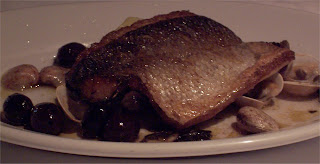
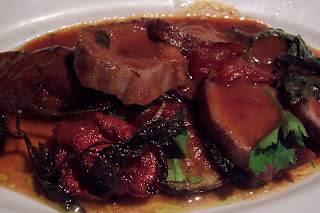
polished us off with warm, soft chocolate cake…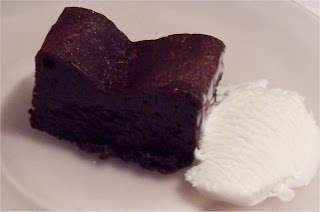
and for me a nest of perfectly ripe strawberries tossed in citrus and served with gelato.To work all that off, we went nutria-spotting, checked out some puppets, popped our heads into the Baptistry, the Duomo, and every other church we came upon, except the desanctified ones (which were several); had walks in the Parco Ducale and Parco della Cittadella, sampled gelato from Grom and K2, had a drink in Web ‘n Wine, saw the Aga Khan masterpieces exhibition and peeped round the corner into the Teatro Farnese.
Then a day in Bologna, where we saw the Museo Civico Medievale and the Museo Morandi, the Chiesa San Stefano, the Basilica di San Petronio, and still had time to stumble upon an excellent pizzeria and have a sampling of gelato (from Gelateria Gianni, branches which seemed to materialise at every turning). We expired on a sofa somewhere and had a drink and a few olives before returning to Parma. Where we planned our assault on Milan the following day.
Of course we visited first the Duomo, and then wandered about looking for lunch, which we found at Bellavista Cafe – the food was excellent – the seafood plate disappeared a little too quickly to capture;
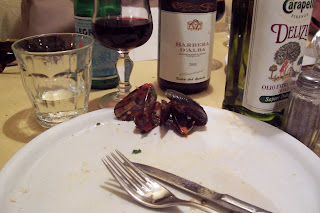
the pizzas looked amazing as they went by; the apple cake was delightful.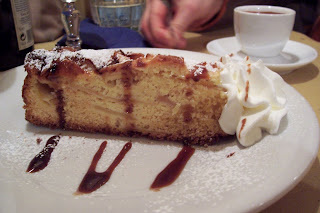
We then ambled through the Castello Svorzesco for most of the afternoon and never really got to the end of it. Meli had an hour to sprint round the Pinacoteca di Brera while I rested my feet and sipped a spremuta d’arancia.And then Meli took to the skies from our very own Aeroporto G. Verdi, where the approach roundabout must have the best topiary ever:


Latest Posts
- Writers at Word!
- Sublime and Twisted Readings coming up!
- Sublime
- Good weather for reading
- The world, the world
- Sublime launch!
Aldeburgh Poetry Festival Barny Haughton BBC BC poets Berkswell blackberries Black Stilt Bologna book launch Borough Market Carlo Petrini Catalonia Cyrus Todiwala dairy Daunt's Books Dijon Edinburgh Fanny Bay Feast of Fields Food and Morality food history food journalism Jenna Butler lardo Malahat Review Michael Pollan Okanagan olive oil tasting olive trees Omnivore's Dilemma Our Food Our Future Oxford Parmigiano-Reggiano Planet Earth Poetry poetry poetry readings Poetry videos prosciutto salumi Sean O'Brien Suffolk ticks Wendy Morton Wired Writing Yvonne Blomer

In her latest collection, Rhona McAdam navigates the dark places of human movement through the earth and the exquisite intricacies lingering in backyard gardens and farmlands populated by insects and pollinators, all the while returning to the body, to the tune of staccato beats and the newly discovered symmetries within the human heart.
“…A beautiful, filling collection, Larder is a set of poems to read at the change of the seasons, to appreciate alongside a good meal, and to remind yourself of the beauty in everything, even the things you may not appreciate before opening McAdam’s collection….”
Rhona McAdam is a writer, poet, editor, and Registered Holistic Nutritionist with a Master’s in Food Culture from Italy and a deep-rooted passion for ecology and urban agriculture. Her work spans corporate and technical writing to poetry and creative nonfiction, often exploring the vital links between what we eat and how we live. Based in Victoria, BC, and available via Zoom, Rhona is always open to new writing commissions, readings, or workshops on nutrition and the culinary arts.
