-
GM day – hello US GM beet ban – goodbye organic corn?
Read Full Post: GM day – hello US GM beet ban – goodbye organic corn?Excellent news this morning about sugar beets south of the border: a federal court ruling that the US government illegally approved genetically modified sugar beets, on the grounds that they cross-pollinate easily, making it impossible for those who wish to grow non-GM beets to continue doing so.
Which begs the question about the approval of SmartStax GM corn: one might question the approval of a wind-pollinated member of the grass family in countries where the only GM labelling permitted is that of its negative: certified organic food cannot contain genetically modified ingredients.
Monsanto/Dow Chemical’s SmartStax GM corn was approved in the US and Canada in what I hope is record speed (I would hate to think this is the turnaround for all product approvals).
It took the EPA and the CFIA about a month to approve the stuff, from the time Monsanto submitted its documents on June 16 until the official registration July 20, which rather suggests they didn’t bother overmuch with doing their own messy safety checks or independent evaluation of environmental risks, preferring to accept Monsanto’s research. Is such haste normal? If it’s not, it appears to mark some new dodge on Monsanto’s part, that they have figured out how to outmaneuvre those pesky regulations.
Approval in Canada was announced the same day as in the US; I’m told it’s normally just a matter of rubber-stamping such products once they’ve been approved in the US. Canada certainly hasn’t demonstrated much interest in reining in the environmental or health risks of GM in the past: look at the trade pickle we ended up in recently with contaminated flax seed. Health Canada has a lovely flow chart that shows the steps required, officially, to assure our safety, but it’s hard to match all these steps to the approval of SmartStax. Here’s a full list of the GM products we already have on our tables here. So far, SmartStax doesn’t appear on the list.
Whether our legislators will attend to US court rulings, or somehow maintain that our winds don’t blow the same as theirs is another question. As is whether Canada will respect the very similar US court judgement that ruled GM alfalfa posed undue risks of cross-pollination to farmers who didn’t want to grow it, resulting in a nationwide ban in the States.
Meantime, GM sugar beets have been planted in Canada for the first time this year; your sugarbowl will certainly contain some GM sugar if you buy Rogers sugar. Vote with your dollars, folks.
-
Haliburton Work Party and Feast of Fields
Read Full Post: Haliburton Work Party and Feast of FieldsSaturday’s work party at Haliburton went surprisingly well: although rain had been forecast, it happily and courteously fell overnight, leaving a fresh-washed farm shining in the sun for a team of workers that included a group of school kids. Our main task of the day was harvesting the chickpeas, which farmer Rod then threshed with his handy Italian tractor
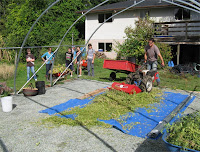
and then “all” we had to do was sort the beans.
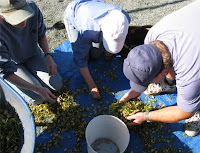
When you’re counting chickpeas, a day’s work doesn’t look like much. But that’s why organic costs more… We all had time to agree at some length we would never look at a tin of chickpeas the same way.
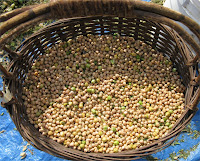
After all that sorting
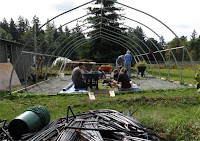
you are ready to sit down and have some lunch.
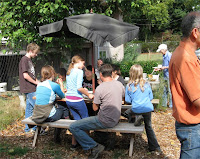
Naomi had made some excellent soup for us; I contributed a bit of fattoush,
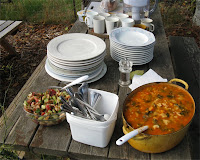
and following this we had many, many cakes: chocolate, chocolate zucchini, plum and grape. Then, after Laura showed us what the Salt Spring zucchini are wearing this season
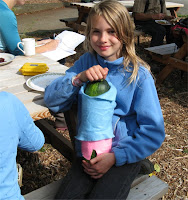
it was back to work.

A tour of the fields showed the kidney beans and black soya ready to harvest

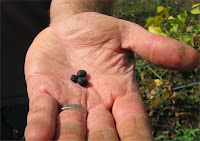
pumpkin ripening in the fields
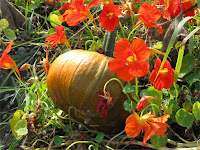
and lemon cucumber and purple tomatillo ready for harvest.


Sunday was another beautiful day, perfect for the Feast of Fields, held this year at Providence Farm, a most gorgeous and appropriate setting. Before things got rolling, I had time to do a short inspection of the llama (or is it an alpaca?) enjoying a leisurely tree break and other farm animals.


A few of the sights:
Saanich Organics, with plenty of excellent local fruit and veg to taste
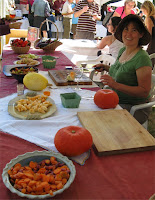
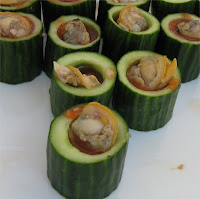
Oak Bay Marina‘s seafood shooters, topped with a clam:
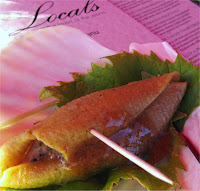
Locals, a treat from Courtenay, with a pulled pork stuffed pasta, very nice:
Seasonality: highlighting local cream in a beautiful pumpkin soup:
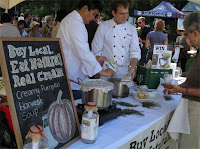
LifeCycles offered fruit, including grapes hand picked by moi only days earlier:

Cheryl’s Gourmet Pantry had one of the winners, good ol’ beans on toast, featuring local pork and exquisite beans:

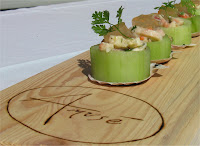
Amuse had a highly delectable seafood cucumber topped with jellied tomato water:
-
Howdja like them apples?
Read Full Post: Howdja like them apples?I went on another apple pick for the Fruit Tree Project the other day, or tried to. When we got there the owner explained that a fellow who’d picked his apples last year to make wine had turned up again this year and been told the fruit was going to LifeCycles; a couple of days later the tree was completely stripped,
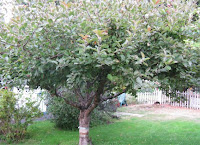
leaving only this one little windfall to show what a gorgeous apple it was:
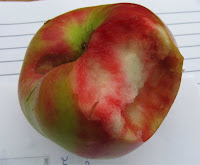
And this is what the skin looked like:
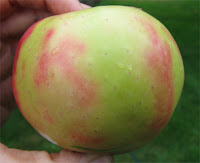
The owner didn’t know what it was; the pick leader thought maybe Gravenstein. So we picked what few apples there were on two other trees


and headed for a grapevine that was growing all over a house and into the hedge
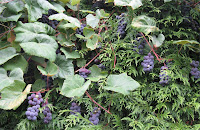
and picked about 140 lbs of grapes from the one vine.

Then I made a cake from some of the grapes.

I admit I was suspicious of the recipe’s description of the “rustic crunch” of the grape pips, but in fact it was just so, and an excellent cake. We had some assorted appetizers – artichoke dip, Greek Salad, and some of Delia’s courgette & potato cakes with mint & feta (aka kolokythokeftedes) which I have made before and always have trouble turning as they get mushy, but they dry out eventually and are delicious. Had some beautiful yellow zucchini which I picked myself at Haliburton on Wednesday and made that into a respectable zucchini alla scapece.
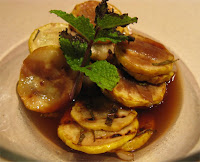
So a good old feed.
Ready to feed the soul with the opening night of Planet Earth poetry later this evening!


Latest Posts
- Writers at Word!
- Sublime and Twisted Readings coming up!
- Sublime
- Good weather for reading
- The world, the world
- Sublime launch!
Aldeburgh Poetry Festival Barny Haughton BBC BC poets Berkswell blackberries Black Stilt Bologna book launch Borough Market Carlo Petrini Catalonia Cyrus Todiwala dairy Daunt's Books Dijon Edinburgh Fanny Bay Feast of Fields Food and Morality food history food journalism Jenna Butler lardo Malahat Review Michael Pollan Okanagan olive oil tasting olive trees Omnivore's Dilemma Our Food Our Future Oxford Parmigiano-Reggiano Planet Earth Poetry poetry poetry readings Poetry videos prosciutto salumi Sean O'Brien Suffolk ticks Wendy Morton Wired Writing Yvonne Blomer
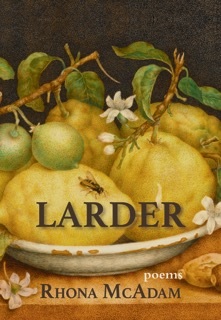
In her latest collection, Rhona McAdam navigates the dark places of human movement through the earth and the exquisite intricacies lingering in backyard gardens and farmlands populated by insects and pollinators, all the while returning to the body, to the tune of staccato beats and the newly discovered symmetries within the human heart.
“…A beautiful, filling collection, Larder is a set of poems to read at the change of the seasons, to appreciate alongside a good meal, and to remind yourself of the beauty in everything, even the things you may not appreciate before opening McAdam’s collection….”
Rhona McAdam is a writer, poet, editor, and Registered Holistic Nutritionist with a Master’s in Food Culture from Italy and a deep-rooted passion for ecology and urban agriculture. Her work spans corporate and technical writing to poetry and creative nonfiction, often exploring the vital links between what we eat and how we live. Based in Victoria, BC, and available via Zoom, Rhona is always open to new writing commissions, readings, or workshops on nutrition and the culinary arts.