-
Shades of Facebook
Read Full Post: Shades of FacebookThere’s been some flap about how Facebook makes rather too free with the photos and personal information posted by its subscribers – using people’s personal photos for advertising without asking and so on.
No sooner do we sort out that – to some extent (by adjusting privacy settings) – than we’re presented with Google’s new terms of service which you must agree to in order to post photos on Blogger, or Picasa albums (emphasis mine):
Google claims no ownership or control over any Content submitted, posted or displayed by you on or through Picasa Web Albums. You or a third party licensor, as appropriate, retain all patent, trademark and copyright to any Content you submit, post or display on or through Picasa Web Albums and you are responsible for protecting those rights, as appropriate. By submitting, posting or displaying Content on or through Picasa Web Albums, you grant Google a worldwide, non-exclusive, royalty-free license to reproduce, adapt, distribute and publish such Content through Picasa Web Albums, including RSS or other content feeds offered through Picasa Web Albums, and other Google services. In addition, by submitting, posting or displaying Content which is intended to be available to the general public, you grant Google a worldwide, non-exclusive, royalty-free license to reproduce, adapt, distribute and publish such Content for the purpose of displaying, distributing and promoting Google services. Google will discontinue this licensed use within a commercially reasonable period after such Content is removed from Picasa Web Albums.
I fear my love affair with Blogger – and all things pertaining to the Google empire – may be drawing to a close…
-
Tomatoes and things
Read Full Post: Tomatoes and things
As the canning season progresses, it might be useful to refer to the Table of Condiments for guidance. I’m not sure how accurate it is, but it’s entertaining!The Slow Food Vancouver Island & Gulf Islands convivium has been eventless for some months, so it was with joy and sunshine we celebrated the love-apple yesterday at Haliburton farm, hosted by the delightful Dayle of Terralicious gardening & cooking school.

We brought tomatoes for tasting

enjoyed a seed-saving demo
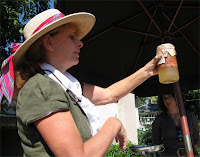
and then chowed down

on some extraordinary grub. I must say that Slow Food events have the best tasting food, and the most enthusiastic diners.


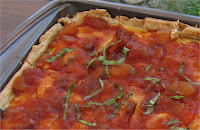
Dayle even dropped a perfect loaf of hot bread
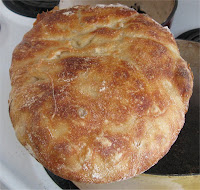
on the table which we fell upon with as much enthusiasm as we could muster, given the wonders that had preceded it. She had made this pretty Andy Warhol Cake

which turns out to be a reincarnation of ye olde tomato soup cake, but she made it with heirloom tomatoes, of course. And Joan’s green tomato and apple crisp was an inspiration!
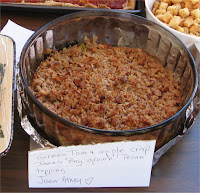
Then we had a tour of the farm which was, like us, baking gently in some late season sunshine.


And then gave out the raffle prize – seasonal condiments plus a bit of Slow Food swag –
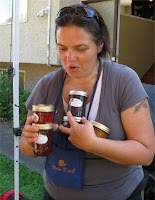
but are holding off awarding the grand prizes (a place on a Terralicious course, a night for two at Sooke Harbour House) to award with signed copies of Michael Pollan‘s books, at a Slow Food sponsored screening of Food, Inc. at Cinecenta on September 22.
-
Is it or isn’t it? Organic food gets studied. And studied.
Read Full Post: Is it or isn’t it? Organic food gets studied. And studied.There has been a lot of buzz around the UK’s Food Standards Agency-sponsored study – actually not a field study but a literature review – released in July, which claimed that organic food was no better, nutritionally, than conventionally-grown. As this article points out, the flaw in the FSA‘s treatment of the topic was to sidestep the main fact so many people buy organic: to avoid pesticides and agricultural chemicals in our food. COG has a few things to say about the study as well.
People choosing organic are choosing it for a variety of reasons, including faith in organic farming methods, which attend more closely to the longterm health of the soil, water and animals involved. Choose “nutritionally equal” conventionally grown foods and you choose to support farming methods that have been shown to exhaust soil fertility, contaminate water and deplete nonrenewable natural resources that prop up chemical fertilization and pesticide productions.
For the yay-sayers, a new French study contradicts those pesky Englishmen and upholds organics as all-round better, because
organic plant products contain more dry matter and minerals – such as iron and magnesium – and more antioxidant polyphenols like phenols and salicylic acid.
and
Organic animal products were seen to have more polyunsaturated fats.
Carbohydrate, protein and vitamin levels were not studied because the authors feel they are insufficiently documented. They did look at pesticides though, and found
between 94 and 100 per cent of organic food does not contain any pesticide residues, and organic vegetables have about 50 per cent less nitrates.


Latest Posts
- Writers at Word!
- Sublime and Twisted Readings coming up!
- Sublime
- Good weather for reading
- The world, the world
- Sublime launch!
Aldeburgh Poetry Festival Barny Haughton BBC BC poets Berkswell blackberries Black Stilt Bologna book launch Borough Market Carlo Petrini Catalonia Cyrus Todiwala dairy Daunt's Books Dijon Edinburgh Fanny Bay Feast of Fields Food and Morality food history food journalism Jenna Butler lardo Malahat Review Michael Pollan Okanagan olive oil tasting olive trees Omnivore's Dilemma Our Food Our Future Oxford Parmigiano-Reggiano Planet Earth Poetry poetry poetry readings Poetry videos prosciutto salumi Sean O'Brien Suffolk ticks Wendy Morton Wired Writing Yvonne Blomer
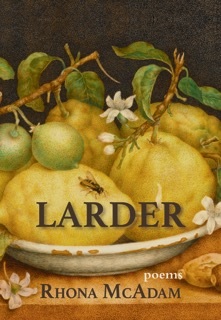
In her latest collection, Rhona McAdam navigates the dark places of human movement through the earth and the exquisite intricacies lingering in backyard gardens and farmlands populated by insects and pollinators, all the while returning to the body, to the tune of staccato beats and the newly discovered symmetries within the human heart.
“…A beautiful, filling collection, Larder is a set of poems to read at the change of the seasons, to appreciate alongside a good meal, and to remind yourself of the beauty in everything, even the things you may not appreciate before opening McAdam’s collection….”
Rhona McAdam is a writer, poet, editor, and Registered Holistic Nutritionist with a Master’s in Food Culture from Italy and a deep-rooted passion for ecology and urban agriculture. Her work spans corporate and technical writing to poetry and creative nonfiction, often exploring the vital links between what we eat and how we live. Based in Victoria, BC, and available via Zoom, Rhona is always open to new writing commissions, readings, or workshops on nutrition and the culinary arts.