Skip to content

2011

Prawns & other fishy business
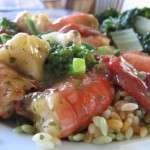
I often share tables and menus with people who have not spent the past half dozen years or so obsessing about food to the same degree as I, and who therefore do not have as much trouble finding something edible in restaurants and other food outlets. Most of them do not register my shudder at the sight of prawns on the menu; nor do I act on first instincts to seize the menu and tear it into tiny pieces and then arms flailing eyes wild to scream at them “don’t touch them they’re poison!!!!” It’s become one of those things I simply won’t comment on unless invited.

One of the reasons I eat very little fish anymore, and particularly avoid prawns, as well as farmed catfish, basa, tilapia etc from China, Thailand, Indonesia, Vietnam and elsewhere – and of course farmed salmon from  Canada – is because of the use of antibiotics, which are used to combat potential infection in overcrowded tanks and cages. This is prophylactic use, not treatment of illness, and is as worrying as the use of low dosages of antibiotics as a growth enhancer in land-based meat farming. The most troubling of these antibiotics is a series called fluoroquinolones.

So I’m inviting myself to comment here, because I have just read an article about these very chemicals (showing up in fish illegally imported to the US from China, Thailand, Canada, Indonesia, Vietnam and Ecuador) and simultaneously noticed that the Canadian Food Inspection Agency has relaxed by .04 ng/g the fluoroquinolone residues in aquaculture products action level from 0.6 ng/g (ppb) to >1.0 ng/g. This is because

The revised action level continues to provide adequate human health safety to consumers and is considered stringent enough to detect deliberate use of fluoroquinolone therapeutants in aquaculture.

Well all right then. It’s tiny, and the CFIA continues to assure us that  there is no change in Health Canada’s policy of

zero tolerance for deliberate use of fluoroquinolone therapeutants (ciprofloxacin, danofloxacin, enrofloxacin and sarafloxacin) during fish production life cycle.

But if you also read

Resistance to quinolones has been reported in a variety of important bacterial pathogens, including Escherichia coli, Klebsiella pneumoniae, and other enteric organisms; Pseudomonas aeruginosa; Chlamydia trachomatis and Mycoplasma pneumoniae; Campylobacter jejuni; Burkholderia cepacia; Stenotrophomonas maltophilia; Neisseria gonorrhoeae; Staphylococcus aureus (especially oxacillin-resistant strains); Enterococcus faecium; and Streptococcus pneumoniae.

Don’t you just not want to go there at all? Particularly on a week when there’s news of a new antibiotic-resistant strain of gonorrhea and a spike in the incidence of syphilus — as well as general increases in STD’s in the elderly as well as youth. Not to forget the ever-increasing rates of food-borne illnesses like campylobacter jejuni, salmonella, and E. coli O157:H7 (and the new one that surfaced in Germany this year, E. coli O104:H4). And of course the hospital superbugs. It’s all enough to put you off your dinner.

A couple of months ago Barry Estabrook laid out the issues, and praised the one prawn I will still eat and am thankfully positioned to find – the Spot Prawn.
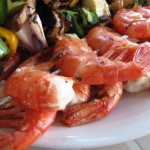
I have no doubt that things have improved since 2003 when Felicity Lawrence documented problems with the industry; but I am still suspicious of foods like prawns whose cost has so cheapened on the menu. And I know that most restauranteurs are watching their price points too carefully to ask too many questions about the full story on everything they buy. And will mislead you whether by accident or not, as I learned in Newfoundland a few years ago where a waitress informed me that the tiger prawns on the menu were local, which I doubted enough to double check; and yes, they were local – to Thailand I think it was.

Victoria’s farmers markets

If you consulted the BC Association of Farmers Markets  Marketfinder, you might be forgiven for thinking there are only two farmers markets in Victoria. We visited a couple of off-the-list markets last Saturday, and there are many more besides.

It’s another one of those situations of fragmentation I guess; we are over-supplied with information and have no way to concentrate people’s attention on one source. What is the authoritative source of current information about farmers markets? We just don’t have one place to look anymore. In little old Victoria we have two print phone books now, as well as multiple online directories, and where directories are concerned, authority seems to change as swiftly as technology itself . Choosing a directory so people can find your business is a nightmare. Farmers market administrators would have to work out which  information sources to subscribe to and then keep updated; prospective customers come from all kinds of backgrounds and are seeking the markets for all kinds of reasons, so will be looking in all different directions. Phew. Information overload already. Little wonder many simply rely on their own websites. No: make that blogs… No: Facebook… No: Twitter… No: iPad apps… No: Groupon. No: ..?!

Anyway. The listings include Moss Street, of course, and Oaklands – which I’ve never heard of but seems to be a Thursday community market. But there are in fact a number of others absent from its listings, who presumably simply don’t belong to the organization. The Victoria Downtown Public Market struggled on through the winter – its meat  (Terra Nossa) and produce stands were always thronged but attendance looked poor to me in the cold months; I haven’t been downtown much so haven’t seen how it is this summer, or whether the Island Chefs Collaborative market is running competition for it in Bastion Square.

The James Bay Farmers Market is a small neighbourhood market, nestled behind the legislature building and the Tally-Ho stop, so perfectly positioned for tourist as well as neighbourhood trade.

It’s time for fresh produce at last at last. And there are  lots of tomatoes to be had, despite the cool start to the summer. Those with greenhouse space are a month or two ahead of me. Sun Trio Farm had a good variety of plum sized tomatoes of many colours.

Given this long cool year we’ve had, it’s early for it, though even so, later in the day I encountered at least one farmer who was selling fresh garlic, but Golden Maples Farm had a great selection from last year. And nicely displayed too. They were labelled Purple Stripe and Metechi, but from what I read, Metechi is a kind of Purple Stripe; there are hundreds of varieties of garlic and all I can safely say about what’s in my garden is that I’m growing both hard and soft neck varieties and they haven’t died yet, so I’m hopeful that a harvest is still in my future. Anyway… these ones looked good.

The bread seller at James Bay has beautiful looking loaves. Not cheap – many clocking in around $8 or $10 a loaf, but brisk sellers:  he was down to a couple of loaves when we passed by later that day.


Another Saturday market not on the BCAFM list was the North Saanich Farmers Market, run by the North Saanich Food for the Future Society (“dedicated to supporting farms and farmers, and further developing the agricultural capacity of the district.”). It’s another small neighbourly market with a regular clientele and – like James Bay – musical accompaniment. It seems to be well appreciated by the marketgoers too: things really do run out near the end of its three hour day.

There are more missing from the listings. From a food-shopper’s point of view, the risk that farmers markets run as they mature is in evolving into crafts markets, but that seems to happen to many of them. The farmers have to weigh time away from the fields against sales, and a great many of them (thanks in large part to the long-running Island Farm Fresh directory) have farmgate or direct sales as well as connections to retailers and restaurants. Moss Street has avoided this by keeping the crafts and food vendors physically separate, and the vendors are attuned to consumer trends: organic and gluten-free foods are the mainstay. It’s been a while since I went to the Saanich Fairgrounds, to the market that for a while seemed to be the only show in town (now known as the Peninsula Country Market), but it looks from the vendor list to have lagged a bit on farmer presence; and the last time I was at the Thursday evening Sidney Summer Market it was thoroughly mobbed, but had almost no produce stands.

Food – sight and sound

B is for Bananas (if you didn’t know why it was important to buy these organic and Fairtrade, here’s your briefing)


BANANAS!* trailer.
 

B is also for Bees


Queen of the Sun trailer from Youtube.


And R is for radio, specifically NPR (I’m close enough to the border to be able to listen in) where you can hear

Yotam Ottolenghi talking vegetables – promo for his excellent cookbook Plenty (recipes born in YO’s wonderful Guardian column, The New Vegetarian); Barry Estabrook speaking in depth to NPR’s Fresh Air about his new book Tomatoland, which blows the lid off many aspects of the Florida tomato industry – labour standards, soil depletion, pesticide use – and explains why big ag’s focus on high yield tomatoes does not put good tasting food on your plate (which is exactly why Slow Food exists); and then a brief look at sustainable fish (tilapia) production: urban fish agriculture (but not the kind that involves feeding them corn and, like other farmed protein sources, causes more of the same old problems to those who eat them)

Canada Day on the Gorge

The very best thing about living along the Gorge Waterway is the annual closure of Gorge Road for an all-day Canada Day picnic. The peace of morning – the road closes first thing for set-up – is charmingly broken by a small parade (a swarm of decorated bikes, one fire engine, one vintage police car, some First Nations drummers, and one small marching band), and then peaceable throngs of Canadians wearing red and white (somehow I still haven’t managed to get myself a giant Canada Day hat..)

For some reason this year a clutch of food vendors ended up right on my doorstep: Indian food; Mexican tamales; mini-donuts (I think that still counts as food?); Mr Tubesteak and his (not as good as the ones at Courtenay folk fest but still hugely popular) hot dogs; and Pizzeria Prima Strada, with its mobile wood-fired pizza oven and interesting selections, which was rightly mobbed all day. There were others as well: the always popular International Women’s Catering Co-op was doing a booming trade in portable foods from all over; and the lineup for pancake breakfast was said to be 45 minutes by 10am.

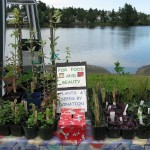
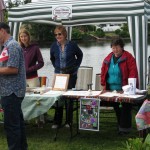
The Gorge Tillicum Urban Farmers were there, spreading the gospel of back (and front) yard food gardens, urban chickens and the joy of neighbours who grow. We had a great big table full of plant starts and vegetable seeds, donated by members, and offered to passers-by for the price of a small donation and a helping of advice on what was what and how to grow it. Although a lot of what we had on hand might have been called weeds by some, they also had ornamental, medicinal or edible properties, like feverfew (good for migraines and many other ailments), day lilies (all parts edible) and borage (young leaves and flowers are said to taste like cucumber).

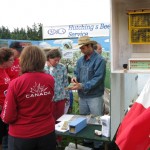
Our neighbour again this year was GTUFer and bee expert Gord Hutchings, who as always attracted a continuous stream of people interested in knowing more about wild pollinators in general and blue orchard mason bees in particular.

The day which had started off grey and windy became warm and sunny, ideal for wandering musicians, Morris dancers, dog-walkers, picnickers, stall-holders and all those just having a gentle day off.

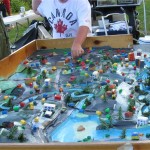
The municipality of Saanich was there talking up sustainability issues; I particularly liked this watershed model which attracted a lot of children who got to practice raining on a model landscape of our area to see the contaminating effects of road, lawn and garden runoff.

And then it was over.

ASLE 6: my 2011 bibliography

Last time I attended ASLE I documented the most interesting (to me) books, articles and films that were discussed or even mentioned in various sessions I attended, so I thought I’d take a stab at it again this year to see what it reveals about the preoccupations of those presenters I followed, and my own wandering attentions. The list is much shorter for some reason; could be the sessions I attended or the paucity of my notes.

Bekoff, Marc: The Animal Manifesto: Six reasons for expanding our compassion footprint. and Animals at Play: Rules of the game. (books)
Berry, Wendell: “The Pleasures of Eating” (essay)
Brockman, Terra: The Seasons on Henry’s Farm. (book)
Busch, Akiko: Nine Ways to Cross a River. (book)
Caplow, Florence and Susan A. Cohen, editors: Wildbranch: An Anthology of Nature, Environmental, and Place-based Writing. (anthology)
Chamoiseau, Patrick: Texaco. (Book)
Deakin, Roger: Waterlog: A Swimmer’s Journey Through Britain.
Detor, Krista: Chocolate Paper Suites. (music)
Fischman, Robert L: “The Legal Challenge of Protecting Animal Migrations.” (essay)
Geyrhalter, Nikolaus: Our Daily Bread. (film)
Grandin, Temple: The World Needs All Kinds of Minds. (TED talk)
Hardin, Garrett: “The Tragedy of the Commons.” (essay)
Henderson, Fergus: Nose to Tail Eating. (cookbook)
Irland, Basia: Water Library. (book) and A Gathering of Waters: The Rio Grande, source to sea. (water art)
LaChapelle, Dolores: “Ritual is Essential“. (essay)
Laporte, Dominique: History of S**t. (book) (**I’m not being coy, I just don’t want your spam filters to block me for being too literal!)
Latulippe, Hugo: Bacon. (film)
Leopold, Aldo: “Land Ethic“. (essay)
LePan, Don: Animals. (book)
Mazeaud, Dominique: The Great Cleaning of the Rio Grande. (art project)
McDonough, William: Cradle To Cradle: Remaking the Way We Make Things. (book)
McKibben, Bill: Deep Economy: The wealth of communities and the durable future. (book)
Nestle, Marion: Safe Food: The politics of food safety. (book)
Psihoyos, Louie: The Cove. (film)
Reed, Ishmael: The Free-lance Pallbearers. (book)
Robinson, Jennifer M., and J. A. Hartenfeld: The Farmers’ Market Book: Growing Food, Cultivating Community. (book)
Sanders, Scott Russell, with Carrie Newcomer, Krista Detor, Tim Grimm, Tom Roznowski, Michael White: Wilderness Plots (performance)
Singer, Peter: “All Animals are Equal.” (essay)
Steinke, David: Green Fire: Aldo Leopold and a Land Ethic for Our Time. (film)
Walker, Barbara: The Little House Cookbook: Frontier Foods from Laura Ingalls Wilder’s Classic Stories. (cookbook)
Zurkow, Marina: Mesocosm. (animated landscape portrait)

ASLE 5: Mesocosm, animals and environmental law

ASLE plenary speakers were wide-ranging and various, and I didn’t always have my notebook handy. Una Chaudhuri and Helen Tiffin were the first I heard, on Wednesday. During Chaudhuri’s talk we watched Mesocosm playing out in the background (and heard that the figure in it is modelled on Leigh Bowery, which brought a few random things together for me: having arrived in England in the decade after his glory days, I’d only known of him because of Lucien Freud’s paintings)

Thursday’s plenary speaker Marc Bekoff was stranded because of airport disruptions, so he joined us from his wilderness hideaway by skype, which worked remarkably well, all things considered. He spoke generally about his work which has led to such publications as The Animal Manifesto and Animals at Play: Rules of the Game (which he said brought together his 30 years of research into play behaviour). But his theme, animal compassion, he summarized by saying “Anyone who says that life matters less to animal than our life means to us has never held in their hands an animal fighting for its life.”

He observed that humans have a confusing relationship with animals: claim to love them and yet hunt them or rear them in factory farms, and generally treat them in ways we wouldn’t treat a family pet. They’re very much like us, he said, but also different. Speciesism doesn’t work as a way of establishing a natural hierarchy, where we assign higher and lower designations to animal life using ourselves as a template, because in fact they do a lot of things better than us.

In the Q&A he was asked his opinion of Temple Grandin, which he answered carefully, saying they had met, and that they’d agreed to disagree. He acknowledged her work by saying she’s improved the lives of a minute fraction of the animals who go to slaughter, and acknowledged her “amazing effect,” with which she reaches a very wide audience, informs people about animal sentience. But in Bekoff’s view, she’s not improving the well-being of animals, and it is worth remembering she’s paid by the meat industry.

Next up was environmental lawyer Robert L. Fischman, who teaches at Indiana University Bloomington, and is known among environmentalists for his writings on animal migrations, spoke on themes that affect environmental law at present.

Climate change, he said, currently dominates scholarship and rule making. And observed that in environmental law there is a stark division between people studying pollution control, viewing the environment as a sink; and those studying conservation on other hand , viewing the environment as a treasure trove for goods (natural resources). Pollution control law grew out of public health concerns, while resource management is more rooted in judgements made law, and undergoes conservative incremental change, with changes in ideas of ownership and property.

Which led to discussion of land trusts, the big environmental issue in the US today. In 1980 there were about a tenth of a million acres in trust; tax laws changed around then and so did the interest in land trusts. By 2003 there were 5 million acres, and in 2005 some 12 million acres; and it’s probably doubled since then. Land trusts are a relatively new species of property right, placing values on land and water rather than on the monetary value of land for transformative development use.

Initially, land trusts were isolated zoo-like reserves, but they became stepping stones, and then lines on a map. By the 1980s, biology had taught us that webs of conservation are importan, so reserves must be nodes in a network. The realities of what we’ve already observed in climate change on land and what changes we anticipate mean that connecting our landscape will be very important in allowing both animals and ecological services to adapt and be resilient to climate change.

Bringing it home to the audience, he pointed out that in environmental law and policy, interdisciplinary work means working with social and natural scientists, not scholars from the arts and humanities. Yet what passes for research in this field really is related to the humanities: you search sources and make arguments based on your findings. Storytelling and rhetoric became uniquely important tools in this particular area of law.

Finally, he said, we need to think through to resilience issues rather than stopping with conservation of the present: for example, we have halted the species elimination of buffalo, but eliminated the migration aspects of their lives. We need to safeguard migration corridors as well as habitat. This “connectivity” is too broad a concept to capture public support, but migration conservation is a concept that might be possible to use to promote a more holistic cause.

In the Q&A, the topic of mountaintop removal in the coal industry came up; timely subject for this Vancouver Islander. Is this, the questioner wondered, as corrupt an industry as it seemed? Stepping lightly through his answer, Fischman chose instead to observe that this area rather demonstrates what a clumsy tool the clean water act is to use on mining and mountaintops.He noted that the Obama administration had at least revoked nationwide permits allowing free mountaintop removal. But the clean water act saved as much of the High Sierra as has been saved; negotiated solutions are still needed.