-
Honey extracting
Read Full Post: Honey extractingLast Monday a group of us went to Larry and Marilyn’s for an extracting party. So absorbed was I in my task of finding cool comfortable clothes to last me a day in a warm garage I forgot to remember who else might be there…
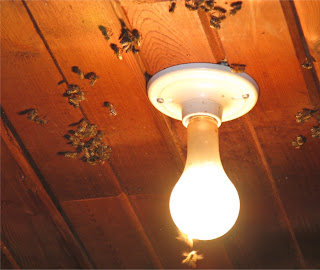
but luckily was able to adapt my wardrobe to suit the conditions and escaped without a sting, although not everyone was so lucky. The bees were a bit dopey and curious and kept a close eye on us and the honey supers, and did a bit of the fine cleaning.
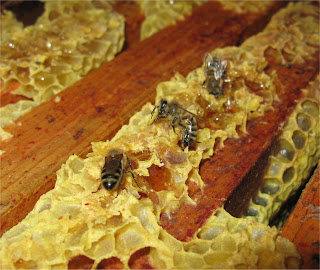
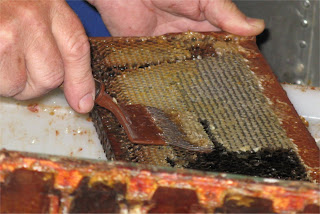
First task was to cut the cappings on the honey. There were several tools at our disposal. Top of the line was the capping knife,
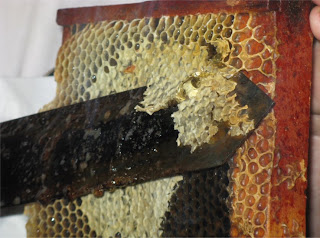
which melts the tops off in one fell swoop, with relative speed (depending on who was operating it)…
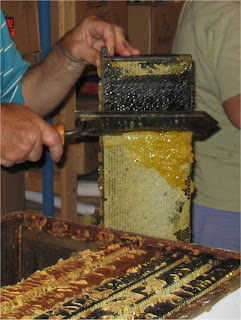
and then there’s this more modest version…

and finally the capping comb, which is useful and necessary for finishing work as well. They must all be used carefully as you don’t want to damage the comb and make more work for the bees when you return the frames to the hive.
Then the frames, dripping honey, are positioned in the extractor, either a larger-capacity mechanical one
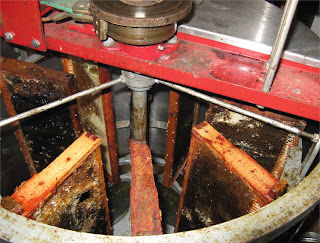
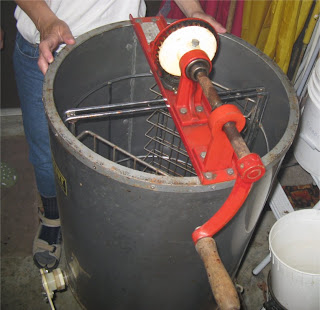
or a hand-cranked model that can do two frames at a time.
After a while it starts to flow…
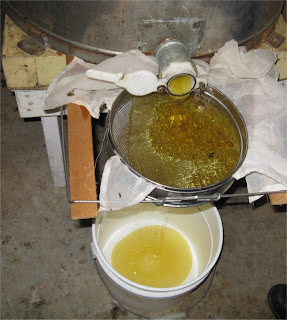
and flow.

And then, when you have uncapped as many frames as you can,
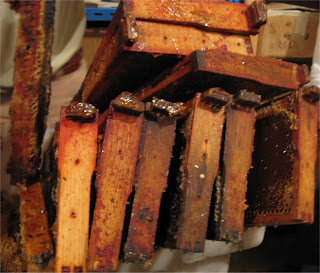
you can down tools (the cappings are melted down for the beeswax)

and go for lunch. If you are not too full from sampling fingerfuls of honey.
-
Food price issues for low incomes; BC Day, blackberries and zucchini
Read Full Post: Food price issues for low incomes; BC Day, blackberries and zucchiniIn Our Food, our Future last week, the topic was the impact of high food prices on those with less disposable income, where the proportion of monthly income spent on food is escalating with possibly dangerous results. Some interesting issues raised. The rise in obesity among poor people, because fatty, sugary foods are cheaper than better quality ones. The lack of practical food skills (selection, preparation) among those who need them most: young, pregnant or breastfeeding women, single parents, students. The difficulty of feeding ever-hungry teens on a small budget. And the economic risk of experimenting with cooking or dietary change: if you are on a very tight food budget, with children to feed, monotony is a big problem, because you must stick to foods with a long shelf life (fatty, sugary, highly-processed) that you know how to portion and prepare, and that your family will eat.
It’s been party time in Victoria. Last weekend was BC Day, and the crowds were out in the inner harbour,

the Snowbirds did an impressive flyby.
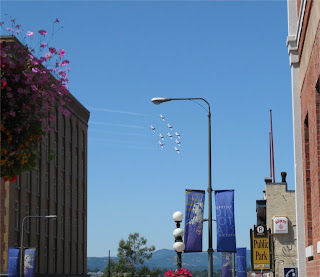
I didn’t stay for the evening’s open-air entertainment which included Burton Cummings, Feist and Sarah McLachlan, because I had food to think about.
The Himalayan blackberries are in season now, though I suspect people are not picking them because there’s a rumour about (repeated to me with my berry pail at every turning) that they aren’t ripe until the end of August. Ok, so believe that if you wish. I believe with mine eyes and mine palate and mine berry bucket.
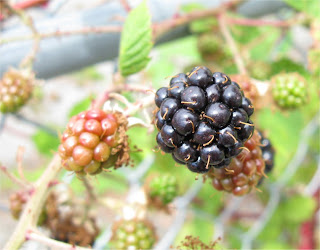
During an irresponsible visit to some farm markets, I bought loganberries and giant boysenberries, which for scientific purposes I compared in my berry line-up, in order of size, with a Himalayan and a native blackberry.

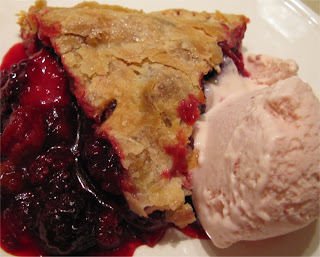
Then, because my apples are ripe and my berry pail full, I made pie. Rather good with Udder Guy’s strawberry ice cream.
And for those who say to me “but don’t you get tired of zucchini?” I can only laugh sadly and smugly. There’s soup to be made, chocolate-zucchini cake of course, but also zucchini parmigiana as earlier mentioned, and this wonderful thing which I sampled last April (paired with smoked provolone) at the wonderful La Croce di Malta in Parma. I thought the proprietor was calling it zucchini escabeche, but in fact she was saying Zucchini alla Scapece,
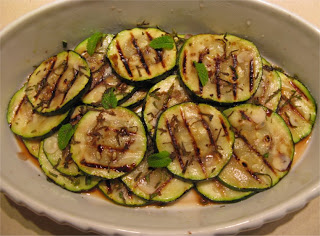
which is a superb Italian cousin; by her account from Sicily. It’s a wonderful substance, featuring fresh mint, garlic and vinegar and – best of all for dinner party purposes – a good long sit on the kitchen counter. I read that its combination of sour and sweet flavour signals its origins in Spanish cuisine, and its roots in Spanish-ruled parts of the country.
-
Organic weeds
Read Full Post: Organic weedsI spent some time reflecting on the back-breaking nature of organic farming last week.
Wednesday’s tasks at Haliburton were to liberate the squash patch from smartweed, which was something more than abundant.
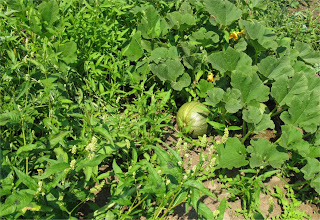
Four of us made a good dent
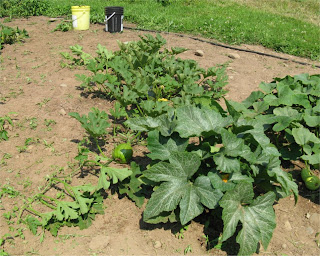
and were rewarded with lemonade and some rejected potatoes, which I took home and roasted with thyme, lemon and mushrooms, as instructed by Nigel Slater.
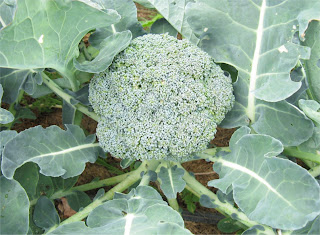
Saturday I paid a visit to Local Yokels, where with my growing weed-naming skills I can with some certainty say that we pulled smartweed, sorrel, morning glory, plantain, mustard and lots of other stuff from the squash,


the broccoli
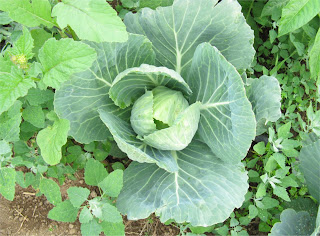
the cabbage
and the corn (boo!)
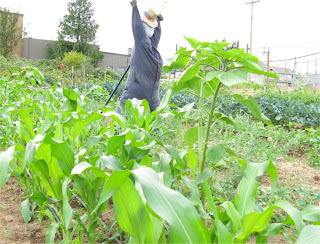
Couldn’t say hello to the chickens as they had been taken away for a holiday to get over the trauma of witnessing whatever was killing their kin – a weasel, it was thought, rather than raccoons, as the corpses were left in the chicken tractor. Whatever it was, security’s going to be ramped up considerably before they return to the field.
But the berry trail was looking good, with lots of berries ready for the picking.

And the bees are very happy in the borage
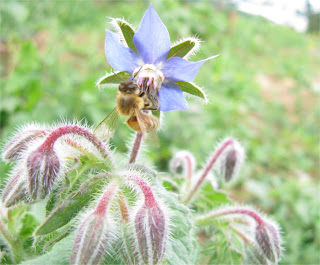
though it’s nearing the end of honey season, and I’m looking forward to a visit to Larry & Marilyn’s to help out with some extraction on Monday.


Latest Posts
- (no title)
- Sublime and Twisted Readings coming up!
- Sublime
- Good weather for reading
- The world, the world
- Sublime launch!
Aldeburgh Poetry Festival Barny Haughton BBC BC poets Berkswell blackberries Black Stilt Bologna book launch Borough Market Carlo Petrini Catalonia Cyrus Todiwala dairy Daunt's Books Dijon Edinburgh Fanny Bay Feast of Fields Food and Morality food history food journalism Jenna Butler lardo Malahat Review Michael Pollan Okanagan olive oil tasting olive trees Omnivore's Dilemma Our Food Our Future Oxford Parmigiano-Reggiano Planet Earth Poetry poetry poetry readings Poetry videos prosciutto salumi Sean O'Brien Suffolk ticks Wendy Morton Wired Writing Yvonne Blomer
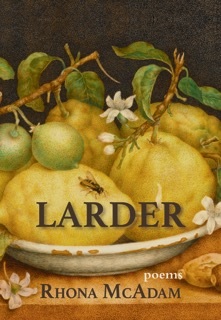
In her latest collection, Rhona McAdam navigates the dark places of human movement through the earth and the exquisite intricacies lingering in backyard gardens and farmlands populated by insects and pollinators, all the while returning to the body, to the tune of staccato beats and the newly discovered symmetries within the human heart.
“…A beautiful, filling collection, Larder is a set of poems to read at the change of the seasons, to appreciate alongside a good meal, and to remind yourself of the beauty in everything, even the things you may not appreciate before opening McAdam’s collection….”
Rhona McAdam is a writer, poet, editor, and Registered Holistic Nutritionist with a Master’s in Food Culture from Italy and a deep-rooted passion for ecology and urban agriculture. Her work spans corporate and technical writing to poetry and creative nonfiction, often exploring the vital links between what we eat and how we live. Based in Victoria, BC, and available via Zoom, Rhona is always open to new writing commissions, readings, or workshops on nutrition and the culinary arts.